A Research-Based Guide to Iowa Finances
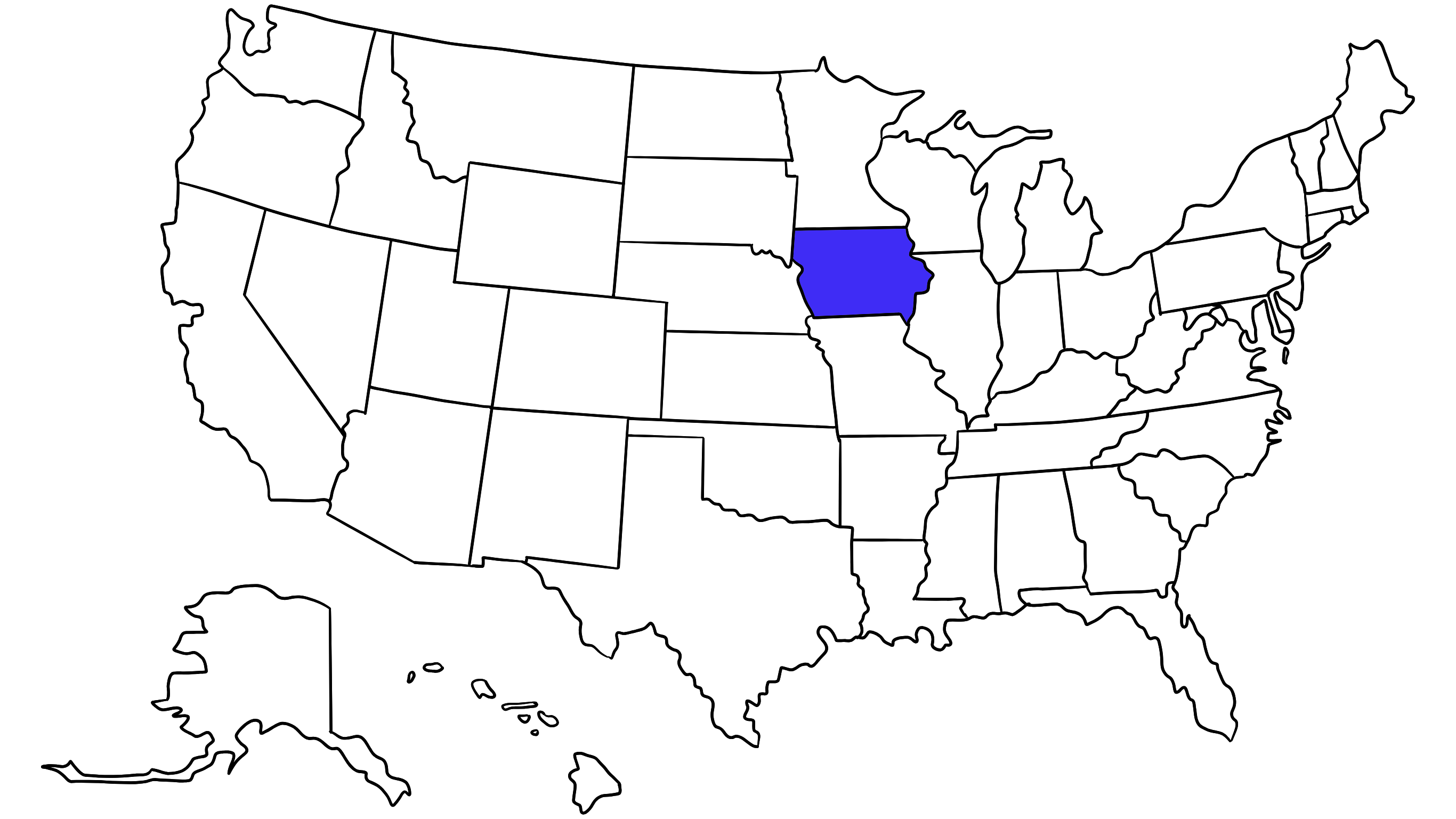
Des Moines sits in the middle of the state, but a lot of Iowa paychecks are earned within sight of a state line: the Quad Cities on the Mississippi, Council Bluffs across the river from Omaha, Sioux City where three states meet. Iowa's flat 3.8% income tax is simple. Deciding which state gets to apply it is where new hires and small employers get tripped up.
 Create Your Iowa Pay Stub
Iowa Resources
Jump straight to what you need.


The river is the border, but residency decides who taxes the wages
Iowa sorts every worker into one of three boxes. A resident reports income from all sources, including wages earned in Illinois, Nebraska or anywhere else. A nonresident owes Iowa tax only on Iowa-source income. Schedule IA 126 computes the ratio of Iowa income to total income so that the out-of-state share drops out. A part-year resident combines both: resident-period income plus Iowa-source income from the rest of the year.
For the resident who crosses the river to work, Iowa does not simply ignore the other state's tax. The mechanism is an out-of-state tax credit on the Iowa return, available when Iowa's conditions are met. It is designed to prevent the same wages being taxed twice, but it does not remove the need to file in both states.
Remote work follows the same logic. An Iowa resident working from a home office for a Minnesota company owes Iowa tax on those wages. A Nebraska resident working entirely from Nebraska for a Des Moines employer does not acquire Iowa-source wages just because the employer's address is in Iowa. Employers that must withhold federal tax on services performed in Iowa generally must withhold Iowa tax as well, so the work location, not the headquarters, drives payroll setup.
One rate for everyone, yet your check is not gross pay times 3.8%
Since Iowa collapsed its bracket table into a single 3.8% rate, the arithmetic on the return is short: Iowa taxable income multiplied by 3.8%. On $50,000 of taxable income that is $1,900 before credits. The word that matters is taxable. Iowa starts from federal taxable income, which already reflects the federal standard or itemized deduction, then applies Iowa-specific additions and subtractions. The Department of Revenue cautions against subtracting a second generic standard deduction on top of that.
Payroll works differently from the return. Employers use the withholding tables and formula the Department of Revenue put into effect on January 1, 2026, not a flat multiplication. Online Paystub's calculator mirrors that approach by applying the 3.8% rate only after a standard deduction allowance of $12,000 for a single filer or $24,050 for a joint filer. Supplemental wages are the exception: when federal tax on a bonus is withheld at a flat rate, Iowa requires flat 3.8% withholding on the same amount.
Filing status has to match the federal return, a rule in place since tax year 2023. The return itself is due April 30, not April 15. Iowa has no paper extension form: pay at least 90% of the correct tax by April 30 and the filing deadline moves to October 31 automatically, though interest still runs on any unpaid balance.
The low-income exemption that can zero out Iowa tax
A flat rate sounds like everyone pays. In practice Iowa exempts its lowest earners entirely. For 2026 a single filer under 65 with Iowa taxable income of $9,000 or less owes no Iowa income tax, provided nobody else claims them as a dependent. Other filing statuses under 65 qualify at combined Iowa taxable income of $13,500 or less. At 65 and older the thresholds rise to $24,000 for single filers and $32,000 for everyone else.
The test is not a single line from the federal return. Iowa applies special addbacks when checking eligibility. Married separate filers have a combined-income rule of their own. A part-time worker near the line should run the numbers on the actual 2026 IA 1040 instructions rather than assume.
A veterinary technician's biweekly check in Des Moines
Picture a veterinary technician at a Des Moines clinic earning $24 an hour, 40 hours a week, paid every two weeks and filing single. Federal income tax, Social Security at 6.2% and Medicare at 1.45% come out first, then Iowa withholding under the 2026 formula. The Iowa paycheck calculator at Online Paystub produced this breakdown.
| Line | Amount per check |
|---|---|
| Gross pay (80 hours at $24.00) | $1,920.00 |
| Federal income tax | $146.55 |
| Iowa state income tax | $55.42 |
| Social Security (6.2%) | $119.04 |
| Medicare (1.45%) | $27.84 |
| Estimated take-home pay | $1,571.14 |
Figures come from the Online Paystub Iowa paycheck calculator for 2026. Local taxes, health premiums and retirement contributions are not included.
What stands out is how small the Iowa line is next to the federal one once a flat 3.8% is applied after the standard deduction allowance. Compare the year-to-date column on a real statement against these per-period figures; the YTD totals are what the April 30 return will eventually reconcile.
Seven things to check in your first two weeks on an Iowa payroll
- Your state withholding form. Iowa withholding is set from the state form you give your employer, separate from the federal W-4. Fill in both.
- Which state your work location is in. If you live in Iowa and work across the river, expect to sort out which state withholds and to claim Iowa's out-of-state credit for tax the other state keeps.
- Filing status. It must match your federal return, so decide once.
- The payday statement. Iowa Code section 91A.6 entitles you to a statement each regular payday showing hours worked, wages earned and deductions, on paper or by secure electronic delivery.
- Bonus withholding. A signing bonus withheld at the federal flat rate gets a flat 3.8% Iowa withholding too.
- Your hourly floor. Iowa's minimum wage is $7.25, the federal figure. Overtime and rate questions start there.
- Whether the low-income exemption applies. Part-time and seasonal workers near $9,000 of taxable income may owe nothing to the state.
Six cents on the dollar, sometimes seven, at the register
Iowa's sales tax is 6% statewide. Cities, counties and unincorporated areas can add a 1% local option sales tax, known as LOST, which takes the combined rate to 7% wherever it has been adopted. The list changes on January 1 and July 1. On July 1, 2026, Coralville, Iowa City, North Liberty, Oxford and Shueyville joined it. Two addresses in the same county can sit on different sides of that line, so the Department of Revenue's jurisdiction list matters more than a county name.
Groceries are mostly exempt. Candy, soft drinks, prepared food, dietary supplements, alcohol and tobacco are not. Services are taxed only when Iowa law lists them, such as certain repair, transportation and personal services. Use tax, owed when a seller did not collect, stays at 6% because there is no local option use tax. A remote seller must start collecting once it reaches $100,000 in gross revenue from Iowa sales, counting exempt and wholesale sales toward the threshold.
None of this touches payroll. A business that sells taxable goods keeps sales tax in its own filings through GovConnectIowa. Wage records belong on the statement the employee receives, which is what the Iowa pay stub generator is built to organize.
Frequently Asked Questions
Does Iowa still have income tax brackets?
No. Iowa applies a single 3.8% rate to all Iowa taxable income in 2026, regardless of filing status.
I live in Council Bluffs but work in Omaha. Do I file in Iowa?
Yes. Iowa residents report income from all sources. Iowa's out-of-state tax credit can offset tax Nebraska keeps on the same wages when Iowa's conditions are met.
When is the Iowa return due?
April 30 following the tax year. Paying at least 90% of the tax by that date earns an automatic extension to October 31 with no form to file, though interest accrues on any unpaid balance.
Is the combined sales tax 7% everywhere in Iowa?
No. The state rate is 6%. The extra 1% local option tax applies only in jurisdictions that adopted it. The list is updated on January 1 and July 1.
Does Iowa withhold on bonuses differently?
When federal tax on supplemental wages is withheld at a flat rate, Iowa requires 3.8% state withholding on those wages.