
New York State Income Tax: 2026 Rates, Brackets, and Filing Rules
Tuesday, Jul 28, 2026
· by Alexander Caldwell – Financial Expert
New York State has a progressive personal income tax system. For the 2026 tax year, marginal rates range from 3.9% to 10.9%, depending on taxable income and filing status. New York City residents may also owe a separate city income tax, while Yonkers residents and some people working in Yonkers can face additional local taxes.
The 2026 rates apply to income earned between January 1 and December 31, 2026. Returns covering that income will normally be filed in 2027. This should not be confused with the 2026 filing season, when taxpayers filed returns for income earned during 2025.
New York State Income Tax at a Glance
| Tax item2026 rule | |
| State income tax system | Progressive |
| Lowest marginal rate | 3.9% |
| Highest marginal rate | 10.9% |
| Number of state brackets | Nine |
| New York City income tax | 3.078% to 3.876% for NYC residents |
| NYC tax for nonresidents | None |
| Yonkers resident tax | Surcharge based on New York State tax |
| Full-year resident return | Form IT-201 |
| Nonresident or part-year return | Form IT-203 |
| Employee withholding form | Form IT-2104 |
| Separate supplemental wage withholding rate | 11.70% |
| New York Social Security tax | Social Security benefits are exempt |
| Pension exclusion | Up to $20,000 for qualifying taxpayers age 59½ or older |
New York residents are generally taxed on income from all sources. Nonresidents are generally taxed only on New York-source income, such as compensation for services performed in the state, income from New York real property, and income connected with a business conducted in New York.
Does New York Have a State Income Tax?
Yes, New York imposes a personal income tax on residents and on qualifying New York-source income received by nonresidents. Unlike states with a flat income-tax rate, New York uses multiple marginal brackets.
The rate applied to a taxpayer depends on:
- New York taxable income
- Filing status
- Residency status
- State deductions and modifications
- Available tax credits
- New York City or Yonkers residency
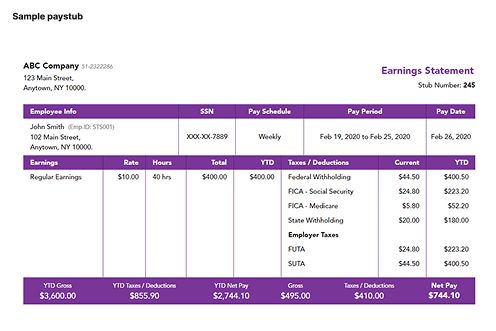
New York State income tax is separate from federal income tax. Employees may therefore see federal, New York State, New York City, Yonkers, Social Security, Medicare, and other payroll deductions on the same paycheck.
New York State Income Tax Brackets for 2026
New York State has nine marginal income-tax rates for 2026. The rates are 3.9%, 4.4%, 5.15%, 5.4%, 5.9%, 6.85%, 9.65%, 10.3%, and 10.9%.
2026 New York Income Tax Brackets
| Marginal rateSingle or married filing separatelyMarried filing jointly or qualifying surviving spouseHead of household | |||
| 3.9% | $0 to $8,500 | $0 to $17,150 | $0 to $12,800 |
| 4.4% | $8,500 to $11,700 | $17,150 to $23,600 | $12,800 to $17,650 |
| 5.15% | $11,700 to $13,900 | $23,600 to $27,900 | $17,650 to $20,900 |
| 5.4% | $13,900 to $80,650 | $27,900 to $161,550 | $20,900 to $107,650 |
| 5.9% | $80,650 to $215,400 | $161,550 to $323,200 | $107,650 to $269,300 |
| 6.85% | $215,400 to $1,077,550 | $323,200 to $2,155,350 | $269,300 to $1,616,450 |
| 9.65% | $1,077,550 to $5 million | $2,155,350 to $5 million | $1,616,450 to $5 million |
| 10.3% | $5 million to $25 million | $5 million to $25 million | $5 million to $25 million |
| 10.9% | More than $25 million | More than $25 million | More than $25 million |
These are marginal tax brackets. Moving into a higher bracket does not cause all taxable income to be taxed at the higher rate. Only the portion falling within that bracket is subject to that rate.
The lower and middle-income rates were reduced for 2026. This is the first stage of a two-year reduction affecting taxpayers with taxable income up to $215,400 for single filers and $323,200 for joint filers. Another scheduled reduction applies in 2027 under current law.
Marginal Rate vs. Effective Tax Rate
A taxpayer’s marginal rate is the rate applied to the highest portion of taxable income. The effective rate is total state income tax divided by total income.
For example, a single taxpayer with $100,000 in wages, no major state adjustments and an $8,000 standard deduction would have approximately $92,000 in New York taxable income. Applying the 2026 brackets produces about $4,860 in state income tax before credits, local income taxes and other adjustments.
The taxpayer’s highest marginal rate would be 5.9%, but the effective state rate would be lower because the first portions of taxable income are taxed at lower rates.
Taxpayers with New York adjusted gross income above $107,650 may also be subject to a supplemental tax calculation. This calculation recaptures some of the benefit created when income is initially taxed through lower brackets, so a simple bracket calculation may not produce the final liability for certain higher-income taxpayers.
How Is New York Taxable Income Calculated?
New York taxable income generally starts with federal adjusted gross income. New York additions and subtractions are then applied to calculate New York adjusted gross income.
The general calculation is:
- Begin with federal adjusted gross income.
- Add income or adjustments that New York taxes differently.
- Subtract income that New York excludes.
- Claim the New York standard deduction or allowable itemized deductions.
- Apply the appropriate state tax schedule.
- Add any NYC, Yonkers or other applicable taxes.
- Subtract eligible credits and payments.
New York does not always follow current federal deduction rules. A taxpayer may sometimes itemize deductions on a New York return even when using the federal standard deduction. New York also applies its own additions, subtractions and limits to certain deductions.
New York Standard Deduction for 2026
The New York standard deduction depends on filing status. The 2026 amounts are:
| Filing statusStandard deduction | |
| Single, not claimed as a dependent | $8,000 |
| Single, claimed as a dependent | $3,100 |
| Married filing jointly | $16,050 |
| Married filing separately | $8,000 |
| Head of household | $11,200 |
| Qualifying surviving spouse | $16,050 |
Taxpayers can compare the standard deduction with their allowable New York itemized deductions and generally use the option that produces the larger deduction.
Who Must File a New York State Tax Return?
A New York resident generally must file Form IT-201 when required to file a federal return. A resident may also have to file when federal adjusted gross income plus New York additions exceeds $4,000, or $3,100 for a single dependent taxpayer.
A resident may also file to:
- Claim a refund of withheld tax
- Claim a refundable or carryover credit
- Report additional New York City or Yonkers tax
- Pay tax not fully covered by withholding
Full-year residents normally use Form IT-201. Nonresidents and part-year residents normally use Form IT-203.
Nonresident Filing Requirements
A nonresident may need to file Form IT-203 when receiving New York-source income and meeting the applicable income threshold. Filing may also be necessary to claim a refund of New York withholding or an available tax credit.
New York-source income can include:
- Wages for services performed in New York
- Business or professional income connected with New York
- Rental income from New York property
- Gains from certain New York real-property interests
- Partnership or S corporation income allocated to New York
A part-year resident generally reports all income received while a New York resident, plus New York-source income received during the nonresident portion of the year.
When Is the New York Tax Return Due?
The return filed during 2026 covered the 2025 tax year and was due April 15, 2026. An automatic six-month filing extension could move the filing deadline to October 15, 2026.
An extension gives additional time to submit the return, but it does not provide additional time to pay the tax. Tax expected to be due must generally be paid by the original deadline to reduce interest and penalties.
Income earned during the 2026 tax year will be reported on returns filed in 2027. Taxpayers should confirm the official 2027 filing deadline after the New York State Department of Taxation and Finance releases the relevant forms and instructions.
New York Residency and the 184-Day Rule
A person is generally treated as a New York resident when New York is their domicile. A person domiciled in another state can also become a statutory resident by maintaining a permanent place of abode in New York for substantially all of the year and spending at least 184 days in the state.
For this test, any part of a day generally counts as a New York day. Taxpayers claiming nonresident status should maintain calendars, travel records, receipts and other evidence showing where they were located throughout the year.
Domicile is a broader concept than simply owning or renting a home. New York can consider factors such as:
- The location of the taxpayer’s primary home
- Family and personal connections
- Business activities
- Time spent in each location
- Valuable or sentimental possessions
- Driver’s license and vehicle registration
- Voter registration
- The location described as home in legal and financial records
Changing a mailing address or registering to vote elsewhere does not, by itself, prove that New York domicile has been abandoned.
Do Remote Workers Owe New York Income Tax?
A nonresident working remotely outside New York may still owe New York income tax when the employee’s assigned or primary office is located in New York. This is commonly called the convenience-of-the-employer rule.
Under this rule, remote working days may be treated as New York workdays unless the work outside New York is required by the employer or the employer has established a qualifying bona fide employer office at the remote location.
Simply choosing to work from a home in Florida, Texas, New Jersey or another state does not automatically remove those wages from New York taxation. The employer’s office location, employment arrangement and home-office facts must be reviewed.
Nonresident employees who divide work between New York and another state may need Form IT-203-B to allocate wages. Stock options, restricted stock, deferred compensation and certain termination payments can require separate multi-year allocation calculations.
New York State vs. New York City Income Tax
New York City residents generally pay both New York State income tax and New York City resident income tax. NYC rates generally range from 3.078% to 3.876%.
New York City includes:
- Manhattan
- Brooklyn
- Queens
- The Bronx
- Staten Island
The top NYC rate does not apply to all city taxable income. NYC also uses a progressive bracket system. The 2026 NYC withholding schedules did not include a rate-table change from the prior year.
NYC personal income tax is based primarily on residency, not merely on where a person works. Someone who lives in New Jersey, Connecticut, Long Island or Westchester and commutes to Manhattan generally does not owe NYC resident income tax.
A person living in Brooklyn or another borough is an NYC resident and can owe city income tax even when working outside the city. NYC nonresidents do not pay the city’s personal income tax.
How Does Yonkers Income Tax Work?
Yonkers uses a resident income-tax surcharge rather than the same bracket system used by New York City. The Yonkers resident surcharge is generally calculated as 16.75% of New York State tax after specified adjustments and credits.
A nonresident who earns wages or carries on a trade or business in Yonkers may also owe the Yonkers nonresident earnings tax and may need to file Form Y-203.
A taxpayer can owe New York State tax and Yonkers tax together. Residency changes during the year may require Form IT-360.1 to calculate part-year local tax.
New York Paycheck Withholding
New York income-tax withholding is an advance payment toward the employee’s expected annual tax liability. It is not necessarily the employee’s final tax rate.
Employees generally use Form IT-2104 to report withholding allowances and request additional withholding. Nonresident employees may also need Form IT-2104.1 to certify nonresident status and estimate the portion of compensation attributable to New York services.
New York revised its withholding schedules for payrolls issued on or after January 1, 2026. Employees who previously completed Form IT-2104 using older worksheets may need to review their withholding elections.
Are Bonuses Taxed at 11.70%?
Separately identified supplemental wages may be withheld at New York’s optional 11.70% supplemental rate in 2026. Supplemental wages can include bonuses, commissions, overtime pay and certain awards.
The 11.70% figure is a withholding rate, not necessarily the final tax rate on the bonus. The bonus is included with the taxpayer’s other taxable income when the annual return is prepared. The final liability is calculated using the applicable brackets, deductions and credits.
New York Income Tax for Self-Employed Workers
Self-employed workers generally pay New York personal income tax on taxable business profits attributable to the state. Sole proprietors and independent contractors normally report this income through their individual returns.
Quarterly estimated payments may be required when a taxpayer expects to owe at least $300 in New York State, New York City or Yonkers income tax after subtracting withholding and credits. Federal estimated taxes may also be required separately.
Self-employed people working in the Metropolitan Commuter Transportation District may also be subject to the Metropolitan Commuter Transportation Mobility Tax. Beginning with the 2026 tax year, the self-employed income threshold is $150,000 for each applicable MCTD zone.
Partnerships and eligible S corporations may consider New York’s Pass-Through Entity Tax election. PTET is paid at the entity level and can affect the owners’ state credits and federal tax treatment, so the election should be reviewed separately from the individual bracket calculation.
Does New York Tax Retirement Income?
New York does not tax Social Security benefits, including benefits that are taxable on the federal return. Qualifying Tier 1 railroad retirement benefits are also excluded from New York adjusted gross income.
Taxpayers age 59½ or older may generally exclude up to $20,000 of qualifying pension and annuity income. When both spouses have qualifying pension income, each may claim an exclusion of up to $20,000. One spouse cannot use the unused portion of the other spouse’s exclusion.
Certain federal, New York State and local government pensions may qualify for broader exclusions. Private pensions, IRA withdrawals and 401(k) distributions must be reviewed under the specific pension and annuity rules.
How Does New York Tax Capital Gains?
New York does not use a separate personal capital-gains tax bracket comparable to the preferential federal long-term capital-gains rates. Taxable capital gains generally flow into the New York adjusted gross income calculation and are taxed through the ordinary New York personal income-tax system.
For nonresidents, only gains treated as New York-source income are generally included. This can cover gains connected with New York real or tangible property and certain interests in entities holding substantial New York real estate.
Selling stocks after moving out of New York does not always produce a simple result. Residency on the sale date, domicile, statutory residency, deferred compensation rules and the nature of the asset can affect whether income remains taxable by New York.
New York State Tax Credits for 2026
Eligible taxpayers can reduce their final New York tax through refundable and nonrefundable credits. Important individual credits include the New York Earned Income Credit, Empire State Child Credit, household credit, child and dependent care credit, college tuition credit and resident credit for taxes paid to another state.
New York Earned Income Credit
The New York State Earned Income Credit generally equals 30% of the taxpayer’s allowed federal Earned Income Tax Credit, subject to New York adjustments. It is refundable for qualifying full-year residents.
Empire State Child Credit
For the 2026 tax year, the Empire State Child Credit provides up to:
- $1,000 for each qualifying child under age four
- $500 for each qualifying child age four through 16
The credit is reduced when federal adjusted gross income exceeds the applicable threshold for the taxpayer’s filing status. A valid Social Security number or Individual Taxpayer Identification Number is required for the taxpayer and each qualifying child listed on Form IT-213.
Credit for Taxes Paid to Another State
A New York resident who earns income taxed by another state may qualify for a resident credit. The credit is intended to reduce double taxation, although it may not always equal the full amount paid to the other jurisdiction. The credit generally applies only to income that is properly sourced to and taxed by the other state while the taxpayer is a New York resident.
New York State income-tax rates range from 3.9% to 10.9% for the 2026 tax year. The exact amount owed depends on taxable income, filing status, residency, deductions, credits and possible local taxes. New York City residents can owe an additional city income tax of 3.078% to 3.876%. Yonkers residents face a local surcharge, while some Yonkers nonresidents can owe tax on earnings sourced to the city.
Full-year residents generally file Form IT-201 and report income from all sources. Nonresidents and part-year residents generally file Form IT-203 and pay tax based on New York-source income and the period of residency.
Remote employees, people moving into or out of New York, business owners and high-income taxpayers should pay particular attention to the 184-day residency test, the convenience-of-the-employer rule, supplemental tax calculations and income-allocation requirements.
This article is for general informational purposes and does not replace personalized tax or legal advice.

Alexander Caldwell – Financial Expert
Alexander Caldwell is a financial expert specializing in payroll management, with over 12 years of experience in the industry. He earned his bachelor's degree in finance from the University of California, Berkeley. Throughout his career, Alexander has worked with businesses of all sizes, helping them streamline payroll processes and ensure compliance with tax regulations. At Online Pay Stub, he is dedicated to providing accurate and reliable payroll solutions, making it easier for employees and businesses to manage their financial records efficiently.


Comments (0)
Loading comments...


