Florida Paystub Generator
Florida has no state income tax, so your pay stub shows only federal withholding, Social Security and Medicare. Enter your payroll details and download an instant PDF in minutes.
 Create Your Florida Pay Stub
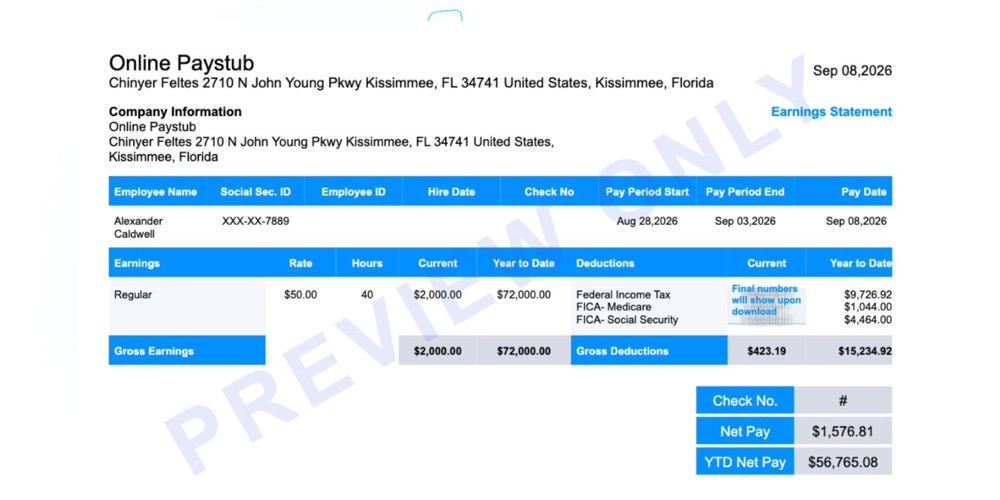
Florida Check Stub Maker
A Florida check stub is simpler than most states because there is no state income tax line to calculate. What remains still has to be right: federal withholding, Social Security, Medicare and the correct minimum wage for the pay period, including the tipped cash wage where it applies.
Enter your payroll details, review the calculated result and make any changes before you download. You stay in control of every figure on the document.
How to Make a Florida Paycheck Stub Online (Video Guide)
Watch a Florida pay stub come together, from employer details and earnings to the free preview and PDF download.
Florida Pay Stub Requirements at a Glance
| Item | 2026 |
|---|---|
| State income tax | None. Florida is one of nine states with no personal income tax |
| Employee state withholding | None |
| State disability insurance | None |
| Statewide paid leave | None |
| Minimum wage | $14.00/hr through Sept 29, 2026, then $15.00/hr |
| Tipped cash wage | $10.98/hr, then $11.98/hr from Sept 30, 2026 |
| Tip credit | $3.02/hr, fixed |
| Local minimum wages | Prohibited by state law (Fla. Stat. 218.077) |
| Pay stub required? | No general state requirement |
| Labor pool exception | Written statements required under Fla. Stat. 448.24 |
| Overtime | Federal FLSA only: 1.5x after 40 hours per week |
| Daily overtime | None |
| Meal and rest breaks | Not required for adult employees |
| Employer payroll tax | Reemployment Tax, 0.10% to 5.4% on the first $7,000 |
| Pay frequency | No state mandate for private employers |
| Final paycheck | Next regular payday, no special deadline |
| Record retention | Federal FLSA: 3 years for payroll records |
Why Florida Paychecks Look Different
No State Income Tax and What It Means for Take-Home Pay
Florida has never levied a personal income tax and the state constitution prohibits one. Practically, that means the state tax line most workers are used to seeing simply does not exist on a Florida pay stub. The only income tax withheld is federal.
For an employee this shows up directly in net pay. On a $60,000 salary, the difference between Florida and a neighboring state with an income tax runs into the thousands of dollars a year. For an employer it means one fewer withholding account to register, one fewer schedule to apply and no state withholding return to file.
What a Florida Pay Stub Does Show
Every deduction on a Florida stub falls into one of three groups:
Federal taxes:
- Federal income tax, based on the employee's W-4 and the 2026 IRS withholding tables
- Social Security (OASDI): 6.2% on wages up to $184,500
- Medicare: 1.45% on all wages, no cap
- Additional Medicare: 0.9% on wages over $200,000 single or $250,000 married filing jointly
Voluntary deductions: health, dental and vision premiums, 401(k) or other retirement contributions, HSA or FSA contributions, union dues.
Court-ordered deductions: wage garnishments and child support withholding.
Notably absent: state income tax, state disability insurance and any state paid family leave contribution. Florida has none of these.
Florida Take-Home Pay vs. Neighboring States
Approximate annual state income tax for a single filer earning $60,000, before local taxes:
| State | State income tax | Approximate annual state tax |
|---|---|---|
| Florida | None | $0 |
| Georgia | Flat rate | Roughly $2,400 to $2,500 |
| Alabama | Graduated, 2% to 5% | Roughly $2,300 to $2,500 |
| South Carolina | Graduated, 0% to top rate | Roughly $1,600 to $1,900 |
Figures are illustrative estimates for a single filer with standard deductions and no credits. Actual liability depends on filing status, deductions and the current-year rate in each state. Federal tax, Social Security and Medicare apply identically in all four.
The practical takeaway: on the same gross salary, a Florida worker keeps roughly $2,000 more per year than a Georgia or Alabama worker, before considering any difference in cost of living.
Does Florida Require Employers to Provide Pay Stubs?
No General State Requirement
Florida has no statute requiring private employers to give employees an itemized wage statement. This is the opposite of states like California, where the required contents of a pay stub are spelled out in law and omissions carry per-employee penalties.
There is no Florida equivalent, no state agency issuing wage statement penalties and no state-level private right of action for a missing stub.
The Labor Pool Exception (Florida Statute 448.24)
One category of employer is covered. Labor pools, meaning day-labor and temporary staffing operations, must provide each worker with a written itemized statement showing gross earnings and every deduction taken. Florida Statute 448.24 also restricts what a labor pool may deduct, including limits on charges for transportation and equipment.
If you operate a labor pool in Florida, the wage statement is mandatory and enforceable. For every other employer, it is not.
Federal FLSA Recordkeeping Still Applies
The absence of a state rule does not mean no rules. Under the federal Fair Labor Standards Act, every covered employer must keep accurate records of:
- Hours worked each workday and each workweek
- Regular hourly rate and the basis on which wages are paid
- Total straight-time and overtime earnings
- All additions to and deductions from wages
- Total wages paid each pay period and the pay date and period covered
Payroll records must be kept for three years and the underlying time records for two years. The FLSA does not require you to hand the employee a stub, but it does require you to be able to produce the numbers on demand.
Why Most Florida Employers Provide Stubs Anyway
Employees ask for them. A pay stub is what a landlord, a mortgage lender, or a credit issuer asks for as proof of income and an employee who cannot produce one will come back to payroll for it. Issuing a stub every period is far less work than reconstructing one months later.
It also protects the employer. When a wage dispute arises, a contemporaneous itemized statement showing hours, rate and every deduction is the cleanest evidence there is.
Florida Payroll Taxes for 2026
Florida Reemployment Tax: The State's Version of SUI
Florida renamed its unemployment tax "Reemployment Tax" in 2012. It is administered by the Florida Department of Revenue, not the Department of Commerce.
| Item | 2026 |
|---|---|
| Who pays | Employer only |
| New employer rate | 2.7% for roughly the first 10 quarters |
| Experienced employer range | 0.10% to 5.4% |
| Short-Time Compensation maximum | 6.4% |
| Taxable wage base | First $7,000 per employee per year |
| Maximum per employee | $378 at the 5.4% rate |
| Filing | Quarterly, Form RT-6 |
| Rate notice | Mailed each December for the following year |
Two things to get right. Reemployment Tax is employer-paid and cannot be deducted from an employee's wages, so it must never appear as a deduction line on a pay stub. And after roughly ten quarters of reported payroll, the flat 2.7% new-employer rate is replaced by an experience-rated figure based on your claims history.
Federal Payroll Taxes on a Florida Stub
| Tax | 2026 rate | Wage base |
|---|---|---|
| Social Security (OASDI) | 6.2% employee, 6.2% employer | First $184,500 |
| Medicare | 1.45% employee, 1.45% employer | All wages |
| Additional Medicare | 0.9% employee only | Over $200,000 single / $250,000 MFJ |
| Federal income tax | Per W-4 and IRS Publication 15-T | All wages |
The Social Security wage base rose from $176,100 in 2025 to $184,500 in 2026, capping the employee contribution at $11,439 for the year. Many payroll articles and generators still carry the 2025 figure.
FUTA and the State Credit
Federal Unemployment Tax applies to the first $7,000 of each employee's wages at a gross rate of 6.0%. Employers who pay their state reemployment tax on time receive a credit of up to 5.4%, bringing the effective net FUTA rate to 0.6%, or $42 per employee per year. Like Reemployment Tax, FUTA is employer-paid and never an employee deduction.
How to Create a Florida Pay Stub in Under Two Minutes
Step 1: Enter Employer and Employee Information
Business name, address, employee name and an identifier. Keep these identical across every stub in a set. Inconsistent employer details between consecutive stubs is the single most common reason a set gets questioned.
Step 2: Add the Pay Period, Hours and Rates
Enter the pay period start and end dates, the pay date, hours worked and the hourly rate or salary. Select the pay frequency: weekly, biweekly, semi-monthly, or monthly. Add overtime hours separately if any were worked.
Step 3: Add Deductions
The generator calculates federal income tax, Social Security and Medicare automatically from what you entered. There is no state withholding line to add. Enter voluntary deductions like insurance premiums, retirement contributions, or garnishments as separate labeled lines.
Step 4: Preview Free and Download Your PDF
Check the preview, confirm the YTD totals carry forward correctly and download. No account is needed to preview.
Florida Pay Stub Example: Gross Pay to Net Pay
Here is a full weekly stub for a single-filer employee in Florida earning $50.00 an hour, with 40 regular hours and no overtime for the period.
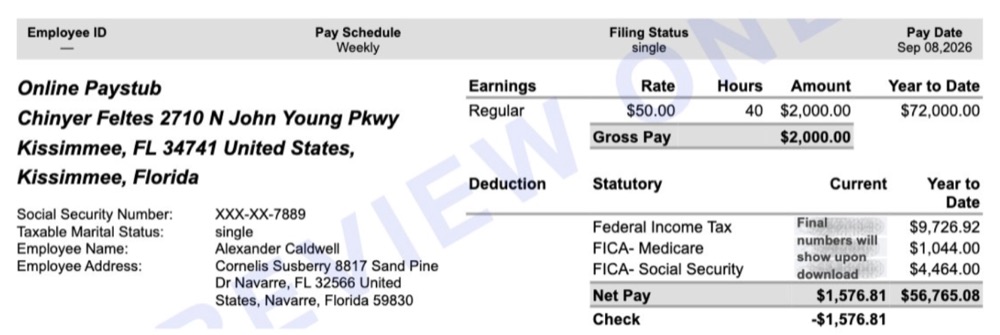
| Earnings | Hours | Rate | Current | YTD |
|---|---|---|---|---|
| Regular | 40.00 | $50.00 | $2,000.00 | $72,000.00 |
| Gross pay | 40.00 | $2,000.00 | $72,000.00 |
| Deductions | Current | YTD |
|---|---|---|
| Federal income tax | $270.19 | $9,726.92 |
| Social Security (6.2%) | $124.00 | $4,464.00 |
| Medicare (1.45%) | $29.00 | $1,044.00 |
| State income tax | $0.00 | $0.00 |
| Total deductions | $423.19 | $15,234.92 |
| Net pay | $1,576.81 | $56,765.08 |
Federal withholding depends on the employee's W-4 elections, so treat that line as illustrative. FICA is a fixed percentage and always calculates the same way. The state tax line is $0.00 in every Florida scenario.
Total deductions here come to about 21.2% of gross. In a state with a 5% income tax, the same employee would lose roughly another $100 per period.
How to Read Your Florida Pay Stub Fields
- Gross pay: everything earned before deductions, including regular hours, overtime, tips, bonuses and commissions
- OASDI or FICA-SS: the Social Security line, 6.2%
- Medicare or FICA-MED: 1.45%, no cap
- Net pay: what actually reaches the bank account
- YTD columns: the running calendar-year total beside each earnings and deduction line
Why YTD Totals Matter More in Florida
In states with income tax withholding, an employee has a second paper trail: the state return reconciles against the stubs. Florida has no state return, so the pay stub set is the entire record.
That makes YTD accuracy the thing most worth getting right. Each stub's YTD figure should equal the previous stub's YTD plus the current period, every time. A YTD column that resets mid-year, jumps, or does not add up is the first thing a careful reader notices. It also flags when Social Security withholding should stop, once cumulative wages pass $184,500.
Florida Minimum Wage in 2026
The Current Rate and the September 30 Increase
Florida is unusual: its minimum wage changes on September 30, not January 1. That is the schedule voters set in Amendment 2 in 2020 and it catches out employers who assume a January change like most states.
| Period | Minimum wage | Tipped cash wage |
|---|---|---|
| Sept 30, 2025 to Sept 29, 2026 | $14.00/hr | $10.98/hr |
| From Sept 30, 2026 | $15.00/hr | $11.98/hr |
September 30, 2026 is the final scheduled step. Amendment 2 raised the wage by $1.00 each year from $8.65 in 2021 to $15.00 in 2026. From September 30, 2027 onward, the rate adjusts annually for inflation instead.
If you are generating stubs that span the September 30 boundary, the correct rate changes mid-period. Pay periods that straddle the date must apply $14.00 to hours worked through September 29 and $15.00 to hours worked from September 30.
Tipped Employees, the $3.02 Tip Credit and the Math
Florida allows a tip credit of $3.02 per hour and that figure is fixed. It does not rise with the minimum wage, which is why the tipped cash wage always sits exactly $3.02 below the full rate.
How it works in practice: the employer pays a direct cash wage of $10.98 (rising to $11.98 on September 30, 2026) and tips must bring the employee's total to at least the full minimum wage for every hour worked. If tips fall short in any workweek, the employer must make up the difference.
On the pay stub this should appear as separate lines: the direct cash wage as regular earnings and reported tips as their own earnings line. Combining them into a single figure makes it impossible to show the tip credit was applied correctly and Florida's hospitality and tourism economy means a large share of the state's workforce is paid this way.
Overtime for tipped employees is calculated on the full minimum wage, not the reduced cash wage. This is one of the most commonly miscalculated items in Florida payroll.
Why Florida Has No City or County Minimum Wages
Florida Statute 218.077 preempts local wage ordinances. No Florida city or county can set a minimum wage above the state rate for private employers.
This makes Florida payroll considerably simpler than states like California, where dozens of city ordinances mean the correct wage depends on exactly where an employee performed the work. In Florida, the state rate applies in Miami, Jacksonville, Tampa, Orlando and everywhere else, without exception.
What Happens After 2026
The $15.00 rate reached on September 30, 2026 is the last fixed step. Beginning September 30, 2027, the minimum wage adjusts each year based on the Consumer Price Index. Expect a modest increase every fall going forward rather than a flat rate.
Overtime and Hours Rules in Florida
Florida Follows Federal FLSA
Florida has no state overtime statute. Non-exempt employees earn 1.5x their regular rate after 40 hours in a workweek, per the FLSA and that is the entire rule.
No Daily Overtime, No Mandatory Breaks
Florida does not require:
- Daily overtime after 8 or 12 hours, unlike California
- Meal breaks or rest breaks for adult employees
- Premium pay for weekends, holidays, or a seventh consecutive workday
- Paid sick leave or paid family leave at the state level
Minors under 18 do have break requirements under Florida's child labor law. For adults, if a break is offered and runs under 20 minutes, federal rules require it to be paid.
How Overtime Should Appear on the Stub
Overtime belongs on its own line with its own rate and hour count, separate from regular hours. Even though Florida does not legally require this level of itemization, a stub that shows 85 hours at a single blended rate is harder to verify and looks less credible to anyone reviewing it.
For a tipped employee, remember that the overtime rate is 1.5x the full minimum wage, not 1.5x the $10.98 cash wage.
Pay Stubs for Florida's Biggest Workforces
Tipped and Hospitality Workers
Florida's tourism economy means servers, bartenders, hotel staff, valets and tour operators make up a large share of the workforce. Their stubs need the cash wage and reported tips shown separately, with the tip credit visible in the math. A hospitality stub that lumps everything into one earnings line is both harder to verify and less useful as proof of income.
Gig and Rideshare Workers
Drivers and couriers working through Uber, Lyft, DoorDash, Instacart, Amazon Flex and similar platforms receive 1099 income, not a W-2 and no employer issues them a pay stub. When one is needed for a lease application or for organized tax records, generating an accurate stub from real earnings data is the standard approach. Contractor mode removes employee-side tax lines and shows gross earnings.
Independent Contractors and 1099 Workers
A contractor stub shows gross pay with no federal withholding, no Social Security and no Medicare deducted, because a contractor pays self-employment tax directly rather than having it withheld. Keeping consistent stubs across the year makes quarterly estimated tax payments considerably easier to calculate.
Seasonal and Snowbird Workers
Florida's seasonal employment swings hard between winter and summer, particularly in tourism, agriculture and construction. Seasonal workers often need income documentation covering a period that has already ended. Generating a consistent set of stubs for the actual season worked, with YTD totals that accumulate correctly across it, is what makes that documentation usable.
Household Employers
If you employ a nanny, caregiver, or housekeeper and pay above the federal threshold, you have real payroll obligations: FICA withholding, Reemployment Tax registration with the Florida DOR and a W-2 at year end. A generated pay stub is the practical paper trail for that and it is what your employee will need when they apply for anything.
Small Business Owners Running Their Own Payroll
For a handful of employees, dedicated payroll software is often more overhead than it is worth. A generator that calculates federal taxes correctly and produces a clean stub per employee per period covers the requirement without a monthly subscription.
Using a Florida Pay Stub as Proof of Income
What Landlords and Lenders Actually Check
Most requestors look at four things: gross pay, net pay, the pay period dates and the YTD totals. A mortgage underwriter will also check that the YTD figure is consistent with the stated annual salary and the pay frequency.
How Many Stubs You Usually Need
Landlords typically ask for the two or three most recent. Mortgage lenders usually want 30 days of stubs plus two years of W-2s. Auto lenders and credit issuers vary but rarely ask for more than a month. In every case the stubs should be consecutive and consistent.
Mistakes That Make a Stub Look Wrong
Pay dates that do not match the schedule. If the stub says biweekly, every pay date should be exactly 14 days apart. Irregular gaps are the first thing that gets noticed.
YTD that does not accumulate. Each stub's YTD must equal the previous YTD plus the current period. A reset mid-year reads as an error.
Deductions out of proportion. A stub showing large gross pay with token federal withholding does not hold up. Deductions should reflect the actual bracket rates for the amount earned.
Inconsistent formatting. Switching templates or changing the employer address between consecutive stubs undermines the whole set. Pick one layout and stay with it.
Round numbers everywhere. Real payroll produces figures like $1,831.15, not $1,800.00. Calculated deductions rarely land on even dollars.
Florida Employer Payroll Checklist
Registration and Reporting
- Classify each worker as an employee or independent contractor
- Register for a Reemployment Tax account with the Florida Department of Revenue
- Obtain a completed federal W-4 from each employee (there is no Florida equivalent)
- Report every new hire to the Florida New Hire Reporting Center within 20 days
- File Form RT-6 quarterly and pay Reemployment Tax
- Deposit federal taxes on your assigned IRS schedule
- Issue W-2s by January 31
Final Paycheck Rules in Florida
Florida has no statute setting a deadline for final wages. The employee is paid on the next regular payday following separation, whether they quit or were terminated. There are no waiting time penalties as in California.
Unused vacation is treated according to your written policy. Florida does not require payout unless your own policy or an employment agreement promises it, which makes having that policy in writing important.
Record Retention
Under FLSA, payroll records must be kept for three years and time and earnings records supporting them for two years. Florida Reemployment Tax records should be kept for five years.
Florida Pay Stub Templates
Pick from professional layouts, each of which itemizes earnings, federal deductions, net pay and YTD totals. Preview any of them free before downloading.
- Modern: clean two-column layout, good for digital delivery
- Classic: traditional payroll format, prints cleanly
- Detailed: expanded YTD columns, best for tipped and multi-rate employees
- Compact: minimal layout for straightforward hourly stubs
Why Choose Online Paystub for Florida Pay Stubs
- Current 2026 figures. The $184,500 Social Security wage base, the current minimum wage and the September 30 change date and the correct tipped wage math. Several competing tools still show 2025 figures or list the Florida wage change as a January event.
- YTD that actually accumulates. Enter a hire date and the generator carries totals forward correctly across every period.
- No phantom state tax line. Florida stubs are generated in the correct federal-only format rather than a national template with a blank state field.
- Employee and contractor modes. Contractor stubs drop withholding lines automatically.
- Tipped earnings support. Cash wage and reported tips as separate lines.
- Free preview. See the finished stub before you pay, with no account.
- Secure and private. 256-bit SSL and we never sell or share what you enter.
Florida Payroll Glossary
FLSA: the federal Fair Labor Standards Act, which governs minimum wage, overtime and recordkeeping where no state rule exists. FUTA: Federal Unemployment Tax Act. Employer-paid, effectively 0.6% on the first $7,000 after the state credit. Gross wages: total earnings before any deduction. Medicare: federal health payroll tax, 1.45% on all wages with no cap. Net wages: take-home pay after all deductions. Non-exempt employee: an employee entitled to overtime after 40 hours in a workweek. OASDI: Old-Age, Survivors and Disability Insurance, the formal name for the Social Security payroll tax. Reemployment Tax (RT): Florida's unemployment insurance tax, employer-paid, filed quarterly on Form RT-6. RT-6: the quarterly Florida Reemployment Tax return. Tip credit: the amount an employer may count toward the minimum wage from an employee's tips. Fixed at $3.02 in Florida. Tipped cash wage: the direct hourly wage paid to a tipped employee before tips. Wage base: the annual earnings ceiling to which a tax applies. $7,000 for Reemployment Tax and FUTA, $184,500 for Social Security. YTD: year-to-date, the running calendar-year total for an earnings or deduction line.
Disclaimer
This page is general information, not legal, tax, or accounting advice. Rates and rules change and correct treatment depends on your circumstances. Verify current figures with the Florida Department of Revenue, the Florida Department of Commerce, the US Department of Labor and the IRS, or consult a qualified professional.
Always enter accurate information that reflects real earnings. Our tools are for legitimate payroll and income documentation.
Last verified: 08.09.2026 | Sources: Florida Department of Revenue, Florida Department of Commerce, Florida Constitution Art. X § 24, US DOL, IRS, SSA
Nearby State Pay Stub Resources
Create a pay stub for a nearby state or one of our most popular states.


Frequently Asked Questions About Florida Pay Stubs
Does Florida have a state income tax?
No. Florida is one of nine states with no personal income tax and the state constitution prohibits one. Florida pay stubs show federal income tax, Social Security and Medicare, but no state withholding line.
Are employers required to provide pay stubs in Florida?
Not for most employers. Florida has no general law requiring itemized wage statements. The exception is labor pool employers, who must provide written statements under Florida Statute 448.24. Federal FLSA recordkeeping requirements still apply to everyone.
What is the Florida minimum wage in 2026?
$14.00 per hour through September 29, 2026, rising to $15.00 per hour on September 30, 2026. Florida adjusts its rate at the end of September rather than in January, following the Amendment 2 schedule voters approved in 2020.
What is the tipped minimum wage in Florida?
$10.98 per hour in direct cash wage through September 29, 2026, rising to $11.98 from September 30. The tip credit is fixed at $3.02 and tips must bring the employee to at least the full minimum wage for every hour worked.
What is Florida Reemployment Tax and who pays it?
Reemployment Tax is Florida's version of state unemployment insurance, administered by the Department of Revenue. New employers pay 2.7% on the first $7,000 per employee for roughly ten quarters, after which the rate is experience-rated between 0.10% and 5.4%. It is employer-paid and must never appear as an employee deduction.
What deductions appear on a Florida pay stub?
Federal income tax, Social Security at 6.2% up to $184,500, Medicare at 1.45% on all wages, plus any voluntary deductions such as health premiums, retirement contributions, or garnishments. No state income tax, no state disability insurance.
Can I use a Florida pay stub as proof of income for a lease?
Pay stubs are the standard proof of income document for landlords and lenders, provided they reflect real earnings. Most landlords ask for the two or three most recent consecutive stubs and consistency across the set matters as much as any single stub.
Can I create a pay stub as a 1099 contractor in Florida?
Yes. Contractor mode removes employee-side withholding and shows gross earnings. Contractors commonly generate stubs to document income for tax preparation, quarterly estimated payments, or a rental application.
How does overtime work in Florida?
Florida follows the federal FLSA: 1.5x the regular rate after 40 hours in a workweek. There is no daily overtime, no seventh-day premium and no required meal or rest breaks for adult employees.
Do any Florida cities have their own minimum wage?
No. Florida Statute 218.077 prevents cities and counties from setting a minimum wage above the state rate for private employers. The state rate applies uniformly across Florida.
How long should Florida employers keep payroll records?
Three years for payroll records and two years for the underlying time records under the FLSA. Florida Reemployment Tax records should be kept for five years.
Can I generate multiple pay periods at once?
Yes. Keep the employer and employee details fixed, then update the dates and figures for each period. The generator carries YTD totals forward so the set stays internally consistent.