California Paystub Generator
Generate pay stubs in California as quickly as possible. With our online pay stub tool, you can quickly create your California pay stubs using more than 10 different themes.
 Create Your California Pay Stub
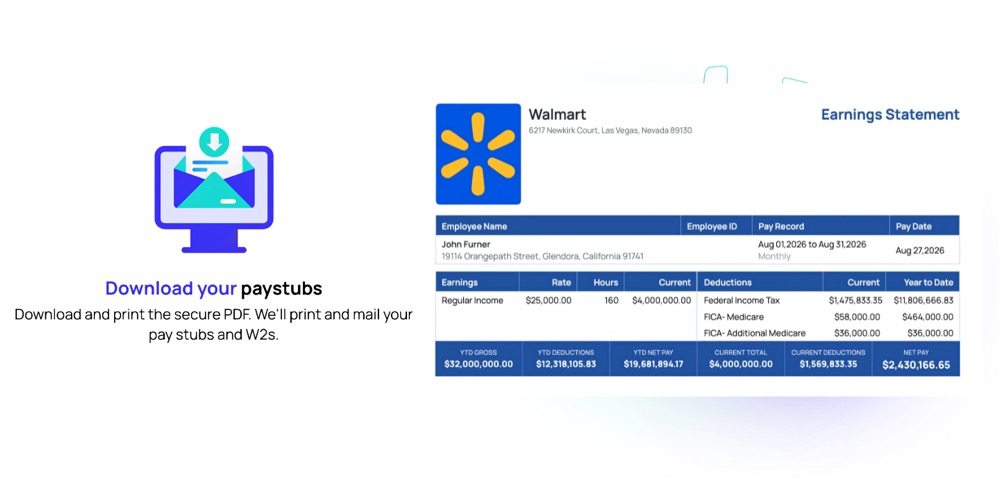
Download California Paystubs
A California pay stub has to do more than list a gross and a net figure. State law requires nine separate items on every wage statement, a 1.3% SDI deduction with no wage cap and income tax brackets that run up to 13.3%. Our generator applies these 2026 figures automatically, so what you enter turns into a statement that actually matches what California requires.
Enter your payroll details, review the calculated result and make any changes before you download. You stay in control of every figure on the document.
California Paystub Generator: Create a California Pay Stub Online in Minutes (2026)
Watch how our California paystub generator applies the 2026 state tax brackets, SDI and all nine required wage statement fields automatically, so you can create and download your California pay stub in minutes.
California Paystub Requirements at a Glance
California has the strictest wage statement rules in the country. Here is the short version before we get into detail.
| Item | 2026 requirement |
|---|---|
| Pay stub required? | Yes, under Cal. Labor Code Section 226(a) |
| Required fields | Nine specific items on every wage statement |
| State income tax | 10 progressive brackets, 1% to 13.3% |
| SDI (employee-paid) | 1.3% of all wages, no wage cap |
| Statewide minimum wage | $16.90/hr as of January 1, 2026 |
| Minimum pay frequency | Semimonthly for most employees |
| Overtime | 1.5x after 8 hours/day or 40 hours/week, 2x after 12 hours/day |
| Electronic pay stubs | Allowed, with a paper option available |
| Record retention | 3 years |
| Copy request deadline | 21 days |
| Penalty for non-compliance | $50 first violation, $100 each after, capped at $4,000 per employee |
What Must Be Included on a California Pay Stub?
Most states let employers hand over a summary and call it done. California does not. The law lists exactly what has to appear. Leaving out a single item makes the statement non-compliant even if every dollar was paid correctly.
The Nine Required Fields Under Labor Code Section 226
Every itemized wage statement issued in California must show:
- Gross wages earned during the pay period
- Total hours worked (not required for salaried exempt employees)
- Number of piece-rate units earned and the applicable piece rate, if the employee is paid on a piece-rate basis
- All deductions, itemized separately
- Net wages earned
- The inclusive dates of the pay period, start and end
- Employee name and the last four digits of their Social Security number, or an employee ID number
- Employer's legal name and address
- All applicable hourly rates in effect during the pay period and the number of hours worked at each rate
Field nine is where most employers get caught. If someone worked 38 regular hours at $22.00 and 6 overtime hours at $33.00, both rates and both hour counts have to appear separately. A single blended line does not satisfy the statute.
Additional California-Specific Requirements
Two more items come from outside Section 226 but still belong on or alongside the stub:
- Paid sick leave balance. Under AB 1522, employers must show available paid sick leave either on the wage statement or on a separate document issued the same day.
- SDI as its own line item. State Disability Insurance cannot be lumped into a generic "state taxes" line or labeled vaguely. It gets its own row.
Penalties for Non-Compliant Wage Statements
The numbers escalate quickly:
- $50 per employee for the first violation, per pay period
- $100 per employee for each subsequent violation, per pay period
- $4,000 maximum per employee
- $750 for failing to provide requested copies within 21 days
- Plus the employee's attorney fees
California also grants employees a private right of action. They can sue directly without first filing a claim with the Labor Commissioner, which is why wage statement claims are so common here.
California Payroll Stub Taxes Explained
A California paystub carries more deduction lines than almost any other state. Here is what each one is and how it is calculated in 2026.
California State Income Tax Brackets (2026)
California runs ten progressive brackets. The top rate of 13.3% is the 12.3% bracket plus a 1% Mental Health Services surcharge on income above $1 million.
| Taxable income (single filer) | Rate |
|---|---|
| $0 to $11,079 | 1.0% |
| $11,079 to $26,264 | 2.0% |
| $26,264 to $41,452 | 4.0% |
| $41,452 to $57,542 | 6.0% |
| $57,542 to $72,724 | 8.0% |
| $72,724 to $371,479 | 9.3% |
| $371,479 to $445,771 | 10.3% |
| $445,771 to $742,953 | 11.3% |
| $742,953 to $1,000,000 | 12.3% |
| Over $1,000,000 | 13.3% |
Withholding on an actual paycheck follows the EDD's DE 44 schedules (Method A wage bracket or Method B exact calculation) and the employee's DE-4 elections, not the annual return brackets directly. Our generator applies the 2026 schedules automatically.
California SDI and Paid Family Leave (PFL)
This is the deduction most people get wrong. Most online generators still have it wrong too.
2026 SDI rate: 1.3% of all wages. There is no wage cap.
Senate Bill 951 removed the taxable wage ceiling effective January 1, 2024. It has not returned. If a tool or an article tells you SDI stops at $153,164 or $176,000, it is describing a year that has already passed. In 2026 an employee earning $250,000 pays 1.3% on the full amount, roughly $3,250 for the year.
SDI is entirely employee-funded. Employers contribute nothing to it. The money supports two programs:
- Disability Insurance (DI): short-term wage replacement for a non-work-related illness or injury
- Paid Family Leave (PFL): up to 8 weeks of partial pay to care for a seriously ill family member or bond with a new child
The 2026 maximum weekly benefit for both is $1,765.
SUI and ETT: The Employer-Paid California Taxes
These two never appear as employee deductions, but they belong on your payroll ledger:
- State Unemployment Insurance (SUI): 1.5% to 6.2% under Schedule F+, on the first $7,000 of each employee's wages
- Employment Training Tax (ETT): 0.1% on the first $7,000
If your stub shows either of these as an employee deduction, something is wrong.
Federal Payroll Taxes That Still Apply
California deductions sit on top of the federal ones, not instead of them.
| Tax | 2026 rate | Wage base |
|---|---|---|
| Social Security (OASDI) | 6.2% | First $184,500 |
| Medicare | 1.45% | All wages, no cap |
| Additional Medicare | 0.9% | Wages over $200,000 (single) / $250,000 (MFJ) |
| Federal income tax | Per W-4 and IRS withholding tables | All wages |
The Social Security wage base rose from $176,100 in 2025 to $184,500 in 2026, capping the employee contribution at $11,439 for the year.
How to Create a California Paystub in Under Two Minutes
Step 1: Enter Employer and Employee Information
Use your legal registered entity name, the one on your EIN registration, not your DBA or trade name. Section 226 asks for the legal name and address specifically. Add the employee's full name and the last four digits of their SSN or their employee ID.
Step 2: Add the Pay Period, Hours and Pay Rates
Enter the inclusive start and end dates of the pay period, not just "week of." Then add hours worked. If the employee earned more than one rate during the period (overtime, a shift differential, a second job classification), add each rate as its own line so the stub shows the hours worked at each.
Step 3: Itemize Deductions
The generator calculates federal income tax, Social Security, Medicare, California PIT and SDI automatically from the information you entered. Add voluntary deductions like health premiums, 401(k) contributions, or garnishments as separate labeled lines. "Misc" is not a valid label in California.
Step 4: Preview Free and Download Your PDF
Check the preview against the nine required fields, then download. You get an instant PDF you can print, email, or file. No account is needed to preview.
California Pay Stub Example: Gross Pay to Net Pay
Here is a full biweekly stub for a single-filer employee in Los Angeles earning $30.00 an hour, with 80 regular hours and no overtime for the period.
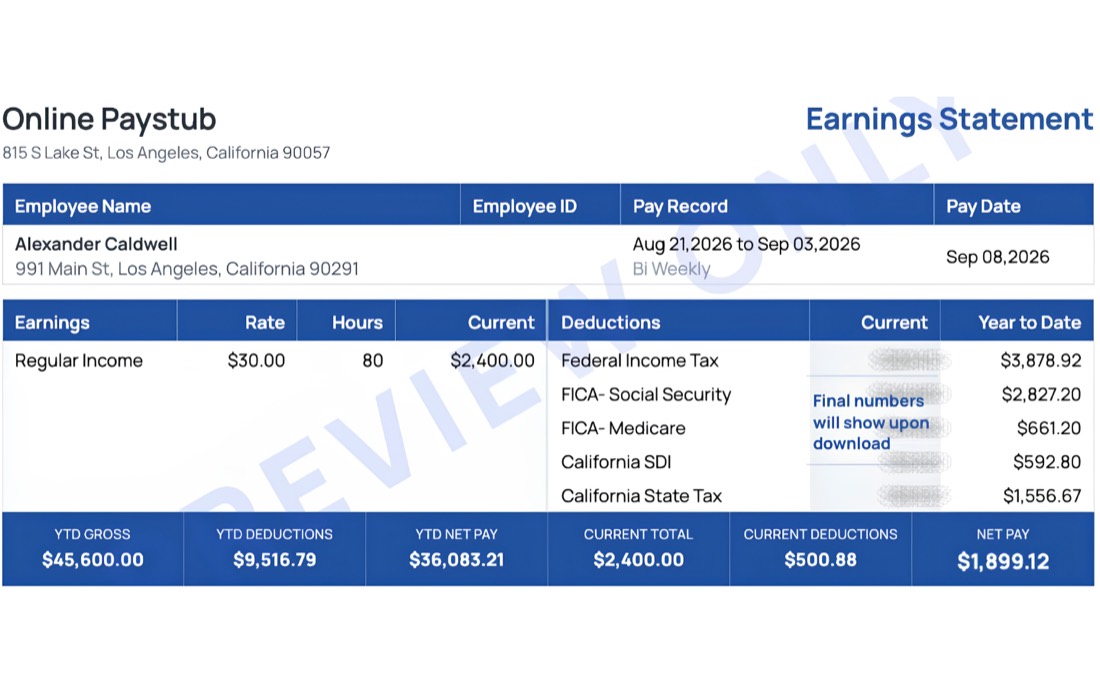
| Earnings | Hours | Rate | Current | YTD |
|---|---|---|---|---|
| Regular | 80.00 | $30.00 | $2,400.00 | $45,600.00 |
| Gross pay | 80.00 | $2,400.00 | $45,600.00 |
| Deductions | Current | YTD |
|---|---|---|
| Federal income tax | $210.00 | $3,878.92 |
| Social Security (6.2%) | $148.80 | $2,827.20 |
| Medicare (1.45%) | $34.80 | $661.20 |
| CA SDI (1.3%) | $31.20 | $592.80 |
| CA state income tax (PIT) | $76.08 | $1,556.67 |
| Total deductions | $500.88 | $9,516.79 |
| Net pay | $1,899.12 | $36,083.21 |
Federal and state withholding amounts depend on the employee's W-4 and DE-4 elections, so treat those two lines as illustrative. FICA and SDI are fixed percentages and will always calculate the same way.
How to Read Your California Pay Stub Fields
- Gross pay is everything earned before any deduction: regular hours, overtime, bonuses, commissions, tips.
- Net pay is what actually lands in the bank account after every deduction comes out.
- Rate columns must be broken out by rate, with matching hours, for every rate that was in effect.
- CASDI is how State Disability Insurance is usually abbreviated on a stub. It is a deduction, not a tax you can opt out of.
- OASDI is the Social Security line. Some payroll systems label it FICA-SS instead.
What Year-to-Date (YTD) Totals Should Show
Every earnings and deduction line should carry a running YTD column alongside the current-period figure. YTD totals matter for three reasons: they let an employee reconcile the stub against their W-2 in January, they show when Social Security withholding stops after $184,500 and they are the first thing a lender or landlord checks when a stub is used as proof of income. If you generate multiple consecutive stubs, keep the YTD figures consistent across the whole set.
Pay Stubs for Every Type of California Worker
Hourly Employees and Overtime Rules
California overtime is stricter than the federal standard because it triggers on a daily basis, not just weekly:
- 1.5x after 8 hours in a workday, after 40 hours in a workweek and for the first 8 hours on the seventh consecutive workday
- 2x after 12 hours in a workday and after 8 hours on the seventh consecutive workday
Each of those rates has to appear separately on the stub with its own hour count.
Salaried and Exempt Employees
To be exempt from overtime under the administrative, executive, or professional exemptions in 2026, an employee must earn at least twice the state minimum wage for full-time work, which is $70,304 per year. Salary alone does not create exempt status. The duties test has to be satisfied too.
If an employee is salaried but non-exempt, their stub still has to show total hours worked. Only genuinely exempt employees can skip that field.
Independent Contractors and 1099 Gig Workers
Contractors do not have employee payroll taxes withheld, so a contractor stub shows gross pay with no FICA, no PIT withholding and no SDI. Our generator has a contractor mode that removes those lines automatically. Contractors commonly generate stubs to document income for tax preparation, bookkeeping, or a loan application.
If you are unsure whether a worker is an employee or a contractor in California, the ABC test under AB 5 governs the classification. Getting it wrong carries its own penalties.
Tipped and Commission-Based Workers
California does not allow a tip credit. Tipped employees must be paid the full minimum wage before tips. Tips are shown as separate earnings lines. Commissions need a written agreement and should be labeled as commissions rather than folded into regular wages, so a one-off spike does not read like a permanent raise.
California Minimum Wage and Local Ordinances
Statewide Minimum Wage
The California minimum wage is $16.90 per hour as of January 1, 2026, up from $16.50 in 2025. It applies to every employer regardless of size.
City and County Minimum Wages
More than 40 California cities and two counties set higher local rates. The rate that applies is based on where the work is physically performed, not where the business is headquartered or where the employee lives. Most ordinances cover anyone who works at least two hours inside city limits in a given week, remote and hybrid workers included.
| Jurisdiction | 2026 rate |
|---|---|
| California (statewide) | $16.90/hr |
| Emeryville | $20.34/hr |
| West Hollywood | $20.25/hr |
| Mountain View | $19.70/hr |
| San Francisco | $19.61/hr |
| Berkeley | $19.61/hr |
| Belmont | $18.95/hr |
| El Cerrito | $18.82/hr |
| Cupertino | $18.70/hr |
| Palo Alto | $18.70/hr |
| Pasadena | $18.57/hr |
| Los Angeles County (unincorporated) | $18.47/hr |
| Santa Monica | $18.47/hr |
| Los Angeles (City) | $18.42/hr |
| Fremont | $18.05/hr |
| San Diego (City) | $17.75/hr |
| Oakland | $17.34/hr |
Local rates change on January 1 and July 1 depending on the ordinance. Confirm your city's current figure before running payroll.
Industry-Specific Minimums
Some industry floors override both the state and the local rate:
- Fast food at chains with 60 or more locations nationwide: $20.00/hr under AB 1228
- Healthcare facility workers: $23.00 to $25.00/hr depending on facility type, under a phased schedule
- Hotel workers in Los Angeles, Long Beach and Glendale: separate higher rates apply
The rule is always the same. Pay whichever applicable rate is highest.
Common California Paycheck Deductions
Mandatory Deductions
| Deduction | Basis |
|---|---|
| Federal income tax | W-4 elections and IRS tables |
| Social Security (OASDI) | 6.2% up to $184,500 |
| Medicare | 1.45% on all wages |
| CA state income tax (PIT) | DE-4 elections and 2026 EDD schedules |
| CA SDI | 1.3% on all wages, no cap |
Voluntary Deductions and Written Authorization
Voluntary deductions require the employee's signed authorization. Each one gets its own labeled line:
- Health, dental and vision insurance premiums
- 401(k) or other retirement contributions
- HSA and FSA contributions
- Union dues
- Life or disability insurance
Labor Code Section 221 prohibits unauthorized deductions from wages. Even with written authorization, California employers cannot deduct for cash register shortages, breakage, uniforms, or ordinary business expenses. Keep signed authorization forms in the employee file so you can produce them if a deduction is ever disputed.
Wage Garnishments and Child Support Orders
Garnishments are court-ordered and do not require employee consent, but they still have to be itemized with a clear label. California caps ordinary wage garnishment more tightly than federal law does. Child support orders take priority over other garnishments.
California Final Paycheck and Termination Rules
The timing rules here surprise almost every new California employer.
Timing Requirements
| Situation | Final paycheck due |
|---|---|
| Terminated or laid off | Immediately, at the time of termination |
| Quits with no notice | Within 72 hours |
| Quits with 72+ hours notice | On the last day worked |
"Immediately" means immediately. Not end of day, not the next scheduled payroll run.
Waiting Time Penalties
If the final paycheck is late, the employee can claim their daily wage rate for every day it is late, up to 30 days. An employee earning $25 an hour ($200 a day) can claim up to $6,000 in waiting time penalties on top of the wages themselves.
Accrued Vacation Must Be Paid Out
California treats earned vacation as wages. Use-it-or-lose-it policies are not enforceable here. Any accrued, unused vacation has to be paid out in the final check and shown on the stub. Paid sick leave under AB 1522 is treated differently and generally does not require payout on termination.
Five Pay Stub Mistakes That Trigger California Lawsuits
- Blending multiple pay rates into one line. Overtime and shift differentials must each show a rate and matching hours. A single combined figure fails Section 226 even when the math is right.
- Vague pay period labels. "Week of March 3" is not enough. The stub needs inclusive start and end dates, for example 03/01/2026 to 03/15/2026.
- Generic deduction labels. "Misc," "Other," and "State insurance" all fail. Every deduction needs a specific, plain label the employee can understand.
- Using a DBA instead of the legal entity name. The stub must carry the legal registered business name and address, the one tied to your EIN.
- Omitting hours for non-exempt salaried employees. Paying a salary does not remove the hours requirement. Only genuinely exempt employees can skip it.
Why California Check Stub Are Stricter Than Other States
| Requirement | California | Most other states |
|---|---|---|
| Itemized deductions | Every single one, separately labeled | Often optional |
| Multiple pay rates with hours | Mandatory | Usually not required |
| State disability insurance | Yes (SDI) | Only CA, HI, NJ, NY, RI and PR |
| Daily overtime | Yes, after 8 hours | Rare, weekly only |
| Final paycheck timing | Immediate on termination | Next regular payday typical |
| Paid sick leave on the stub | Required | Rare |
| Private right of action | Yes, employees can sue directly | Many states require an agency complaint first |
That last row is the reason California wage statement litigation volume is so high. There is no administrative gatekeeper between an employee and a lawsuit.
California Pay Stub Templates
Choose from professional templates, each of which lays out the nine required Section 226 fields and calculates 2026 California taxes automatically. Pick the layout that fits how you want the stub to read, then preview it free before downloading.
- Modern: clean two-column layout, good for digital delivery
- Classic: traditional payroll format, prints well
- Detailed: expanded YTD columns, best for multi-rate employees
- Compact: minimal layout for simple hourly stubs
Why Choose Online Paystub for California Pay Stubs
- Current 2026 data. The 1.3% SDI rate with no wage cap, the $16.90 minimum wage and the 2026 EDD withholding schedules. Most competing tools are still running 2023 and 2024 figures.
- All nine Section 226 fields built into the form, so you cannot accidentally omit one.
- Multi-rate support. Add as many pay rates as the pay period actually had.
- Free preview. See the finished stub before you pay, without creating an account.
- Instant PDF. Download, print, or email the moment it is generated.
- Employee and contractor modes. Contractor stubs drop employee-side taxes automatically.
- Your information stays private. We never sell or share what you enter with anyone else.
California Payroll Glossary
- CASDI: the abbreviation for California State Disability Insurance as it appears on a pay stub.
- DE-4: California's employee withholding allowance certificate, the state counterpart to the federal W-4.
- DE 44: the EDD's California Employer's Guide, which contains the official withholding schedules.
- EDD: Employment Development Department, the agency administering California payroll taxes and SDI.
- ETT: Employment Training Tax, 0.1% on the first $7,000 of wages, paid by the employer.
- Exempt employee: an employee who meets both a salary threshold and a duties test and is therefore not entitled to overtime.
- Gross wages: total earnings before any deduction.
- Net wages: take-home pay after all deductions.
- Non-exempt employee: an employee entitled to overtime and to seeing total hours worked on their wage statement.
- OASDI: Old-Age, Survivors and Disability Insurance, the formal name for the Social Security payroll tax.
- PFL: Paid Family Leave, funded by SDI, providing up to 8 weeks of partial wage replacement.
- Piece rate: pay based on units produced rather than hours worked. Both the unit count and the rate must appear on the stub.
- PIT: Personal Income Tax, California's state income tax withholding.
- Shift differential: a premium added for working a less desirable shift. It counts as a separate rate on the wage statement.
- SUI: State Unemployment Insurance, 1.5% to 6.2% on the first $7,000 of wages, paid by the employer.
- Wage statement: California's legal term for a paystub.
- YTD: year-to-date, the running total of an earnings or deduction category for the calendar year.
Disclaimer
This page is for general informational purposes and is not legal, tax, or accounting advice. Tax rates, minimum wage rates and local ordinances change. The correct treatment depends on your specific facts. Verify current figures with the California Employment Development Department (EDD), the Department of Industrial Relations (DIR) and the IRS, or consult a qualified professional.
Always enter accurate information that reflects real earnings. Our tools are provided for legitimate payroll and income documentation.
Last verified: 08.09.2026 | Sources: California EDD, California DIR, IRS, SSA
Nearby State Pay Stub Resources
Create a pay stub for a nearby state or one of our most popular states.


Frequently Asked Questions About California Pay Stubs
Are employers required to provide pay stubs in California?
Yes. Labor Code Section 226(a) requires an itemized wage statement every pay period, containing nine specific items. Non-compliance carries penalties of $50 for the first violation and $100 for each subsequent violation, up to $4,000 per employee, plus attorney fees.
Can I use a California paystub as proof of income?
Pay stubs are routinely accepted as proof of income by lenders, landlords and credit issuers, provided the figures reflect real earnings. Most requestors ask for two to three consecutive stubs, so keep the employer details, format and YTD totals consistent across the set.
Are electronic pay stubs legal in California?
Yes. Electronic wage statements are permitted as long as the employee can easily access and print them, the employer keeps copies for three years and a paper option remains available on request.
What is the California SDI rate in 2026?
1.3% of all wages, with no wage cap. Senate Bill 951 removed the taxable wage ceiling effective January 1, 2024, so every dollar earned is subject to the deduction. SDI is entirely employee-funded and must appear as its own line on the stub.
How is California state income tax calculated on my paystub?
Withholding is based on your DE-4 elections and the EDD's 2026 withholding schedules, applied to your gross wages for the pay period. Annual liability follows the ten progressive brackets from 1% to 13.3%. Because withholding is an estimate, the amount on your stub will not match your final return exactly.
Can I create pay stubs for a 1099 contractor in California?
Yes. Switch to contractor mode and the generator removes employee-side payroll taxes, showing gross pay only. Contractors commonly use stubs to document income for tax preparation, bookkeeping, or loan applications.
What is the California minimum wage in 2026?
$16.90 per hour statewide as of January 1, 2026. More than 40 cities and counties set higher local rates and industry minimums apply to fast food and healthcare. Always pay the highest applicable rate for the location where the work is performed.
How long must California employers keep payroll records?
At least three years. Employees may request copies of their wage statements. The employer must comply within 21 days or face a $750 penalty.
Do I need to show paid sick leave on the pay stub?
Available paid sick leave must appear either on the wage statement or on a separate written notice provided on the same day as the paycheck.
Can I generate multiple pay periods at once?
Yes. Keep the employer and employee details fixed, then update only the dates and the figures for each period. Consistent formatting across a set of stubs matters more than any single stub looks perfect.
What happens if a required field is missing from my pay stub?
The statement is non-compliant even if the wages themselves were paid correctly. Employees can sue directly without filing an administrative claim first. Penalties accumulate per employee per pay period.
Do I need an account to preview my stub?
No. Preview is free and requires no account. Create one only if you want to save drafts or manage several stubs.