Illinois Paystub Generator
Illinois taxes wages at a flat 4.95% with no city or county tax anywhere, but its 2025 wage statement law is one of the strictest in the country. Enter your payroll details and download an instant PDF with every required item in place.

 Create Your Illinois Pay Stub
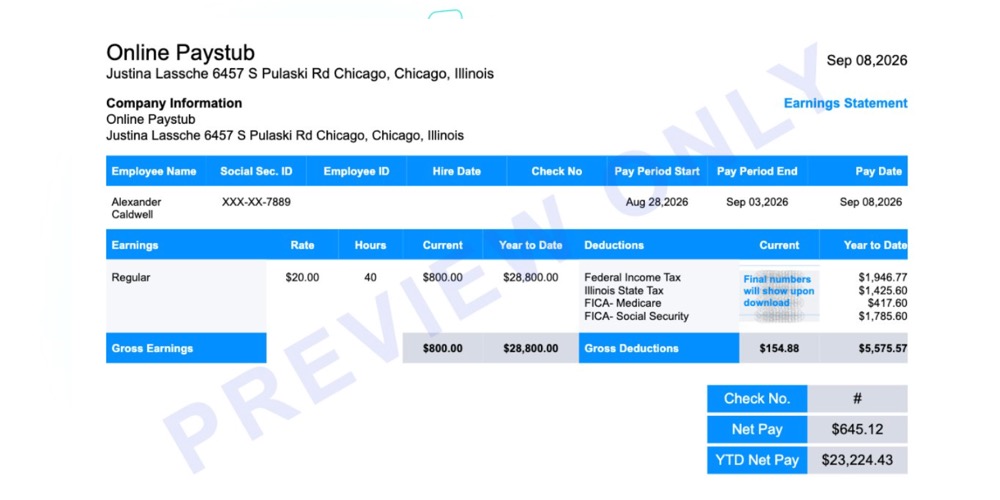
Illinois Paystub Generator
Illinois keeps the tax math simple: a flat 4.95% state rate with no city or county income tax anywhere, not even in Chicago. What the law requires is stricter than most states expect. Since January 2025, every statement needs seven specific items, including hours worked for salaried exempt employees and running year-to-date totals for both wages and deductions.
Enter your payroll details, review the calculated result and make any changes before you download. You stay in control of every figure on the document.
How to Generate an Illinois Paystub Online: Quick Video Tutorial
This short tutorial shows how to add hours and pay rates, review the preview and download an Illinois paystub.
Illinois Paystub Requirements at a Glance
| Item | 2026 |
|---|---|
| Paystub required? | Yes, under the Illinois Wage Payment and Collection Act |
| Required items | Seven, plus available paid leave balance |
| Effective date of current rules | January 1, 2025 |
| State income tax | 4.95% flat, no brackets |
| Local income tax | None anywhere in Illinois, Chicago included |
| State disability insurance | None |
| Statewide minimum wage | $15.00/hr |
| Chicago minimum wage | $17.05/hr from July 1, 2026 |
| Cook County minimum wage | $15.40/hr from July 1, 2026 |
| Tipped cash wage (state) | $9.00/hr, 60% of the minimum |
| Overtime | 1.5x after 40 hours per week |
| SUI (employer-paid) | Experienced 0.75% to 7.05%, wage base $14,250 |
| Penalty for non-compliant statement | Up to $500 per violation |
| Record retention | 3 years |
| Copy request deadline | 21 calendar days |
What Must Be on an Illinois Paystub?
The Seven Required Items
Public Act 103-0953 amended the Illinois Wage Payment and Collection Act effective January 1, 2025. Every paystub issued to an Illinois employee must now be an itemized statement showing:
- Hours worked
- Rate of pay
- Overtime pay
- Overtime hours worked
- Gross wages earned
- Wage deductions
- Total wages and deductions year to date
Items three and four are separate requirements. Showing an overtime dollar figure without the corresponding hour count does not satisfy the statute and neither does the reverse.
Item seven matters more than it looks. Year-to-date totals are not a courtesy in Illinois; they are a statutory element of a compliant statement.
Hours Worked Is Required for Salaried Exempt Employees Too
This is the provision that separates Illinois from almost every other state with a wage statement law and it is the one employers most often get wrong.
In California and Maryland, the hours field can be omitted for genuinely exempt salaried employees. Illinois has no such carve-out. Since January 1, 2025, hours worked must appear on the statement for salaried exempt employees as well as hourly non-exempt ones.
This has a knock-on effect. To put hours on an exempt employee's statement, you have to be tracking them and the IWPCA has separately required employers to maintain daily time records for exempt administrative, executive and professional employees for years. Many Illinois employers discovered in 2025 that they were not doing this.
If your payroll template drops the hours column whenever an employee is marked salaried, it is producing non-compliant statements.
Paid Time Off Balances
The amendments also require employers to show the unused balance of any benefit or paid time off available to the employee. This may be provided on the statement itself or in a separate document issued alongside it, which is the route most payroll systems take.
The requirement interacts with the Paid Leave for All Workers Act, which since January 2024 has entitled most Illinois employees to at least 40 hours of paid leave per year and with the separate Chicago Paid Leave and Paid Sick and Safe Leave Ordinance for employees working in the city.
Penalties: $500 Per Violation, On Top of IWPCA Damages
An employer who fails to furnish a compliant statement, or who violates any of the record-keeping provisions below, is subject to a civil penalty of up to $500 per violation, payable to the Department.
That penalty sits on top of existing IWPCA remedies. An employee with an underlying wage claim can still pursue damages and attorney fees through the normal route, so a defective statement adds exposure rather than replacing it.
Why Guides Published Before 2025 Are Wrong
Illinois genuinely did not specify wage statement contents before this law. For years the accurate summary was that Illinois required an itemized statement of deductions but did not prescribe what else it had to contain. Several competing check stub sites still publish exactly that and one of the more detailed Illinois payroll guides online was last updated in February 2023 and still lists the minimum wage as $9.25.
Anything written before January 2025 describes a legal position that no longer exists.
Illinois Pay Stub Record-Keeping Rules
The 2025 amendments did not just change what goes on the statement. They created a set of retention and access obligations that no neighbouring state has in this form.
The Three-Year Retention Requirement
Employers must maintain a copy of each employee's paystub for at least three years after the date of payment, regardless of whether the employee's employment ends during that period. Separation does not shorten the clock.
The 21-Day Copy Request Rule
Upon request from a current or former employee, the employer must furnish copies of that person's paystubs within 21 calendar days.
The limits:
- An employer need not grant a current employee's request more than twice in any 12-month period.
- A former employee's request need not be granted more than one year after separation.
- The employer may require the request to be made in writing.
- Requests must go to the person responsible for maintaining payroll records.
The Separation Offer Requirement
This provision is specific enough that it is worth quoting the effect precisely.
If an employer furnishes paystubs only electronically, in a manner a former employee cannot access for at least a full year after separation, then on separation the employer must offer to provide the departing employee with a record of all their paystubs from the preceding year. The offer must be made by the end of the employee's final pay period and the employer must record the date the offer was made and the employee's response.
In practice: if your payroll portal cuts off access when someone leaves, you owe them a year of statements on the way out and you owe yourself a documented record that you offered.
Physical or Electronic: The Employee Chooses
When a copy is requested, the employee designates the format, physical or electronic. Electronic includes email, text message, or any transmission that can be downloaded or permanently retained. The employer does not get to decide.
Illinois Income Tax and Payroll Taxes
The Flat 4.95% State Income Tax
Illinois taxes individual income at a flat 4.95%, in effect since July 1, 2017. There are no brackets, no phase-ins and no separate rate for higher earners.
For payroll this is genuinely simple. The same rate applies to an employee earning $30,000 and one earning $300,000, so there is none of the bracket-lookup work that dominates payroll in states like California or New York.
Corporations pay 7%, plus a 2.5% personal property replacement tax.
Illinois Has No Local Income Tax
No Illinois municipality or county levies an income tax. Not Chicago, not Cook County, nowhere.
This is worth stating plainly because it is the opposite of the situation in two neighbouring jurisdictions. Every Maryland county levies a mandatory piggyback income tax of 2.25% to 3.30%. Pennsylvania municipalities levy local Earned Income Tax. Illinois has neither, so a Chicago check and a downstate paystub carry exactly the same state tax line.
Illinois also has no state disability insurance and no employment training tax equivalent.
Form IL-W-4 and How Withholding Is Set
Illinois does not use the federal W-4 for state withholding. Employees complete Form IL-W-4, claiming a basic personal allowance plus allowances for dependents and additional allowances for being 65 or older or legally blind. The personal exemption is $2,925 for 2026.
Because the rate is flat, allowances rather than brackets are what move the withholding figure.
State Unemployment Insurance
| Item | 2026 |
|---|---|
| Who pays | Employer only. Employees contribute nothing |
| Taxable wage base | $14,250 per employee |
| Experienced employer range | 0.75% to 7.05%, including a 0.55% fund-building surtax |
| New employer rate | Approximately 3.35% including the surtax |
| Administered by | Illinois Department of Employment Security (IDES) |
| Filed on | Form UI-3/40, quarterly |
A caution worth taking seriously: third-party sources publish sharply conflicting 2026 Illinois SUI figures, with wage bases quoted anywhere from $13,271 to $14,250 and new employer rates from 3.175% to 3.95%. The figures above follow the IDES rate publication. The only number that actually governs your account is the one printed on your annual Notice of Contribution Rate from IDES. Use that, not a blog table.
Illinois's wage base is roughly double the federal FUTA base of $7,000 and higher than most neighbouring states, so SUI is a larger line in an Illinois payroll budget than employers relocating from elsewhere expect.
Reciprocity with Iowa, Kentucky, Michigan and Wisconsin
Illinois has reciprocal agreements with Iowa, Kentucky, Michigan and Wisconsin. A resident of one of those states working in Illinois is not subject to Illinois withholding and vice versa.
Two forms handle it:
- Form IL-W-5: Certificate of Residence in Illinois
- Form IL-W-5-NR: Employee's Statement of Nonresidence in Illinois
Note who is not on that list: Indiana and Missouri. Illinois has no reciprocity with either, despite both bordering the state and sending significant numbers of commuters across the line. An Indiana resident working in Illinois has Illinois tax withheld and claims a credit on their Indiana return.
Federal Payroll Taxes
| Tax | 2026 rate | Wage base |
|---|---|---|
| Social Security (OASDI) | 6.2% each, employee and employer | First $184,500 |
| Medicare | 1.45% each | All wages |
| Additional Medicare | 0.9%, employee only | Over $200,000 single / $250,000 MFJ |
| FUTA | 6.0% gross, 0.6% net after state credit | First $7,000 |
| Federal income tax | Per W-4 and IRS Publication 15-T | All wages |
The Social Security wage base rose from $176,100 in 2025 to $184,500 in 2026.
How to Create an Illinois Pay Stub in Under Two Minutes
Step 1: Enter Employer and Employee Information
Business name, address, employee name and identifier. Keep these identical across every statement in a set.
Step 2: Add Pay Period, Hours and Rates
Enter the pay period dates, hours worked and rate of pay. Enter hours for salaried employees too, exempt or not. Illinois requires the field regardless of classification and our form will not let you skip it.
If overtime was worked, enter the overtime hours and the overtime pay separately. Both are individually required items.
Step 3: Itemize Deductions and YTD Totals
The generator calculates federal withholding, Social Security, Medicare and the flat 4.95% Illinois tax automatically. Add voluntary deductions as separate labeled lines. Year-to-date totals for both wages and deductions populate from your entries, since Illinois requires them explicitly.
Step 4: Preview Free and Download Your PDF
Check the preview against the seven required items, confirm the YTD columns carry forward, then download. No account is needed to preview.
Illinois Pay Stub Example: Gross Pay to Net Pay
Here is a full weekly stub for an employee in Illinois earning $20.00 an hour, with 40 regular hours and no overtime for the period.
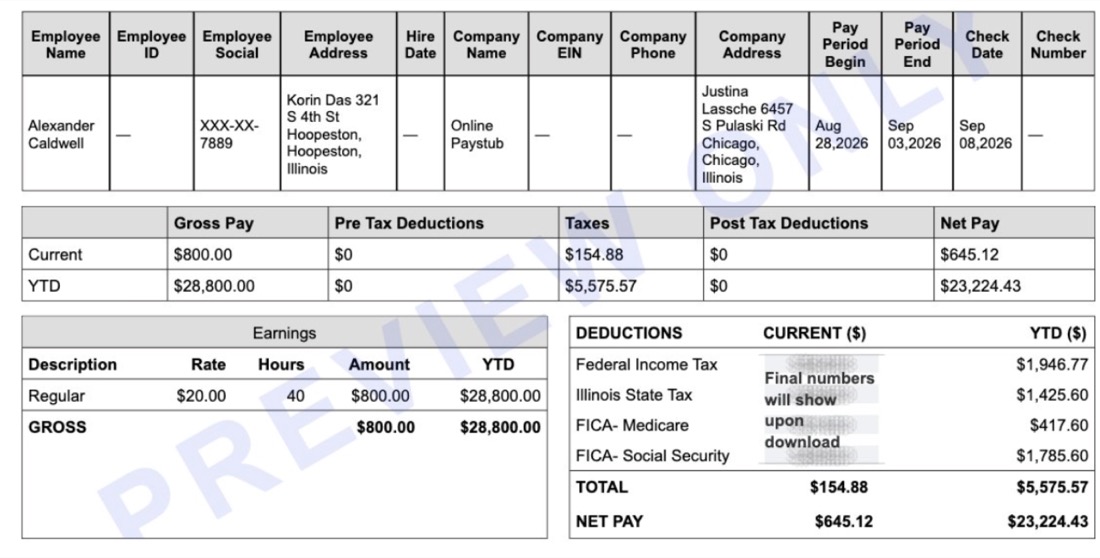
| Earnings | Hours | Rate | Current | YTD |
|---|---|---|---|---|
| Regular | 40.00 | $20.00 | $800.00 | $28,800.00 |
| Gross pay | 40.00 | $800.00 | $28,800.00 |
| Deductions | Current | YTD |
|---|---|---|
| Federal income tax | $54.08 | $1,946.77 |
| Social Security (6.2%) | $49.60 | $1,785.60 |
| Medicare (1.45%) | $11.60 | $417.60 |
| Illinois state tax (4.95%) | $39.60 | $1,425.60 |
| Total deductions | $154.88 | $5,575.57 |
| Net pay | $645.12 | $23,224.43 |
Federal withholding depends on the employee's W-4, so treat that line as illustrative. The Illinois line is straightforward: 4.95% of taxable wages after IL-W-4 allowances, with no bracket to look up and no local tax underneath it.
Note that both the earnings and deduction tables carry YTD columns. That is not formatting preference; it is item seven of the statute.
How to Read Your Illinois Pay Stub Fields
- Gross pay: everything earned before deductions
- Rate and hours: shown separately for regular and overtime, both required
- IL State Tax: the flat 4.95% line
- OASDI: the Social Security line, 6.2%
- Net pay: what reaches the bank account
- YTD: running calendar-year totals for wages and deductions
Why YTD Totals Are Explicitly Required in Illinois
Most states treat year-to-date columns as good practice. Illinois names them in the statute. A statement showing this period's figures with no cumulative totals is missing a required element, whatever else it gets right.
Practically, YTD is also what lets an employee reconcile against their W-2 in January and it flags when Social Security withholding stops after $184,500 in cumulative wages.
Illinois Minimum Wage in 2026: Three Different Rates
Illinois is a three-tier state. Which rate applies depends entirely on where the work is performed.
| Jurisdiction | Standard rate | Tipped cash wage | Effective |
|---|---|---|---|
| Illinois statewide | $15.00/hr | $9.00/hr | Since January 1, 2025 |
| Cook County (outside Chicago) | $15.40/hr | $9.25/hr | July 1, 2026 |
| Chicago | $17.05/hr | $12.96/hr | July 1, 2026 |
| Chicago city contracts and concessions | $18.50/hr | $12.96/hr | July 1, 2026 |
The Statewide Rate
Illinois reached $15.00 per hour under the schedule set in 2019, which raised the minimum from $8.25 in annual steps. That schedule is now complete and Illinois law contains no automatic inflation adjustment. Any further statewide increase requires new legislation.
Chicago Minimum Wage
Chicago's rate is $17.05 per hour from July 1, 2026, applying to employers with four or more workers. Employers with fewer than four follow the state rate.
Two coverage rules catch people out:
- An employee who works at least two hours in any two-week period within Chicago city limits is entitled to the Chicago rate for those hours. This applies to delivery drivers, field technicians and anyone whose work crosses the city line.
- All domestic workers in Chicago, including nannies, caregivers and house cleaners, are entitled to the Chicago minimum wage regardless of employer size.
The Chicago subsidized youth and transitional employment wage now matches the full minimum at $17.05, the first year it has done so.
Cook County Minimum Wage
Cook County outside Chicago is $15.40 per hour from July 1, 2026, with a tipped base of $9.25. The county's overtime rate works out to $23.10 for non-tipped and $16.94 for tipped employees.
The critical caveat: more than 80% of Cook County municipalities have opted out of the county ordinance. In an opted-out municipality, the state rate of $15.00 applies instead. Before applying the county rate, confirm the specific municipality's status. This is the single most common Cook County payroll error.
Cook County's formula also has a circuit breaker: the CPI-based increase is blocked entirely if county unemployment reaches 8.5% or higher.
Tipped Employees and the 60% Cash Wage
Statewide, tipped employees may be paid 60% of the minimum wage, or $9.00 per hour, with a maximum tip credit of $6.00. Tips must bring total compensation to at least the full minimum for every hour worked and the employer covers any shortfall.
Cash wage and reported tips belong on separate earnings lines so the tip credit math is visible on the statement.
The Chicago Tip Credit Phase-Out Was Halted in 2026
Chicago passed an ordinance in 2023 to eliminate the tip credit entirely by 2028, stepping the credit down each July. That phase-out ran through 2025, reducing the credit to 24% of the Chicago minimum wage.
In 2026 the City Council voted to halt it. Under the One Fair Wage Compromise Ordinance, the Chicago tipped wage is frozen at $12.96, with the next scheduled movement on July 1, 2028.
A great deal of published content still describes Chicago as being mid-phase-out on a fixed annual schedule. That is no longer the position. If you are budgeting Chicago hospitality labour costs for 2027, the tipped wage does not move.
Youth and Training Wages
Employees under 18 who work fewer than 650 hours in a calendar year may be paid $13.00 per hour statewide. Once they cross 650 hours, the full minimum applies. Employers may also pay 50 cents below the applicable rate during an employee's first 90 days.
Illinois Wage and Hour Rules
Overtime
Illinois follows the federal standard: 1.5x the regular rate after 40 hours in a workweek. There is no daily overtime requirement.
One Day Rest in Seven Act
ODRISA entitles most employees to at least 24 consecutive hours of rest in every consecutive seven-day period and to a 20-minute meal break for every 7.5 continuous hours worked, beginning no later than five hours into the shift. Additional 20-minute breaks are required for shifts extending significantly beyond 7.5 hours.
Illinois is stricter than most states here. Penalties are assessed per employee and they scale with employer size.
Paid Leave for All Workers Act
Since January 1, 2024, most Illinois employees accrue at least 40 hours of paid leave per 12-month period, usable for any reason, at one hour per 40 hours worked. Employees covered by the Chicago or Cook County ordinances follow those instead.
The available balance is one of the items that must be communicated alongside the paystub.
Chicago Paid Leave Ordinance
Chicago runs its own, more generous scheme, providing both paid leave and paid sick and safe leave with separate accrual and carryover rules. Employers with staff working in Chicago need to track these separately from the statewide entitlement.
Final Paycheck
Final compensation, including any severance owed, is due by the next regularly scheduled payday, whether the employee resigned or was terminated. Illinois does not impose an accelerated deadline.
Record Retention
Payroll records must be kept for three years, matching the paystub retention requirement. Daily time records for exempt employees fall under the same obligation.
Illinois Employer Payroll Checklist
New Hire Reporting Within 20 Days
Every new or rehired employee must be reported to the Illinois New Hire Directory within 20 days of their first day. Failure to report, or conspiring with an employee not to report, carries a penalty of $500 per report. Reporting can be done online, electronically, or by mail.
Two Separate Agency Registrations
Illinois splits payroll across two agencies, which surprises employers coming from states with a single tax department:
- Illinois Department of Revenue (IDOR) for income tax withholding
- Illinois Department of Employment Security (IDES) for unemployment insurance
Both are managed through the MyTax Illinois portal, which also supports EFT and ACH payments.
Form IL-941 and Form IL-501 Deposit Schedules
Form IL-941 is the quarterly withholding return. It must be filed by every registered employer even if no tax was withheld. Employers unable to file electronically request a waiver on Form IL-900-EW.
Form IL-501 is the withholding payment, on one of two schedules:
- Monthly: due by the 15th of the month following withholding. Assigned to employers reporting under $12,000 in the lookback period.
- Semi-weekly: amounts withheld Wednesday through Friday are due the following Wednesday; amounts withheld Saturday through Tuesday are due the following Friday. Assigned to employers reporting over $12,000.
If a due date falls on a weekend or legal holiday, it moves to the next business day.
Form UI-3/40
The Employer's Contribution and Wage Report, filed quarterly with IDES, due the last day of the month following each quarter end.
Illinois Secure Choice
Illinois employers above the applicable size threshold that do not offer a qualifying retirement plan must facilitate enrolment in Illinois Secure Choice, the state-run retirement savings program. Employer contributions are not required, but employee deferrals are withheld through payroll and appear as a deduction line. Registration thresholds and deadlines have been expanded over successive phases, so confirm your current obligation.
Annual Filings
W-2s are due to employees by January 31. Illinois does not require a separate fourth-quarter annual reconciliation return.
Pay Stubs for Every Type of Illinois Worker
Hourly and Non-Exempt Employees
The straightforward case, but note that overtime hours and overtime pay are two separate required items, not one.
Salaried and Exempt Employees
Hours worked is still required. This is the Illinois-specific trap. A salaried exempt employee's statement must show hours alongside rate, gross wages, deductions and YTD totals, exactly as an hourly employee's does.
Independent Contractors and 1099 Workers
Contractor statements show gross pay without withholding, FICA or state tax, since a contractor pays self-employment tax and files their own Illinois return. Our contractor mode removes those lines automatically. The flat 4.95% rate makes Illinois estimated tax calculations unusually simple: no bracket modelling required.
Tipped and Hospitality Workers in Chicago
Chicago's hospitality workforce needs cash wage and tips shown as separate earnings lines, with the tip credit visible. Given the frozen $12.96 tipped wage and the $17.05 standard rate, the credit is a material figure and should be documented clearly on every statement.
Cross-Border Workers
Illinois borders five states and the treatment splits cleanly:
- Iowa, Kentucky, Michigan, Wisconsin: reciprocity applies. File IL-W-5-NR and no Illinois tax is withheld from a resident of those states.
- Indiana and Missouri: no reciprocity. Illinois tax is withheld and the employee claims a credit on their home-state return.
For employers in the St. Louis metro east or along the Indiana line, this distinction drives the entire withholding setup.
Five Illinois Pay Stub Mistakes That Trigger Penalties
- No hours for salaried exempt employees. The most common Illinois-specific failure. There is no exemption from the hours field.
- Missing year-to-date totals. Item seven of the statute, not a formatting nicety.
- Overtime pay without overtime hours. They are separate required items and both must appear.
- No available leave balance. Must be on the statement or in a document issued alongside it.
- Not retaining copies. Three years from the date of payment, regardless of whether the employee has left and a documented separation offer if you deliver electronically only.
How Illinois Compares to Neighboring States
| State | Income tax | Local income tax | Minimum wage | Stub required |
|---|---|---|---|---|
| Illinois | 4.95% flat | None | $15.00/hr (higher in Chicago and Cook County) | Yes, 7 items |
| Indiana | Flat, low | Yes, county tax | $7.25/hr | Yes |
| Wisconsin | Graduated | None | $7.25/hr | Yes |
| Iowa | Flat (recently changed) | Limited school surtax | $7.25/hr | Yes |
| Missouri | Graduated | Kansas City and St. Louis | Indexed annually | No |
| Kentucky | Flat | Yes, local occupational tax | $7.25/hr | Yes |
Two things stand out. Illinois's minimum wage is more than double every neighbour except where local ordinances apply, which is a real cost differential for employers operating across state lines. And Illinois is one of the few states in the region with no local income tax at all, while Indiana and Kentucky both layer county or occupational taxes on top of the state rate.
Confirm current rates for any neighbouring state before relying on this table; several have changed rates recently.
Illinois Pay Stub Templates
Choose from professional layouts, each of which lays out the seven required items with YTD columns for both earnings and deductions. Every template keeps the hours field visible for salaried employees rather than hiding it, which is what Illinois requires. Preview any of them free before downloading.
- Modern: clean two-column layout, good for digital delivery
- Classic: traditional payroll format, prints cleanly
- Detailed: expanded YTD columns, best for overtime and multi-rate employees
- Compact: minimal layout for straightforward hourly statements
Why Choose Online Paystub for Illinois
- Hours worked kept on the statement for salaried exempt employees too, the requirement most templates quietly drop.
- Running YTD totals for both wages and deductions on every line, because Illinois names it directly in the statute.
- Overtime hours and overtime pay itemized as two separate figures, not combined into one.
- The 2026 SUI wage base and the July 2026 Chicago and Cook County minimum wage figures, current where several competing pages still cite older rates.
- No local tax line left blank or guessed at. Illinois has none, statewide.
- A contractor mode that shows gross pay only, with no withholding lines that wouldn't apply.
- Your information stays private. We never sell or share what you enter with anyone else.
Illinois Payroll Glossary
Form IL-W-4: Illinois's employee withholding allowance certificate, the state counterpart to the federal W-4. Form IL-W-5 / IL-W-5-NR: certificates of Illinois residence and nonresidence, used for reciprocity with Iowa, Kentucky, Michigan and Wisconsin. Form IL-941: the quarterly Illinois withholding income tax return. Form IL-501: the Illinois withholding tax payment, on a monthly or semi-weekly schedule. Form UI-3/40: the quarterly employer contribution and wage report filed with IDES. Gross wages: total earnings before any deduction. IDES: Illinois Department of Employment Security, which administers unemployment insurance. IDOR: Illinois Department of Revenue, which administers income tax withholding. IWPCA: the Illinois Wage Payment and Collection Act, the statute governing wage statements. MyTax Illinois: the state portal for registration, filing and payment. Net wages: take-home pay after all deductions. ODRISA: the One Day Rest in Seven Act, governing rest days and meal breaks. Secure Choice: the state-facilitated retirement savings program for employers without a qualifying plan. Tip credit: the amount an employer may count from tips toward the minimum wage. Up to $6.00 statewide. Wage base: the annual earnings ceiling to which a tax applies. $14,250 for Illinois SUI, $184,500 for Social Security. YTD: year-to-date and in Illinois a statutory element of a compliant statement.
Disclaimer
This page is general information, not legal, tax, or accounting advice. Rates and rules change and correct treatment depends on your circumstances. Verify current figures with the Illinois Department of Revenue, the Illinois Department of Employment Security, the Illinois Department of Labor and the IRS, or consult a qualified professional.
Always enter accurate information that reflects real earnings. Our tools are for legitimate payroll and income documentation.
Last verified: [date] Sources: Illinois Department of Revenue, Illinois Department of Employment Security, Illinois Department of Labor, Public Act 103-0953, City of Chicago, Cook County, IRS, SSA
Nearby State Pay Stub Resources
Create a pay stub for a nearby state or one of our most popular states.


Frequently Asked Questions About Illinois Pay Stubs
Does Illinois require employers to provide pay stubs?
Yes. Since January 1, 2025, the Illinois Wage Payment and Collection Act requires an itemized statement every pay period containing seven specific items, plus the available paid leave balance. Non-compliance carries a civil penalty of up to $500 per violation.
What must be included on an Illinois paystub?
Hours worked, rate of pay, overtime pay, overtime hours worked, gross wages earned, wage deductions and total wages and deductions year to date. The unused balance of available paid time off must also be provided, either on the statement or alongside it.
Do salaried exempt employees need hours on their pay stub?
Yes. Illinois has no exemption from the hours requirement based on employee classification. This differs from California and Maryland, where exempt employees can be omitted from the hours field and it is the most commonly missed Illinois requirement.
How long must Illinois employers keep pay stubs?
Three years from the date of payment, regardless of whether the employee's employment ends during that period.
Can I request copies of my old pay stubs in Illinois?
Yes. Current and former employees may request copies, which the employer must provide within 21 calendar days. An employer need not grant more than two requests in a 12-month period and a former employee's right expires one year after separation. You choose whether to receive them physically or electronically.
What is the Illinois income tax rate?
A flat 4.95% on individual income, in effect since July 2017. There are no brackets. The personal exemption for 2026 is $2,925, claimed on Form IL-W-4.
Does Illinois have a local income tax?
No. No Illinois city or county levies an income tax, Chicago included. A Chicago paystub and a downstate paystub carry the same state tax line.
What is the minimum wage in Illinois in 2026?
$15.00 per hour statewide. Chicago is $17.05 and Cook County outside Chicago is $15.40, both effective July 1, 2026. The applicable rate follows where the work is performed.
What is the Chicago minimum wage in 2026?
$17.05 per hour from July 1, 2026, for employers with four or more workers. The tipped cash wage is $12.96 and is frozen until July 1, 2028 after the City Council halted the tip credit phase-out.
What is the tipped minimum wage in Illinois?
$9.00 per hour statewide, 60% of the minimum wage, with a maximum tip credit of $6.00. Chicago is $12.96 and Cook County is $9.25. Tips must bring total pay to at least the full applicable minimum.
Can I create pay stubs for a 1099 contractor in Illinois?
Yes. Contractor mode shows gross pay without withholding, FICA or state tax. The flat 4.95% rate makes quarterly estimated tax calculations straightforward.
Are electronic pay stubs legal in Illinois?
Yes, but with conditions. If you deliver only electronically and former employees lose access within a year of separation, you must offer departing employees a record of the previous year's statements and document that offer and their response.