W-9 Form Generator
Create your W-9 form online with our easy-to-use W-9 Form Generator. Enter your taxpayer information, choose your federal tax classification and prepare a completed W-9 form for your client or business.
Whether you're a freelancer, independent contractor or business owner, you can complete your tax information in a few simple steps.

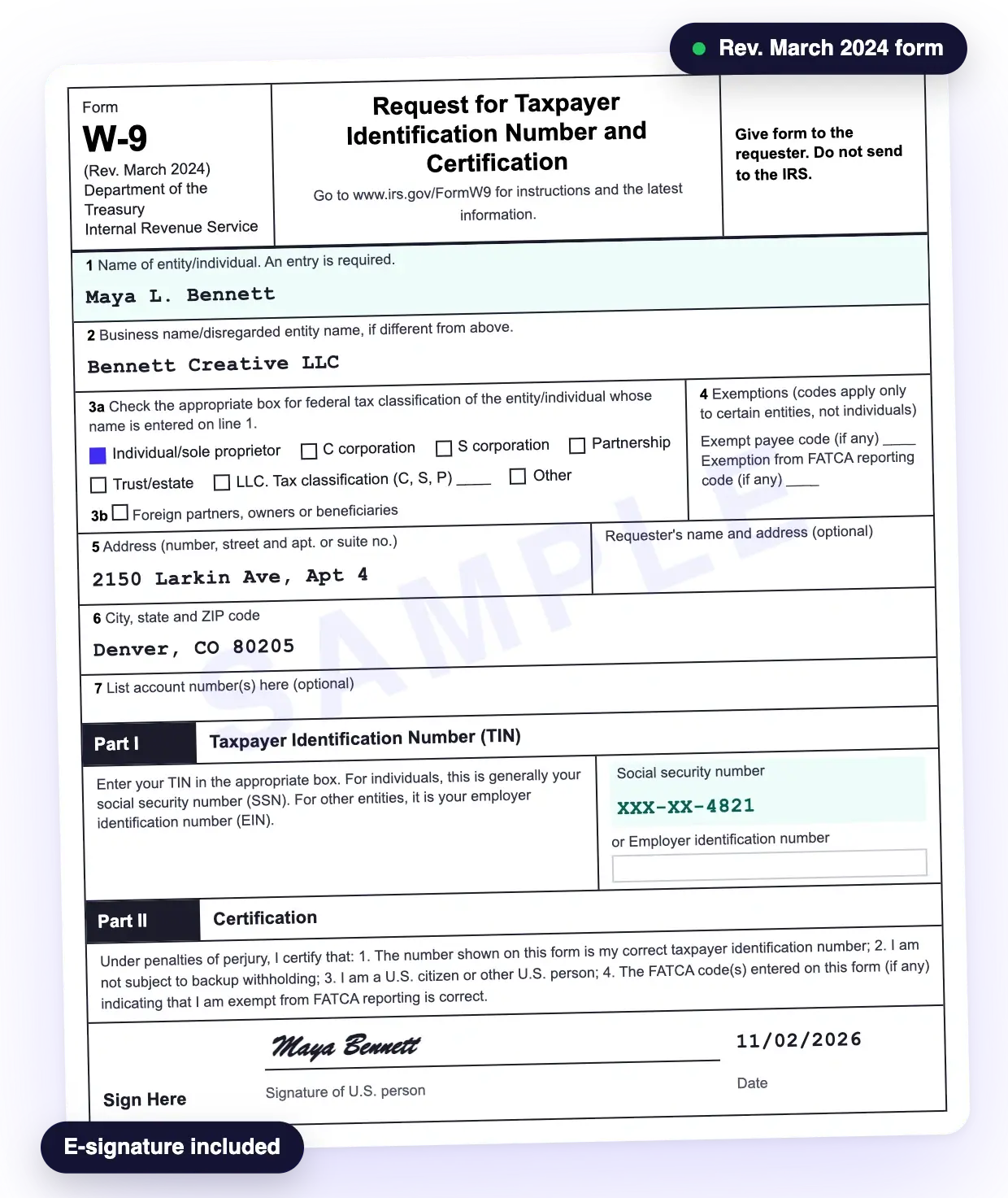
- Rev. March 2024 form
- E-signature included
- No subscription
- Secure checkout
- 30-day money-back guarantee
- 24/7 support


- Apple Pay
- G Pay
- VISA
- Mastercard
- AMEX
Money-back guarantee · Free preview · No subscription · Reviews on Trustpilot
What Our Customers Say
4.7 out of 5from 3,459 customer ratings
Feedback from people who created a W-9 with Online Paystub.
- 4.9
I was able to quickly create a W-9 form
Brynn L. - 4.8
I regularly use the W-9 form
Denny B. - 4.7
I’ve used the form a few times and I like it
Billy R. - 4.7
I’ve generated W-2, W-4 and W-9 forms. It’s very useful
Denny W. - 5.0
Thank you to the quick and helpful customer service representative
Reed M. - 5.0
The best online W-9 form generator
Willy A.
- What it doesGives a payer your name, tax classification, address and TIN.
- Who fills it inU.S. contractors, freelancers, vendors and businesses that receive reportable payments.
- Where it goesTo the person or business that asked for it. Never to the IRS.
- Current formRev. March 2024, the version the IRS still lists in 2026.
- Price$9.99 per form, signed PDF sent to your email.
How to Generate a W-9 Form Online
Our online W-9 generator helps you organize the information needed to prepare your form.
- 1
Step 1: Enter your personal or business information
Start with your legal name as it appears on your federal income tax return. If you operate under a separate business name or DBA (Doing Business As), include it in the business name field.
- 2
Step 2: Select your federal tax classification
Choose the classification that applies to you or your business: individual or sole proprietor, C corporation, S corporation, partnership, trust or estate and limited liability company (LLC).
- 3
Step 3: Provide your Taxpayer Identification Number
Enter the right TIN, such as your Social Security Number (SSN) or Employer Identification Number (EIN). The number must belong to the taxpayer named on line 1.
- 4
Step 4: Review and complete your W-9
Check your information, sign the certification when it applies and prepare your W-9 for the person or business that asked for it.
Completing IRS Form W-9 doesn't have to be complicated. The generator organizes the information the form asks for, so you only answer what applies to you.
What Is a W-9 Form?
Form W-9, officially titled "Request for Taxpayer Identification Number and Certification," is an IRS document used to collect taxpayer information from individuals and businesses.
The form gives the requester your legal name, federal tax classification, address and Taxpayer Identification Number (TIN). Businesses and financial institutions use this information to prepare tax documents and report certain payments to the Internal Revenue Service (IRS).
For example, a company that hires an independent contractor may request a completed W-9 before issuing payment. The company can then use the information to prepare Form 1099-NEC when required.
Unlike a tax return, Form W-9 is not sent to the IRS by the person completing it. It goes to the business or organization that requested it. You can view the official document in the IRS Form W-9 PDF.
Who Needs to Fill Out a W-9 Form?
Form W-9 is commonly requested from U.S. persons who receive payments that may need to be reported to the IRS.
Independent contractors and freelancers
Self-employed professionals such as writers, designers, consultants and developers may need to give Form W-9 to the clients paying them for their services.
Sole proprietors and LLC owners
Business owners may need to complete a W-9 when working with companies that require taxpayer information for payment reporting. What you enter depends on the business's federal tax classification.
Vendors and service providers
Businesses may request Form W-9 from vendors, suppliers and professional service providers before making reportable payments.
Other people receiving reportable payments
Banks, financial institutions and other organizations may request Form W-9 for certain transactions involving interest, dividends, real estate and other reportable payments.
Form W-9 is meant for U.S. persons, including U.S. citizens, resident aliens for federal tax purposes and qualifying domestic entities. Foreign persons generally need the right Form W-8 or another applicable document instead.
How to Fill Out IRS Form W-9
The official IRS Form W-9 has several sections. Knowing what each field asks for helps you avoid mistakes when preparing your form.
Line 1: Name of entity or individual
Enter your name exactly as it appears on your federal income tax return. If you're a sole proprietor, use your personal legal name rather than only your business name.
For a single-member LLC treated as a disregarded entity, enter the owner's name on line 1. Other business entities generally enter the name shown on their federal tax return.
Line 2: Business name or disregarded entity name
Enter your business name, trade name or DBA if it differs from the name on line 1. If you run a freelance design business under a trade name, your legal name goes on line 1 and the business name on line 2. Without a separate business name, you can generally leave this field blank.
Line 3a: Federal tax classification
Select the federal tax classification of the person or entity named on line 1. The official W-9 lists seven boxes:
- Individual or sole proprietor
- C corporation
- S corporation
- Partnership
- Trust or estate
- Limited liability company (LLC)
- Other
An LLC generally checks the LLC box and enters C, S or P to show its tax classification, unless it is a disregarded entity. A disregarded entity selects the classification of its owner instead. A single-member LLC owned by an individual and disregarded for federal tax purposes generally checks Individual/sole proprietor.
Line 3b: Foreign partners, owners or beneficiaries
This box applies to partnerships, trusts, estates and LLCs taxed as partnerships. If you give Form W-9 to a partnership, trust or estate in which you have an ownership interest, check it when your entity has foreign partners, owners or beneficiaries. It does not apply to most individual freelancers and sole proprietors.
Line 4: Exemptions
Certain entities may be exempt from backup withholding or from reporting under the Foreign Account Tax Compliance Act (FATCA). If an exemption applies, enter the code given in the IRS instructions. Most individuals and sole proprietors leave line 4 blank. If you're unsure whether your business qualifies, check the official W-9 instructions.
Lines 5 and 6: Mailing address
Line 5 takes your street address with any apartment or suite number. Line 6 takes your city, state and ZIP code. The requester may mail information returns to this address, so keep it accurate and current.
Line 7: Account numbers
This optional line lets you list account numbers tied to the request, such as an account number a financial institution asks you to include. If the requester doesn't need it, you can leave it blank. The form also has a separate optional box for the requester's name and address.
Part I: Taxpayer Identification Number (TIN)
Part I takes the right taxpayer identification number for your situation:
- Social Security Number (SSN)
- Employer Identification Number (EIN)
- Individual Taxpayer Identification Number (ITIN), entered in the SSN box when it applies
Sole proprietors may generally give either their SSN or their EIN if they have one. For a single-member LLC treated as a disregarded entity, use the owner's SSN or EIN rather than an EIN assigned to the LLC. The name and TIN must match IRS records to avoid reporting issues and possible backup withholding.
Part II: Certification and signature
The certification confirms that your TIN is correct, that you are a U.S. person and where you stand on backup withholding and FATCA reporting. Read the statements before you sign and date the form.
Whether a signature is required depends on the type of payment or transaction. Follow the instructions that come with the official IRS Form W-9.
W-9 Form for Independent Contractors and Freelancers
If you work as an independent contractor, your client may ask for Form W-9 before making your first payment.
Say you're a freelance graphic designer working with a marketing agency. Before processing your invoices, the agency asks for a W-9 with your name, address, federal tax classification and TIN. It keeps the form and uses the details to prepare the tax reporting documents that apply.
For payments made in 2026, the general Form 1099-NEC reporting threshold for nonemployee service payments rose from $600 to $2,000. A business can still request a W-9 before any payment, whether or not the threshold is reached in the end.
Completing a W-9 does not mean federal income tax will be withheld from your payments. Independent contractors generally handle their own tax payments unless special withholding rules apply.
How to Fill Out a W-9 for an LLC
The right way to complete Form W-9 for an LLC depends on how the business is classified for federal income tax purposes.
| LLC type | Name on line 1 | Tax classification (line 3a) |
|---|---|---|
| Single-member LLC, disregarded | Owner's tax name | Owner's classification |
| Multi-member LLC taxed as a partnership | LLC's legal tax name | LLC, code P |
| LLC taxed as a C corporation | LLC's legal tax name | LLC, code C |
| LLC taxed as an S corporation | LLC's legal tax name | LLC, code S |
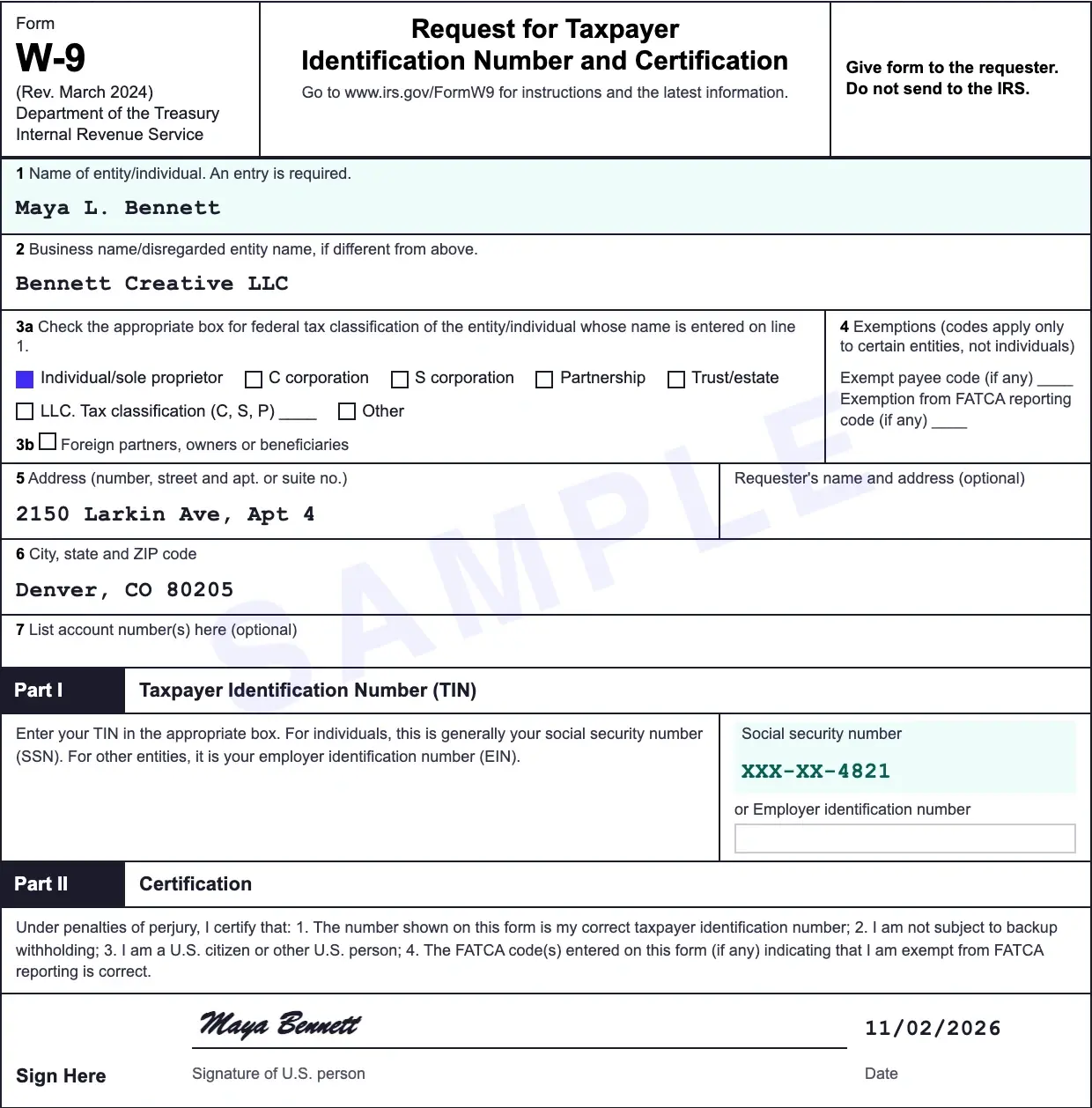
A single-member LLC owned by an individual and disregarded for federal tax purposes generally puts the individual's name on line 1, the LLC's name on line 2 and the owner's SSN or EIN in Part I. The sample W-9 on this page is filled in that way.
If the LLC has elected corporate tax treatment, different rules apply. Because LLC classifications vary, review your federal tax election and the official IRS instructions before completing the form.
W-9 vs. W-4 vs. 1099: What's the Difference?
These forms all relate to U.S. taxes, yet each one has a different job.
| Tax form | Purpose | Common user |
|---|---|---|
| Form W-9 | Collects taxpayer identification information | Freelancers, contractors and businesses |
| Form W-4 | Helps employers calculate federal income tax withholding | Employees |
| Form 1099-NEC | Reports qualifying nonemployee compensation | Businesses making reportable payments |
Form W-9 is completed by the person or business receiving payments and handed to the requester. Employees fill out a W-4 form so their employer knows how much federal income tax to withhold. Payers prepare Form 1099-NEC to report certain payments to people and businesses that are not their employees, while other payments such as rents and royalties go on Form 1099-MISC.
The W-9 gives the payer the information needed to complete a 1099. The two forms are not interchangeable.
What Is Backup Withholding on Form W-9?
Backup withholding is federal tax withholding that can apply to certain reportable payments. When it applies, the rate is 24%.
Backup withholding may apply if you:
- Fail to provide a required taxpayer identification number.
- Provide a TIN that the IRS identifies as incorrect.
- Fail to make a required certification.
- Receive an IRS notice about underreported interest or dividend income.
A correctly completed W-9 helps the payer decide whether backup withholding is needed. If the IRS has told you that backup withholding applies to you, follow the certification instructions carefully instead of certifying that you are not subject to it.
Common W-9 Form Mistakes to Avoid
Form W-9 is fairly simple. Even so, wrong details can cause problems when businesses prepare their tax documents.
- Using a business name instead of your tax name: a sole proprietor or disregarded entity may need the owner's tax name on line 1 rather than only the business name.
- Selecting the wrong LLC classification: not every LLC should check the LLC box. The right choice depends on its federal tax treatment.
- Entering the wrong TIN: your SSN, EIN or ITIN must belong to the taxpayer named on the form.
- Leaving out required information: a missing name, the wrong classification or an incomplete certification can lead the requester to ask for a corrected form.
- Sending your W-9 to an unverified recipient: the form holds sensitive taxpayer information. Confirm who is asking for it and share it through a secure method.
Frequently Asked Questions About W-9 Forms
Can’t find an answer? See all FAQs or contact support.
Can I fill out a W-9 form online?
Yes. You can complete Form W-9 electronically with an online form generator such as Online Paystub. Make sure the finished document has all the required information and meets the IRS certification and electronic signature rules that apply to you.
Is Form W-9 free?
Yes. The official IRS Form W-9 is free to download from the IRS website. Online generators charge for preparing the document. Online Paystub shows its price, $9.99 per form, before you complete your order.
Do I need a W-9 if I'm self-employed?
You may need one when a business asks for your taxpayer information for reportable payments. This commonly applies to freelancers, independent contractors and sole proprietors.
What is the W-9 reporting threshold for 2026?
Form W-9 has no minimum payment amount for requesting taxpayer information. The general Form 1099-NEC reporting threshold for qualifying payments made in 2026 is $2,000. Other reporting rules and exceptions may apply.
Do I send Form W-9 to the IRS?
No. You give your completed W-9 to the person or business that requested it. The requester keeps it for its tax reporting.
Can I use an EIN instead of an SSN on Form W-9?
In some cases, yes. Sole proprietors who have an EIN may generally use either their SSN or their EIN. Other entities must give the number that matches their federal tax classification.
Does a W-9 need to be signed?
Not in every situation. IRS signature rules depend on the payment type and circumstances. Some requesters still ask for a signed certification, so review the official instructions before you send your form.
Can I fill out a W-9 without an EIN?
Yes, depending on your tax status. Individuals and sole proprietors may generally use an SSN. Certain resident aliens use an ITIN. Businesses that need an EIN should follow IRS guidance if they have not received one yet.
What happens if I don't submit a W-9?
If you don't provide the required taxpayer information, the payer may have to apply backup withholding to certain payments. The backup withholding rate is 24%.
Do I need to complete a new W-9 every year?
Not necessarily. You generally don't need a new W-9 each year if your information is still accurate. Provide an updated form when your name or TIN changes or when a requester asks for updated documentation.
Can non-U.S. citizens complete Form W-9?
Some can. U.S. resident aliens for federal tax purposes may use Form W-9. Nonresident aliens and foreign entities generally use the right Form W-8 or another applicable document instead.
Create Your W-9 Form Online
Preparing your W-9 starts with the right taxpayer information. Whether you're working with a new client, registering as a vendor or updating your business records, the W-9 Form Generator helps you organize the details your form needs. Review your information, follow the IRS instructions and prepare your W-9 for the person or business requesting it.