Wisconsin Paystub Generator
Wisconsin withholding is not a flat percentage. Employers apply a formula with a sliding deduction and four rates, set out in Department of Revenue Publication W-166, to every paycheck. This Wisconsin paystub generator runs that formula, adds federal tax and FICA and gives a Milwaukee manufacturer, a Madison clinic or a Door County resort a statement with totals that agree.
Hi! I will fill in your paystub through a short conversation. Three quick questions, then the preview opens.
What is the company's legal name?



- Apple Pay
- G Pay
- VISA
- Mastercard
- AMEX
Money-back guarantee · Free preview · No subscription
 Create Your Wisconsin Paystub
Free preview · W-166 withholding formula · Instant PDF
The Sliding Deduction, Handled
The Wisconsin formula annualizes the wages, subtracts a deduction that shrinks as income rises, applies four rates and divides the answer by the number of pay periods. One slip in the middle changes every figure after it.
Online Paystub does the calculation in the background, shows the Wisconsin line next to federal income tax, Social Security and Medicare and updates the year-to-date column. You can review the full statement at no cost before downloading.
Key points
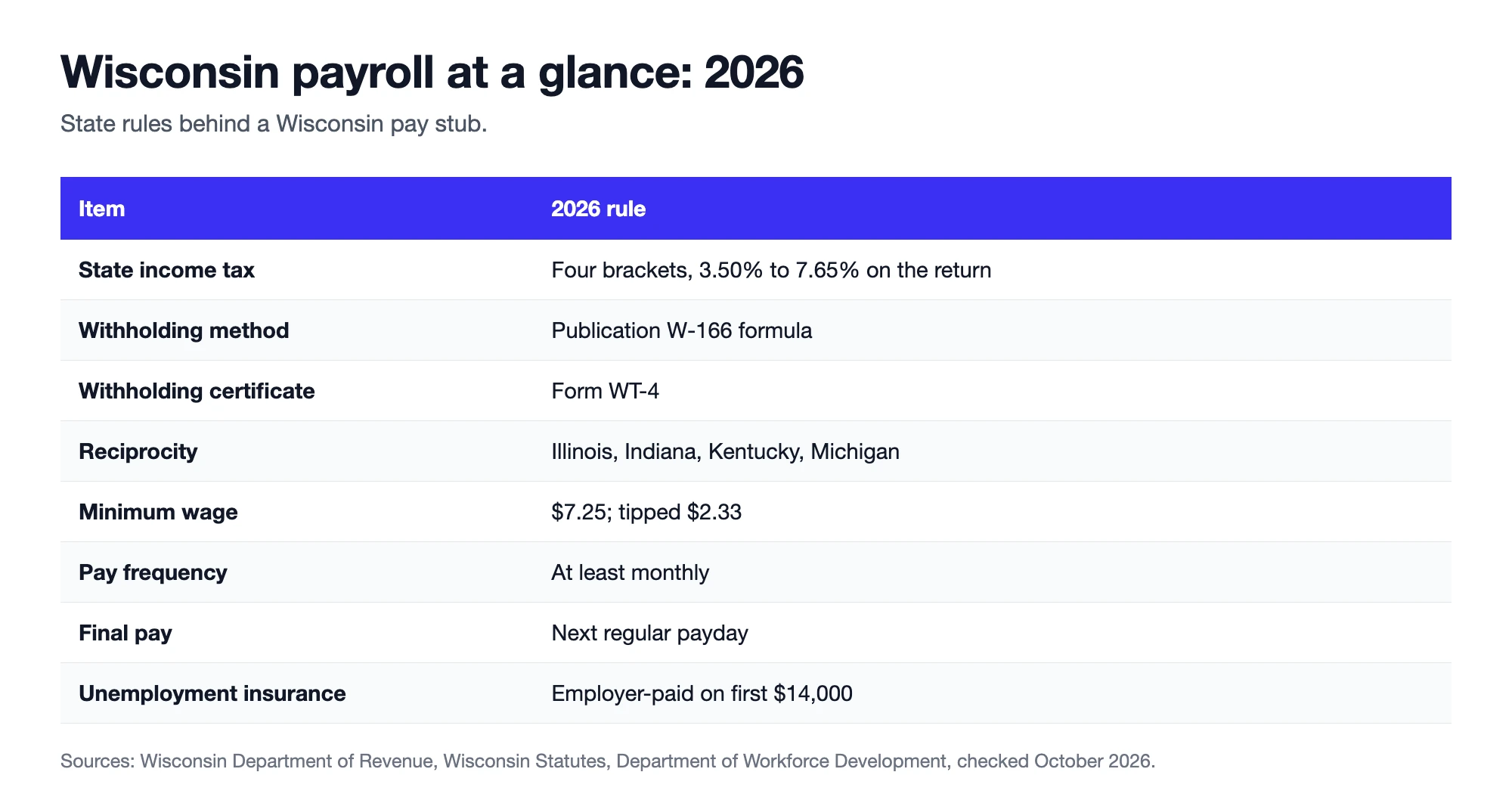
A 2026 Wisconsin pay stub shows federal income tax, Social Security, Medicare and Wisconsin withholding calculated with the Publication W-166 formula at rates from 3.54% to 7.65%. Employees claim exemptions on Form WT-4. Wisconsin has no state disability or paid leave deduction. Residents of four neighboring states can be exempt.
- 4 ratesin the withholding formula
- $400deduction per WT-4 exemption
- $7.25minimum wage
- 31 dayslongest gap between paydays
How Wisconsin Withholding Is Calculated
Publication W-166 gives employers a formula in place of a bracket table. It works on annual figures, so the first step is to multiply the paycheck by the number of pay periods in the year.
- Annualize the gross wages.
- Subtract the standard deduction. For a single employee it is $6,702, reduced by 12% of annual wages above $17,780, reaching zero at $73,630.
- Subtract $400 for each exemption claimed on Form WT-4.
- Apply the rates of 3.54%, 4.65%, 5.30% and 7.65% to the result.
- Divide the annual tax by the number of pay periods.
Single, biweekly, $2,240 gross, no exemptions
The complete method and the alternate tables are in Wisconsin Publication W-166.
Why Withholding Runs Slightly Ahead of the Tax
The withholding formula has been in effect since 2022. The income tax itself has changed since then: for 2026 a single filer pays 3.50% on the first $15,110 of taxable income, 4.40% up to $51,950, 5.30% up to $332,720 and 7.65% above that.
On the paycheck
- Rates of 3.54%, 4.65%, 5.30% and 7.65%
- Formula effective since 2022
- Sliding standard deduction
On the 2026 return
- Rates of 3.50%, 4.40%, 5.30% and 7.65%
- Brackets indexed for 2026
- Wider second bracket
Because the paycheck rates are a little higher, most employees have slightly more withheld than they owe and the difference returns as a refund. A stub that follows W-166 is correct even though its rates do not match the return.
Lakeshore Dairy Equipment: A Milwaukee Example
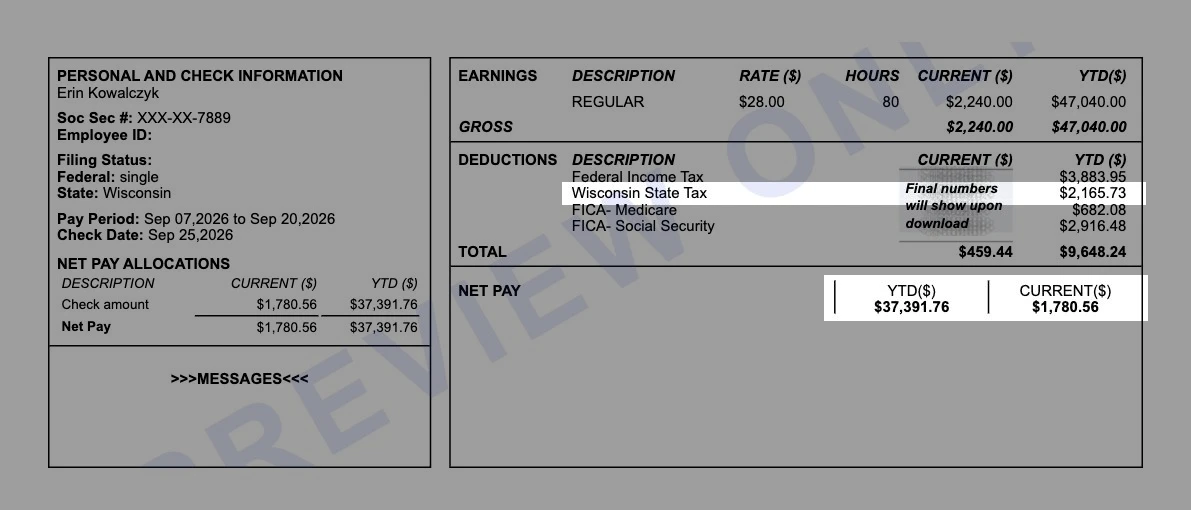
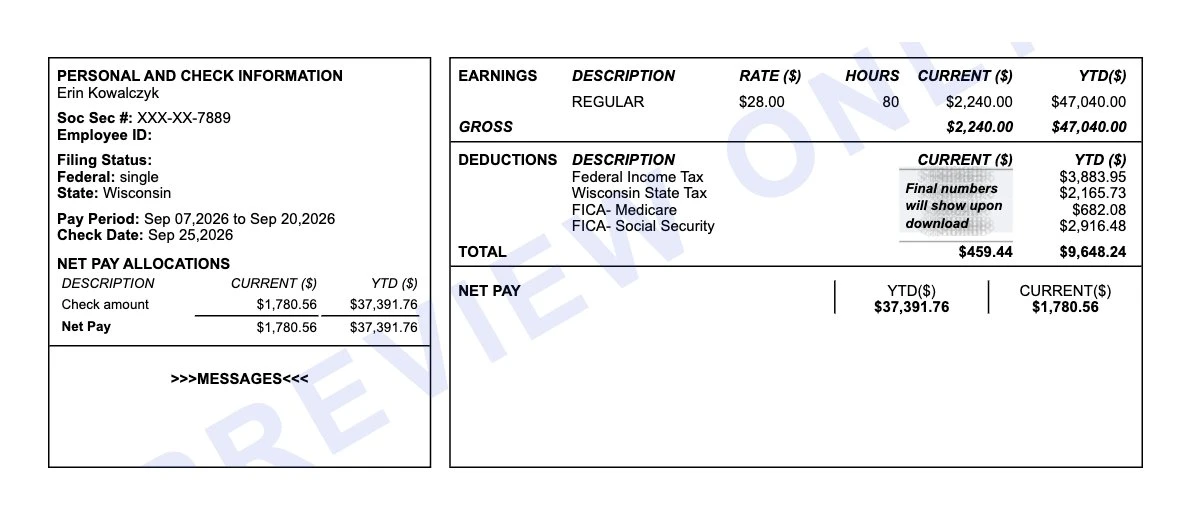
Scenario: Erin Kowalczyk works for Lakeshore Dairy Equipment Inc. at 735 N Water St in Milwaukee. She earns $28.00 an hour, works 80 hours from September 7 to September 20, 2026 and is paid September 25. She files single with no WT-4 exemptions and this is her 21st paycheck of the year.
| Line | Current | Year to date |
|---|---|---|
| Gross pay | $2,240.00 | $47,040.00 |
| Federal income tax | $184.95 | $3,883.95 |
| Wisconsin state tax | $103.13 | $2,165.73 |
| Medicare | $32.48 | $682.08 |
| Social Security | $138.88 | $2,916.48 |
| Total deductions | $459.44 | $9,648.24 |
| Net pay | $1,780.56 | $37,391.76 |
With one exemption on her WT-4 the state line would be about $102.31. Each figure in the right-hand column is 21 times the current amount; see what year to date means on a pay stub for how that column is used.
Form WT-4 and Border-State Commuters
New employees complete Form WT-4, the Wisconsin withholding exemption certificate, alongside the federal W-4. It records the number of exemptions and any additional amount the employee wants withheld.
- Reciprocity states
- Illinois, Indiana, Kentucky, Michigan
- Form the employee files
- W-220
- Income tax is paid to
- The home state
- Minnesota
- No agreement in force
Wisconsin has reciprocity agreements with those four states. A resident of one of them who works in Wisconsin files Form W-220 with the employer and pays income tax to the home state instead. Minnesota is not on the list: the agreement with Minnesota ended years ago, so a Hudson or Superior employer withholds Wisconsin tax from Minnesota commuters.
What a Wisconsin Pay Statement Must Show
Wisconsin law requires employers to tell each employee, with every wage payment, how the pay was worked out.
Required with each payment
- The number of hours worked
- The rate of pay
- The amount of each deduction
- The reason for each deduction
The statement may be delivered electronically. A wisconsin pay stub that adds pay period dates, gross and net pay and year-to-date totals gives the employee everything a lender or agency later asks for.
Paydays and the Last Check
Under Wisconsin Statute 109.03 most employees must be paid at least monthly, with no more than 31 days between the end of a pay period and the payday for it. Weekly, biweekly and semimonthly schedules all satisfy the rule.
An employee who quits or is discharged is paid in full by the next regular payday on which the wages would have been paid. The final stub's year-to-date totals should agree with the W-2 issued in January; our guide explains what a W-2 form is box by box.
Minimum Wage and Tipped Employees
Wisconsin's minimum wage is $7.25 an hour, the same as the federal rate. Tipped employees may be paid a cash wage of $2.33 an hour when tips bring the total to at least $7.25. Overtime is time and a half after 40 hours in a workweek.
Not a Paycheck Deduction in Wisconsin
On the stub
- Federal income tax, Social Security and Medicare
- Wisconsin income tax withholding
- Benefits the employee authorized
Not on the stub
- Unemployment insurance taxes
- Workers' compensation premiums
- A state disability or paid leave premium, because Wisconsin has none
Unemployment insurance is paid by employers on the first $14,000 of each worker's wages. New employers generally start at 3.05% or 3.25% depending on payroll size, with separate rates for construction.
Farms, Factories and Freelancers
Dairy farms, cheese plants, paper mills and machine shops employ hourly workers whose overtime and shift pay change from period to period. An itemized stub is how those changes are explained.
Independent contractors are paid without withholding. Rents, prizes and some other non-wage payments are reported on a different form; this article covers what Form 1099-MISC is. A self-employed person who prepares a stub as an income record should make sure it matches actual transfers and tax filings.
Make Yours in Three Steps
- 1
Company and employee
Enter the business name, a Wisconsin address, the employee's name and the last four digits of the SSN.
- 2
Pay details
Choose hourly or salary, the pay frequency, the rate, the hours and the dates.
- 3
Preview and download
Check the Wisconsin and federal lines in the free preview. Pay $6.99 and download the PDF.
The wisconsin paystub generator shares its form with the paystub maker on our home page. Each Wisconsin paystub carries the totals forward, so a wisconsin pay stub from February lines up with one from November.
For Genuine Payroll Only
A wisconsin check stub, a payroll stub and a paycheck stub all describe the same thing: a record of wages that were really paid. Preparing one with invented income or a fictitious employer to qualify for a loan or a lease is fraud. Use the wisconsin paystub generator for real payroll and keep each wisconsin paystub consistent with bank deposits and the W-2. A Wisconsin pay stub prepared that way holds up to verification.
See How a Stub Is Made
This step-by-step tutorial covers employer and employee details, earnings and Wisconsin income tax withholding, then the PDF download. Choose Wisconsin as the work state and state withholding is filled in.
Wisconsin Paystub Questions
How is Wisconsin withholding calculated?
With the formula in Publication W-166. Wages are annualized, a sliding standard deduction and $400 per exemption are subtracted, rates of 3.54% to 7.65% are applied and the result is divided by the number of pay periods.
What are the Wisconsin income tax rates for 2026?
On the return a single filer pays 3.50% up to $15,110 of taxable income, 4.40% up to $51,950, 5.30% up to $332,720 and 7.65% above that.
What is Form WT-4?
The Wisconsin employee's withholding exemption certificate. New hires complete it to claim exemptions or request additional withholding.
Which states have reciprocity with Wisconsin?
Illinois, Indiana, Kentucky and Michigan. Residents of those states who work in Wisconsin file Form W-220 and are not subject to Wisconsin withholding.
Are Wisconsin employers required to provide pay stubs?
Yes. With each wage payment the employer must state the hours worked, the rate of pay and the amount and reason for each deduction.
When is a final paycheck due in Wisconsin?
By the next regular payday, whether the employee quit or was discharged.
What is the minimum wage in Wisconsin?
$7.25 an hour. Tipped employees may be paid a $2.33 cash wage when tips make up the difference.
How much does it cost to create a stub?
$6.99 per stub with a free preview and no subscription.
Wisconsin Paychecks and the Reciprocity States
Wisconsin has reciprocity with Illinois, Indiana, Kentucky and Michigan, filed on Form W-220. Minnesota is not on the list, which matters in Hudson and Superior.
- Hudson and Superior residents who work in the Twin Cities or Duluth pay Minnesota tax and Paid Leave premiums because there is no reciprocity. Use the Minnesota paystub generator for those jobs.
- Kenosha and Beloit residents commuting to Illinois claim reciprocity and keep Wisconsin withholding, while Illinois residents in Wisconsin jobs need the Illinois paystub generator.
- Marinette and Menominee share workers across the river. Michigan residents in Wisconsin jobs are covered by reciprocity; see the Michigan paystub generator.

Payroll rules on this page checked against Wisconsin Department of Revenue Publication W-166, Wisconsin Statutes Chapters 103 and 109 and the Department of Workforce Development by Olivia Bennett, Payroll Specialist. Last reviewed .