
Form W-2, officially titled the Wage and Tax Statement, is the single most important tax document most American workers receive each year. It is the form your employer uses to report how much you earned and how much was withheld from your paychecks for federal income tax, Social Security, Medicare and state and local taxes. Without it, you cannot accurately file a federal income tax return and the numbers on it are matched against what you report.
If you have ever compared your W-2 to the year-to-date totals on your last pay stub and found that the numbers do not match, you are not alone. That mismatch is normal, expected and almost always explainable. This guide walks through what the W-2 is, who gets one, what every box reports, why the wage figures differ from your gross pay and what to do when a W-2 is late, wrong or never shows up.
The guide is written for employees who receive a W-2, but it also covers the employer side: the deadlines, the copies and the filing obligations that small businesses have to meet every January.
What Form W-2 Is and Who Receives One
A W-2 is an information return. Your employer prepares one for every person who worked as an employee during the calendar year and reports two things at once: your compensation and the taxes already withheld and remitted on your behalf. Copies go to you, to the Social Security Administration and usually to your state tax agency.
In general, an employer must issue a W-2 to any employee from whose pay income tax, Social Security tax or Medicare tax was withheld and, for wages paid after 2025, to any employee who was paid $2,000 or more during the year even if nothing was withheld. The threshold was $600 before the 2025 tax law change. Because Social Security and Medicare are withheld from essentially the first dollar of employee wages, in practice nearly every employee gets one, including part-time and seasonal workers.
You do not receive a W-2 for independent contractor work, for most self-employment income or for investment income. Those are reported on other forms.
Employer Deadlines and Filing Obligations
Employers must furnish Copy B, Copy C and Copy 2 to each employee by January 31 following the tax year or the next business day when January 31 falls on a weekend. For 2026 wages the deadline is February 1, 2027, according to the IRS instructions for Forms W-2 and W-3. The same date applies to filing Copy A with the Social Security Administration along with Form W-3, the transmittal summary. W-2s go to the SSA, not directly to the IRS. The SSA posts the earnings to your Social Security record and shares the data with the IRS.
Employers who file ten or more information returns of all types combined in a year are required to file electronically. Late or incorrect filings carry per-form penalties that increase the longer the delay runs, so most payroll providers file well ahead of the deadline.
The Different Copies
- Copy A goes to the Social Security Administration with Form W-3.
- Copy 1 goes to the state, city or local tax department where required.
- Copy B is the one you attach to your federal income tax return if you file on paper.
- Copy C is yours to keep for your personal records.
- Copy 2 is filed with your state or local income tax return.
- Copy D is retained by the employer.
What's New on the 2026 W-2
- Higher reporting threshold: an employer only has to issue a W-2 to an employee with no tax withheld once wages reach $2,000, up from $600.
- Box 12, code TP: total cash tips reported to the employer, used for the new qualified tip deduction.
- Box 12, code TT: total qualified overtime compensation, used for the new overtime deduction.
- Box 12, code TA: employer contributions to a Trump account for an employee or an employee's dependent.
- Box 14b: the Treasury tipped occupation code for workers in tipped jobs. Box 14 is now split into 14a (other) and 14b.
The tip and overtime amounts do not reduce Box 1 on their own. You use them on Schedule 1-A of your Form 1040 to claim the deductions.
A Box by Box Walkthrough of Form W-2
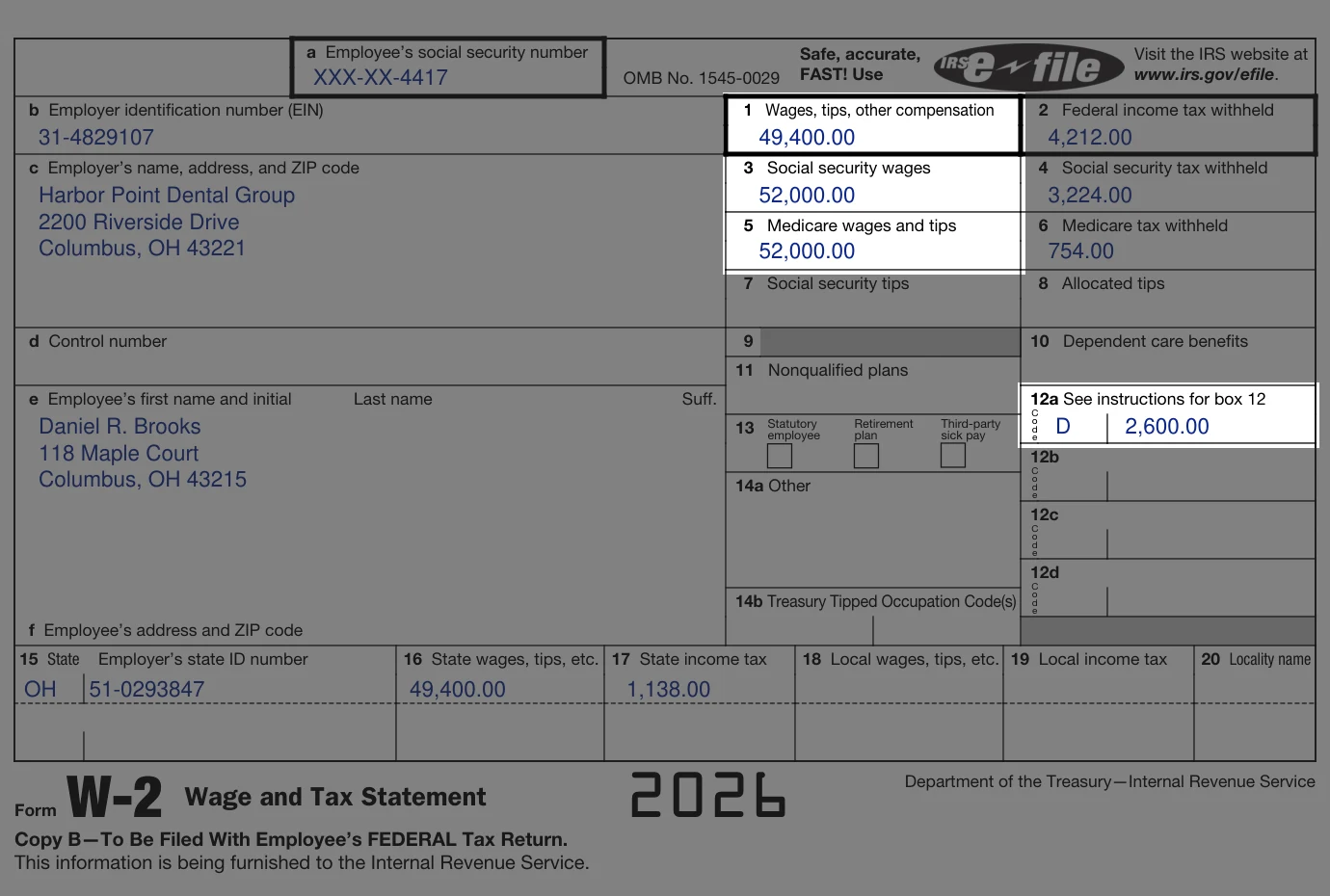
The lettered boxes at the top identify the parties: box a is your Social Security number, box b is the employer identification number, box c is the employer name and address, box d is an optional control number used by the payroll system and boxes e and f carry your name and address. Check box a carefully, because a wrong Social Security number is one of the most common reasons a return gets rejected. The numbered boxes carry the money.
| Box | What It Reports |
|---|---|
| 1 | Wages, tips and other compensation subject to federal income tax. This is your federal taxable wage figure, after pre-tax deductions. |
| 2 | Federal income tax withheld from your pay during the year. |
| 3 | Social Security wages, capped each year at the Social Security wage base. |
| 4 | Social Security tax withheld, calculated at 6.2 percent of Box 3. |
| 5 | Medicare wages and tips. There is no cap on this figure. |
| 6 | Medicare tax withheld at 1.45 percent, plus any Additional Medicare Tax withheld on high earnings. |
| 7 | Tips you reported to your employer that are subject to Social Security tax. |
| 8 | Allocated tips assigned to you by certain food and beverage employers. These are not included in Box 1. |
| 9 | Currently unused. It is a reserved box left over from a discontinued credit. |
| 10 | Dependent care benefits provided under a dependent care assistance program. |
| 11 | Distributions to you from a nonqualified deferred compensation plan or nongovernmental 457(b) plan. |
| 12 | Coded items such as retirement plan deferrals, HSA contributions and the cost of employer health coverage. Up to four entries appear as 12a through 12d. |
| 13 | Three checkboxes: statutory employee, retirement plan participant and third-party sick pay. |
| 14a | Other. A free-form box for items like union dues, after-tax insurance, state disability contributions or educational assistance. |
| 14b | Treasury tipped occupation code(s) for employees in tipped occupations. New for 2026. |
| 15 | The state abbreviation and your employer state ID number. |
| 16 | State wages, tips and other compensation. |
| 17 | State income tax withheld. |
| 18 | Local wages, tips and other compensation. |
| 19 | Local income tax withheld. |
| 20 | The name of the locality tied to Boxes 18 and 19. |
Why Box 1 Is Lower Than Your Year-to-Date Gross Pay
This is the question that generates the most confusion every February. Your final pay stub of the year shows a year-to-date gross figure, which is everything you earned before any deduction. Box 1 is not gross pay. It is taxable wages, which means the pre-tax items that were subtracted from your paychecks are also subtracted from Box 1.
The most common items that reduce Box 1 are traditional 401(k) or 403(b) elective deferrals, employee premiums for employer-sponsored health, dental and vision coverage paid through a Section 125 cafeteria plan, health savings account contributions made by payroll deduction, flexible spending account contributions for health care or dependent care and qualified transit or parking benefits.
Boxes 3 and 5 are calculated on a different base. Traditional retirement deferrals reduce Box 1 but do not reduce Social Security and Medicare wages, which is why Boxes 3 and 5 are often higher than Box 1 for anyone contributing to a 401(k). Cafeteria plan premiums and HSA payroll contributions, by contrast, generally reduce all three.
One more structural difference matters. Box 3 stops at the Social Security wage base, which the SSA adjusts annually, so a high earner will see Box 3 frozen at that ceiling while Box 5 keeps climbing. Box 5 has no cap at all and once your Medicare wages pass the Additional Medicare Tax threshold your employer must withhold an extra 0.9 percent on the excess, which shows up inside Box 6.
How to Reconcile Your Last Pay Stub Against Your W-2
You can usually prove your W-2 is correct in about ten minutes with your final stub of the year in hand. Work through it in this order.
- Start with the year-to-date gross wages on your last pay stub.
- Subtract year-to-date traditional 401(k) or 403(b) deferrals, pre-tax insurance premiums, HSA and FSA contributions and pre-tax commuter deductions.
- Add any taxable fringe benefits such as group-term life insurance over $50,000, personal use of a company vehicle or taxable gift cards and bonuses if they are not already in gross.
- The result should equal Box 1.
- Repeat with the retirement deferrals added back to test Boxes 3 and 5, remembering that Box 3 stops at the wage base.
- Match the year-to-date federal, Social Security, Medicare, state and local withholding lines to Boxes 2, 4, 6, 17 and 19.
Keeping clean, itemized stubs all year makes this check quick. If your figures line up, the W-2 is right. If they are off by an amount that matches a single deduction line, you have found the item to ask payroll about.
Box 12 Codes You Are Most Likely to See
Box 12 is where the detail lives. Each entry has a letter code and a dollar amount and up to four fit on one form. Some of these codes affect your tax return directly, while others are purely informational.
| Code | Meaning |
|---|---|
| C | Taxable cost of group-term life insurance coverage over $50,000. Already included in Boxes 1, 3 and 5. |
| D | Elective deferrals to a traditional 401(k) plan, including any SIMPLE 401(k) arrangement. |
| DD | Total cost of employer-sponsored health coverage. Informational only and not taxable. |
| E | Elective deferrals under a Section 403(b) salary reduction agreement. |
| G | Elective deferrals and employer contributions to a Section 457(b) deferred compensation plan. |
| W | Employer contributions to your health savings account, including your own contributions made through a cafeteria plan. |
| AA | Designated Roth contributions under a 401(k) plan. These are after-tax and do not reduce Box 1. |
| BB | Designated Roth contributions under a 403(b) plan. |
| EE | Designated Roth contributions under a governmental Section 457(b) plan. |
| TA | Employer contributions to a Trump account. New for 2026. |
| TP | Total cash tips reported to the employer, used for the tip deduction on Schedule 1-A. New for 2026. |
| TT | Total qualified overtime compensation, used for the overtime deduction on Schedule 1-A. New for 2026. |
W-2 vs 1099-NEC and Worker Classification
A W-2 reports employee wages. Form 1099-NEC reports nonemployee compensation paid to independent contractors and the current 1099-NEC instructions explain when a client has to send one. The difference is not a matter of preference or of what a contract says it is. It turns on the degree of behavioral and financial control the payer has over the worker and the nature of the relationship and misclassification exposes an employer to back taxes and penalties.
| Feature | W-2 Employee | 1099-NEC Contractor |
|---|---|---|
| Who issues it | Employer | Client or payer |
| Reporting threshold | $2,000 in wages with no withholding or any amount with tax withheld | $2,000 in nonemployee compensation for payments after 2025 |
| Income tax withheld | Yes, based on your Form W-4 | No, unless backup withholding applies |
| Social Security and Medicare | Split: employee pays half, employer pays half | Self-employment tax, paid entirely by the worker |
| Estimated tax payments | Usually unnecessary | Usually required quarterly |
| Business expense deductions | Very limited | Deductible on Schedule C |
| Benefits and protections | Often eligible for benefits, overtime, unemployment | Generally none |
| Deadline to furnish | January 31 | January 31 |
Multiple W-2s in One Year
If you changed jobs, worked two jobs at once or your employer was acquired mid-year, you will receive more than one W-2. You must report all of them on a single return and you should not file until every one has arrived.
Multiple jobs create two predictable side effects. First, withholding may be too low, because each employer calculates federal withholding as if its job were your only income, one of the reasons people find little or no federal income tax withheld. The Form W-4 multiple jobs worksheet and the IRS withholding estimator exist to fix that. Second, if your combined Box 3 wages exceed the Social Security wage base, you paid excess Social Security tax. Each employer withheld correctly on its own, so you do not ask them for a refund. You claim the excess as a credit on your federal return.
A single employer that overwithheld Social Security tax is different: in that case, ask the employer to correct it and refund you directly.
If Your W-2 Is Late, Wrong or Never Arrives
Start with your employer. Confirm the mailing address on file, ask whether the form was posted to an employee self-service portal and request a reissued copy. A large share of missing W-2s are simply sitting in an online payroll portal or were mailed to a former address.
If it still has not arrived by the end of February, contact the IRS. The same steps apply when you need to get your W-2 from a previous employer. You will be asked for your employer's name and address, its EIN if you have it, your dates of employment and an estimate of your wages and withholding, which you can pull from your final pay stub. The IRS will contact the employer on your behalf.
If the deadline approaches and you still have nothing, file using Form 4852, the substitute for Form W-2, using your pay stub figures. Attach it to your return and keep the stub that supports your numbers. If the real W-2 later shows different amounts, file an amended return on Form 1040-X.
Corrected Forms: the W-2c
When an employer discovers an error after issuing a W-2, it issues Form W-2c, Corrected Wage and Tax Statement and files Form W-3c with the SSA. Knowing why corrected W-2 forms matter helps you decide whether you need to amend. A W-2c typically shows previously reported and corrected amounts side by side. If you have not filed yet, use the corrected figures. If you already filed and the correction changes your tax, amend.
Not every error requires a W-2c. A misspelled name or a wrong address is often handled administratively, but a wrong Social Security number or a wrong wage figure should always be corrected, because your Social Security earnings record depends on it.
State and Local Reporting in Boxes 15 Through 20
Boxes 15 through 20 handle everything below the federal level. Box 16 state wages often differ from Box 1, because states do not always follow federal treatment of items like HSA contributions or certain retirement deferrals. A handful of states tax some contributions that the federal government does not.
If you lived in one state and worked in another or moved during the year, you may see multiple state lines on one W-2 or receive separate forms. Watch for double counting: some states report your full annual wages in Box 16 even though only part was earned there and the allocation is handled on the state return itself. Boxes 18 through 20 cover city, county and school district income taxes in the jurisdictions that impose them.
How Long to Keep Your W-2
The IRS generally has three years from the filing date to assess additional tax and six years if income was substantially understated, so a common rule is to keep tax records for at least three years and preferably seven. W-2s deserve a longer horizon than that. The Social Security Administration builds your future benefit on your reported earnings and if a year is ever missing or wrong from your record, your W-2 is the proof.
Keep digital copies indefinitely if you can. Check your earnings record periodically through a my Social Security account and compare it to your saved W-2s, especially for years when you changed jobs.
If you lose a W-2 later, an IRS wage and income transcript can stand in for it and you can get a copy of your W-2 online in a few minutes.
Match your pay stubs to your W-2 with clear, itemized pay records for every pay period.
Create a Pay Stub Now