
Form 1099-MISC, officially called Miscellaneous Information, is an IRS information return used to report certain types of payments made in the course of a trade or business. Common examples include rent, royalties, prizes and awards, medical and healthcare payments, certain attorney payments and other miscellaneous income.
The easiest way to understand the process is:
Business or payer → makes a reportable payment → files Form 1099-MISC → sends a copy to the recipient → recipient uses the information when preparing a tax return.
One important distinction is that Form 1099-MISC is generally not used to report ordinary payments to independent contractors anymore. Most nonemployee compensation is now reported on Form 1099-NEC.
For payments made during 2026, several reporting thresholds have also changed. In particular, the threshold for a number of payment categories increased from $600 to $2,000.
What Is a 1099-MISC Used For?
Form 1099-MISC is used by businesses and other payers to tell both the IRS and the recipient that certain reportable payments were made during the tax year.
It is an information return, which means the form itself does not calculate the recipient's tax bill. Instead, it provides information that may need to be included when preparing a federal income tax return.
For example, a business might need to issue Form 1099-MISC when it pays qualifying rent to a landlord, makes certain medical payments, distributes a prize or award or pays royalties.
The IRS can then compare information reported by the payer with the information reported by the recipient on their tax return.
Who Receives Form 1099-MISC?
A person or business may receive Form 1099-MISC when they receive a qualifying type of miscellaneous payment from another business or payer.
For 2026, common situations include receiving:
- Rent payments
- Royalties
- Prizes or awards
- Certain other income
- Medical or healthcare payments
- Crop insurance proceeds
- Fishing boat proceeds
- Certain attorney payments
- Certain nonqualified deferred compensation
- Certain broker payments
The exact reporting requirement depends on both the type of payment and the amount paid during the year.
Receiving Form 1099-MISC also does not necessarily mean you are self-employed. A taxpayer could receive miscellaneous income without operating a business.
Who Is Required to Issue a 1099-MISC?
Businesses and other payers generally issue Form 1099-MISC when they make qualifying payments in the course of their trade or business and the applicable reporting threshold is reached.
Ordinary personal payments are generally outside these information-reporting rules.
For example, if a company rents commercial property and pays enough qualifying rent during the year, it may have a Form 1099-MISC reporting obligation.
By contrast, an individual's ordinary personal payment to another person does not automatically create the same reporting requirement.
What Is the 1099-MISC Threshold for 2026?
For 2026 payments, the reporting threshold for several major Form 1099-MISC categories is $2,000.
According to the IRS 2026 instructions for Forms 1099-MISC and 1099-NEC, Form 1099-MISC generally applies when a business pays at least $2,000 in categories including:
| Payment Type | 2026 Reporting Threshold |
|---|---|
| Rents | $2,000 |
| Prizes and awards | $2,000 |
| Other income payments | $2,000 |
| Medical and healthcare payments | $2,000 |
| Crop insurance proceeds | $2,000 |
| Certain notional principal contract payments | $2,000 |
| Section 409A deferrals | $2,000 |
| Nonqualified deferred compensation | $2,000 |
| Royalties | $10 |
| Certain broker payments | $10 |
| Gross proceeds paid to an attorney | $600 |
| Certain direct sales for resale | $5,000 |
Fishing boat proceeds may also be reportable under Form 1099-MISC rules.
Another major exception involves backup withholding. If federal income tax was withheld under the backup withholding rules, a Form 1099-MISC may be required regardless of the amount of the payment.
Reporting thresholds can change, so taxpayers and businesses should verify the rules for the specific tax year involved.
What Types of Income Are Reported on Form 1099-MISC?
Form 1099-MISC covers several categories of miscellaneous payments rather than one single type of income.
Some of the most common include:
Rents
Businesses may need to report qualifying payments for office space, equipment rentals, machinery, land and certain other rental arrangements.
For 2026, the general reporting threshold for rents is $2,000.
Royalties
Royalty payments can include income associated with intellectual property, copyrights, patents, mineral interests and similar arrangements.
The reporting threshold for royalties remains much lower than many other Form 1099-MISC categories. The IRS instructions specify a threshold of $10.
Prizes and Awards
Certain prizes and awards that are not payments for services may be reported as miscellaneous income.
For 2026, qualifying prizes and awards generally become reportable at the $2,000 threshold.
Other Income
Box 3 can be used for certain miscellaneous payments that do not fit another specific reporting category.
How the recipient reports Box 3 income on a tax return depends on what the payment actually represents.
Medical and Healthcare Payments
Payments made in the course of a business to physicians, healthcare providers and certain other medical service providers may be reportable.
An important point is that some medical and healthcare payments to corporations can still be reportable even though payments to corporations are often exempt from certain 1099 requirements.
Attorney Payments
Certain payments involving attorneys may trigger information-reporting requirements.
The correct treatment can depend on whether the payment represents compensation for legal services or gross proceeds paid to an attorney.
What Is the Difference Between 1099-MISC and 1099-NEC?
The primary difference is that Form 1099-NEC reports nonemployee compensation, while Form 1099-MISC reports various other types of miscellaneous payments.
This distinction is especially important for freelancers and independent contractors, whose pay for services always goes on the 1099-NEC under the current 1099-NEC instructions.
| Form 1099-MISC | Form 1099-NEC |
|---|---|
| Rents | Independent contractor services |
| Royalties | Freelancer compensation |
| Certain prizes and awards | Professional service fees |
| Other miscellaneous income | Commissions for nonemployees |
| Medical and healthcare payments | Payments for qualifying nonemployee work |
| Crop insurance proceeds | Certain attorney service payments |
| Certain attorney gross proceeds | Other nonemployee compensation |
For 2026, the general Form 1099-NEC threshold for qualifying nonemployee compensation is also $2,000. For payments before 2026, the corresponding threshold was generally $600.
This means that a freelance designer, consultant, marketer, developer or other independent contractor would usually expect qualifying service compensation to appear on Form 1099-NEC rather than Form 1099-MISC.
Is Form 1099-MISC for Employees?
No. Employee wages are generally reported on Form W-2, not Form 1099-MISC.
The basic distinction is:
Employee wages → Form W-2
Independent contractor compensation → Form 1099-NEC
Qualifying miscellaneous payments → Form 1099-MISC
However, receiving a Form 1099-MISC does not automatically make someone an independent contractor. The form can report many types of income unrelated to employment status.
Does Receiving a 1099-MISC Mean You Owe Taxes?
Not necessarily, but the payment reported on Form 1099-MISC may represent taxable income.
Form 1099-MISC reports information. It does not determine the final amount of tax you owe.
Your actual tax liability depends on factors such as:
- The reason you received the payment
- Your total annual income
- Your filing status
- Applicable deductions
- Credits
- Expenses associated with the income
- Federal tax already withheld
- State tax rules
For example, receiving $3,000 of reportable income does not automatically mean you owe tax on exactly $3,000 at one fixed rate.
The tax treatment depends on the underlying nature of the payment.
Do You Have to Report 1099-MISC Income?
Taxable income generally must be reported even if you never physically receive Form 1099-MISC.
The form is an information-reporting document. It does not create the income itself.
For example, if you received taxable income during the year but the payer failed to send the required 1099, that does not necessarily remove your obligation to include the income on your tax return.
This is why keeping your own records of payments is important rather than relying entirely on tax forms received after the end of the year.
Where Do You Report 1099-MISC Income?
There is no single tax-return line that applies to every Form 1099-MISC.
Where the income is reported depends on why you received the money.
Depending on the circumstances, income may ultimately be associated with forms or schedules such as:
- Form 1040
- Schedule 1
- Schedule C
- Schedule E
- Other applicable tax schedules
For example, rental income can receive different treatment from prize income, royalty income or income connected with a trade or business. Lenders reviewing your gross monthly income also treat rent differently, often counting only part of it.
The box containing the payment is therefore important, but taxpayers should also understand the actual nature of the transaction.
What Do the Boxes on Form 1099-MISC Mean?
Each box identifies a particular type of payment or reporting item.
Some of the major boxes include:
| Box | Generally Reports |
|---|---|
| Box 1 | Rents |
| Box 2 | Royalties |
| Box 3 | Other income |
| Box 4 | Federal income tax withheld |
| Box 5 | Fishing boat proceeds |
| Box 6 | Medical and healthcare payments |
| Box 7 | Certain direct sales of consumer products |
| Box 8 | Substitute payments in lieu of dividends or tax-exempt interest |
| Box 9 | Crop insurance proceeds |
| Box 10 | Gross proceeds paid to an attorney |
| Box 11 | Fish purchased for resale |
| Box 12 | Section 409A deferrals |
| Box 13a | Cash tips (new for 2026) |
| Box 13b | Treasury tipped occupation code or TTOC (new for 2026) |
| Box 14 | Overtime compensation (new for 2026) |
| Box 15 | Nonqualified deferred compensation |
| Boxes 16 to 18 | State reporting information |
The 2026 revision adds Box 13a for cash tips, Box 13b for the tipped occupation code and Box 14 for overtime compensation, which moved nonqualified deferred compensation to Box 15 and state information to Boxes 16 to 18.
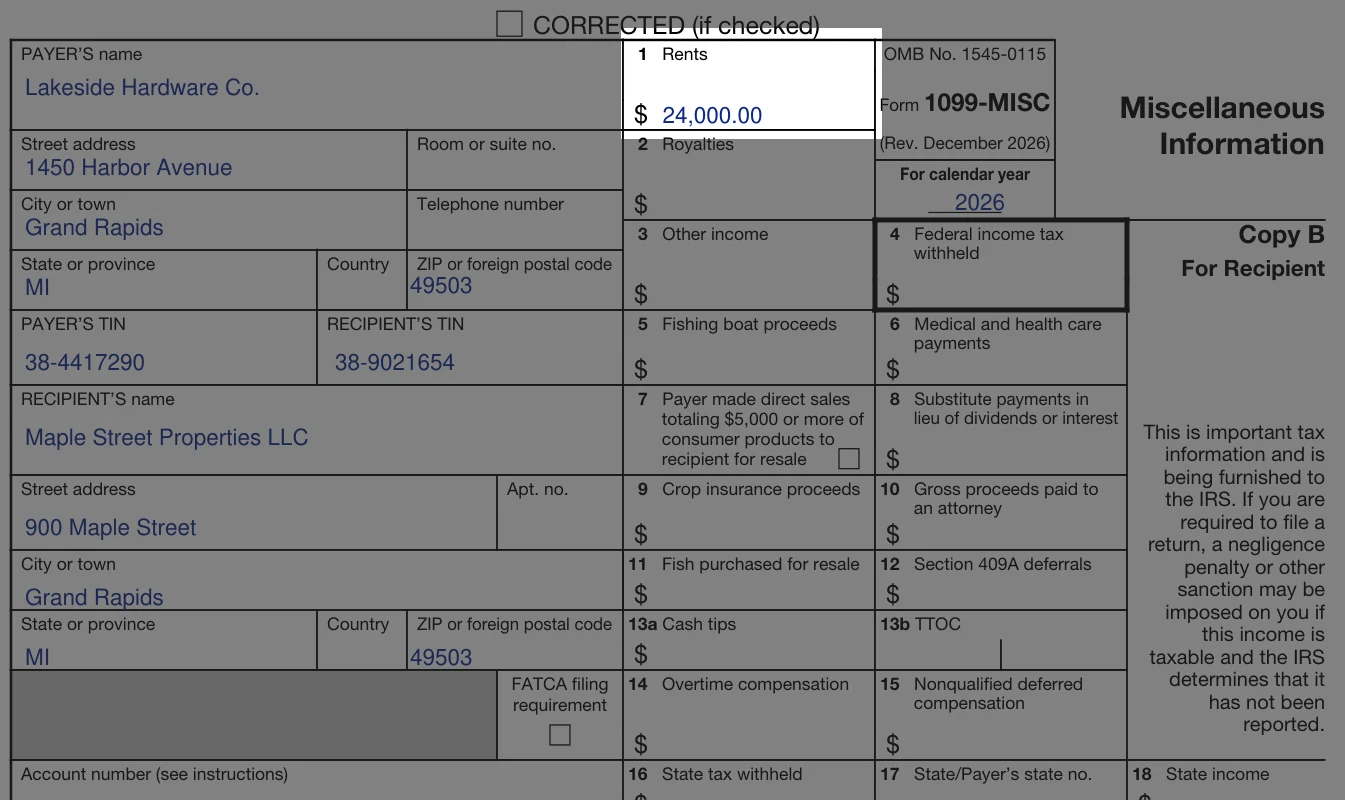
Because tax treatment can vary substantially from one box to another, recipients should not assume that every Form 1099-MISC is reported in the same way.
Why Did I Receive a 1099-MISC Instead of a 1099-NEC?
You may have received Form 1099-MISC because the payment was not ordinary compensation for services performed as an independent contractor.
For example, a payment for rent, royalties, certain prizes, medical services or another qualifying miscellaneous category may belong on Form 1099-MISC.
If you performed services as a nonemployee and the payment represents ordinary compensation for those services, Form 1099-NEC is generally the more appropriate form.
If the payer appears to have used the wrong form, contact the payer before filing your return and ask them to verify how the payment was classified.
Can You Receive Both 1099-MISC and 1099-NEC?
Yes. A person can receive both forms, including from the same payer, if the payments represent different reportable categories.
For example, suppose a business pays someone for professional services and also makes a separate payment that falls within a Form 1099-MISC category.
The service compensation may belong on Form 1099-NEC while the other qualifying payment may be reported on Form 1099-MISC.
What matters is the nature of each payment.
Can an LLC Receive a 1099-MISC?
Yes, an LLC can receive Form 1099-MISC, but whether one must be issued depends partly on how the LLC is classified for federal tax purposes and what type of payment was made. That classification also shapes the LLC operating agreement, so the W-9 an LLC gives payers should match it.
Certain payments to corporations are generally exempt from some information-return requirements, but important exceptions exist.
For example, the IRS specifically notes that the corporate exemption does not generally apply to reportable medical and healthcare payments made to corporations, including professional corporations.
Businesses commonly request Form W-9 from vendors and other payees so they can determine the recipient's legal name, tax identification number and federal tax classification before preparing information returns.
When Is Form 1099-MISC Due?
Businesses generally must provide Form 1099-MISC statements to recipients by January 31 following the tax year.
The IRS filing deadline differs depending on how the payer files:
Paper filing: generally February 28
Electronic filing: generally March 31
If a deadline falls on a Saturday, Sunday or applicable legal holiday, the deadline generally moves to the next business day.
Form 1099-NEC follows a different filing schedule and is generally due to the IRS by January 31.
This difference is another reason businesses should correctly distinguish MISC payments from NEC payments.
| Deadline for 2026 forms | Date |
|---|---|
| Copy B to recipients | February 1, 2027 |
| Copy B when Box 8 or Box 10 is used | February 16, 2027 |
| Copy A to the IRS on paper | March 1, 2027 |
| Copy A to the IRS electronically | March 31, 2027 |
Each date reflects the weekend and holiday rule: January 31 and February 28, 2027 fall on Sundays and February 15, 2027 is Presidents' Day. Filers with 10 or more information returns of all types combined must file electronically.
What Should You Do If You Don't Receive a 1099-MISC?
If you expected a Form 1099-MISC but did not receive one, first review your own payment records and contact the payer.
Check:
- Whether the payment actually falls within a 1099-MISC category
- Whether the applicable reporting threshold was reached
- Whether the payer has your correct mailing address
- Whether the payer has your correct tax information
- Whether the form was made available electronically
Most importantly, do not assume that income becomes non-taxable simply because a form was not issued.
Your own records should remain the primary source for determining how much income you actually received.
What Should You Do If Your 1099-MISC Is Wrong?
Contact the payer as soon as possible if Form 1099-MISC contains incorrect information.
Common errors include:
- Incorrect payment amount
- Wrong name
- Incorrect TIN
- Wrong payment category
- Incorrect box
- Payment reported in the wrong tax year
- Duplicate reporting
Ask the payer to investigate and, when appropriate, issue a corrected information return.
If the payer has already filed the incorrect form with the IRS, correcting the IRS copy can be particularly important because the agency may otherwise compare your tax return against incorrect information.
The IRS provides separate procedures for correcting previously filed information returns.
What Happens If You Receive Multiple 1099 Forms?
Receiving several 1099 forms is normal when you earn money from multiple sources or receive several different types of income.
You might receive:
- Form 1099-MISC
- Form 1099-NEC
- Form 1099-INT
- Form 1099-DIV
- Form 1099-K
- Other information returns
Each form represents a particular reporting category.
Do not simply add every form together without reviewing the underlying transactions. In certain situations, especially when payment platforms are involved, records should be checked carefully to make sure the same underlying income is not misunderstood or counted twice.
The IRS also notes that certain payment-card and third-party network transactions are reported by payment settlement entities on Form 1099-K rather than Form 1099-MISC or Form 1099-NEC.
What Happens If You Don't Report 1099-MISC Income?
Failing to report taxable income shown on an information return can create a mismatch between your tax return and information the IRS has received.
The payer generally sends information to both you and the IRS.
If your return does not reflect reportable taxable income, the IRS may identify the discrepancy and request additional information or propose an adjustment.
Keeping accurate records and resolving incorrect forms before filing can reduce the likelihood of these problems.
Does the IRS Already Know About Your 1099-MISC?
Generally, yes, if the payer properly filed the information return.
Form 1099-MISC is not simply a receipt sent privately from the payer to the recipient. A reportable copy is also filed with the IRS.
That information allows the IRS to compare income reported by payers with information included on taxpayers' returns.
This is why ignoring a 1099 generally does not make the reported payment disappear from IRS records.
What Records Should You Keep With a 1099-MISC?
Keep Form 1099-MISC together with the records that explain the underlying payment.
Useful documentation can include:
- Invoices
- Contracts
- Bank statements
- Payment confirmations
- Rental agreements
- Royalty statements
- Prize or award documentation
- Expense records
- Correspondence with the payer
- Form W-9 information
- Corrected tax forms
Good records are especially helpful if the amount on the form differs from the amount you believe you received. Freelancers who also get a 1099-NEC often keep monthly pay stubs for independent contractors so each form can be checked against real deposits.
1099-MISC vs. W-2 vs. 1099-NEC
These three forms serve very different purposes.
| Form | Main Purpose | Typical Recipient |
|---|---|---|
| W-2 | Employee wages | Employee |
| 1099-NEC | Nonemployee compensation | Freelancer or independent contractor |
| 1099-MISC | Miscellaneous reportable payments | Landlord, royalty recipient, prize recipient and other qualifying payees |
The form you receive should correspond to the underlying relationship and type of payment, not simply the fact that money changed hands.
Keep clear records of what you are paid so every 1099 is easy to check.
Create a Pay Stub Now