Vermont Paystub Generator
Vermont payroll has more moving parts than its size suggests: four withholding rates, a state allowance worth $5,400 a year, its own Form W-4VT and one of the highest minimum wages in New England. This Vermont paystub generator applies the 2026 withholding tables, adds the federal lines and gives a Burlington shop, a Stowe inn or a Brattleboro farm a statement that holds together.
Hi! I will fill in your paystub through a short conversation. Three quick questions, then the preview opens.
What is the company's legal name?



- Apple Pay
- G Pay
- VISA
- Mastercard
- AMEX
Money-back guarantee · Free preview · No subscription
 Create Your Vermont Paystub
Free preview · 2026 Vermont withholding · Instant PDF
Summary
A 2026 Vermont pay stub shows federal income tax, Social Security, Medicare and Vermont withholding at marginal rates from 3.35% to 8.75%. Employees claim allowances on Form W-4VT. Vermont has no local income tax and no mandatory disability deduction. Employers may withhold a small share of the Child Care Contribution.
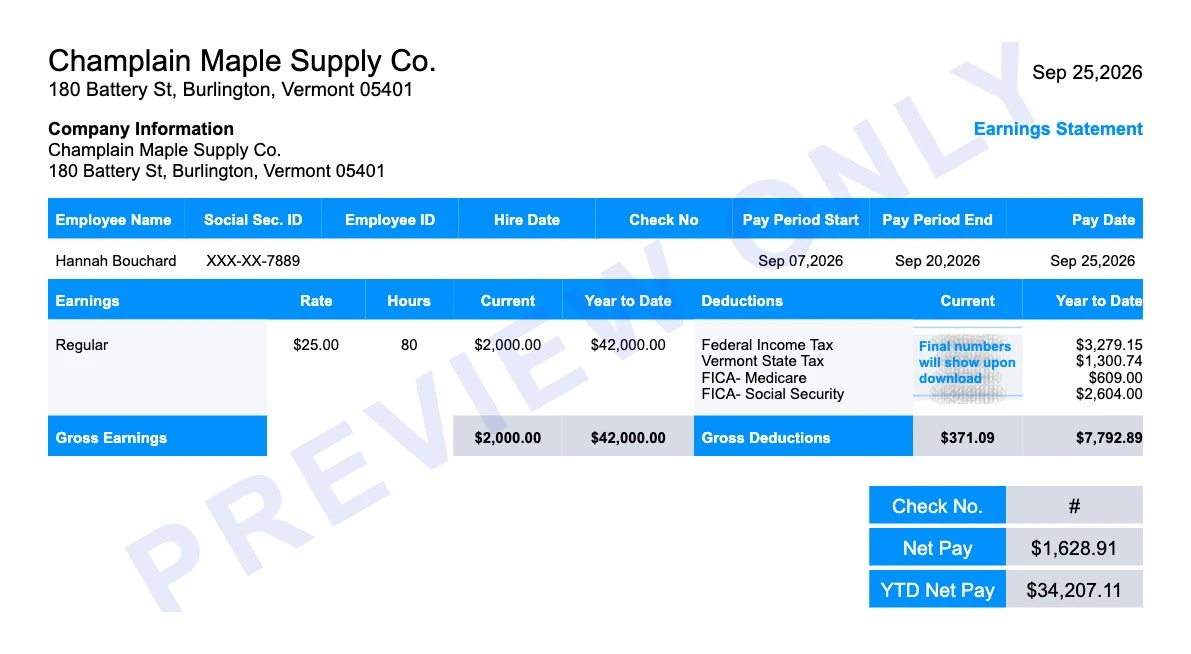
Vermont Withholding Without the Worksheet
The state publishes a percentage method with separate tables for single and married filers and a per-allowance amount for each pay period. Doing it by hand means three lookups before you reach a number.
Online Paystub runs that method for you, places the Vermont line beside federal tax, Social Security and Medicare and updates the year-to-date column. You review the result free of charge before downloading.
- 3.35%lowest withholding rate
- $14.42minimum wage in 2026
- 72 hoursfinal pay after a discharge
- $207.69biweekly value of one allowance
How Vermont Withholding Works in 2026
Vermont uses a percentage method published each year in guide GB-1210. The employer subtracts the value of the employee's allowances from gross wages, then applies the table for the pay period and filing status.
| Wages after allowances | Withholding |
|---|---|
| Up to $151 | $0 |
| $151 to $2,103 | 3.35% of the amount over $151 |
| $2,103 to $4,876 | $65.39 plus 6.6% of the amount over $2,103 |
| $4,876 to $10,009 | $248.41 plus 7.6% of the amount over $4,876 |
| Over $10,009 | $638.52 plus 8.75% of the amount over $10,009 |
Each allowance removes $207.69 from biweekly wages before the table is used. Married filers have wider brackets. The tables and the full method are on the Department of Taxes page for Vermont withholding.
Form W-4VT: The Certificate Vermont Asks For
The federal W-4 no longer uses allowances, but Vermont's method still does. That is why the state has its own certificate. Employees enter a filing status, a number of allowances and any extra amount to withhold.
Vermont has no reciprocity agreement with New Hampshire, New York or Massachusetts. Wages earned in Vermont are subject to Vermont withholding wherever the employee lives.
Champlain Maple Supply: A Burlington Example
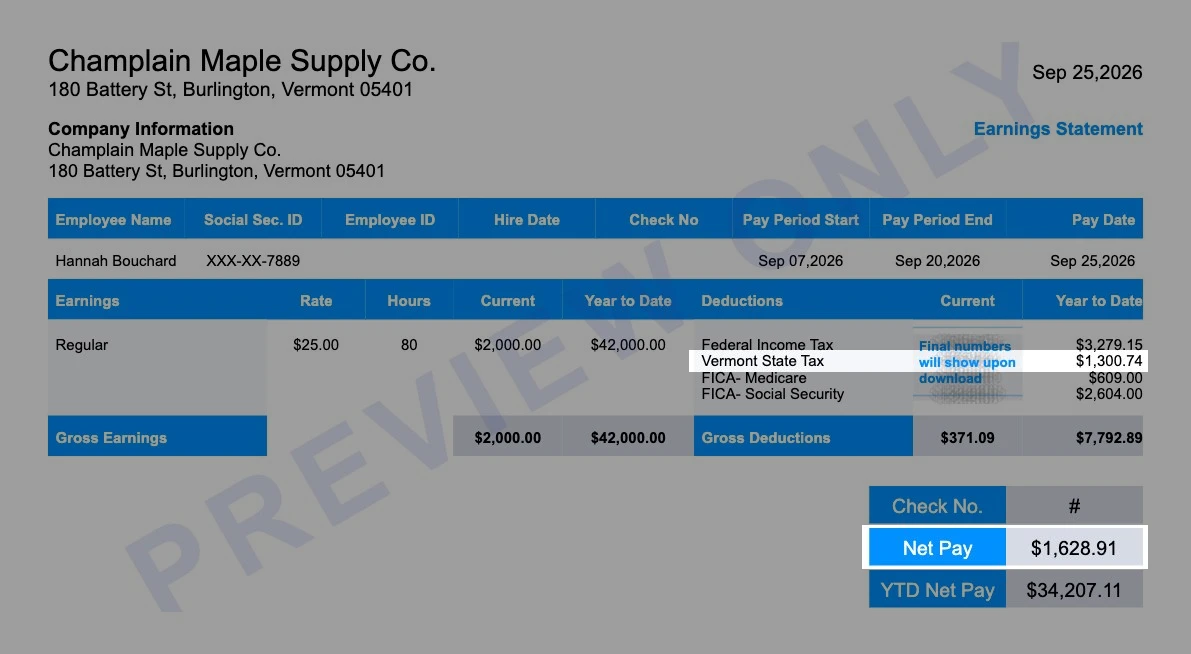
Scenario: Hannah Bouchard works for Champlain Maple Supply Co. at 180 Battery St in Burlington. She earns $25.00 an hour, works 80 hours from September 7 to September 20, 2026 and is paid September 25. She files single with zero allowances and this is her 21st paycheck of the year.
| Line | Current | Year to date |
|---|---|---|
| Gross earnings | $2,000.00 | $42,000.00 |
| Federal income tax | $156.15 | $3,279.15 |
| Vermont state tax | $61.94 | $1,300.74 |
| Medicare | $29.00 | $609.00 |
| Social Security | $124.00 | $2,604.00 |
| Gross deductions | $371.09 | $7,792.89 |
| Net pay | $1,628.91 | $34,207.11 |
Checking the Vermont line
With one allowance on her W-4VT the taxable amount would drop by $207.69 and the state line would fall to about $54.98. The year-to-date column is explained in what YTD means on a pay stub.
The Child Care Contribution
Since July 2024 Vermont employers have paid a 0.44% payroll tax called the Child Care Contribution. The law lets an employer pass up to one quarter of it to employees, which works out to no more than 0.11% of wages.
- Total rate
- 0.44% of wages
- Most an employee can be charged
- 0.11% of wages
- On $2,000 of wages
- Up to $2.20
- Employer's choice
- Many employers pay the full amount themselves
What a Vermont Wage Statement Must Include
Title 21, Section 342 requires employers to give each employee a written statement with every wage payment. The contents are short but specific.
Required on each statement
- Total hours worked in the pay period
- The hourly rate
- Gross wages
- An itemized list of every deduction
A vermont pay stub that also carries the pay period dates, year-to-date totals and the employer's address is more useful for the employee without adding work for the employer. If you have never read one closely, start with what a paystub is.
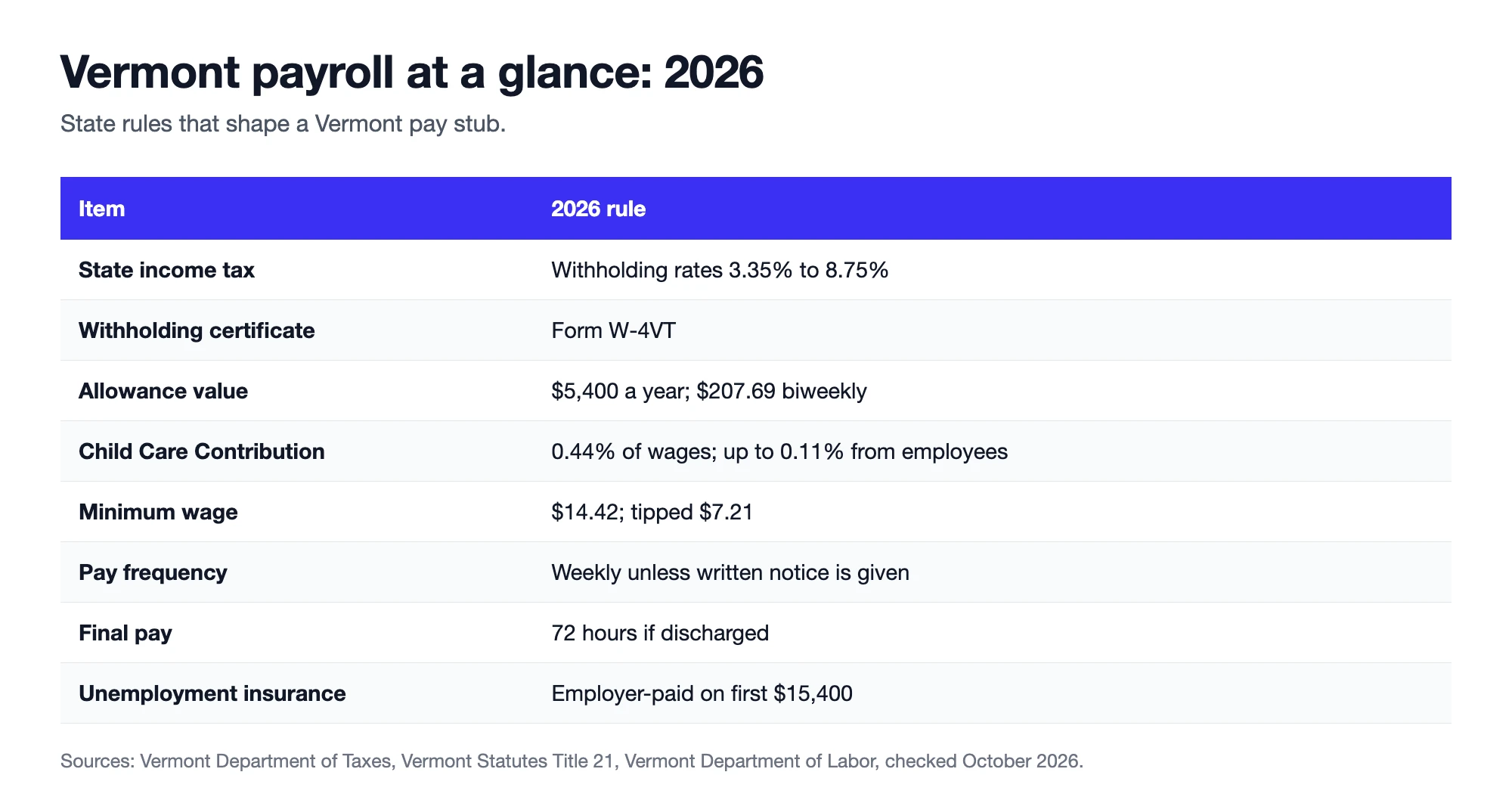
Weekly Pay Is the Default
Vermont is unusual in making weekly pay the baseline. An employer may pay every two weeks or twice a month only after giving employees written notice. Whatever the schedule, payday must fall within six days after the pay period ends.
- Employee is discharged
Wages are due within 72 hours.
- Employee quits
Wages are due on the last regular payday. If there is no regular payday, the following Friday.
- Every regular payday
No later than six days after the close of the pay period.
Minimum Wage and Tips
Vermont's minimum wage rose to $14.42 an hour on January 1, 2026 and is adjusted for inflation each year. The tipped minimum is $7.21 for service employees who customarily receive more than $120 a month in tips, provided tips bring the total to at least $14.42. Overtime is time and a half after 40 hours in a workweek for most employees.
What Employers Pay Themselves
Can appear as a deduction
- Federal income tax, Social Security and Medicare
- Vermont income tax withholding
- Up to 0.11% Child Care Contribution, if the employer passes it on
Cannot
- Unemployment insurance contributions
- Workers' compensation premiums
- The employer's 0.33% share of the Child Care Contribution
Unemployment insurance is paid by employers on the first $15,400 of each worker's wages in 2026. Vermont's Family and Medical Leave Insurance program is voluntary, so a premium appears only when an employer or an individual has enrolled.
Proof of Income in a Tight Housing Market
Rental vacancies around Burlington and in ski towns are low, so landlords screen carefully. Most ask for recent stubs and compare gross pay with the rent. Lenders do the same with a monthly figure; this guide shows how to work out gross monthly income from a weekly or biweekly check.
Seasonal workers at resorts, farms and sugarhouses are employees for payroll purposes and should receive a stub each payday like anyone else.
Create One in Three Steps
- 1
Employer and employee
Enter the business name, a Vermont address, the employee's name and the last four digits of the SSN.
- 2
Pay and schedule
Choose hourly or salary, the pay frequency, the rate, the hours and the dates.
- 3
Preview and download
Confirm the Vermont and federal lines in the free preview, pay $6.99 and download the PDF.
The vermont paystub generator uses the same form as the paystub maker on our home page. Each Vermont paystub carries the totals forward so a vermont pay stub from one period agrees with the next.
Accuracy and Honest Use
Whether you call it a vermont check stub, a payroll stub or a paycheck stub, the document records wages that were actually paid. Making one with invented income or a fictitious employer to secure a lease or a loan is fraud. Use the vermont paystub generator for real payroll and keep every vermont paystub consistent with bank deposits and the W-2. A Vermont pay stub that matches those records speaks for itself.
Vermont Paystub Questions
What is the Vermont income tax withholding rate in 2026?
Withholding uses marginal rates of 3.35%, 6.6%, 7.6% and 8.75%. A single biweekly employee pays nothing on the first $151 after allowances and 3.35% up to $2,103.
Does Vermont have its own W-4?
Yes. Employees complete Form W-4VT to claim Vermont allowances. Each allowance is worth $5,400 a year, which is $207.69 per biweekly pay period.
Are Vermont employers required to give pay stubs?
Yes. Each wage payment must come with a written statement showing hours worked, the hourly rate, gross wages and itemized deductions.
What is the Child Care Contribution on a Vermont paycheck?
A 0.44% payroll tax paid by employers. An employer may withhold up to 0.11% of wages from employees to cover part of it.
How often must Vermont employees be paid?
Weekly by default. An employer may pay biweekly or semimonthly after giving written notice. Payday must be within six days of the end of the pay period.
When is a final paycheck due in Vermont?
Within 72 hours of a discharge. An employee who quits is paid on the last regular payday or the following Friday if there is no regular payday.
What is the minimum wage in Vermont in 2026?
$14.42 an hour. The tipped minimum is $7.21 for employees who receive more than $120 a month in tips.
How much does it cost to create a stub?
$6.99 per stub with a free preview and no subscription.
How the Generator Works
This step-by-step tutorial covers employer and employee details, wages and Vermont income tax withholding, then the PDF download. Choose Vermont as the work state and the state tax line is calculated.
Vermont Paychecks in the Upper Valley and Beyond
Vermont withholds state tax with Form W-4VT. The Upper Valley and southern Vermont share workers with two neighbors.
- White River Junction residents who work in Lebanon or Hanover pay no New Hampshire tax on wages, though Vermont taxes its residents on all income. The New Hampshire paystub generator covers that job.
- Brattleboro and Bennington residents with jobs in Greenfield or Williamstown owe Massachusetts tax and PFML; see the Massachusetts paystub generator.
- Bennington area workers who commute to Albany or Hoosick Falls pay New York tax and paid family leave on that pay. Use the New York paystub generator.

Payroll rules on this page checked against the Vermont Department of Taxes guide GB-1210, Vermont Statutes Title 21 Section 342 and the Vermont Department of Labor by Olivia Bennett, Payroll Specialist. Last reviewed .