
Gross monthly income is the amount you earn in a month before taxes, insurance, retirement contributions or any other deductions come out. Landlords use it to decide whether you can afford the rent, lenders use it to size a loan and it is the fastest way to turn a salary or hourly rate into a monthly budget.
This guide shows the exact formula for every pay schedule, how to read the number straight off your pay stub, how self-employed income is treated and the mistakes that make people understate or overstate what they earn.
What Is Gross Monthly Income?
Gross monthly income is your total earnings for a month before any deductions. For employees it includes base pay plus any overtime, bonuses, commissions and tips you receive regularly. Other recurring income such as rental income, alimony or investment income can count too, depending on who is asking and why.
It is different from net monthly income, which is what actually lands in your bank account after federal and state taxes, Social Security, Medicare, health premiums and retirement contributions. A paycheck with $2,000 in gross pay can easily turn into $1,600 or less in net pay.
How to Calculate Gross Monthly Income
The formula depends on how often you are paid. The key is to convert to a yearly figure first, then divide by 12, because most months do not contain an even number of paychecks.
| How you are paid | Formula | Example | Gross monthly income |
|---|---|---|---|
| Annual salary | Salary ÷ 12 | $60,000 ÷ 12 | $5,000.00 |
| Hourly | Rate × weekly hours × 52 ÷ 12 | $20 × 40 × 52 ÷ 12 | $3,466.67 |
| Weekly paycheck | Gross per check × 52 ÷ 12 | $800 × 52 ÷ 12 | $3,466.67 |
| Biweekly paycheck | Gross per check × 26 ÷ 12 | $2,000 × 26 ÷ 12 | $4,333.33 |
| Semi-monthly paycheck | Gross per check × 2 | $2,100 × 2 | $4,200.00 |
| Monthly paycheck | Gross per check | $4,500 | $4,500.00 |
The biweekly trap
Multiplying a biweekly check by two is the most common mistake. Biweekly pay means 26 paychecks a year, not 24, so two months each year contain three paydays. In the example above, $2,000 × 2 gives $4,000 a month, which understates real gross monthly income by more than $330.
Hourly workers with changing schedules
If your hours vary, use an average. Add up gross pay from your last three to six months of stubs and divide by the number of months or use your year-to-date total as shown in the next section. Include overtime only if it is a regular part of your schedule, since lenders often want to see a two-year history before counting it.
How to Find Gross Monthly Income on Your Pay Stub
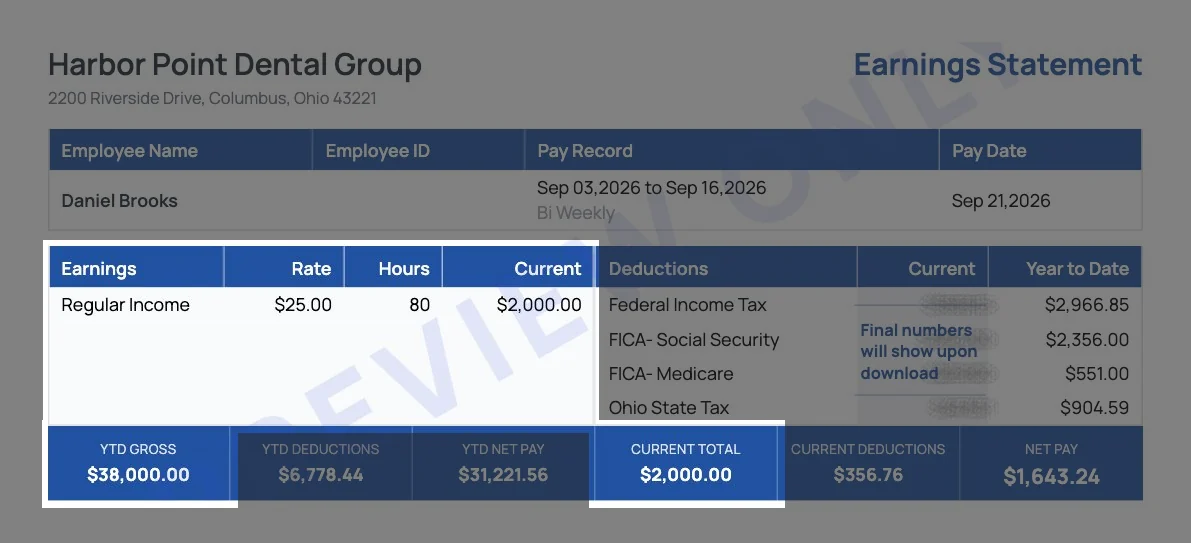
Your stub already contains everything you need. The Current column in the earnings section shows gross pay for this pay period and the YTD Gross box shows everything you have earned since January 1.
There are two ways to turn those figures into a monthly number:
- Per-check method: $2,000 biweekly × 26 ÷ 12 = $4,333.33 a month.
- Year-to-date method: divide the year-to-date gross by the months it covers. $38,000 earned from January 1 to September 21 is about 8.7 months or roughly $4,370 a month.
The year-to-date method is what many underwriters use because it smooths out bonuses, overtime and unpaid time off. If the two numbers are far apart, expect the lender to ask why.
What Counts Toward Gross Monthly Income
| Income type | Usually counted? | Notes |
|---|---|---|
| Base salary or hourly wages | Yes | Use the annualized amount |
| Overtime, bonuses and commissions | Often | Lenders usually want a steady history, commonly two years |
| Tips | Yes, if reported | Unreported cash tips cannot be documented |
| Self-employment income | Yes, as net profit | Based on tax returns, not gross receipts |
| Rental income | Partly | Lenders often count only a share of gross rent to allow for vacancies |
| Alimony or child support | If it will continue | Usually needs a court order and proof of payments |
| Social Security or pension | Yes | Non-taxable income is sometimes grossed up by lenders |
| One-time gifts or windfalls | No | Not recurring income |
Gross Monthly Income When You Are Self-Employed
For freelancers and business owners, gross monthly income is not the total of every invoice. Lenders and landlords look at net business income: revenue minus business expenses, usually taken from Schedule C of your last one or two tax returns and averaged over the months covered.
For example, a freelancer who billed $84,000 last year with $18,000 in business expenses has $66,000 in net profit or $5,500 a month. Showing $7,000 a month based on gross billings will not match the tax return and can sink an application. Monthly pay stubs for independent contractors that tie to real deposits help document the current year.
How Lenders and Landlords Use It
Your debt-to-income ratio is the main place gross monthly income shows up. The CFPB defines it as your monthly debt payments divided by your gross monthly income. With $1,500 in monthly debt payments and $5,000 in gross monthly income, your DTI is 30%. Limits vary by lender and loan type, but a lower ratio generally means better approval odds and rates.
Landlords often use a simpler rule, such as requiring gross monthly income of about three times the rent. For car financing, dealers usually ask for recent stubs, which is why it helps to know how to get a pay stub for an auto loan before you visit.
Household Gross Monthly Income
Household gross monthly income adds up the gross income of everyone in the household who earns money. If one partner earns $4,000 a month and the other earns $2,500, household gross monthly income is $6,500. Rental applications, joint mortgage applications and many assistance programs use the household figure, while an individual credit card application usually uses only your own income or income you have reasonable access to.
Gross Income vs. Adjusted Gross Income (AGI)
Gross monthly income is a budgeting and lending figure. Adjusted gross income is a tax figure: your total income for the year minus specific adjustments such as deductible IRA contributions, student loan interest and the deductible half of self-employment tax. With $60,000 of wages and a $5,000 deductible IRA contribution, AGI is $55,000. AGI then drives which tax credits and deductions you qualify for.
Common Mistakes to Avoid
- Using net pay from your bank deposits instead of gross pay
- Multiplying a biweekly check by 2 instead of by 26 and dividing by 12
- Counting a one-time bonus as monthly income
- Using gross business receipts instead of net profit when self-employed
- Forgetting regular side income that you report on your tax return
- Leaving out pre-tax deductions: gross pay includes the 401(k) and health premiums taken out later
Need clean proof of your gross income? Create an accurate pay stub in minutes.
Create a Pay Stub Now