
A paystub is the document that comes with every paycheck and explains how the amount you were paid was calculated. It lists your gross earnings, every tax and deduction taken out, and the net pay that actually reached your bank account, together with running year-to-date totals.
Whether you get a paper check with a perforated stub or a PDF in a payroll portal, the job of a pay stub is the same: to give you a clear, itemized record of what you earned and where it went. This guide walks through every line of a typical paystub, explains the taxes and deductions behind the numbers, and shows how to read, use, and create one.
Paystub Definition
A paystub (also written "pay stub") is an itemized statement issued by an employer for a single pay period that shows an employee's gross wages, tax withholdings, other deductions, and net pay. Depending on the employer, the payroll provider, or the state, the same document may be called a:
- Paycheck stub or check stub
- Payroll stub
- Earnings statement or wage statement
- Pay slip (more common in the UK, Canada, and Australia)
- Payment statement or pay advice
The spelling changes nothing. "Paystub" and "pay stub" refer to the exact same document, and "paycheck stub", "payroll stub", and "check stub" are simply older or regional names for it.
What Does a Pay Stub Look Like? (Example)
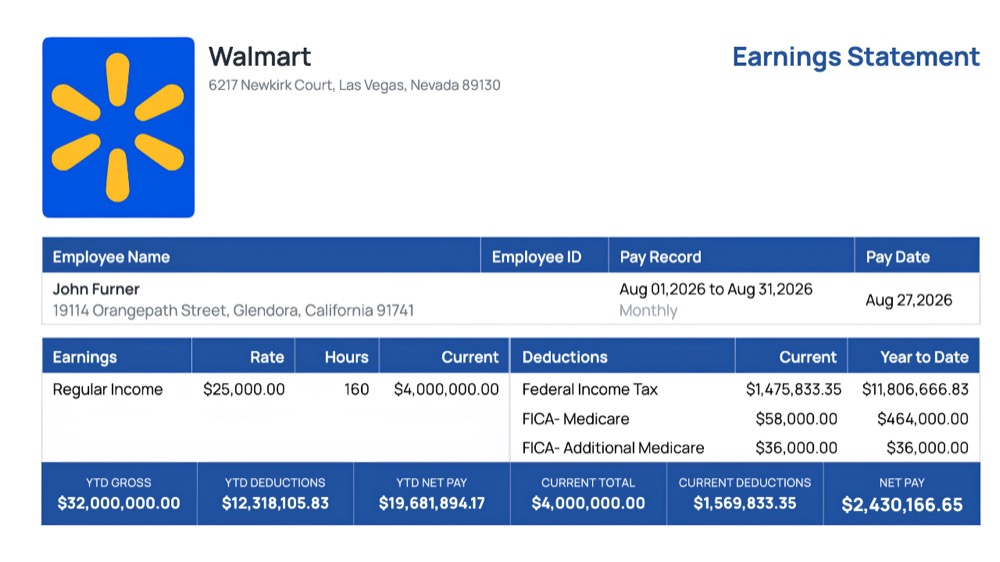
Layouts differ between payroll systems, but almost every pay stub is built from the same blocks: a header with employer and employee details, an earnings block, a taxes and deductions block, and a summary with current and year-to-date totals. Here is an example earnings statement for a monthly-paid employee.
| Rate | Hours | Current | |
|---|---|---|---|
| Regular income | $25,000.00 | 160 | $4,000,000.00 |
| Current total (gross pay) | $4,000,000.00 |
| Current | Year to Date | |
|---|---|---|
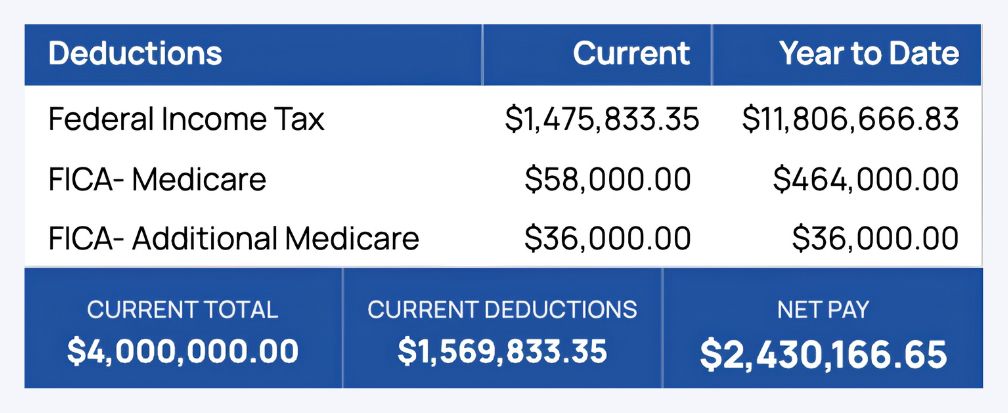
| Federal income tax | $1,475,833.35 | $11,806,666.83 |
| FICA - Medicare | $58,000.00 | $464,000.00 |
| FICA - Additional Medicare | $36,000.00 | $36,000.00 |
| Current deductions | $1,569,833.35 |
| Current | Year to Date | |
|---|---|---|
| Gross pay | $4,000,000.00 | $32,000,000.00 |
| Total deductions | $1,569,833.35 | $12,318,105.83 |
| Net pay | $2,430,166.65 | $19,681,894.17 |
Reading top to bottom, the stub tells the full story. The employee worked 160 hours at a rate of $25,000 per hour, for gross pay of $4,000,000 in August. Federal income tax took $1,475,833.35, Medicare took $58,000 (1.45% of gross), and Additional Medicare took $36,000 (0.9% on wages above the $200,000 threshold). After $1,569,833.35 in total deductions, $2,430,166.65 was paid out as net pay.
The year-to-date column shows the same figures accumulated since January 1: $32,000,000 in gross pay across eight monthly periods, $12,318,105.83 in total deductions, and $19,681,894.17 in net pay.
Notice what is missing, too. There is no Social Security line in the current period because year-to-date wages passed the 2026 wage base of $184,500 back in January, so that 6.2% deduction stopped for the rest of the year. Every pay stub should be read the same way: check each line that is there, and understand why any expected line is not.
What Information Is on a Paystub?
A complete pay stub contains eight groups of information. Not every stub shows every line, and some states require specific items (more on that below), but this is what you should expect to find.
Employer and Employee Details
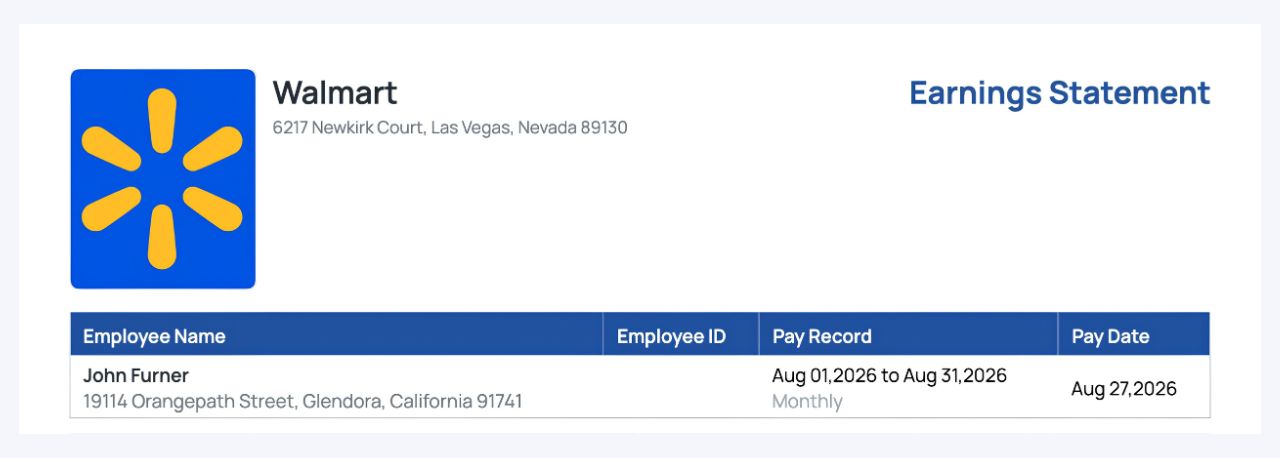
- Employer legal name, address, and often the Employer Identification Number (EIN)
- Employee name, address, and employee ID number
- Sometimes the last four digits of the employee's Social Security number, department, or job title
Pay Period and Pay Date
- Pay period: the start and end dates of the work being paid for (weekly, biweekly, semimonthly, or monthly)
- Pay date: the day the payment is issued or deposited, usually a few days after the period ends
- Check or advice number: a reference number for the payment
Earnings
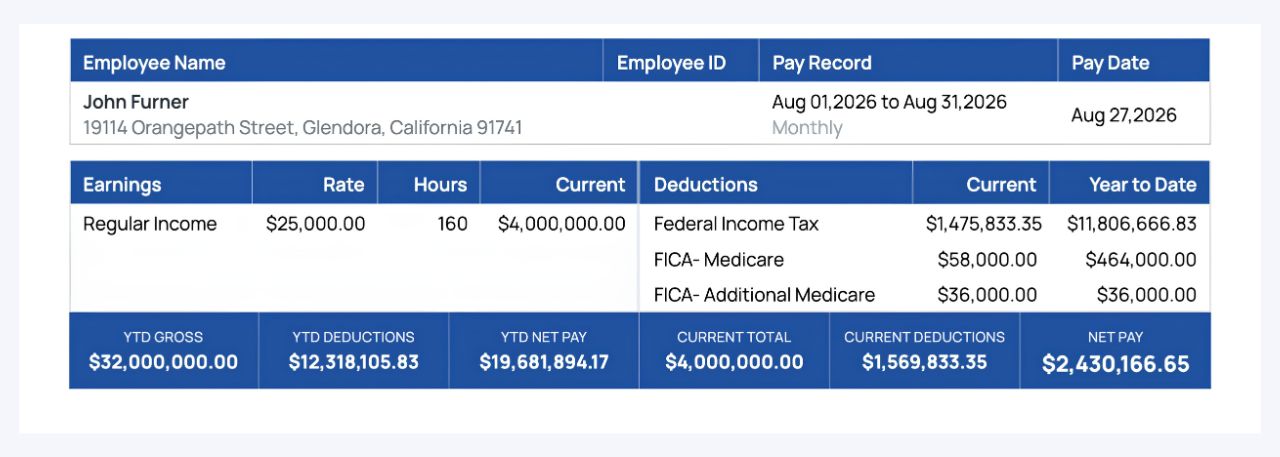
This block shows everything that makes up gross pay:
- Regular wages (hourly rate × hours, or salary ÷ number of pay periods)
- Overtime, usually at 1.5× the regular rate for hours over 40 in a week
- Bonuses, commissions, and tips
- Paid time off, sick pay, and holiday pay
- Reimbursements or allowances (often shown separately because they may be non-taxable)
Taxes Withheld
Amounts your employer sent to the government on your behalf: federal income tax, Social Security, Medicare, and state and local income taxes where they apply. Some stubs also show state disability insurance (SDI) or paid family leave contributions in states that have them.
Pre-Tax and Post-Tax Deductions
Everything else subtracted from your pay: health, dental, and vision premiums, retirement contributions, HSA and FSA contributions, life insurance, union dues, wage garnishments, and loan repayments. Good pay stubs mark whether each item is pre-tax or post-tax.
Employer Contributions
Many stubs include a section for amounts the employer pays that are not deducted from your wages: the employer share of Social Security and Medicare, employer 401(k) matching, and the employer portion of health premiums. These are informational only and do not affect your net pay.
Net Pay and Payment Method
Net pay is the final take-home amount. The stub also shows how it was paid: a physical check, direct deposit (with the masked account number), or a pay card.
Year-to-Date (YTD) Totals
Every earnings, tax, and deduction line usually has a second column showing the cumulative amount since January 1 of the current year. YTD figures are what lenders, landlords, and tax preparers care about most.
Gross Pay vs Net Pay on a Pay Stub
The two numbers that matter most on any paystub are gross pay and net pay.
Gross pay is total compensation before anything is withheld. For hourly workers it is rate × hours plus overtime, bonuses, and tips. For salaried workers it is annual salary divided by the number of pay periods:
- Weekly: salary ÷ 52
- Biweekly: salary ÷ 26
- Semimonthly: salary ÷ 24
- Monthly: salary ÷ 12
Net pay is what is left after taxes and deductions:
Gross pay − taxes − pre-tax deductions − post-tax deductions = Net pay
Two people with the identical salary can have very different net pay because withholding elections on Form W-4, benefit choices, retirement contributions, and state of residence all change what comes out.
What Taxes Are Taken Out of a Paycheck Stub?
Federal Income Tax
The amount withheld for federal income tax depends on your taxable wages, pay frequency, and the information on your Form W-4 (filing status, dependents, other income, and any extra withholding you request). Federal withholding is a prepayment toward your annual tax bill; when you file your return, you either get a refund or pay the difference.
Social Security Tax (OASDI)
Social Security tax is withheld at 6.2% of wages, and the employer pays a matching 6.2%. It stops once your year-to-date wages reach the annual wage base, which is $184,500 for 2026. On a pay stub it may be labeled Social Security, OASDI, FICA-SS, or SS Tax.
Medicare Tax
Medicare tax is 1.45% of all wages with no cap, again matched by the employer. Employees whose wages pass $200,000 in a calendar year have an Additional Medicare Tax of 0.9% withheld on everything above that threshold. Labels vary: Medicare, FICA-Med, Med Tax, or HI.
Together, Social Security and Medicare are called FICA taxes, and the employee share totals 7.65% of gross wages up to the Social Security cap.
State and Local Income Tax
State withholding depends on where you live and work. Nine states, including Texas, Florida, Washington, and Nevada, have no wage income tax, so that line will show $0.00. Others, like California, New York, and New Jersey, withhold at their own rates and may add SDI or family leave contributions. Some cities and counties (New York City, Philadelphia, many Ohio and Pennsylvania municipalities) have local income taxes that appear as a separate line.
Remote workers should check this section carefully. If you live in one state and your employer is in another, the wrong state may be withholding, and fixing it after the fact can be painful.
Pre-Tax vs Post-Tax Deductions
Pre-tax deductions are subtracted before taxable wages are calculated, so they lower your income tax (and sometimes your FICA tax). Common examples:
- Health, dental, and vision insurance premiums (Section 125 plans)
- Traditional 401(k), 403(b), and 457 contributions
- Health Savings Account (HSA) and Flexible Spending Account (FSA) contributions
- Commuter and transit benefits
Example: an employee earning $3,000 in a pay period who contributes $200 to a traditional 401(k) has federal income tax calculated on $2,800, not $3,000. (Note that 401(k) contributions reduce income tax but not Social Security and Medicare tax; Section 125 health premiums reduce both.)
Post-tax deductions come out after taxes have been calculated, so they do not reduce your taxable income:
- Roth 401(k) and Roth IRA payroll contributions
- Wage garnishments and child support orders
- Union dues
- Charitable contributions through payroll
- Some life and disability insurance premiums
- Loan or advance repayments
If your stub does not label each deduction as pre-tax or post-tax, ask payroll or HR. The distinction affects both your paycheck today and your W-2 at year end.
What Does YTD Mean on a Pay Stub?
YTD stands for year-to-date: the total for a given line from January 1 through the current pay period. Every stub should show YTD gross pay, YTD taxes, YTD deductions, and YTD net pay.
YTD figures are useful for three things:
- Checking your W-2. The YTD totals on your final December stub should match the wages and withholding boxes on your W-2.
- Tracking tax caps. Once YTD wages hit the Social Security wage base, that deduction stops. Once they cross $200,000, Additional Medicare Tax starts.
- Proving income. Lenders often annualize your YTD gross pay to estimate yearly income, especially if your hours or commissions vary.
Paystub vs Paycheck vs W-2: What Is the Difference?
These three documents are related but not interchangeable.
| Document | What it is | Covers | Who issues it |
|---|---|---|---|
| Paycheck | The actual payment (paper check or direct deposit) | One pay period | Employer |
| Paystub | The itemized explanation of how the paycheck amount was calculated | One pay period, plus YTD | Employer or payroll provider |
| W-2 | The annual summary of taxable wages and taxes withheld, used to file your tax return | Full calendar year | Employer, by January 31 |
| Bank statement | Confirmation that the net pay reached your account | Per deposit | Your bank |
A paycheck is money; a paystub is information. If you are paid by direct deposit you may never see a physical check, but you should still receive a stub for every payment. A W-2 is essentially the sum of all your pay stubs for the year, reorganized into IRS boxes.
Why Paystubs Matter: 7 Ways They Are Used
- Verifying your pay. Confirm hours, rate, overtime, bonus, and commission amounts every period. Small errors compound.
- Proof of income for loans and mortgages. Lenders typically request your two most recent pay stubs plus W-2s.
- Renting an apartment. Most landlords and property managers ask for recent stubs showing income of roughly three times the rent.
- Filing taxes. Stubs help you cross-check your W-2 and estimate whether you are over- or under-withholding.
- Applying for benefits. Unemployment claims, child support calculations, and public assistance programs often require pay stubs.
- Resolving payroll disputes. A stub is the primary evidence if wages, overtime, or deductions were handled incorrectly.
- Tracking benefits. Retirement contributions, PTO balances, and employer matches are all visible on the stub.
Are Employers Required to Provide Pay Stubs?
There is no federal law requiring employers to give employees a pay stub. The Fair Labor Standards Act (FLSA) requires employers to keep accurate records of hours and wages, but it does not require them to hand a statement to the worker.
State law fills the gap, and rules fall into four groups:
- No requirement: a small group of states, including Alabama, Arkansas, Florida, Georgia, Louisiana, Mississippi, Ohio, South Dakota, and Tennessee, do not require pay stubs at all.
- Access states: employers must give employees a way to see their pay information, either printed or electronic. Examples include Arizona, Illinois, Indiana, Michigan, New York, and Virginia.
- Print or opt-in states: employers must provide a paper stub unless the employee agrees to electronic delivery. California, Colorado, Connecticut, Iowa, Maine, Texas, and Washington fall here.
- Opt-out states: electronic delivery is the default but the employee can request paper. Delaware, Minnesota, and Oregon are examples.
Several states, most notably California (Labor Code section 226), also specify exactly what the stub must contain, including gross wages, total hours, all deductions, net wages, the pay period dates, the employee's name and ID, the employer's name and address, and hourly rates with hours at each rate. Penalties for missing or incomplete stubs can run into thousands of dollars per employee.
Because the rules change and vary, check your state pay stub requirements or use a state-specific paystub template that already includes the required fields.
How to Get Your Pay Stubs
- Current employer: log in to the payroll or HR portal (ADP, Paychex, Gusto, Workday, Paylocity, and similar) or ask HR for printed copies.
- Former employer: contact HR or payroll directly. Most employers keep records for at least three years under FLSA, and many payroll portals keep former-employee access open for a period after separation.
- Lost stubs: your bank statements show net deposits, and your W-2 or IRS wage transcript shows annual totals, but neither replaces an itemized stub if a lender wants one.
- Self-employed or paid without stubs: you can create a pay stub from your own records in minutes with the Online Paystub generator. Enter your gross pay, pay period, and work state, and federal, state, and FICA withholding are calculated automatically. Download the finished stub as a PDF, ready to send to a lender, landlord, or accountant.
Common Pay Stub Errors to Check
Even automated payroll systems make mistakes. Review each stub for:
- Wrong hours or rate: especially after a raise, a schedule change, or a switch between hourly and salaried.
- Missing overtime: non-exempt employees must be paid 1.5× for hours over 40 in a workweek.
- Incorrect filing status or allowances: compare the withholding to what you entered on your W-4.
- Wrong state withholding: common after a move or a change to remote work.
- Deductions that should have stopped: a canceled benefit, a paid-off garnishment, or a loan that has been repaid.
- YTD totals that do not add up: if the current column plus last stub's YTD does not equal this stub's YTD, something was corrected or missed.
- Social Security still withheld above the wage base: high earners should see the OASDI line drop to $0 once YTD wages pass $184,500 in 2026.
If you spot an error, contact payroll in writing and keep a copy of the stub.
Who Needs a Paystub Besides W-2 Employees?
Pay stubs are not only for traditional employees.
- Independent contractors and freelancers are paid by invoice and receive a 1099-NEC at year end rather than a W-2. They do not get pay stubs from clients, but many create their own to document income for mortgages, car loans, and rental applications.
- Self-employed business owners who pay themselves a salary through an S corporation should run proper payroll with stubs, since they are employees of their own company.
- Gig workers (rideshare, delivery, marketplace sellers) often need to convert platform earnings summaries into a stub-style statement when a lender or landlord asks for one.
- Small employers with one or two staff who run payroll by hand still need to give each employee an accurate stub in most states.
In each of these cases, the stub must reflect real, verifiable income. Creating a pay stub with inflated or fictional numbers to obtain credit or housing is fraud.
How to Create a Paystub Online
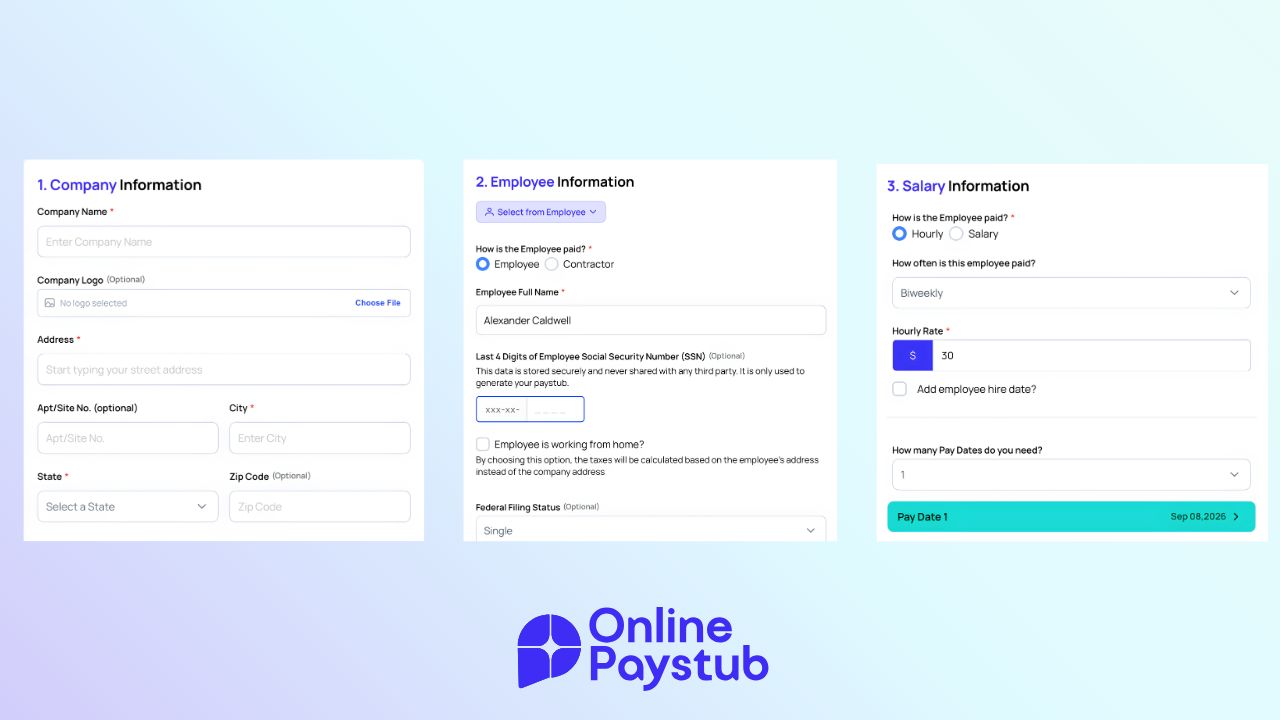
If you run a small business, pay household employees, or need to document self-employment income, an online paystub generator turns the calculation into a few minutes of work:
- Enter the company name, address, and EIN.
- Enter the employee's name, address, and (optionally) the last four digits of the SSN.
- Choose the pay frequency, pay period dates, and pay date.
- Enter gross earnings: hourly rate and hours, or salary, plus any overtime, bonus, or commission.
- Select the work state so federal, state, and FICA withholding are calculated automatically.
- Add any pre-tax or post-tax deductions.
- Review the preview, check the YTD figures, and download the PDF.
A good generator keeps up with the current year's federal brackets, state rates, and FICA wage base, so you are not doing that math by hand. It should also let you choose a template that includes the fields your state requires.
Create your paystub in minutes with the Online Paystub generator.
Create a Pay Stub Now