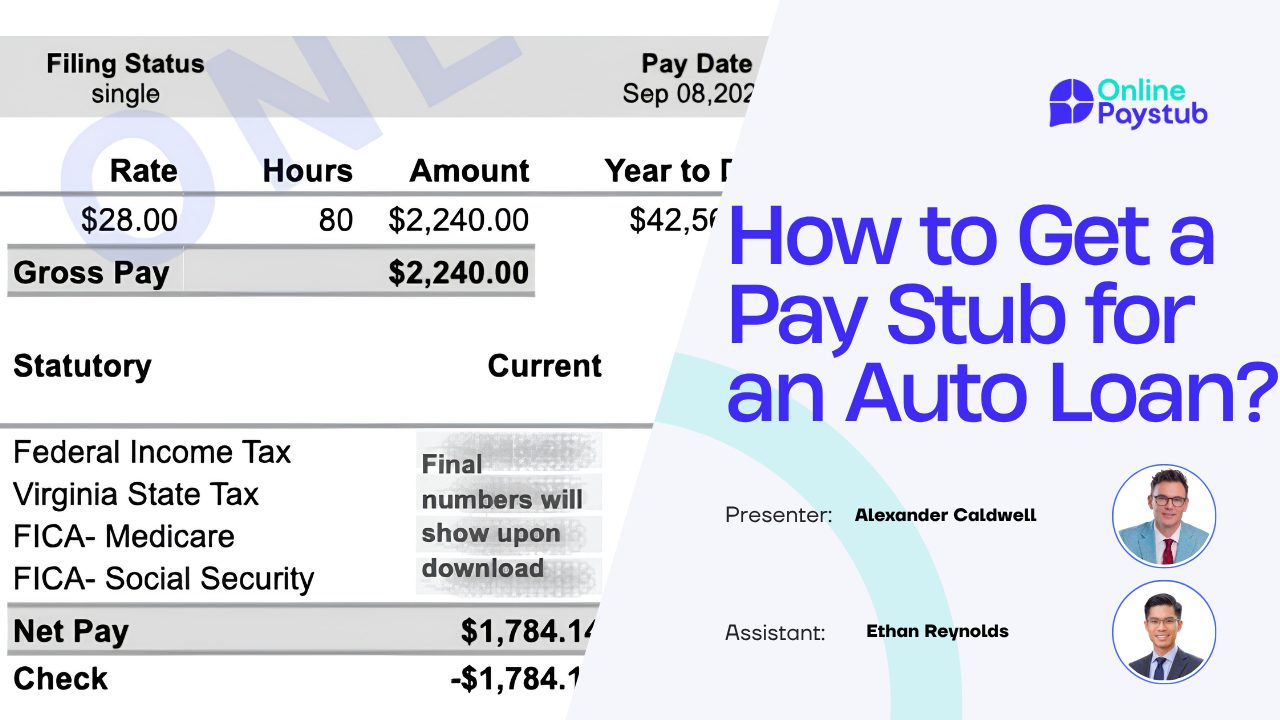

When you apply for a car loan, the lender's first question is simple: can you afford the monthly payment? The fastest way to answer it is a pay stub. It shows what you earn, how often you are paid, how long you have been earning it, and what is already coming out of your check, all on one page.
Here is how to get a paystub ready for an auto loan, step by step:
- Ask the lender what they need. Before you gather anything, confirm how many stubs they want (usually the two most recent, covering 30 days) and how recent they must be (usually within 30 to 45 days). Also ask whether they accept PDFs by email or upload.
- Locate your most recent stubs. If you have an employer, log in to your company's payroll or HR portal and download the last two statements as PDFs. If you receive paper stubs, ask payroll for copies. If you are self-employed or paid without stubs, skip to step 4.
- Check that each stub is complete. The page must show the employer's name and address, your name, the pay period dates, the pay date, gross pay, taxes and deductions, net pay, and year-to-date totals. Do not crop or screenshot only the summary bar; lenders reject partial documents.
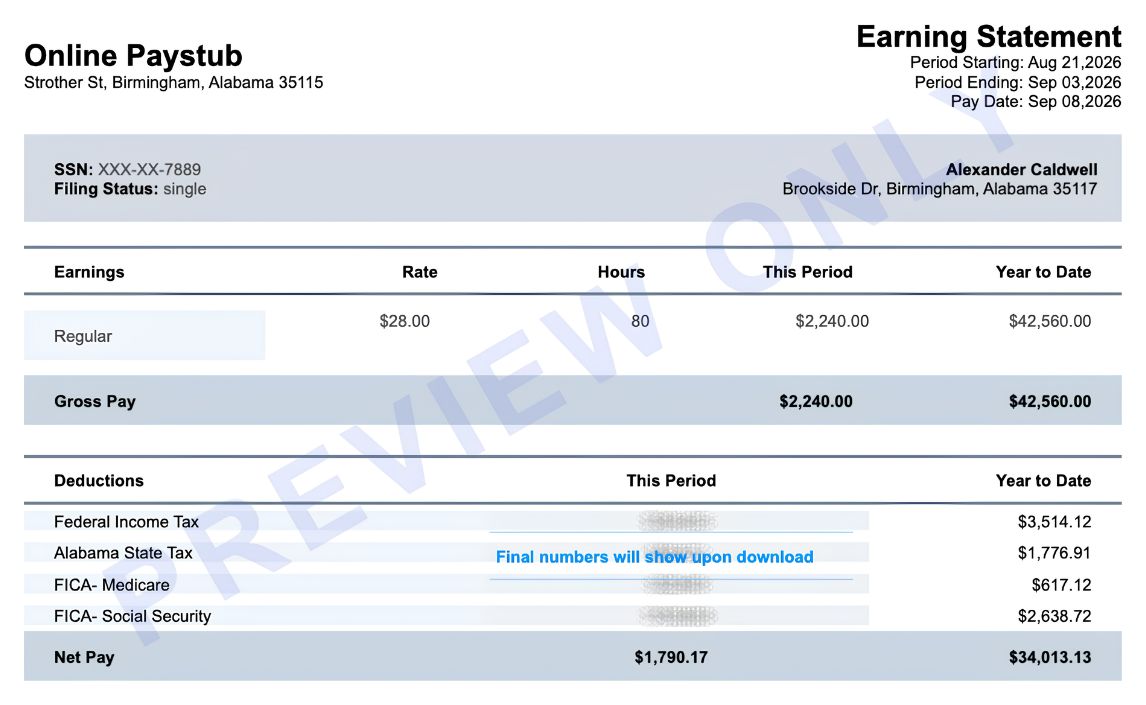
- Create a stub if nobody issues you one. Self-employed workers, contractors, and gig workers can build a pay stub from their own records with the Online Paystub generator. Enter your business as the employer, yourself as the employee, the real pay period and gross amount, and your work state. Federal, state, and FICA figures are calculated for you, and the result downloads as a PDF. The numbers must match your actual deposits and tax records.
- Match the stub to your application. Make sure the gross income, employer name, and pay frequency on the stub are the same as what you enter on the loan application. Any mismatch triggers a verification call and slows approval.
- Gather the supporting documents. Lenders often pair stubs with a W-2, recent bank statements, or (for self-employed borrowers) tax returns and a profit and loss statement. Have these ready in the same folder.
- Submit and keep copies. Upload or email the full set, then save the exact files you sent. If the lender asks a follow-up question, you will be answering about the same documents.
The rest of this guide explains each of these steps in more detail: what auto lenders actually look for on a pay stub, how many they ask for, where to get yours depending on your work situation, and what to do if you do not have a traditional employer issuing them.
Do You Need Pay Stubs to Get a Car Loan?
In most cases, yes. Paystubs are the most common proof of income requested by banks, credit unions, dealership finance offices and online auto lenders. They are not always mandatory: borrowers with excellent credit, a long history with the lender, or a large down payment are sometimes approved on stated income alone.
Lenders are more likely to require pay stubs when:
- Your credit score is fair or poor, or your credit file is thin
- Your debt-to-income ratio is already high
- The vehicle is expensive relative to your income
- You are financing with little or no down payment
- Your income is variable (hourly, tips, commission, gig work)
- You applied for preapproval rather than a quick prequalification
Even when a lender does not ask up front, having your most recent stubs ready removes the most common reason a "same-day" approval turns into a three-day wait.
How Many Pay Stubs Do You Need for a Car Loan?
The standard request is your two most recent pay stubs, or enough stubs to cover the last 30 days of income. Some lenders, especially for subprime borrowers or larger loans, ask for 60 to 90 days.
| Pay frequency | Stubs needed for 30 days | Stubs needed for 60 days |
|---|---|---|
| Weekly | 4 | 8 |
| Biweekly | 2 | 4 |
| Semimonthly | 2 | 4 |
| Monthly | 1 | 2 |
Whatever the count, the stubs must be recent. A stub from four months ago tells the lender what you earned then, not now. Most lenders will not accept a stub older than 30 to 45 days as your primary proof of income.
What Lenders Check on Your Pay Stub
Underwriters do not read a paystub the way you do. They are looking for a handful of specific data points and they cross-check them against your application, your credit report and sometimes a call to your employer.
Gross Income and Pay Frequency
Gross pay, not net pay, is the figure lenders use to qualify you. They combine it with your pay frequency to calculate monthly gross income:
- Weekly pay × 52 ÷ 12
- Biweekly pay × 26 ÷ 12
- Semimonthly pay × 2
- Monthly pay × 1
If your stub does not clearly state the pay period dates or the frequency, the underwriter has to guess and guesses slow things down.
Year-to-Date Earnings
The YTD column is the most important line on the stub for a lender. It proves the current period is not a one-off. Underwriters divide YTD gross by the number of months elapsed in the year to get an annualized figure, then compare it to the current period. A big gap between the two raises questions: was there a recent raise, a bonus, a job change, or unpaid time off?
Employer Details and Employment Length
Lenders want the employer's legal name and address to match what you listed on the application and, ideally, what appears on your credit report. Many also want to see at least six months (often a year) with the current employer. If your stub shows a hire date or an employee ID, that helps confirm stability.
Existing Deductions and Garnishments
Wage garnishments, child support withholdings and loan repayments that appear on your stub are debts. Underwriters add them to your monthly obligations. Voluntary deductions such as 401(k) contributions and health premiums do not count against you, but a garnishment that does not show up on your credit report will show up here.
How Lenders Turn Your Paystub Into a Loan Decision
Two ratios drive most auto loan approvals and both start with the gross income on your stub.
- Debt-to-income ratio (DTI): total monthly debt payments (rent or mortgage, credit cards, student loans, other car loans, plus the proposed payment) divided by gross monthly income. Most auto lenders want this under 45% to 50%.
- Payment-to-income ratio (PTI): the proposed car payment (some lenders include insurance) divided by gross monthly income. The common ceiling is 15% to 20%.
Example: your stub shows $2,400 biweekly gross. Monthly gross is $2,400 × 26 ÷ 12 = $5,200. A $650 car payment gives a PTI of 12.5%, comfortably under most limits. If you already carry $1,600 in other monthly debt, your DTI with the new payment is ($1,600 + $650) ÷ $5,200 = 43%, right at the edge of where many lenders start tightening terms.
The takeaway: the number on your paystub does not just get you approved or denied. It directly sets the payment and therefore the vehicle price the lender is willing to finance.
How to Get Your Pay Stubs: 4 Situations
You Work for an Employer With Payroll
Log in to your company's payroll or HR portal and download your two most recent statements as PDFs. Most portals let you select a date range and export several at once. If your employer still issues paper stubs, ask payroll for reprints; they are required to keep the records.
Before you send them, check that the file shows the full page: employer name and address, your name, pay period, pay date, gross pay, deductions, net pay and YTD totals. A cropped screenshot of the summary bar is not a check stub and most lenders will reject it.
You Recently Changed Jobs
If you have started a new job and have not received a stub yet, most lenders will accept a signed offer letter stating your salary or hourly rate and start date, sometimes paired with your final stub from the previous employer to show income continuity. Once your first stub from the new job arrives, send it; it will strengthen the file.
Do not submit stubs from the previous employer alone. Lenders verify current employment and a mismatch between the stub and your application is a red flag.
You Are Self-Employed, a Contractor, or a Gig Worker
Nobody issues you a pay stub, but you still have income to prove. Lenders will typically ask for one or more of:
- Two years of federal tax returns (with Schedule C or K-1)
- 1099-NEC or 1099-K forms
- Three to six months of business or personal bank statements showing deposits
- A year-to-date profit and loss statement
Many self-employed borrowers also create a pay stub from their own records to give the lender a familiar, one-page summary of monthly gross income and YTD totals alongside the tax documents. You can build one in minutes with the Online Paystub generator: enter your business as the employer, yourself as the employee, the pay period and gross amount you actually paid yourself and the tool calculates federal, state and FICA figures and produces a downloadable PDF.
The stub must reflect real, documented income that matches your bank deposits and tax filings. It supports your other paperwork; it does not replace it.
You Have Lost or Misplaced Your Stubs
- Log back in to the payroll portal; historical stubs are usually available for at least the current and prior year.
- Contact your employer's HR or payroll department for reissued copies. Employers are required to keep payroll records for at least three years under federal law.
- If the employer has closed or will not respond, your W-2 and bank statements showing regular deposits are the next-best evidence.
Alternatives If You Cannot Provide Pay Stubs
Lenders have seen every situation. If paycheck stubs are not an option, these documents are commonly accepted, usually in combination:
| Document | Best for | What it proves |
|---|---|---|
| W-2 form | Salaried or hourly employees | Last year's total wages and withholding |
| Tax returns (1040) | Self-employed, commission earners | Two-year income history |
| Bank statements (2 to 6 months) | Contractors, gig workers, cash-tipped workers | Actual deposits received |
| Offer or employment letter | New hires | Current salary and start date |
| Benefit award letters | Retirees, disability or SSI recipients | Fixed monthly non-employment income |
| 1099 forms | Contractors, freelancers | Annual payments from each client |
| Rental or investment income statements | Landlords, investors | Recurring passive income |
A cosigner with verifiable income or a larger down payment can also offset weak or hard-to-document income.
Common Mistakes That Delay Auto Loan Approval
- Sending an old stub. Anything past 30 to 45 days will usually be sent back.
- Cropping the document. Lenders need the whole page, including YTD and employer details.
- Income that does not match the application. If you wrote $70,000 on the application and your stubs annualize to $58,000, expect a call.
- Counting overtime or bonus as base pay. Lenders average variable income over time, so a single big overtime month will not lift your qualifying income the way you might hope.
- Ignoring garnishments. They are on the stub and the underwriter will see them.
- Mixing employers. Stubs from two jobs are fine, but each needs its own set and both jobs should be on the application.
A Warning About Fake Pay Stubs
Auto lenders verify income. They compare stubs against bank deposits, call employers, use third-party employment verification services and check that tax math is internally consistent (a stub where FICA does not equal 7.65% of gross is caught in seconds). Submitting an altered or fabricated payroll stub to obtain credit is loan fraud, a federal offense and it also voids most lenders' willingness to work with you again.
A pay stub generator is a legitimate tool for documenting income you actually earned, whether you are self-employed or your employer does not issue stubs. It is not a tool for inventing income. The numbers must match your real earnings, deposits and tax records.
Get Your Pay Stub Ready Before You Visit the Dealership
Walking into a dealership or applying online with your income already documented puts you in a stronger position: you can get preapproved, know your real budget and negotiate on price instead of on paperwork.
If you are self-employed, a contractor, or paid without formal stubs, create yours now with the Online Paystub generator. Enter your gross pay, pay period and work state, review the calculated taxes and download a lender-ready PDF in a few minutes.
Create your pay stub now, lender-ready in minutes.
Create a Pay Stub Now