
If you run payroll, even for a single employee, you will run into four letters sooner or later: FUTA. It sits quietly in payroll reports and rarely appears as a deduction on an employee's pay stub. Yet every eligible employer in the United States has to calculate it, deposit it and report it each year.
This guide explains what FUTA means, who pays it, how the rate and wage base work in 2026, what a credit reduction state is and how FUTA relates to the numbers you see on a paycheck stub.
FUTA Meaning: What Does FUTA Stand For?
FUTA stands for the Federal Unemployment Tax Act. It is a federal law that requires employers to pay a payroll tax used to fund unemployment compensation programs. Together with state unemployment insurance systems, FUTA pays for:
- The federal share of administering state unemployment programs
- Extended unemployment benefits during periods of high unemployment
- A loan fund that states can borrow from when their own unemployment trust funds run low
When people say "FUTA tax," they mean the federal unemployment tax itself. On payroll registers it can also show up as Fed Unemployment or FUI, one of many short codes you will find decoded in the list of common pay stub abbreviations and what they mean.
Who Pays FUTA Tax: the Employer or the Employee?
FUTA is an employer-only tax. Unlike Social Security and Medicare (FICA), which are split between employer and employee, FUTA is never withheld from an employee's wages. The full cost belongs to the business.
That is why most employees never see FUTA listed among the deductions on their paystub. When FUTA does appear, it usually sits in a separate "employer taxes" or "company contributions" section, shown for information only. It does not reduce the employee's net pay.
Which Employers Must Pay FUTA?
Most businesses with W-2 employees owe FUTA. The IRS uses three tests and meeting the one that fits your business in the current or previous calendar year is enough.
General employers
You owe FUTA if either of the following applies in the current or previous calendar year:
- You paid $1,500 or more in wages in any calendar quarter.
- You had at least one employee for some part of a day in 20 or more different weeks. The weeks do not have to be consecutive.
Household employers
If you paid $1,000 or more in cash wages to household employees (nannies, housekeepers, caregivers) in any calendar quarter, you owe FUTA.
Agricultural employers
You owe FUTA if you paid $20,000 or more in cash wages to farmworkers in any calendar quarter or employed 10 or more farmworkers during at least part of a day in 20 or more different weeks.
Who Is Exempt From FUTA?
Some organizations and types of payments fall outside FUTA:
- 501(c)(3) nonprofit organizations (religious, charitable and educational organizations)
- Federal, state and local government employers
- Federally recognized Indian tribal governments that participate in their state's unemployment system
- Certain family employment, such as a child under 21 employed by a parent, a spouse employed by a spouse or a parent employed by their child
- Independent contractors, because FUTA applies only to employee wages. Payments reported under the Form 1099-NEC rules are not FUTA wages.
Some fringe benefits and payments are also excluded from FUTA wages, including certain retirement plan contributions, qualified health insurance premiums and some dependent care assistance. Confirm how a specific benefit is treated before you run payroll.
FUTA Tax Rate and Wage Base for 2026
The core FUTA numbers have not changed in years:
| Item | 2026 amount |
|---|---|
| Gross FUTA tax rate | 6.0% |
| Maximum credit for state unemployment tax (SUTA) | 5.4% |
| Net FUTA tax rate (with full credit) | 0.6% |
| Taxable wage base | First $7,000 per employee, per year |
| Maximum FUTA tax per employee (with full credit) | $42 |
How the 5.4% FUTA credit works
The headline rate is 6.0%, but employers who pay their state unemployment taxes in full and on time receive a credit of up to 5.4%. That brings the effective rate down to 0.6%. If state unemployment taxes are paid late, the credit is generally limited to 90% of what it would otherwise have been, so paying SUTA on schedule matters.
Why the $7,000 wage base matters
FUTA applies only to the first $7,000 each employee earns during the calendar year. Once an employee's wages pass that point, you stop owing FUTA on them for the rest of the year. Payroll systems watch each worker's year-to-date (YTD) wages for exactly this reason: the YTD figure tells you when the $7,000 limit has been reached.
The wage base resets every January 1 and applies per employee, per employer. If a worker changes jobs mid-year, the new employer starts counting from zero.
How to Calculate FUTA Tax (With Examples)
The basic formula is simple:
FUTA tax = FUTA-taxable wages (up to $7,000 per employee) × net FUTA rate
Example 1: One employee, standard rate
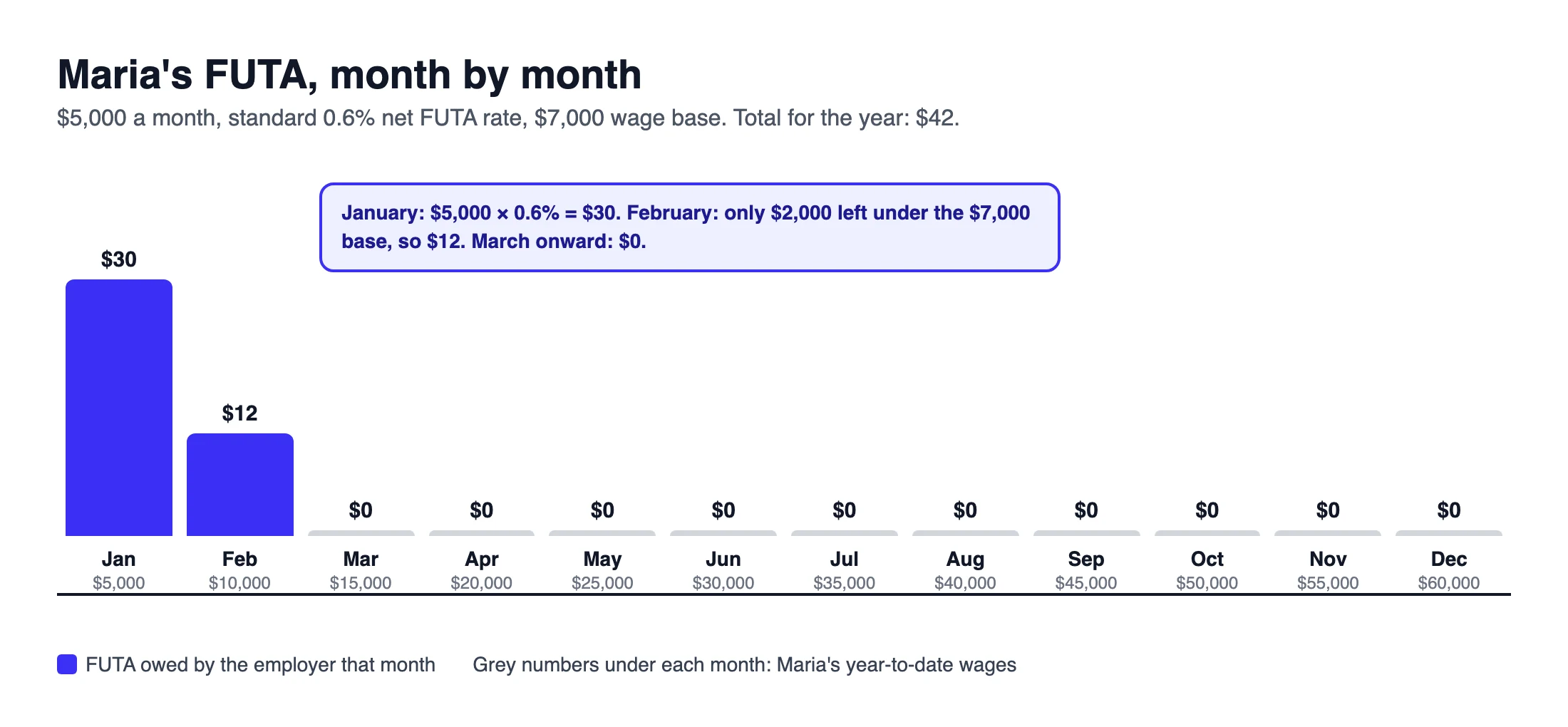
Maria earns $5,000 per month.
- January: $5,000 × 0.6% = $30
- February: only $2,000 remains below the $7,000 cap, so $2,000 × 0.6% = $12
- March through December: $0, because her YTD wages already exceed $7,000
Total FUTA for Maria for the year: $42.
Example 2: Five employees
A small business has five employees who each earn more than $7,000 during the year:
5 employees × $7,000 × 0.6% = $210 in FUTA tax for the year.
Example 3: Part-time employee
A part-time worker earns $4,200 for the entire year. Because the total never reaches the wage base, FUTA applies to all of it:
$4,200 × 0.6% = $25.20
What Is a FUTA Credit Reduction State?
When a state's unemployment trust fund runs short, the state can borrow from the federal government. If the state carries an outstanding loan balance on January 1 for two consecutive years and does not repay it by November 10 of the second year, employers in that state lose part of their 5.4% FUTA credit.
The reduction starts at 0.3% and grows by another 0.3% for each additional year the loan stays unpaid. The result is a higher net FUTA rate for every employer in that state.
Credit reduction states for 2025 (reported on Form 940 in early 2026)
The U.S. Department of Labor confirmed two jurisdictions in its notice of FUTA credit reductions for 2025:
| Jurisdiction | Credit reduction | Net FUTA rate | Max FUTA per employee |
|---|---|---|---|
| California | 1.2% | 1.8% | $126 |
| U.S. Virgin Islands | 4.5% | 5.1% | $357 |
Connecticut and New York were on the preliminary list but repaid their loans before the November 10, 2025 deadline and avoided the reduction.
What to expect for 2026
The final list for the 2026 tax year is published after the November 10, 2026 deadline. If California does not repay its loan by then, its credit reduction is expected to rise to 1.5%, pushing the net FUTA rate to 2.1% (up to $147 per employee). The additional tax from a credit reduction is not deposited during the year. It is calculated on Schedule A and paid with Form 940.
FUTA vs. SUTA vs. FICA: What Is the Difference?
| FUTA | SUTA | FICA | |
|---|---|---|---|
| Full name | Federal Unemployment Tax Act | State Unemployment Tax Act | Federal Insurance Contributions Act |
| Who pays | Employer only | Mostly employer (employees also contribute in a few states) | Employer and employee |
| What it funds | Federal unemployment programs | State unemployment benefits | Social Security and Medicare |
| 2026 rate | 6.0% gross, 0.6% net | Varies by state and employer | 7.65% each for employer and employee |
| Wage base | $7,000 | Varies by state | Social Security has an annual cap; Medicare has none |
| Shown on employee paystub? | Usually not | Only if the employee contributes | Yes, as withholding |
In short, FUTA and SUTA work as a team: paying SUTA earns you the FUTA credit. FICA is a completely separate tax that both sides of the paycheck share.
FUTA Deposits and Form 940 Deadlines
When to deposit FUTA tax
FUTA is calculated quarterly, but you only deposit when your accumulated liability exceeds $500:
- If your FUTA liability for the quarter (plus any carried-over amount) is more than $500, deposit it by the last day of the month after the quarter ends.
- If it is $500 or less, carry it forward to the next quarter.
| Quarter | Deposit due (if over $500) |
|---|---|
| Q1 (Jan to Mar) | April 30 |
| Q2 (Apr to Jun) | July 31 |
| Q3 (Jul to Sep) | October 31 |
| Q4 (Oct to Dec) | January 31 |
Deposits are made electronically, usually through EFTPS. If a due date falls on a weekend or legal holiday, it moves to the next business day.
Filing Form 940
Form 940, the Employer's Annual Federal Unemployment (FUTA) Tax Return, reports your total FUTA liability for the year. For the 2026 tax year it is due February 1, 2027, because January 31, 2027 falls on a Sunday. If you deposited all FUTA tax on time, you have until February 10, 2027 to file. The current form and instructions are on the IRS Form 940 page.
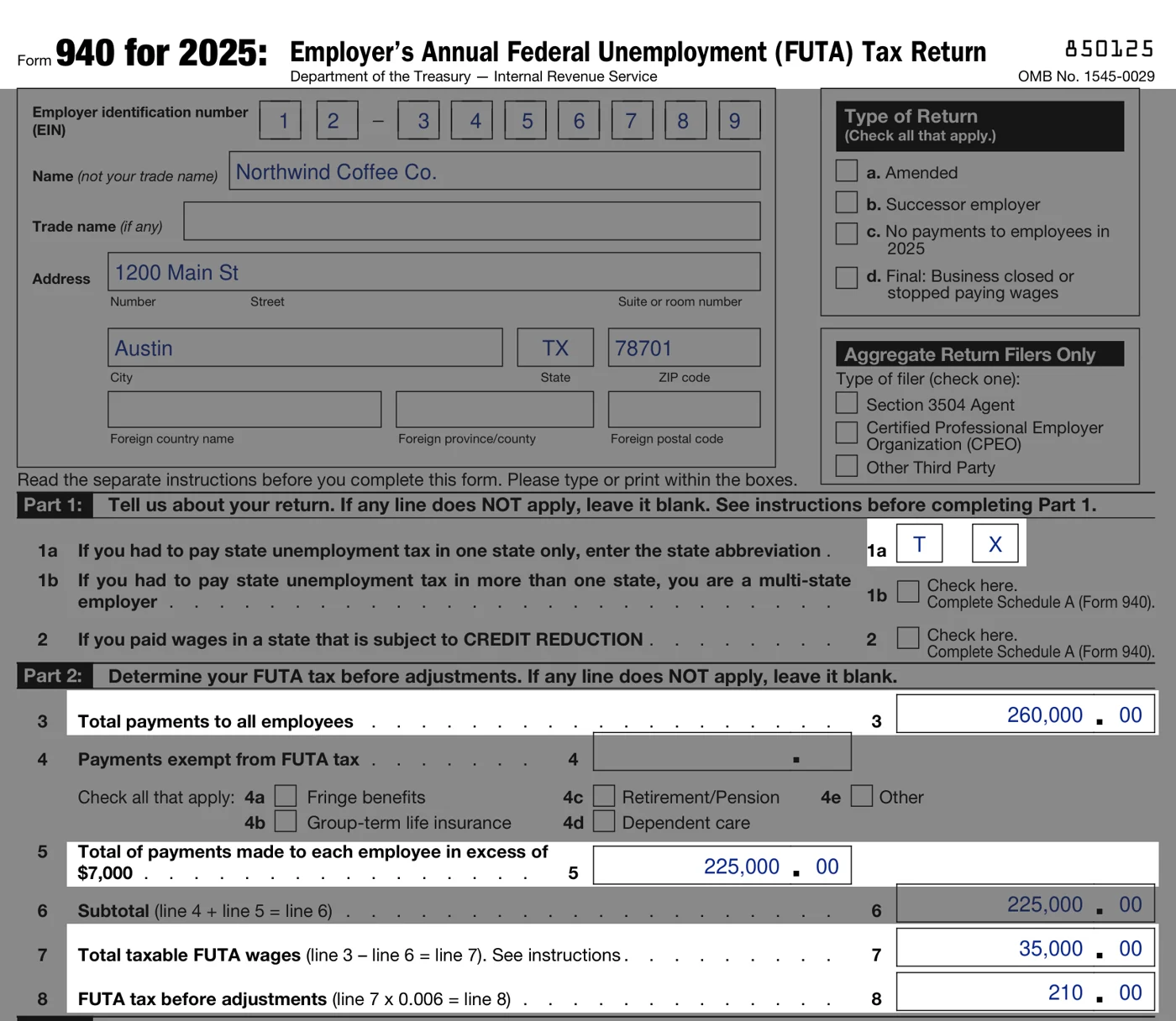
Employers who paid wages in more than one state or in a credit reduction state also complete Schedule A (Form 940).
Penalties for late deposits or filing
Late deposits trigger penalties that range from 2% to 15% depending on how late the payment is, plus interest. Filing Form 940 late adds a separate failure-to-file penalty. Small FUTA amounts can grow quickly once penalties stack up.
What Is FUTA on My Paycheck?
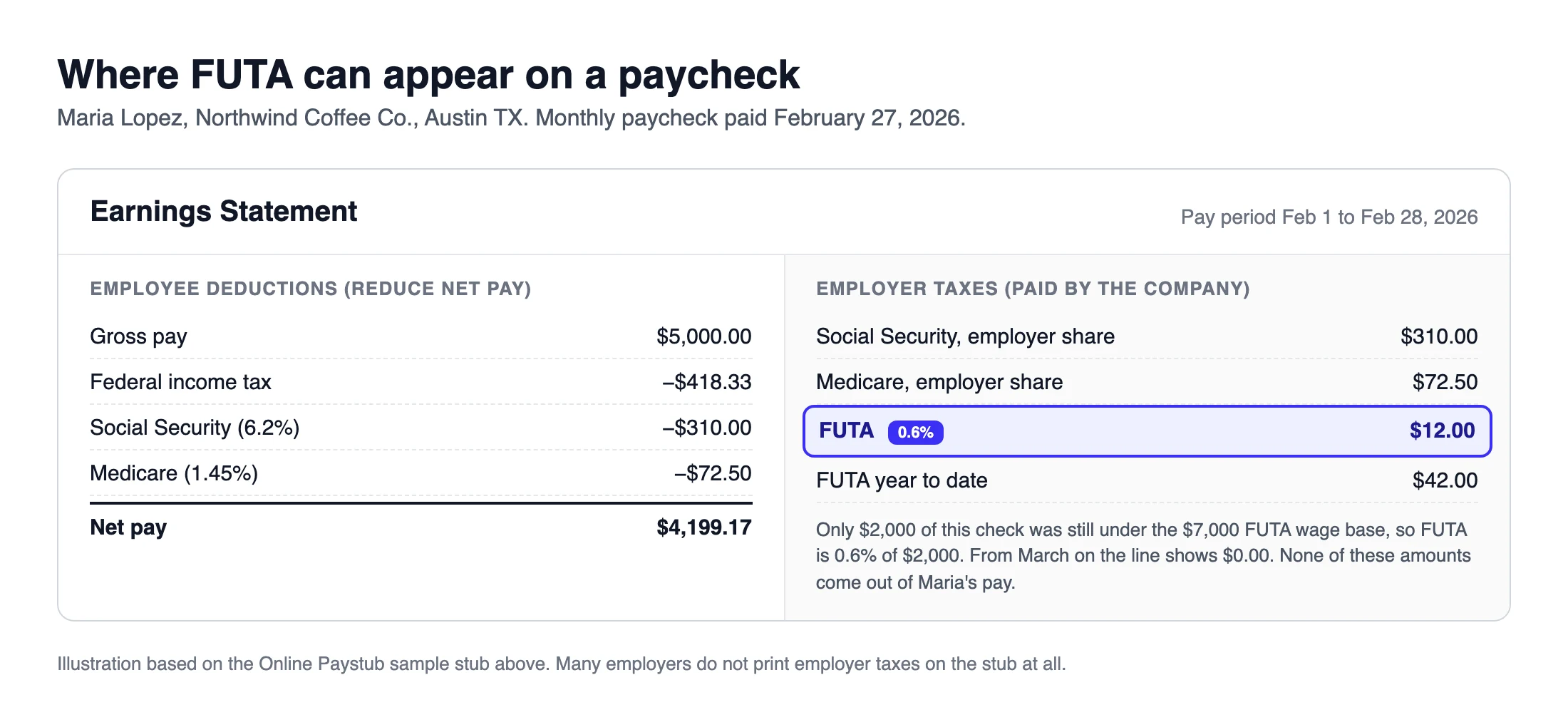
If you spotted "FUTA" on your paycheck and wondered why you are being taxed for unemployment, the short answer is that you are not. FUTA on a paycheck is your employer's federal unemployment tax, shown for transparency. It is the amount your employer pays on your wages to fund unemployment benefits. The money comes out of the company's pocket, not yours.
Here is how to read it:
- Location: FUTA normally appears under a heading such as "Employer Taxes," "Company Paid" or "Employer Contributions," separate from your own withholdings.
- Amount: at the standard 0.6% rate the line is small. On a $2,000 paycheck, for example, it would be about $12.
- Duration: it stops once your year-to-date earnings pass $7,000, so you may see it only on your first few paychecks of the year.
- Effect on take-home pay: none. Your net pay is calculated without it.
If FUTA is listed under your deductions and your net pay is lower because of it, that is a mistake. Ask your employer or payroll department to correct it and refund the amount.
Does FUTA appear on every paystub?
Usually not and that is expected. Because FUTA is paid entirely by the employer, it is not an employee deduction. A standard stub shows gross pay, withholdings such as federal income tax, Social Security, Medicare and state taxes, other deductions and net pay, the same building blocks explained in what a paystub is and what it includes.
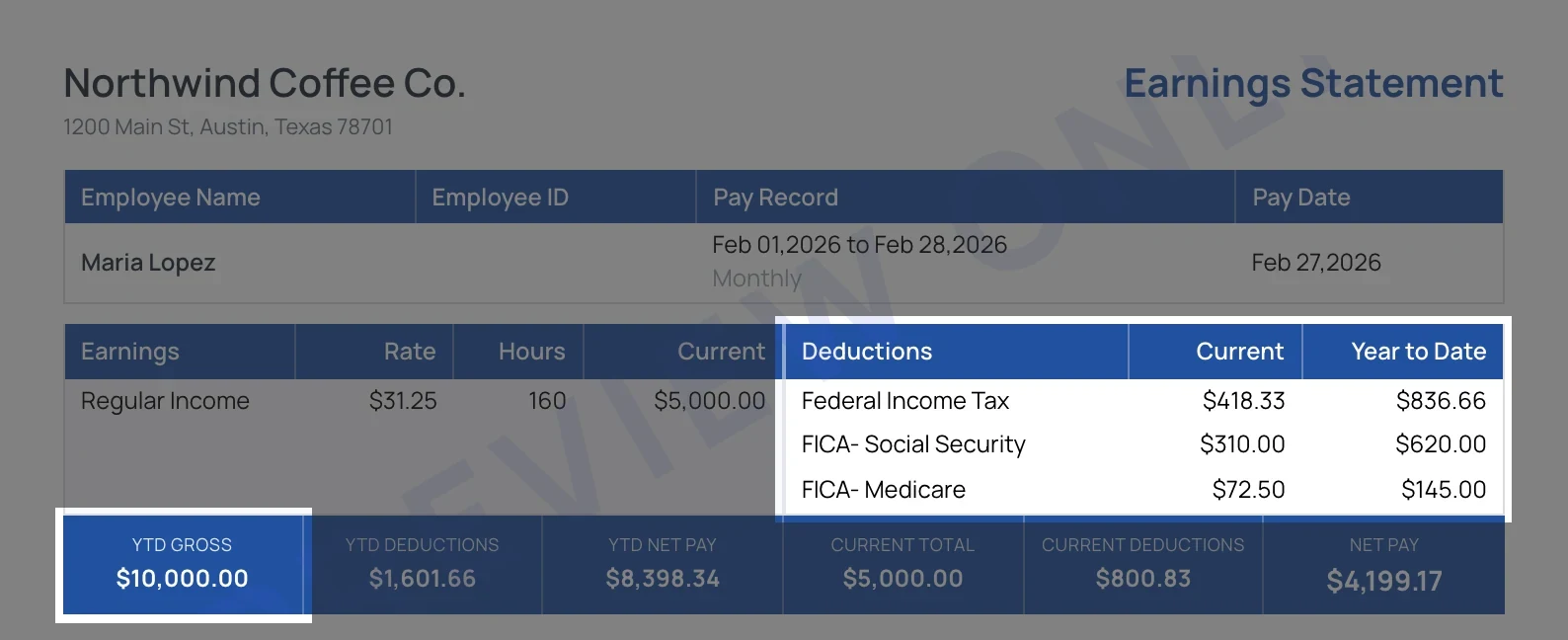
Some employers choose to list FUTA in an "employer contributions" box so workers can see the full cost of their employment. If you see a FUTA line on your payroll stub:
- It should not reduce your take-home pay.
- It should stop accruing once your YTD wages pass $7,000.
- A FUTA line listed under employee deductions is a payroll error worth reporting to your employer.
Common FUTA Mistakes to Avoid
- Withholding FUTA from employee paychecks. FUTA is an employer cost only.
- Ignoring the $7,000 cap. Continuing to calculate FUTA after an employee reaches the wage base overstates your liability.
- Paying SUTA late. Late state payments shrink your 5.4% credit and raise your effective FUTA rate.
- Forgetting credit reduction states. Employers in states like California owe extra FUTA when filing Form 940.
- Treating employees as contractors. Misclassified workers can lead to back FUTA, back FICA and penalties.
- Missing the $500 deposit rule. Carrying forward too long or depositing late creates avoidable penalties.
Keep Your Payroll Records Organized
FUTA depends on accurate wage tracking. Clean payroll records with correct gross pay and YTD totals for each employee make it easy to see when the $7,000 wage base is reached, fill out Form 940 and answer questions from employees or lenders. Small teams that outgrow spreadsheets often compare the best cheap payroll services for small businesses and with Online Paystub you can create professional pay stubs that show earnings, taxes, deductions and YTD totals in minutes.
Track every employee's YTD wages on a clear, professional pay stub.
Create a Pay Stub Now