
You open your pay stub and the federal income tax line is blank, shows $0.00 or is missing altogether. Social Security and Medicare are still there, along with state tax if your state has one. It looks like a mistake, but most of the time it comes straight from the Form W-4 on file or from how much you earn per pay period.
This 2026 guide shows how to confirm what your stub is telling you, the six most common reasons federal income tax is not withheld, what it means for your tax return and how to fix it before the year ends.
Check Your Pay Stub First
Start with the deductions section of your latest stub. Federal income tax usually appears as FIT, FED WH or Federal Income Tax, one of the standard pay stub abbreviations. Look at two columns:
- Current: what was withheld on this paycheck.
- Year to date: the running total since January 1. If the year-to-date total is also zero, nothing has been withheld all year, which points to your W-4 or your pay level rather than a one-off error.
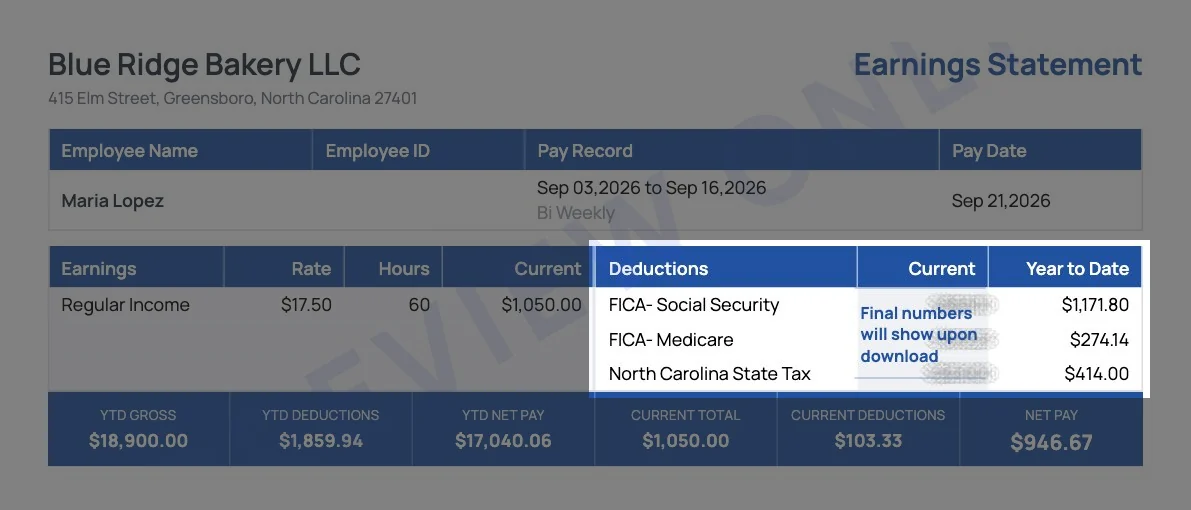
If Social Security and Medicare are also missing, you are probably being paid as a contractor rather than as an employee, which is a different situation covered below.
How Federal Withholding Works in 2026
Your employer does not decide how much federal income tax to take out. It runs your wages through the IRS withholding tables using the answers on your Form W-4:
- Step 1: filing status (single, married filing jointly or head of household).
- Step 2: multiple jobs or a working spouse.
- Step 3: credits for children and other dependents, which reduce withholding dollar for dollar.
- Step 4: other income, extra deductions and any extra amount you want withheld each paycheck.
The tables build the standard deduction into the calculation. For 2026 it is $16,100 for single filers, $32,200 for married couples filing jointly and $24,150 for heads of household. The 2026 W-4 also has a Deductions Worksheet for the new deductions on qualified tips, overtime pay and passenger vehicle loan interest, plus an extra $6,000 for filers aged 65 or older. Every dollar entered there lowers what is withheld from each check.
6 Common Reasons No Federal Income Tax Is Withheld
| Reason | What you see on the stub | What to do |
|---|---|---|
| Your W-4 claims exempt | No federal income tax line at all, Social Security and Medicare still withheld | Only keep exempt status if you owed no tax last year and expect to owe none this year |
| Your wages are low for the pay period | Federal income tax of $0.00 on small or part-time checks | Usually nothing, as long as your yearly income stays near or below the standard deduction |
| Large dependent credits in Step 3 | Little or no withholding even on a full-time check | Check that the credits match your real situation |
| Big deductions in Step 4(b) | Withholding dropped after you filed a new W-4 | Make sure the tips, overtime or other deductions you estimated are realistic |
| You are paid as a contractor | No federal tax, no Social Security and no Medicare | Pay your own tax through quarterly estimates |
| A payroll setup error | Withholding stopped with no change on your side | Ask payroll to review your W-4 record right away |
Exempt status only lasts one year
Claiming exempt on the W-4 is the most common cause of a completely missing federal line. You can only claim it if you had no federal income tax liability last year and expect none this year. The exemption is valid for one calendar year, so to stay exempt in 2027 you must give your employer a new W-4 by February 15, 2027. If you do not, your employer has to withhold as if you were single with no other adjustments.
Pre-tax deductions lower taxable wages
401(k) deferrals, health insurance premiums and HSA contributions come out before federal income tax is figured. A stub with large pre-tax deductions can show gross pay that looks taxable but a much smaller taxable amount behind the scenes.
Contractors have nothing withheld by design
If you receive a 1099 instead of a W-2, the business paying you withholds nothing. You pay income tax and self-employment tax yourself. That is why a pay stub for independent contractors should show no withholding lines at all.
Social Security and Medicare Are Separate
An exempt W-4 only stops federal income tax. It does not stop FICA. Employees still have 6.2% withheld for Social Security on wages up to $184,500 in 2026 and 1.45% for Medicare on all wages. State income tax is also handled separately, using the state's own withholding form. That is why a stub can show several deductions even when the federal income tax line is empty.
The $600 Myth
You may have heard that no federal tax is withheld on paychecks under $600. There is no such rule for employees: any paycheck can have tax withheld if the W-4 and the withholding tables call for it. The confusion comes from Form 1099-NEC, which used to be required for contractors paid $600 or more in a year. For payments made after 2025 that threshold is $2,000, under the current 1099-NEC instructions. It applies only to nonemployee pay.
What Happens at Tax Time
Withholding is a prepayment, not the tax itself. If too little was withheld, the difference shows up as a balance due when you file. You may also owe an underpayment penalty unless you owe less than $1,000 after withholding or you paid at least 90% of this year's tax or 100% of last year's tax (110% if your prior-year adjusted gross income was above $150,000).
Your final pay stub and your Form W-2 will show the same federal withholding total in Box 2. If both show zero while you earned well above the standard deduction, plan for a tax bill.
How to Fix Your Withholding
- Run the IRS Tax Withholding Estimator. The Tax Withholding Estimator uses your latest pay stub to project your 2026 tax and tells you what to enter on a new W-4.
- Submit a new Form W-4. Uncheck exempt if it no longer applies, update Step 3 and Step 4(b) to realistic amounts and consider an extra flat amount per paycheck in Step 4(c).
- Check the next two stubs. Your employer generally has to put a new W-4 into effect within about a month, so confirm the federal line reappears.
- Cover the gap for this year. If most of the year has passed, a larger Step 4(c) amount or an estimated tax payment can make up what was not withheld.
- Keep your records. Save the stubs and a copy of each W-4 you submit in case you need to show when the problem was fixed.
If your employer failed to apply a W-4 you submitted, ask payroll to correct it in writing. You still owe the tax on your return either way. If your W-2 later arrives with the wrong numbers and your employer does not fix it, the IRS can send you Form 4852, Substitute for Form W-2, based on your final pay stub.
Keep accurate records of every paycheck, including the tax lines, with a professional pay stub.
Create a Pay Stub Now