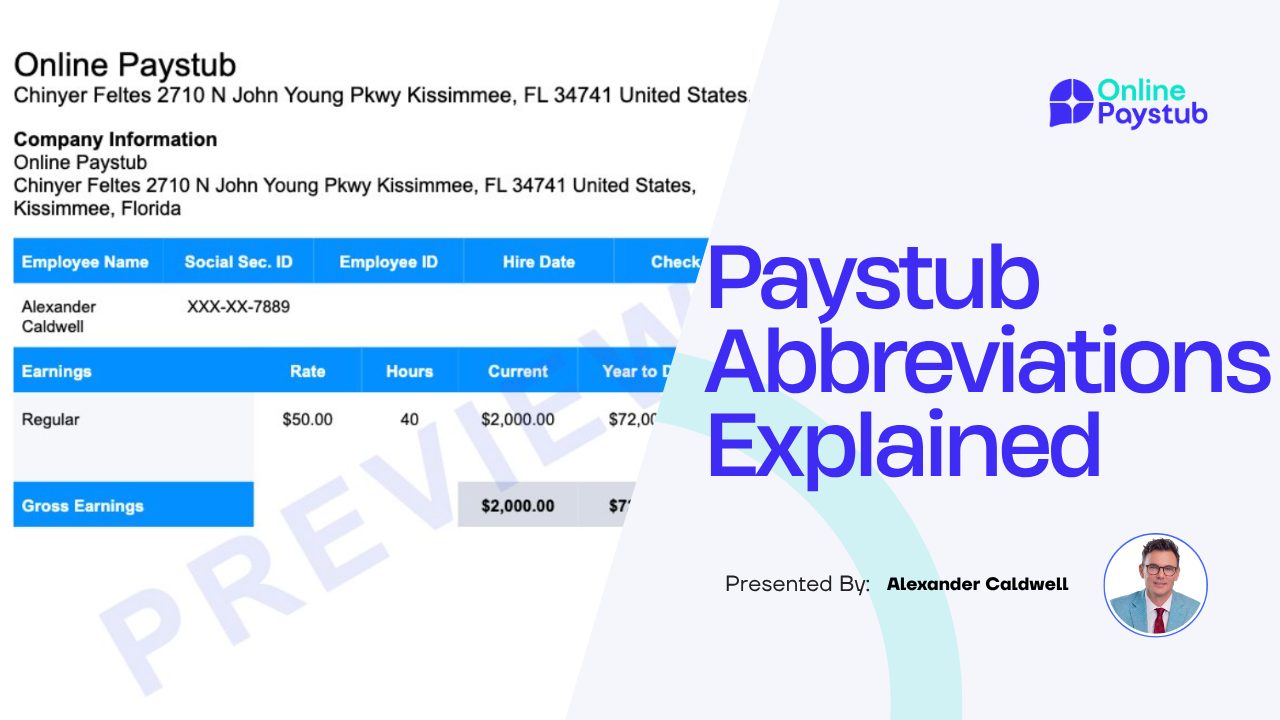

A paystub packs a full financial story into a few inches of paper or a single PDF: what you earned, what was withheld, where each dollar went, and how those numbers add up over the year. To fit all of that into a compact layout, payroll systems rely on abbreviations. Some are universal (GROSS, NET, FICA), some depend on your state (SDI, PFML, SUI), and a few are brand new for 2026 because of federal tax changes that took effect this year.
Whether you call it a paystub, pay stub, paycheck stub, payroll stub or check stub, the codes work the same way, and reading them correctly matters more than ever. Payroll errors are common, tax withholding is easy to get wrong after a life change, and lenders, landlords and government agencies routinely ask for pay stubs as proof of income. If you cannot read your own stub, you cannot catch a mistake.
This guide explains every common abbreviation you are likely to see in 2026, organized by section of the stub, with the current year's tax rates, wage bases and contribution limits so you can check the math yourself.
How a 2026 Pay Stub Is Organized
Almost every paystub, whether printed by a large payroll provider or generated for a small business, follows the same structure:
- Header: employer name and address, employee name, employee ID, pay period start and end dates, pay date, and often the check or advice number.
- Earnings: every type of pay you received this period (regular, overtime, holiday, bonus, tips), usually with hours, rate, current amount and year-to-date amount.
- Taxes: federal, state and local withholdings, plus Social Security and Medicare.
- Deductions: benefits, retirement contributions, garnishments and other withholdings, typically split into pre-tax and post-tax.
- Employer contributions (memo items): amounts your employer pays on your behalf that do not reduce your pay but are shown for transparency.
- Net pay: what is actually deposited or printed on the check.
- YTD summary: running totals for the calendar year.
Most abbreviations belong to one of these sections, so knowing which section you are looking at is half the work.
Earnings Abbreviations
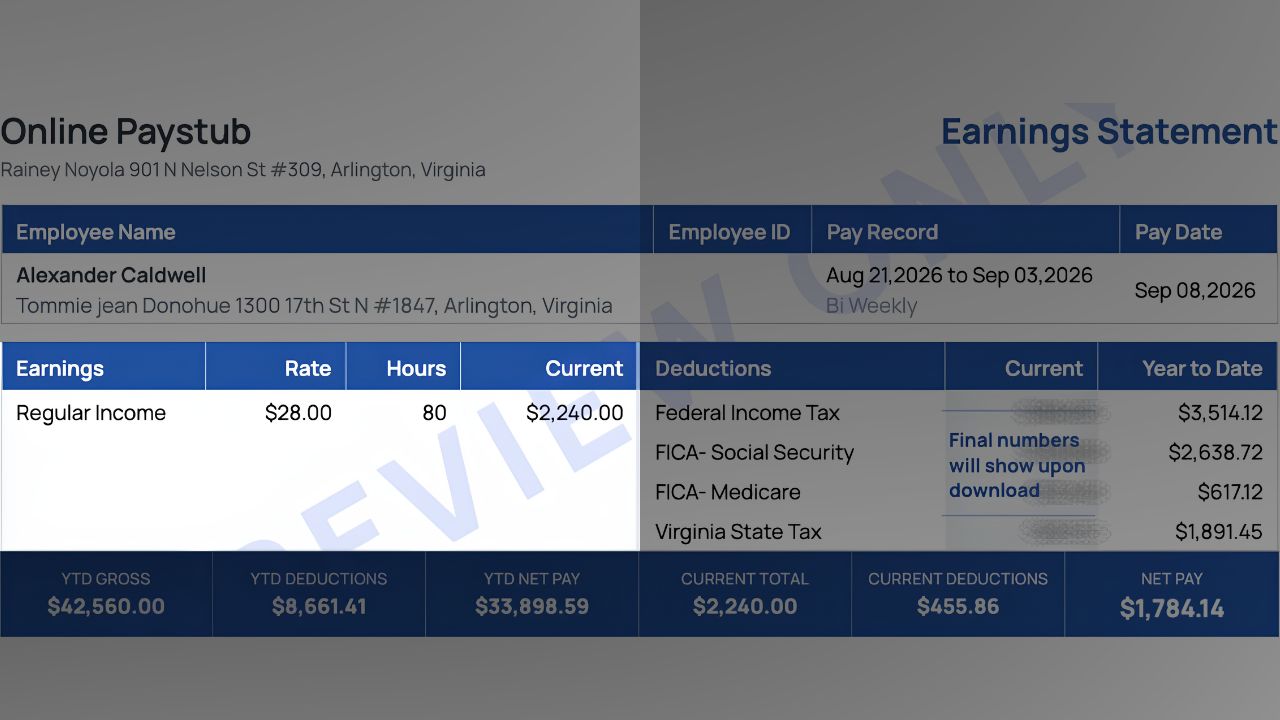
The earnings block shows gross pay broken down by type. Common codes:
| Code | Meaning | Notes |
|---|---|---|
| REG | Regular pay | Base hourly wages or salary for the period |
| OT or OVT | Overtime pay | Hours over 40 in a workweek (or daily overtime in states like California) |
| OT PREM or QOT | Overtime premium / qualified overtime | New in 2026, see below |
| DT | Double time | Typically 2x rate, required in some states or union contracts |
| HOL | Holiday pay | Paid company holidays |
| VAC | Vacation pay | Vacation hours taken |
| SICK | Sick pay | Sick leave hours taken |
| PTO | Paid time off | Combined vacation and sick bank |
| BON or BNS | Bonus | Discretionary or performance bonus |
| COMM | Commission | Sales-based earnings |
| TIPS or TIP | Reported tips | Cash and charge tips reported to the employer |
| TIPS-Q or QTIP | Qualified tips | New in 2026, see below |
| RETRO | Retroactive pay | Back pay for a rate change applied to earlier periods |
| SEV | Severance pay | Paid at separation |
| SHIFT or DIFF | Shift differential | Premium for night, weekend or hazardous shifts |
| PIECE | Piece-rate pay | Pay per unit produced |
| ADJ | Adjustment | Correction to a prior period |
| GTL | Group-term life (imputed income) | Taxable value of employer-paid life insurance over $50,000 |
| GROSS | Gross pay | Total of all earnings before any withholding |
What "HOL" means on a paycheck
HOL stands for holiday pay: compensation for a company-recognized holiday on which you were not required to work. Three things to know:
- It is separate from VAC and SICK. Holiday pay does not draw down your vacation or sick balance.
- It is usually paid at your regular rate. If you actually work the holiday, some employers pay a premium (often shown as HOL PREM or HOL WORKED).
- It may or may not count toward overtime. Federal law does not require employers to count paid holiday hours as hours worked when calculating overtime. Some company policies and union agreements do. Check your handbook if your overtime looks lower than expected in a holiday week.
New for 2026: qualified overtime and qualified tips
The federal tax law enacted in 2025 (the One Big Beautiful Bill Act) created two new deductions for tax years 2025 through 2028: a deduction for qualified tips (up to $25,000) and a deduction for qualified overtime compensation (up to $12,500 for single filers, $25,000 for joint filers). To make those deductions workable, the IRS added new reporting requirements starting with 2026 wages:
- Form W-2 Box 12, code TT reports total qualified overtime compensation for the year.
- Form W-2 Box 12, code TP reports total cash tips reported to the employer.
- Form W-2 Box 14b carries a Treasury Tipped Occupation Code for tipped employees.
Because employers must now track these amounts separately, many 2026 paystubs show new or split earnings lines. The most important detail: only the overtime premium counts as qualified overtime. If you earn $20 per hour and receive $30 per hour for overtime, only the extra $10 per hour is qualified. That is why you may see your overtime split into two lines, for example OT (the regular-rate portion) and OT PREM or QOT (the half-time premium). Common label variations include QUAL OT, OT-PREM, FLSA OT and QOT.
Two important cautions. First, these amounts are still subject to normal withholding and to Social Security and Medicare tax during the year; the deduction is claimed when you file your return. Second, qualified overtime applies only to overtime required under the federal Fair Labor Standards Act, so most salaried exempt employees will not see these lines at all.
Tax Abbreviations
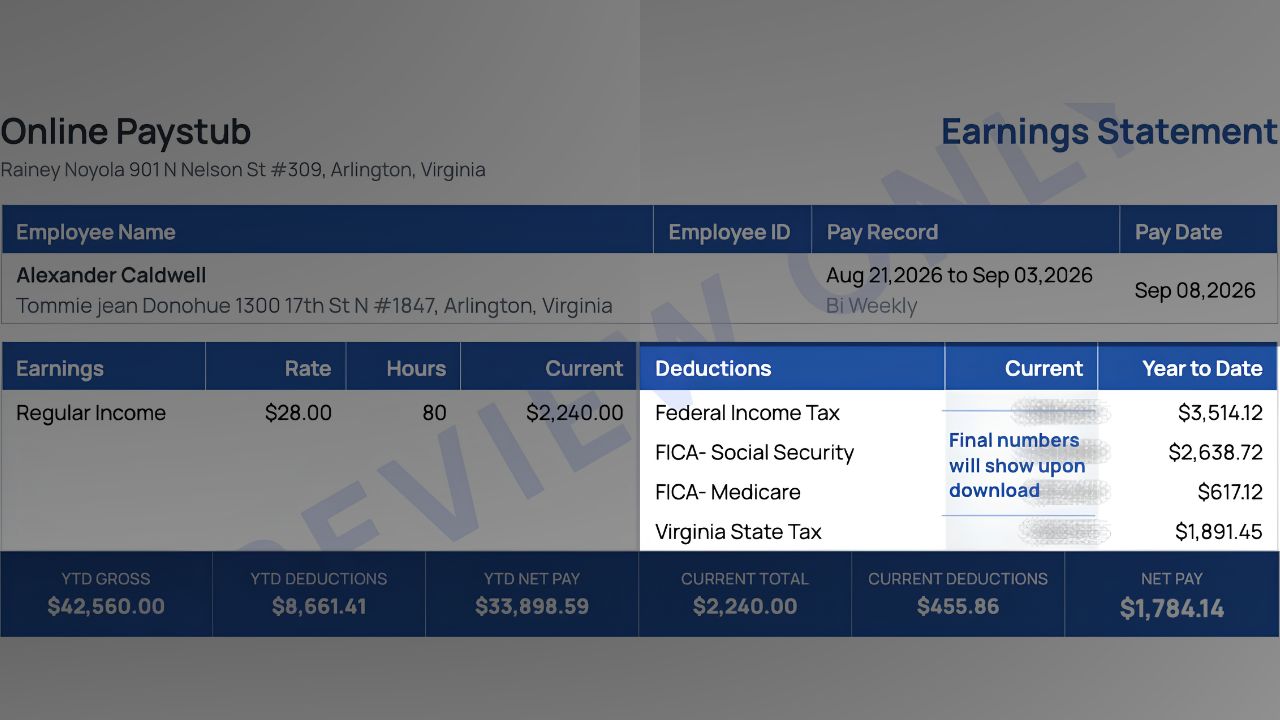
The taxes block is where the largest chunk of your gross pay disappears. Here are the codes and the 2026 figures that go with them.
| Code | Meaning | 2026 details |
|---|---|---|
| FED, FIT, FWT | Federal income tax withheld | Based on your Form W-4 and IRS Publication 15-T tables |
| FICA | Federal Insurance Contributions Act | Umbrella term for Social Security plus Medicare, 7.65% combined for most employees |
| SS, OASDI, SOC SEC | Social Security tax | 6.2% on wages up to $184,500 in 2026 (up from $176,100) |
| MED, HI, MEDICARE | Medicare tax | 1.45% on all wages, no cap |
| ADDL MED, MED2, MEDICARE SURTAX | Additional Medicare tax | Extra 0.9% withheld on wages above $200,000 in a calendar year |
| STATE, SIT, SWT | State income tax withheld | Nine states have no wage income tax (AK, FL, NV, NH, SD, TN, TX, WA, WY) |
| LOCAL, CITY, LIT | Local income tax | Cities, counties and school districts in states such as OH, PA, MD, IN, MI and NY |
| SDI, CASDI, TDI | State disability insurance | Employee-paid in CA, NJ, NY, RI and HI; California removed its wage cap in 2024 |
| PFL, PFML, FAMLI | Paid family and medical leave | Employee contributions in states such as CA, NY, NJ, WA, MA, CT, OR, CO, MN and DE |
| SUI, SUTA, UI | State unemployment insurance | Normally employer-paid, but employees also contribute in AK, NJ and PA |
| WC | Workers' compensation | Employee contribution shown only in a few states (WA, for example) |
Understanding FICA in 2026
FICA is not a single tax; it is two. On a stub it may appear as one FICA line or as separate SS and MED lines.
- Social Security (OASDI): 6.2% of wages until you reach the 2026 wage base of $184,500. Once your YTD Social Security wages cross that line, the SS deduction stops for the rest of the year. If you change employers mid-year, each employer withholds up to the cap independently and you recover any excess when you file.
- Medicare (HI): 1.45% with no wage cap.
- Additional Medicare: once your YTD Medicare wages exceed $200,000, your employer must withhold an extra 0.9%, regardless of your filing status. Your final liability depends on your combined household income, which is reconciled on Form 8959.
Your employer matches the 6.2% and 1.45% but does not match the 0.9% surtax. The employer share does not appear in your deductions, though some stubs list it in an employer contributions section.
Federal income tax (FED) and your W-4
FED withholding depends entirely on the Form W-4 you gave your employer: filing status, multiple-job adjustments, dependents and any extra withholding. If your circumstances changed this year (marriage, a second job, a new child), your FED line may be too high or too low. The IRS Tax Withholding Estimator is the quickest way to check, and you can submit a new W-4 at any time.
Pre-Tax Deduction Abbreviations
Pre-tax deductions reduce your taxable wages before federal and, in most cases, state income tax is calculated. Some also reduce FICA wages (Section 125 benefits) while others do not (traditional 401(k) contributions still owe FICA).
| Code | Meaning | 2026 limits and notes |
|---|---|---|
| 401K, 401(K) | Traditional 401(k) contribution | Employee deferral limit $24,500; catch-up $8,000 at age 50+, $11,250 at ages 60 to 63 |
| 403B, 457 | 403(b) / 457(b) plan contribution | Same $24,500 deferral limit |
| SIMPLE | SIMPLE IRA contribution | $17,000 limit, $4,000 catch-up |
| MED, MEDICAL, HLTH | Medical insurance premium | Pre-tax under a Section 125 cafeteria plan |
| DENT, DNTL | Dental insurance premium | |
| VIS, VSN | Vision insurance premium | |
| FSA, HCFSA, MEDFSA | Health flexible spending account | $3,400 salary-reduction limit; up to $680 carryover if your plan allows |
| DCFSA, DEPCARE, DCAP | Dependent care FSA | Limit raised to $7,500 in 2026 (from $5,000), $3,750 if married filing separately |
| LPFSA | Limited-purpose FSA | Dental and vision only, paired with an HSA |
| HSA | Health savings account | $4,400 self-only, $8,750 family, plus $1,000 catch-up at 55+ (limits include employer contributions) |
| TRANSIT, PARK, COMMUTER | Qualified transportation benefits | Monthly pre-tax limit of $340 each for transit and parking in 2026 |
| STD, LTD | Short-term / long-term disability premium | May be pre-tax or post-tax; post-tax premiums make future benefits tax-free |
Watch the MED code carefully. On many stubs MED means Medicare tax in the taxes block and medical insurance in the deductions block. Location tells you which one you are looking at.
Retirement: a 2026 change that affects higher earners
Starting in 2026, employees whose prior-year Social Security wages from the same employer exceeded $150,000 must make catch-up contributions as Roth (after-tax) rather than pre-tax. If you are 50 or older and earned above that threshold, expect your catch-up amount to move from the 401K line to a ROTH 401K or R401K line this year.
Post-Tax Deduction Abbreviations
These are taken after taxes are calculated and do not reduce your taxable income.
| Code | Meaning | Notes |
|---|---|---|
| ROTH, R401K, ROTH 401K | Roth 401(k) contribution | Same $24,500 combined limit with traditional deferrals |
| LIFE, GTL, SUPP LIFE | Life insurance premium | Employee-paid or supplemental coverage |
| GARN, GARNISH, LEVY | Wage garnishment | Court-ordered debt repayment, tax levy or student loan garnishment |
| CHILD SUP, CS, CSUP | Child support | Income withholding order |
| UNION, DUES | Union dues | Where applicable |
| CHAR, UW, DONATE | Charitable contribution | Workplace giving programs |
| LOAN, 401K LOAN | Loan repayment | Repaying a 401(k) or employer loan |
| ADV, ADVANCE | Payroll advance repayment | |
| UNIFORM, TOOLS | Uniform or equipment deduction | Cannot reduce pay below minimum wage under federal law |
| AFLAC, SUPP INS | Supplemental insurance | Accident, cancer, hospital indemnity plans |
| ESPP | Employee stock purchase plan | After-tax payroll contributions toward company stock |
Employer Contribution and Memo Abbreviations
These lines show what your employer spends on you beyond your wages. They do not change your net pay but they matter for understanding total compensation.
| Code | Meaning |
|---|---|
| ER 401K, MATCH, 401K ER | Employer retirement match or contribution |
| ER HSA | Employer HSA contribution (counts toward your annual HSA limit) |
| ER MED, ER HEALTH | Employer share of health premiums |
| ER SS, ER MED | Employer share of Social Security and Medicare |
| FUTA, SUTA | Federal and state unemployment tax paid by the employer |
| TA, TRUMP ACCT | Employer contributions to a Trump account, a new 2026 W-2 code |
| IMP INC, IMPUTED | Imputed income, the taxable value of a non-cash benefit |
Combined employer and employee contributions to a 401(k) are capped at $72,000 in 2026 (not counting catch-ups), so the MATCH line is also worth tracking if you are a high saver.
Time Off and Balance Abbreviations
Many stubs include a leave balance section:
| Code | Meaning |
|---|---|
| ACCR or ACC | Hours accrued this period |
| USED or TAKEN | Hours used this period |
| BAL or AVAIL | Available balance |
| CARRY | Hours carried over from the previous year |
| PSL | Paid sick leave (a legal term in states and cities with sick leave mandates) |
| COMP | Compensatory time, mostly in public-sector jobs |
If you work in a state with a paid sick leave law (such as California, New York, Washington, Colorado, Illinois or Minnesota), your employer may be legally required to show your sick leave balance on the pay stub or in a separate notice each pay period.
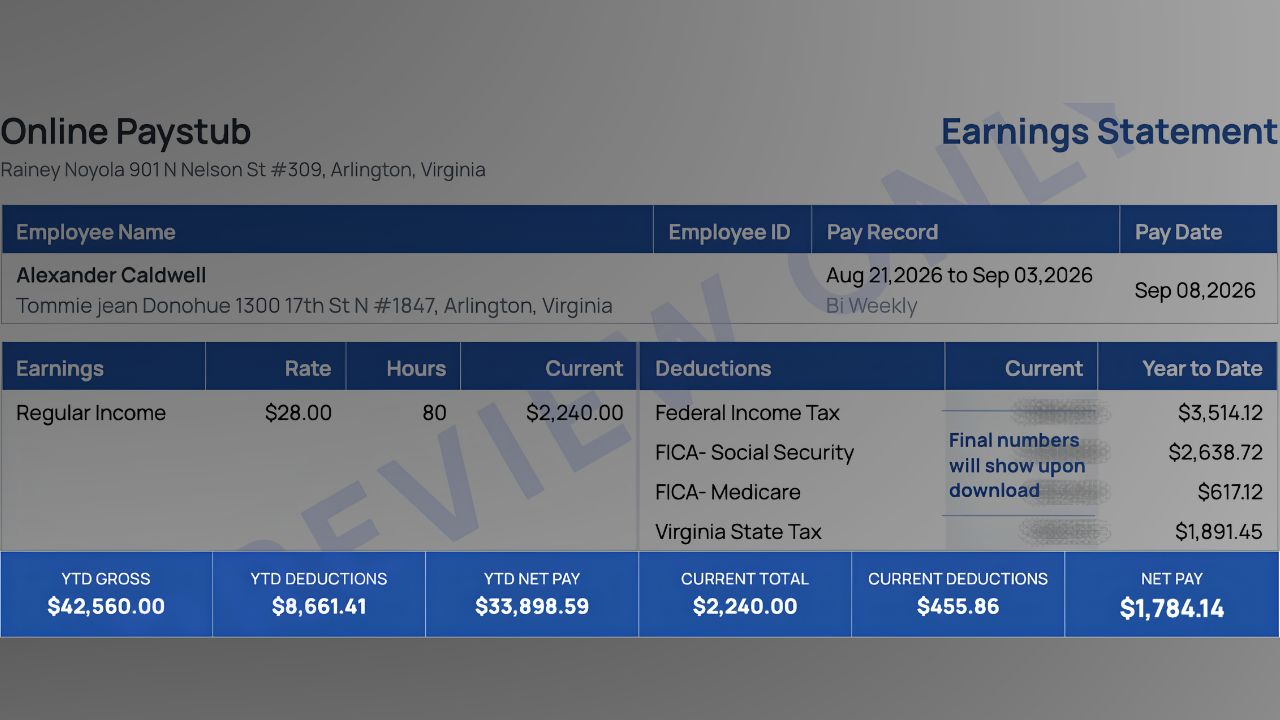
YTD, Gross and Net: The Numbers That Tie Everything Together
GROSS vs NET
Gross pay is everything you earned before withholding: regular wages, overtime, bonuses, commissions, holiday pay and taxable fringe benefits. Net pay is what remains after taxes and deductions. The gap between them is typically 20% to 35% for most employees, depending on state, benefits and retirement contributions.
A useful check each pay period: gross minus taxes minus deductions should equal net exactly. If it does not, either a line is missing from the printout or something was calculated incorrectly.
Taxable wages vs gross wages
Your stub may show several different "wage" figures, and they are not supposed to match:
- Federal taxable wages = gross minus pre-tax deductions (401K, Section 125 benefits, FSA, HSA).
- Social Security wages = gross minus Section 125 benefits, but not minus 401(k), capped at $184,500.
- Medicare wages = same as Social Security wages but with no cap.
- State taxable wages = usually the same as federal, though a few states treat 401(k) or Section 125 contributions differently (Pennsylvania and New Jersey are common exceptions).
These figures flow directly into Boxes 1, 3, 5 and 16 of your W-2, so your final December stub is the best preview of your tax forms.
What YTD means
YTD (year-to-date) is the cumulative total from January 1 through the current pay date. Every earnings, tax and deduction line typically has both a current column and a YTD column. YTD figures let you:
- Confirm you are on track to hit (and not exceed) 401(k), HSA and FSA limits before year end.
- See exactly when your Social Security withholding will stop for the year.
- Project your annual taxable income and adjust your W-4 before it is too late.
- Verify that a mid-year raise or bonus was actually applied.
Note that YTD always follows the pay date, not the period worked. Wages for work done in late December but paid in January count toward the next year.
Why Abbreviations Differ Between Employers
There is no federal standard for pay stub codes. Each payroll system, and often each employer within a system, chooses its own labels. The same deduction can appear as MED, MEDICAL, HLTH, HEALTH INS or BCBS depending on who set up the payroll. Large payroll providers each have their own house style, and small businesses using generator tools or spreadsheets often write out labels in full.
If a code on your stub is not on this list, three quick ways to decode it:
- Look at which section it sits in (earnings, taxes, deductions).
- Check whether it appears in the pre-tax or post-tax group.
- Ask HR or payroll; employers are required to explain deductions, and in many states are required to itemize them.
What Employers Must Show: State Pay Stub Requirements in 2026
Federal law (the FLSA) requires employers to keep accurate payroll records but does not require them to give employees a pay stub. Most states do. As of 2026:
- Roughly a dozen states, including Alabama, Florida, Georgia, Ohio and Tennessee, have no pay stub requirement.
- Most states require either a printed or electronic stub, with electronic delivery allowed as long as employees can access and print it.
- A handful of states, including Delaware, Minnesota and Oregon, allow electronic stubs only if the employee consents or can opt out to paper.
- States with itemization rules (California is the strictest under Labor Code section 226) require specific fields: gross wages, total hours, all deductions, net wages, pay period dates, employee name and ID, employer legal name and address, and applicable hourly rates. California employers face statutory penalties for non-compliant stubs.
For employees, the practical takeaway is that a detailed stub with clearly labeled abbreviations is not just good practice; in many states it is a legal right.
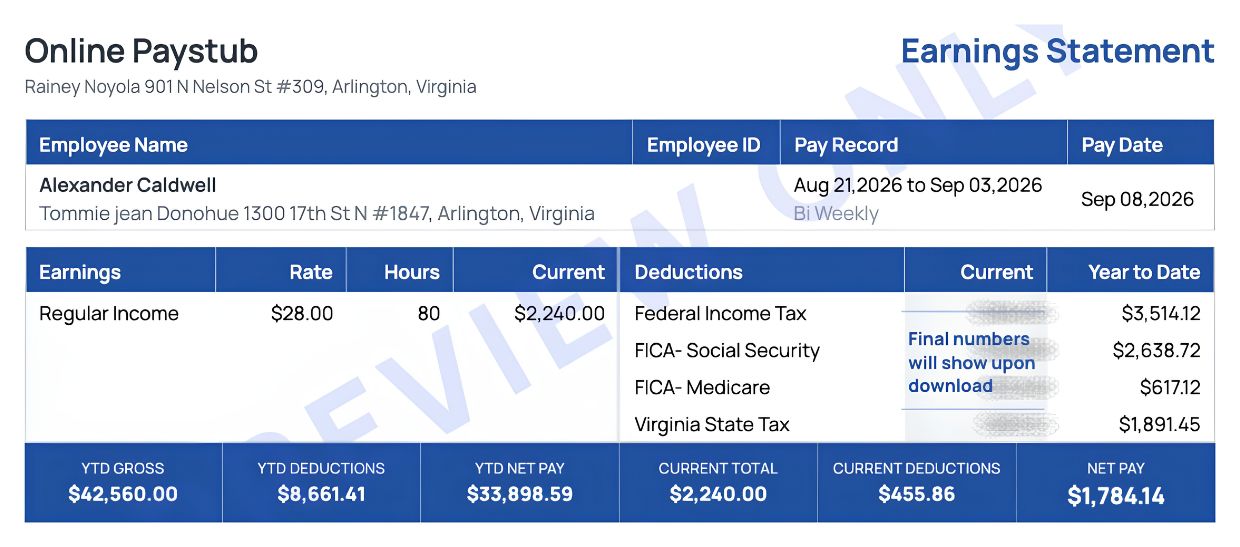
A Step-by-Step Review of Your Paystub
Reviewing every stub takes two minutes once you know the codes. Work through it in this order:
- Header: confirm the pay period dates and that your name, address and filing status are current.
- Hours and rate: for hourly employees, multiply hours by rate for each earnings line and confirm overtime hours are correct. In 2026, check that overtime premium is being tracked separately if you are non-exempt.
- Gross pay: add the earnings lines and confirm they match GROSS.
- FICA math: SS should be 6.2% of Social Security wages (until $184,500 YTD); MED should be 1.45% of Medicare wages. If you are above $200,000 YTD, confirm the extra 0.9% is being withheld.
- FED and STATE: compare with last period. Unexplained jumps usually mean a W-4 change, a bonus taxed at the supplemental rate, or a payroll error.
- Deductions: match every line to a benefit or authorization you actually signed up for. Watch for duplicate premiums after an enrollment change.
- YTD limits: if your YTD 401K is near $24,500 or your HSA near the annual limit, confirm payroll will stop contributions automatically.
- Net pay: verify gross minus taxes minus deductions equals the deposit amount.
- Leave balances: confirm accruals and usage match your records.
Report discrepancies in writing right away. Most payroll corrections are easy within the same quarter and painful after a W-2 has been issued.
Need a compliant, itemized paystub with 2026 tax logic built in?
Create a Pay Stub NowPay stub abbreviations look cryptic only until you know the structure behind them. Earnings at the top, taxes in the middle, deductions below, net pay and YTD totals at the bottom. Once you can place each code in its section, you can verify your FICA math against the 2026 wage base, confirm your retirement and health account contributions are on track, and spot the new qualified overtime and tip lines that appeared this year.