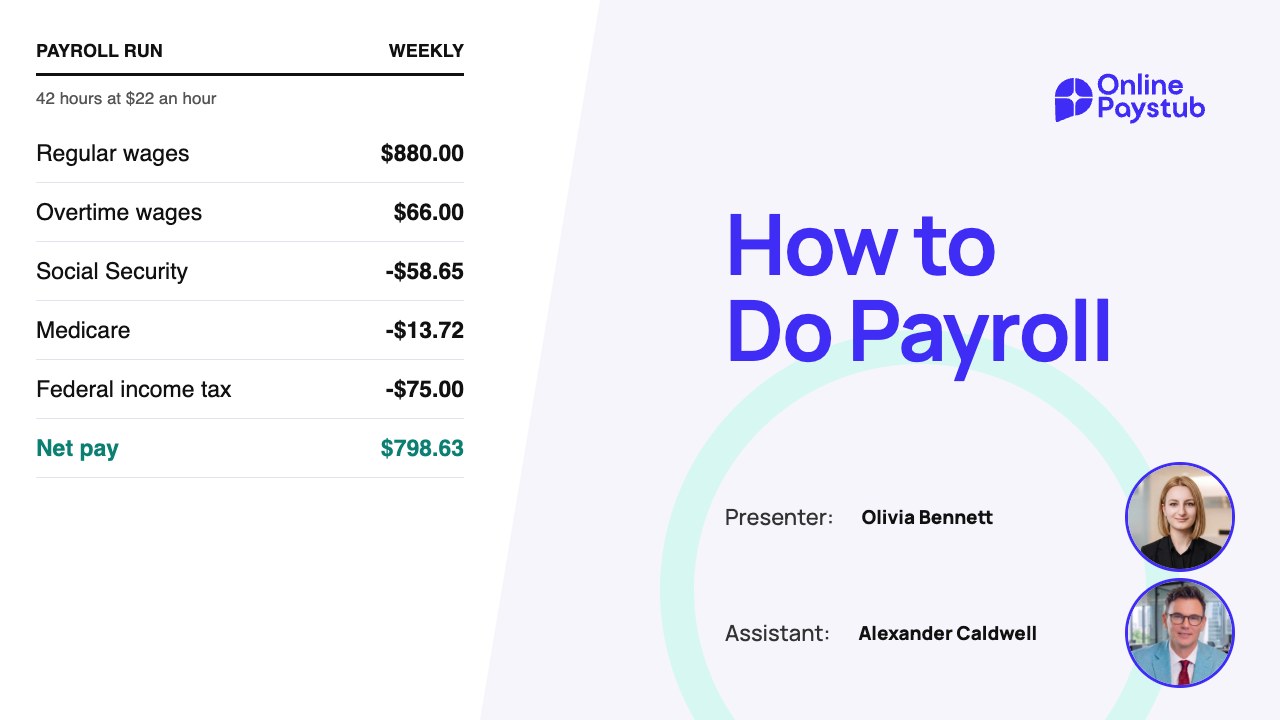
Payroll taxes are taxes tied to employee wages that employers must calculate, withhold, report and pay to federal and state agencies. In 2026 the main federal payroll taxes are Social Security and Medicare under FICA plus federal unemployment tax under FUTA. Employers may also owe state unemployment tax and other state contributions.
For most employees, Social Security and Medicare come to 7.65% of covered wages. The employer pays another 7.65%. Social Security has an annual wage limit, Medicare has an extra tax for high earners and unemployment taxes are generally paid by the employer.
This guide covers the types of payroll taxes, the 2026 rates, what employers owe, what employees pay and how to calculate it all.
What Are Payroll Taxes?
Payroll taxes are taxes on employee pay that fund Social Security, Medicare and unemployment insurance. Employers calculate them, withhold the employee share, add their own share where required and send the money to the right agencies.
Payroll taxes and income taxes are related but not the same. The term usually means Social Security, Medicare and unemployment taxes. Income tax withholding is a big part of running payroll, but it follows separate rules.
The main payroll-related taxes are:
- Social Security tax: funds retirement, disability and survivor benefits.
- Medicare tax: funds Medicare health coverage.
- Federal unemployment tax (FUTA): supports the federal-state unemployment system.
- State unemployment tax (SUTA): funds state unemployment insurance.
- Federal income tax withholding: income tax taken from wages under IRS rules.
- State and local payroll taxes: extra taxes or required contributions in some places.
Some of these are shared by employer and employee. Others are paid only by the employer.
Who Pays Payroll Taxes: Employers or Employees?
Both pay, but not the same taxes. Employees pay their share of Social Security and Medicare through paycheck deductions. The employer withholds that amount and adds a matching employer share. Employers also pay federal and state unemployment taxes without taking anything from wages.
| Payroll tax | Employee pays | Employer pays |
|---|---|---|
| Social Security | 6.2% | 6.2% |
| Medicare | 1.45% | 1.45% |
| Additional Medicare Tax | 0.9% when it applies | No matching share |
| FUTA | No | Generally 0.6% effective rate with the full credit |
| SUTA | Usually no | Rate varies by state and employer |
| Federal income tax | Employee's liability | Withholds and remits |
| State income tax | Where it applies | Withholds and remits |
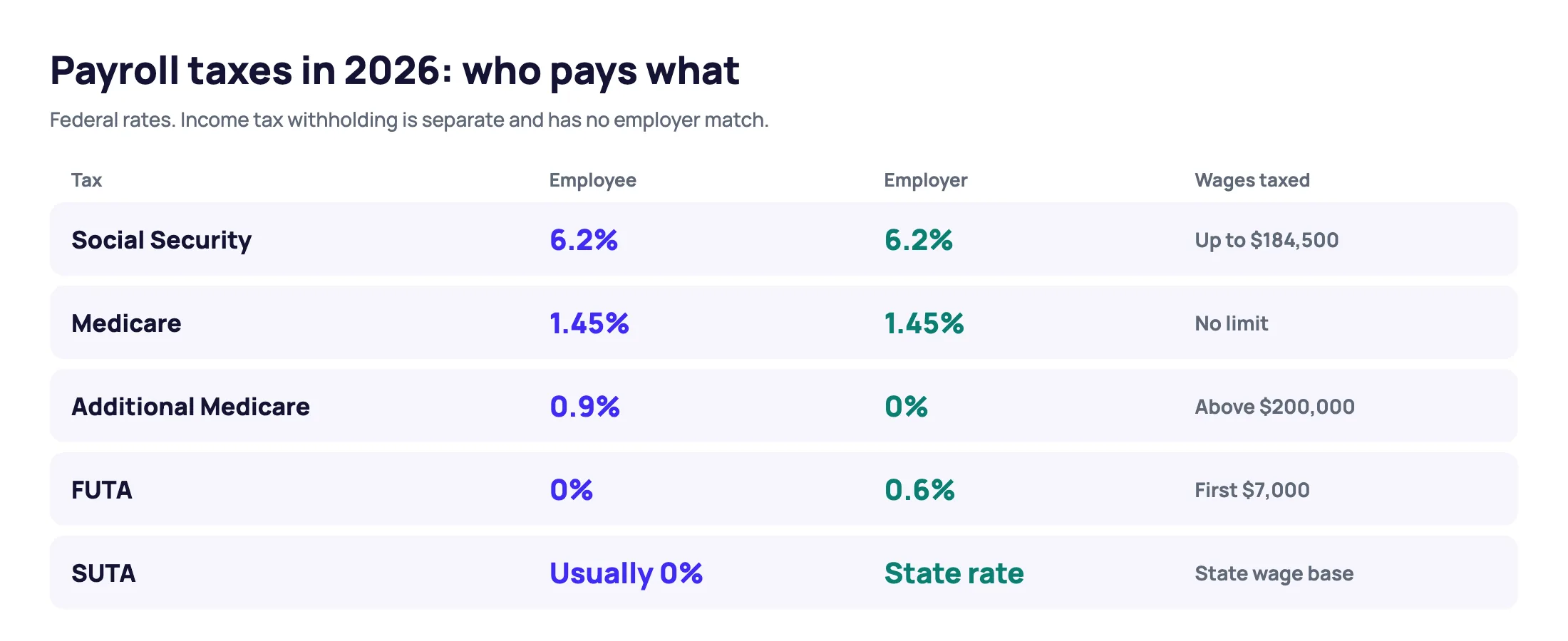
Some states charge employees for unemployment insurance or other payroll programs, so the table shows the general federal picture rather than every state rule.
Below the Social Security wage limit, combined employee and employer FICA is 15.3% of covered wages. Employers also have to budget for unemployment taxes and any state or local obligations.
Types of Payroll Taxes in 2026
Each payroll tax has its own purpose, rate and payment rules. Employers need to know which ones come out of employee pay and which ones are business expenses.
1. Social Security Tax
Social Security tax funds retirement, disability and survivor benefits. In 2026 employees pay 6.2% of covered wages and employers pay another 6.2%, for a combined 12.4%. The tax stops once wages reach the annual limit.
| 2026 Social Security tax | Amount |
|---|---|
| Employee rate | 6.2% |
| Employer rate | 6.2% |
| Annual taxable wage limit | $184,500 |
| Maximum annual tax per party | $11,439 |
The Social Security Administration raised the taxable wage base from $176,100 in 2025 to $184,500 in 2026.
An employee earning $60,000 pays $3,720 in Social Security tax and the employer pays another $3,720. An employee earning $200,000 pays only on the first $184,500, which caps the employee's tax at $11,439.
2. Medicare Tax
Medicare tax funds health coverage mainly for older adults and some people with disabilities. Unlike Social Security, it has no wage limit.
- Employee share: 1.45%.
- Employer share: 1.45%.
- Combined: 2.9%.
An employee with $80,000 of Medicare wages pays $1,160 and the employer pays another $1,160. The tax keeps applying after the employee passes the Social Security limit.
On paystubs the deduction often shows as MED, Medicare or MED EE, the employee share of Medicare.
3. Additional Medicare Tax
Higher earners may owe an extra 0.9% Additional Medicare Tax on Medicare wages above a threshold that depends on filing status.
| Filing status | Additional Medicare Tax threshold |
|---|---|
| Single | $200,000 |
| Head of household | $200,000 |
| Married filing jointly | $250,000 |
| Married filing separately | $125,000 |
| Qualifying surviving spouse | $200,000 |
Employers must start withholding it once they pay an employee more than $200,000 in the calendar year, whatever the employee's filing status. The employer does not match this 0.9%.
If one employer pays an employee $220,000 in 2026, it withholds an extra $180 on the $20,000 above the threshold. The employee's final bill can differ depending on filing status and other income.
4. Federal Unemployment Tax (FUTA)
The Federal Unemployment Tax Act requires most employers to pay federal unemployment tax, which works alongside state programs. It is employer-paid; nothing comes out of employee wages.
The standard rate is 6% on the first $7,000 paid to each employee in the year. Employers that get the full 5.4-point credit for state unemployment tax pay an effective 0.6%.
| FUTA component | Amount |
|---|---|
| Standard FUTA rate | 6.0% |
| Maximum state credit | 5.4 percentage points |
| Effective rate with full credit | 0.6% |
| Annual wage base | $7,000 |
| Annual FUTA with full credit | $42 per employee |
An employer paying someone $50,000 a year generally owes $42 of FUTA for that employee with the full credit. Employers in credit reduction states pay more. The fine print on FUTA covers eligibility, wage limits and the math.
5. State Unemployment Tax (SUTA)
State unemployment tax, also called SUTA or SUI, funds the unemployment benefits each state runs. Most states require it, but rates, wage bases and rules vary widely.
An employer's rate can depend on the state, the industry, its history of claims and whether it is a new employer. With an illustrative 2.5% rate on a $15,000 wage base, the tax for an employee earning at least $15,000 is:
$15,000 × 0.025 = $375
Use the rate and wage base your state agency assigns. SUTA is mostly employer-funded, though a few states also take employee contributions.
6. Federal Income Tax Withholding
Federal income tax withholding is not FICA or unemployment tax, but it is a major part of payroll. Employers withhold based on the employee's Form W-4, taxable wages, pay frequency and the IRS withholding tables.
There is no single percentage. Two employees with the same salary can have different withholding because of filing status, credits or extra withholding on the W-4. Employers send the withheld tax to the IRS but do not pay a matching share.
7. State and Local Payroll Taxes
Depending on where employees work, employers may also handle state income tax, local income tax, state disability insurance, paid family and medical leave contributions or other required taxes.
Some states make employees pay for disability insurance, while others fund it through the employer or split the cost. Businesses in several states need to check the rules for each employee instead of applying one state's rules to everyone.
Payroll Tax Rates for 2026
The main federal payroll tax rates and wage limits for 2026:
| Tax | Employee rate | Employer rate | Wage limit |
|---|---|---|---|
| Social Security | 6.2% | 6.2% | $184,500 |
| Medicare | 1.45% | 1.45% | No limit |
| Additional Medicare | 0.9% above the threshold | 0% | Threshold varies |
| FUTA | 0% | Generally 0.6% with full credit | First $7,000 |
| SUTA | Depends on state | Depends on state | Varies by state |
| Federal income tax withholding | Varies | No matching tax | No general cap |
IRS Publication 15 confirms the 2026 Social Security and Medicare rates.
How to Calculate Payroll Taxes Step by Step
Payroll tax math is more than one percentage applied to gross pay. You need the taxable wages for each tax, the right rates and a clear split between employee deductions and employer costs.
Step 1: Determine Gross Pay
Start with gross wages for the pay period: regular pay, overtime, bonuses, commissions and other taxable pay. An employee earning $25 an hour for 40 hours has $1,000 of gross pay for the week.
Step 2: Determine Taxable Wages
Each tax can use a different wage figure. Some pretax benefits reduce wages for income tax, FICA or both. Work out the right base for each tax instead of applying every rate to gross pay.
Step 3: Calculate Employee FICA
Below the Social Security limit, withhold 6.2% for Social Security and 1.45% for Medicare. On $1,000 of weekly FICA wages:
Social Security = $1,000 × 6.2% = $62
Medicare = $1,000 × 1.45% = $14.50
Total employee FICA is $76.50.
Step 4: Calculate Income Tax Withholding
Figure federal withholding from the IRS tables or computational method and the employee's W-4. Then add state and local withholding where required. These depend on the employee and the work location, so the FICA rate alone cannot tell you the amount.
Step 5: Calculate the Employer Share
The employer pays its own Social Security and Medicare at the same rates. On the $1,000 example that is another $76.50. FUTA, SUTA and any other employer taxes are added separately.
Step 6: Calculate Net Pay and Record the Taxes
Subtract employee taxes and other authorized deductions from gross pay to get net pay. Employer taxes are a business expense; they do not reduce the employee's gross wages or paycheck. Keep records of gross wages, taxable wages, withholding, employer contributions and deposits. The full cycle of running payroll puts these steps in order.
Payroll Tax Calculation Example: $60,000 Salary
Take a small business with one full-time employee paid $60,000 a year ($5,000 a month). All wages are subject to FICA, the employer gets the full FUTA credit and the illustrative SUTA rate is 2.5% on the first $15,000.
Employee Payroll Taxes
| Employee tax | Annual amount |
|---|---|
| Gross salary | $60,000 |
| Social Security (6.2%) | $3,720 |
| Medicare (1.45%) | $870 |
| Total employee FICA | $4,590 |
| Salary after employee FICA | $55,410 |
The employee's FICA for the year is $4,590. The $55,410 left is not take-home pay, because federal income tax, state and local taxes and other deductions still come out.
Employer Payroll Taxes
| Employer expense | Annual amount |
|---|---|
| Gross salary | $60,000 |
| Employer Social Security | $3,720 |
| Employer Medicare | $870 |
| FUTA (0.6% of $7,000) | $42 |
| Illustrative SUTA | $375 |
| Total employer payroll taxes | $5,007 |
| Salary plus employer payroll taxes | $65,007 |
The employer spends about $65,007 a year on this salary and its payroll taxes, which is $5,007 more than the stated salary. Benefits, workers' compensation premiums and other costs are not included.
Calculate Your Estimated Payroll Taxes
Use this calculator to estimate yearly FICA and employer payroll tax costs at 2026 federal rates.
2026 Payroll Tax Calculator Federal plus illustrative SUTA
Assumes all wages are FICA-taxable from one employer. Additional Medicare withholding starts above $200,000. Leaves out income taxes, state-specific contributions, benefits and other costs. Real FUTA and SUTA can differ.
What Is the Employer Payroll Tax Match?
The employer match is the employer's required share of Social Security and Medicare. For most employees it mirrors the employee rates:
- Social Security: 6.2% from the employee and 6.2% from the employer.
- Medicare: 1.45% from the employee and 1.45% from the employer.
- Combined FICA: 7.65% from each side, with Social Security capped at the wage limit.
The match is not taken from the employee's pay; it is an added cost for the business. On $3,000 of monthly FICA wages, the employer pays $229.50 and the employee also pays $229.50 through withholding. There is no match on the 0.9% Additional Medicare Tax.
Payroll Taxes vs. Income Taxes: What's the Difference?
Both are tied to pay, but they serve different purposes and follow different rules.
| Feature | Payroll taxes | Income taxes |
|---|---|---|
| Main purpose | Fund Social Security, Medicare and unemployment programs | Fund general government |
| Examples | FICA, FUTA, SUTA | Federal and state income tax |
| Employee share | Required for the taxes that apply | Based on taxable income |
| Employer share | Required for certain taxes | No general employer match |
| Calculation | Set rates and wage bases | Brackets, deductions, credits and withholding rules |
| Reporting | Forms 941, 940 and W-2 | Forms 941 and W-2 plus individual returns |
Federal income tax withholding is a prepayment toward the employee's own income tax bill. Social Security and Medicare are set by their own rates and wage rules.
How Do Employers Report Payroll Taxes?
Employers report payroll taxes to the IRS on forms that depend on the tax and the type of employer.
Form 941: Employer's Quarterly Federal Tax Return
Most employers use Form 941 each quarter to report federal income tax withheld plus employer and employee Social Security and Medicare, including Additional Medicare Tax withholding.
| Quarter | Regular filing deadline |
|---|---|
| January to March | April 30 |
| April to June | July 31 |
| July to September | October 31 |
| October to December | January 31 of the next year |
A deadline that falls on a weekend or legal holiday moves to the next business day. Employers that deposited all taxes on time get 10 extra calendar days to file. Some employers file Form 944, Form 943 or Schedule H instead.
Form 940: Employer's Annual Federal Unemployment Tax Return
Form 940 reports FUTA once a year, generally by January 31 of the next year. Employers may still need to deposit FUTA during the year once the liability passes the deposit threshold.
Form W-2: Wage and Tax Statement
Form W-2 reports each employee's wages and taxes withheld for the year. The payroll tax figures sit in these boxes:
| W-2 box | Information |
|---|---|
| Box 1 | Wages, tips and other compensation |
| Box 2 | Federal income tax withheld |
| Box 3 | Social Security wages |
| Box 4 | Social Security tax withheld |
| Box 5 | Medicare wages and tips |
| Box 6 | Medicare tax withheld |
| Box 17 | State income tax withheld |
| Box 19 | Local income tax withheld |
Employers must give W-2s to employees and file them with the Social Security Administration by the annual deadline.
When Are Payroll Taxes Due?
Deposit deadlines depend on the tax and the employer's deposit schedule. For income tax withholding and FICA, employers follow a monthly or semiweekly schedule based on their tax in an IRS lookback period, not on how often they pay employees. The IRS explains the rules for depositing employment taxes.
Monthly Depositors
Monthly depositors pay a month's taxes by the 15th of the next month. Taxes on wages paid in March are generally due April 15.
Semiweekly Depositors
Taxes on wages paid Wednesday, Thursday or Friday are due the next Wednesday. Taxes on wages paid Saturday through Tuesday are due the next Friday. The $100,000 next-day deposit rule can require faster payment.
FUTA Deposits
FUTA has its own rule. If the FUTA liability for a quarter is more than $500, deposit it by the last day of the month after the quarter. If it is $500 or less, carry it to the next quarter.
How Payroll Taxes Affect Employee Paychecks
Payroll taxes reduce what employees take home from gross pay. A typical paycheck lists gross earnings, tax deductions, other deductions and net pay.
An employee with $4,000 of monthly FICA wages has $248 withheld for Social Security and $58 for Medicare, $306 in all. Federal income tax, state and local taxes, insurance premiums and retirement contributions reduce take-home pay further.
Employees should check their stubs regularly to make sure the deductions match their pay. Employers preparing payroll records can generate a paystub that lists each tax on its own line.
Common Payroll Tax Mistakes Employers Should Avoid
- Forgetting the employer share. Withholding is not the whole bill. Budget for employer FICA and unemployment taxes too.
- Withholding Social Security past the limit. In 2026 it stops at $184,500 per employee per employer, with special rules for some arrangements.
- Applying FUTA or SUTA to all wages. Both apply only up to their taxable wage bases.
- Misclassifying workers. Employers withhold for employees. Properly classified independent contractors follow different reporting and tax rules.
- Treating filing as paying. Filing Form 941 does not pay the tax. Deposits and returns are separate duties with separate deadlines.
Organized payroll records and regular checks against IRS and state guidance help avoid these errors.
Are Payroll Taxes Different for Self-Employed Workers?
Yes. Self-employed people pay self-employment tax instead of having an employer withhold and match FICA. The rate is 15.3%: 12.4% for Social Security and 2.9% for Medicare.
It generally applies to 92.35% of net earnings from self-employment. The $184,500 Social Security limit still applies, counting any wages from a job. Additional Medicare Tax can apply when combined income passes the threshold. Self-employed workers pay these taxes through their own return and estimated payments.
Final Thoughts
Payroll taxes are a core part of paying employees. In 2026 employees and employers each pay 7.65% toward Social Security and Medicare on wages below the Social Security limit. Employers also pay federal and state unemployment taxes, while employees may have federal, state and local income tax withheld.
Knowing who pays what helps businesses estimate the real cost of a hire, pay people correctly and meet reporting deadlines. Whether you are hiring your first employee or running payroll for a team, accurate records and current IRS rules keep payroll reliable.
This article is general information about payroll taxes, not tax advice. Rates and rules change; check the IRS, your state agencies or a tax professional for your situation.
Frequently Asked Questions
What are payroll taxes?
Payroll taxes are taxes tied to employee wages that fund programs such as Social Security, Medicare and unemployment insurance. Employers calculate, withhold, report and pay them while also paying their own required share.
What is the payroll tax rate in 2026?
The standard combined FICA rate is 15.3%, split evenly at 7.65% for the employee and 7.65% for the employer. Social Security applies only up to the 2026 wage base of $184,500. Medicare has no wage cap.
How much payroll tax does an employer pay?
Employers generally pay 6.2% Social Security tax and 1.45% Medicare tax on wages, with Social Security capped at $184,500 per employee. They may also owe FUTA, SUTA and other state employment taxes.
Do employees pay FUTA or SUTA?
Employees never pay FUTA. SUTA is generally paid by the employer, although a few states also require employee unemployment contributions.
Is federal income tax a payroll tax?
Federal income tax withholding is part of running payroll, but it is separate from FICA and unemployment taxes. Employers withhold it from wages and send it to the IRS without adding a matching share.
What is the difference between FICA and FUTA?
FICA funds Social Security and Medicare and is shared by employer and employee. FUTA supports the unemployment insurance system and is paid entirely by the employer.
Does the employer match all payroll taxes?
No. Employers match the standard Social Security and Medicare taxes. They do not match federal income tax withholding or the 0.9% Additional Medicare Tax.
What happens when an employee earns more than $184,500 in 2026?
Social Security tax stops on wages above $184,500 from the same employer for the year. Medicare tax continues. Additional Medicare Tax withholding starts once that employer pays more than $200,000.
Are bonuses subject to payroll taxes?
Yes. Bonuses are supplemental wages subject to Social Security, Medicare and income tax withholding. The exact withholding method depends on the payment and the IRS rules.
Can employers deduct payroll taxes as a business expense?
Employer-paid payroll taxes are generally deductible business expenses. Taxes withheld from employee wages are not an extra employer expense.
How often must employers pay payroll taxes?
Federal income tax withholding and FICA are deposited on a monthly or semiweekly schedule. FUTA follows its own quarterly rule. State deadlines vary.
What happens if an employer does not pay payroll taxes?
The IRS can charge penalties and interest and start collection. Unpaid trust fund taxes can also make responsible individuals personally liable.
Written by Olivia Bennett and reviewed by Alexander Caldwell.

About the author
View all articles by Olivia
Reviewed by
View all articles by Alexander
Add your info
Use our secure online forms to enter your Company & Personal details in the fields provided.

Preview your document
Make edits before you order. Get documents delivered to your inbox in minutes.

Download your paystubs
Download and print the secure PDF. We'll print and mail your pay stubs and W2s.