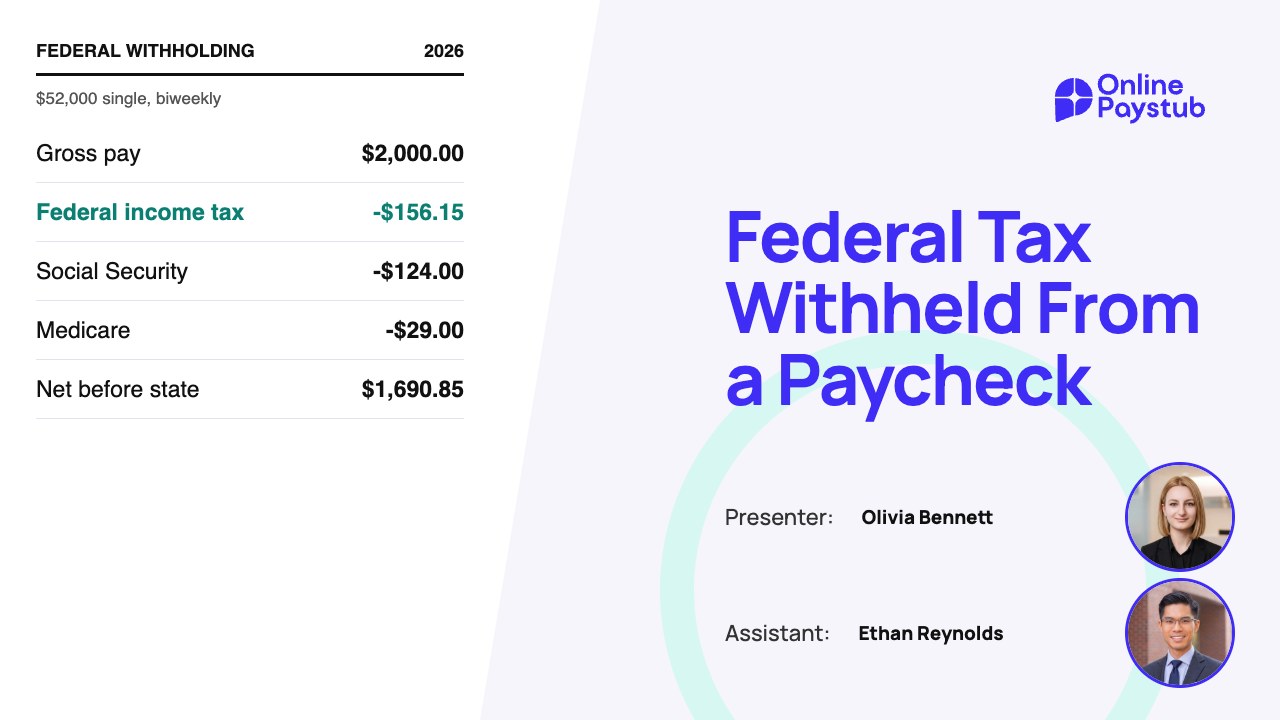

The federal income tax withheld from a paycheck depends on your earnings, pay frequency, filing status and Form W-4. No single withholding percentage applies to every employee.
Federal income tax rates for 2026 run from 10% to 37%, but those are marginal rates on taxable income, not fixed paycheck percentages. Employers calculate withholding with the methods the Internal Revenue Service (IRS) publishes in Publication 15-T.
Your paycheck also shows Social Security and Medicare taxes, which are separate from federal income tax withholding.
How Much Federal Income Tax Is Taken Out of a Paycheck?
It varies by employee. Two people with the same salary can have different amounts withheld because of filing status, a second job, tax credits, extra withholding or other Form W-4 entries.
Employers run payroll information through the IRS withholding tables each pay period. The money withheld counts toward the employee's federal income tax for the year. If too much is withheld, you get a refund after filing; if too little, you owe the difference.
What Determines Federal Tax Withholding?
Gross Pay and Taxable Wages
Higher taxable wages generally mean more withholding. Gross pay is not always the same as wages subject to federal income tax, because pre-tax retirement contributions and some benefit deductions lower taxable wages.
Filing Status
Form W-4 asks for a filing status such as single, married filing jointly or head of household. The IRS uses different schedules for each.
Pay Frequency
The calculation accounts for how often you are paid: weekly, biweekly, semimonthly or monthly. The same salary can produce different per-check withholding depending on the schedule and other inputs.
Form W-4 Information
The Form W-4 covers filing status, multiple jobs, dependents and other credits, other income, deductions and extra withholding. You can give your employer a new one whenever your situation changes.
Federal Income Tax Rates for 2026
The federal income tax uses seven marginal rates in 2026.
| Federal tax rate | General description |
|---|---|
| 10% | Lowest taxable income bracket |
| 12% | Lower-income bracket |
| 22% | Middle-income bracket |
| 24% | Upper-middle-income bracket |
| 32% | Higher-income bracket |
| 35% | High-income bracket |
| 37% | Highest taxable income bracket |
These are marginal income tax rates, not flat withholding rates. Being in the 22% bracket does not mean your employer withholds 22% of your gross pay. The IRS methods account for filing status, wages, pay period and your W-4 adjustments.
How to Calculate Federal Income Tax Withholding
Employers use the IRS Percentage Method or the Wage Bracket Method, depending on their payroll system, the wage amount and the employee's W-4.
Step 1: Determine Taxable Wages
Start with the wages subject to federal income tax withholding for the pay period. Some benefit contributions make this lower than gross pay.
Step 2: Review Form W-4
Take the filing status and adjustments from the employee's W-4: multiple jobs, dependents, other income, deductions and extra withholding.
Step 3: Select the IRS Withholding Method
Use the current tables or automated method. Publication 15-T has the instructions and tables for 2026.
Step 4: Calculate the Withholding Amount
For automated payroll, the Percentage Method annualizes wages, applies the W-4 adjustments, finds the annual withholding in the rate schedule and converts it back to the pay period.
Step 5: Apply Additional Withholding
If the employee asked for extra withholding in Step 4(c), add that amount. The total is the federal income tax withheld on the paycheck.
Federal Income Tax Withholding Example for 2026
Take a single employee earning $52,000 a year on 26 biweekly paychecks of $2,000. The 2026 W-4 shows single filing status with nothing entered in Steps 2 through 4.
Under the 2026 Percentage Method (Worksheet 1A), the employer first annualizes the wages and then, because the Step 2 box is not checked, subtracts $8,600 ($12,900 for married filing jointly). That adjustment is built into the 2026 worksheet and is easy to miss.
| Worksheet 1A step | Amount |
|---|---|
| Annual wages ($2,000 × 26) | $52,000 |
| Line 1g adjustment (Step 2 not checked, single) | −$8,600 |
| Adjusted annual wage amount | $43,400 |
| Annual table row (single) | $19,900 to $57,900 |
| Base withholding for the row | $1,240 |
| 12% of the amount over $19,900 | $2,820 |
| Annual withholding | $4,060 |
| Per biweekly paycheck ($4,060 ÷ 26) | $156.15 |
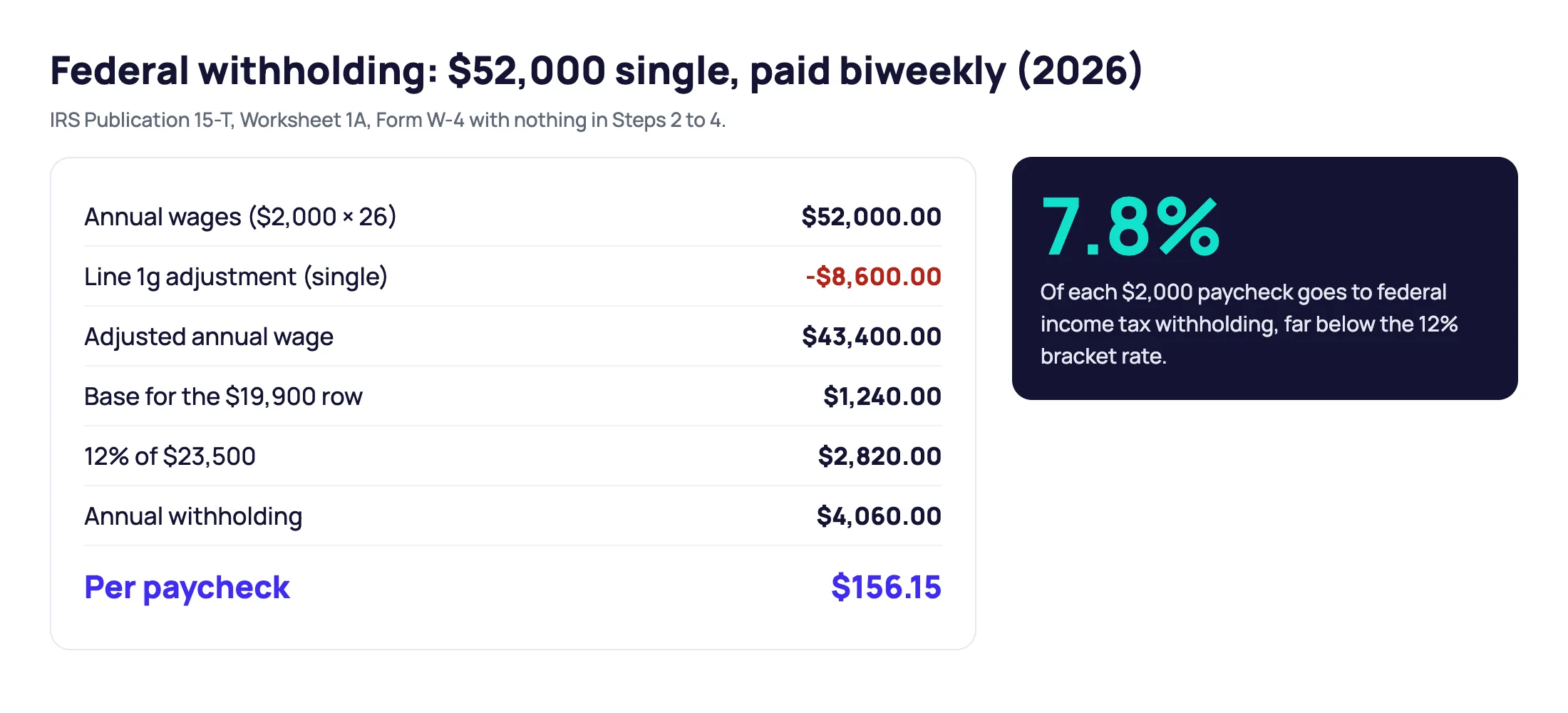
Annual withholding is $1,240 + ($23,500 × 12%) = $4,060. Divided by 26, that is $156.15 per paycheck. The example assumes no pre-tax deductions and no other adjustments; payroll software may round slightly differently.
IRS Percentage Method vs. Wage Bracket Method
| Method | How it works | Common use |
|---|---|---|
| Percentage Method | Annualizes wages and applies rate schedules by filing status | Automated payroll and some manual calculations |
| Wage Bracket Method | Looks up withholding in tables by wage range and pay period | Manual payroll within the table ranges |
Both methods follow IRS rules. The Percentage Method handles any wage amount and adjustment, which is why automated payroll uses it. The Wage Bracket Method simplifies manual calculations within the table ranges. Either way, employers follow the current IRS instructions instead of picking a percentage.
What Is Form W-4 and How Does It Affect Withholding?
Form W-4, the Employee's Withholding Certificate, tells your employer how to figure your federal withholding. The current form uses filing status and dollar amounts instead of the old allowances.
| Form W-4 section | Purpose |
|---|---|
| Step 1 | Personal information and filing status |
| Step 2 | Multiple jobs or working spouse |
| Step 3 | Dependents and other credits |
| Step 4(a) | Other income |
| Step 4(b) | Deductions |
| Step 4(c) | Extra withholding |
| Step 5 | Signature |
The 2026 Deductions Worksheet for Step 4(b) also covers the new federal deductions, such as those for qualified tips and overtime.
How Does Step 2 Affect Withholding?
Step 2 is for multiple jobs or a working spouse. Checking its box makes the employer use a different schedule, without the $8,600 or $12,900 adjustment, so more tax is withheld. That helps avoid underwithholding when a household has more than one income.
How Does Step 3 Affect Withholding?
Step 3 accounts for dependents and other credits, which lower withholding. Eligible parents can reflect the child tax credit 2026 amount here.
How Does Step 4(c) Affect Withholding?
Step 4(c) adds a fixed dollar amount to each paycheck's withholding. Entering $50 adds $50 per pay period, which helps if you expect tax on other income.
Federal Income Tax vs. Social Security and Medicare
Social Security and Medicare, together known as FICA (Federal Insurance Contributions Act) taxes, are separate from federal income tax withholding.
| Tax | Employee rate |
|---|---|
| Federal income tax | Varies |
| Social Security | 6.2% up to $184,500 |
| Medicare | 1.45% |
| Additional Medicare | 0.9% on wages above $200,000 |
Regular Medicare has no wage limit. Employers also withhold the Additional Medicare Tax on wages above $200,000 paid to an employee in a calendar year, as the IRS page on Social Security and Medicare withholding explains. These are calculated separately from income tax withholding.
How Much Tax Is Taken Out of a $1,000 Paycheck?
The federal income tax part depends on your W-4, pay frequency and pre-tax deductions. FICA is simpler. If all $1,000 is subject to FICA and you are under the wage base:
- Social Security: $1,000 × 6.2% = $62.00
- Medicare: $1,000 × 1.45% = $14.50
- Combined employee FICA: $76.50
Federal income tax, state income tax and other deductions come on top, so total deductions are usually higher than $76.50.
Why Was No Federal Income Tax Withheld From My Paycheck?
Your taxable wages may be too low to produce withholding under the IRS tables. Credits or deductions entered on your W-4 can also bring it to zero. You may also have claimed exemption. A zero line does not mean you owe no federal income tax for the year. The full list of causes is in why was no federal income tax withheld from my paycheck.
How Much Federal Tax Is Withheld From Bonuses?
Bonuses are supplemental wages. When the conditions are met, employers can withhold a flat 22% federal income tax on them; supplemental wages above $1 million in a year are withheld at 37%. The 22% is a withholding method, not your final tax rate on the bonus. Social Security, Medicare and state taxes also come out.
Where Can You Find Federal Tax Withholding on Your Paystub?
Federal withholding sits in the taxes or deductions section of the stub, under labels such as Federal Income Tax, FIT, FITW or Federal Withholding. Some payroll systems use less familiar codes; FED MWT EE is one that confuses many employees. Most stubs show both the current amount and the year-to-date total.
How to Check Whether Federal Tax Withholding Is Correct
Compare your paystub with your current W-4 and the IRS guidance. The IRS Tax Withholding Estimator shows whether your withholding is likely to cover your annual federal tax. It is worth running after a job change, marriage, a new child, a big raise or a second job. If something is off, give your employer a new W-4.
Can You Change How Much Federal Tax Is Withheld?
Yes, by submitting a new Form W-4. You might ask for extra withholding in Step 4(c) or update your dependents, deductions or multiple-jobs information. Changing withholding does not change the tax you owe for the year; it changes how much you prepay through your paychecks.
Federal Income Tax Withholding for Employers
Employers must apply the withholding rules, deposit the tax withheld and report payroll. Records should show gross wages, taxable wages, federal income tax withheld, Social Security, Medicare and other deductions. Federal withholding for the year goes in Box 2 of Form W-2. Most employers also report it quarterly on Form 941; the IRS Publication 15 employer's tax guide covers both. With verified figures, you can create a paystub online that shows each line clearly.
Final Thoughts
Federal income tax withholding is not one fixed percentage. It depends on earnings, pay frequency, filing status and Form W-4. For 2026, employers should use the current Publication 15-T methods, including the Worksheet 1A adjustment. Employees can review their stubs, update their W-4 and use the IRS estimator to check that they are paying enough during the year.
This article is general information about federal withholding, not tax or payroll advice. Check the IRS or a tax professional for your situation.
See federal withholding, FICA and net pay on a clear, itemized pay stub.
Create a Pay Stub Now