
Quick answer
MED EE, also shown as Fed MED/EE, is the employee share of Medicare tax. Your employer withholds 1.45% of your Medicare wages from every paycheck with no annual wage limit. It also pays another 1.45% itself. Once your wages from one employer pass $200,000 in a year, an extra 0.9% Additional Medicare Tax is added.
You pay MED EE even if you are years away from Medicare, because the tax funds the program for people who use it today and builds your own eligibility for later. This guide answers the questions people ask most about the line: what it means, how much it should be, why it can jump late in the year, who is exempt and how it shows up on your W-2.
What Does MED EE Mean on a Paystub?
MED is short for Medicare and EE for employee. The Fed MED/EE meaning is the same: the federal Medicare tax withheld from your pay as an employee. It is one half of FICA, the payroll tax that also covers Social Security.
Other Labels: Fed MED/EE, MEDI, FICA MED and Fed MWT EE
| Label | Meaning |
|---|---|
| MED EE or Fed MED/EE | Employee Medicare tax |
| MEDI or MEDICARE | Employee Medicare tax |
| FICA MED or FICA-M | Medicare portion of FICA |
| HI | Hospital Insurance, the formal name of the Medicare tax |
| Fed MWT EE | Medicare withholding tax, employee share |
If your statement uses the MWT version, the Fed MWT EE line can be confirmed with the same 1.45% check described below. State lines such as SIT withheld follow the same pattern of a short tax name plus EE or a state code. The rest of the common pay stub abbreviations work the same way.
How Much Is MED EE? The 1.45% Medicare Tax Rate
- Employee rate: 1.45% of Medicare wages.
- Employer rate: another 1.45%, paid on top of your wages.
- Wage limit: none. Medicare tax applies to every dollar you earn.
- Additional Medicare Tax: 0.9% more on wages above $200,000 from one employer in a calendar year.
These rates are set by law and listed in IRS Topic 751. The 1.45% rate has applied since 1986 and the 0.9% surtax since 2013.
How to Calculate MED EE on Your Paycheck
Multiply your Medicare wages for the pay period by 0.0145.
| Period | Medicare wages | MED EE at 1.45% | Year to date |
|---|---|---|---|
| One biweekly paycheck | $2,400.00 | $34.80 | $34.80 |
| Full year (26 paychecks) | $62,400.00 | $34.80 × 26 | $904.80 |
Which Wages Are Subject to Medicare Tax?
Medicare wages include salary, hourly pay, overtime, bonuses, commissions and most taxable fringe benefits, such as GTL imputed income from employer-paid life insurance. Pre-tax health, dental and vision premiums paid through a Section 125 cafeteria plan are taken out first, so they lower MED EE. Traditional 401(k) contributions are not: they reduce your taxable wages for income tax but stay in Medicare wages. That is why Box 5 of your W-2 can be higher than Box 1.
Additional Medicare Tax: The Extra 0.9% Above $200,000
Once your wages from one employer pass $200,000 in a calendar year, your employer must withhold an extra 0.9% on every dollar above that amount. The employer starts at $200,000 regardless of your filing status. It does not pay a matching 0.9% of its own. The rules are explained in IRS Topic 560.
Example: When MED EE Goes Up Mid-Year
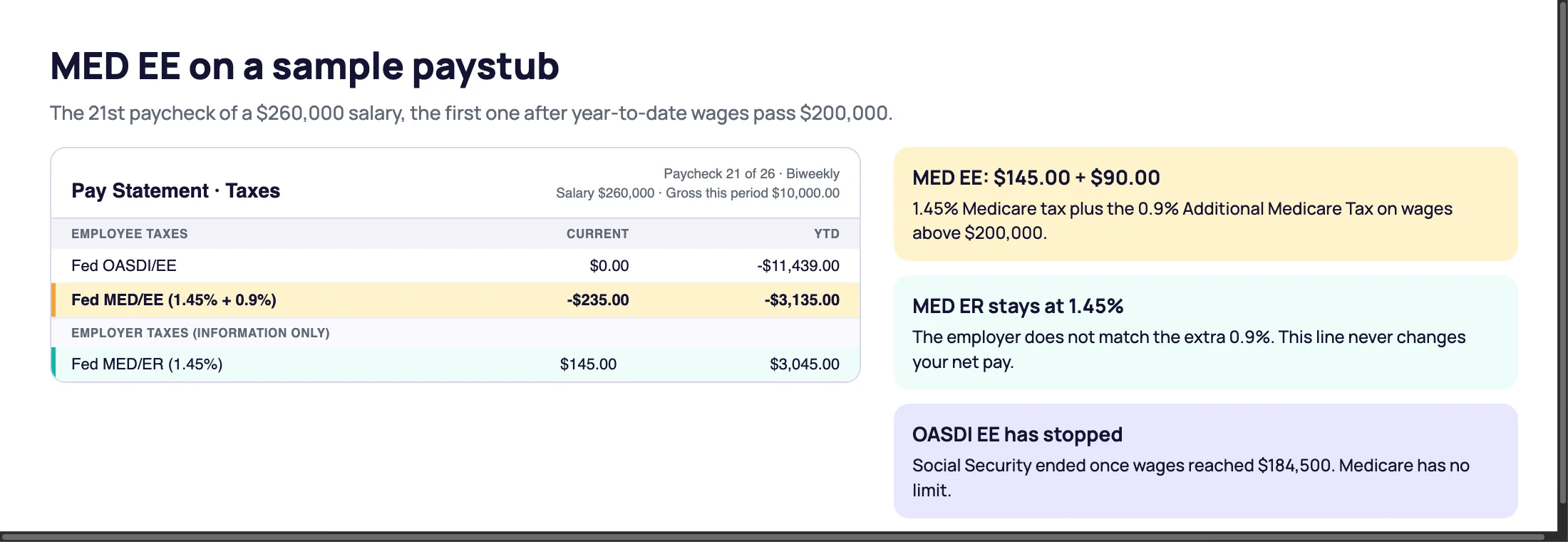
Imagine a $260,000 salary paid in 26 equal paychecks of $10,000.
| Paychecks | YTD wages at the end | 1.45% Medicare | 0.9% Additional | MED EE per paycheck |
|---|---|---|---|---|
| 1 to 20 | $200,000 | $145.00 | $0 | $145.00 |
| 21 to 26 | $260,000 | $145.00 | $90.00 | $235.00 |
| Year total | $260,000 | $3,770.00 | $540.00 | $4,310.00 |
The jump happens on paycheck 21, the first one paid after year-to-date wages reach $200,000. The same employee stops paying Social Security tax partway through paycheck 19, when wages reach the $184,500 wage base, so net pay rises around paycheck 19 and dips a little at paycheck 21.
Two Jobs or Married Couples: Settling Up on Form 8959
The tax you actually owe depends on your filing status, not on what each employer withheld. The thresholds on your return are $250,000 for married couples filing jointly, $125,000 for married filing separately and $200,000 for everyone else. You reconcile the difference on Form 8959.
For example, a single person earning $150,000 at one job and $100,000 at another has no Additional Medicare Tax withheld, because neither employer passes $200,000. On the return their combined $250,000 is $50,000 over the threshold, so they owe $450. Raising federal withholding on your W-4 is the usual way to cover that ahead of time.
MED EE vs. MED ER: Who Pays What?
MED EE is withheld from your pay. MED ER is the employer's matching 1.45%, paid from the employer's own money. Some paystubs list it in an employer section for information. It never reduces your net pay. The employer also does not match the 0.9% Additional Medicare Tax.
MED EE vs. OASDI EE and FICA
| Line | Tax | Employee rate | Wage limit (2026) | Who pays | W-2 box |
|---|---|---|---|---|---|
| MED EE | Medicare | 1.45% (+0.9% above $200,000) | None | Employee; employer matches 1.45% | Box 6 |
| OASDI EE | Social Security | 6.2% | $184,500 | Employee; employer matches 6.2% | Box 4 |
| FICA EE | Both together | 7.65% | Social Security part only | Employee | Boxes 4 and 6 |
Why Your OASDI Stopped but MED EE Didn't
Social Security tax stops once your wages for the year reach the wage base, $184,500 in 2026. Medicare tax has no limit, so MED EE keeps coming out of every paycheck. If your OASDI EE line suddenly shows $0 late in the year while MED EE continues, payroll is working correctly.
What Does Medicare Tax Pay For?
MED EE goes to the Hospital Insurance trust fund, which pays for Medicare Part A: inpatient hospital stays, skilled nursing care, hospice and some home health care. Paying Medicare tax for about 10 years (40 quarters of work) usually qualifies you for premium-free Part A at 65.
Medicare Tax vs. Medicare Premiums
Medicare tax is what you pay while working. Medicare premiums, such as the monthly Part B premium for doctor visits, are paid by people enrolled in Medicare, usually through their Social Security benefits. Paying MED EE now does not replace those premiums later.
Who Doesn't Pay MED EE?
- Some nonresident students and scholars. People in F-1, J-1, M-1 or Q-1 status are exempt on wages for work their visa allows while they are nonresident aliens. For students that usually covers their first five calendar years in the US. The details are on the IRS page on aliens employed in the US.
- Certain state and local government employees who have worked for the same employer without a break since before April 1, 1986 and are not covered by a Social Security agreement.
- Some members of qualifying religious groups who are approved on Form 4029 and work for an employer in the same group.
How to Get Back Medicare Tax Withheld by Mistake
Ask your employer first. An employer can refund over-withheld Medicare tax in the same year and correct your W-2. If the employer cannot or will not, you can claim a refund from the IRS on Form 843; nonresident students and scholars attach Form 8316 with their visa documents.
MED EE on Your W-2 (Boxes 5 and 6)
Box 5 shows your Medicare wages and Box 6 the Medicare tax withheld, including any Additional Medicare Tax. Box 6 should match the MED EE year-to-date figure on your last paystub of December. If you earned over $200,000, Box 6 will be more than 1.45% of Box 5.
Medicare Tax for the Self-Employed
Self-employed people pay both halves of Medicare tax, 2.9% in total, as part of self-employment tax on Schedule SE, plus the 0.9% Additional Medicare Tax above the same thresholds. Because no employer withholds it, MED EE does not appear on a contractor's statement; the tax is paid through estimated payments instead. That is also why paystubs for independent contractors usually show gross pay with no FICA lines at all.
How MED EE Appears on a Paystub You Create
On a correct statement, MED EE equals 1.45% of Medicare wages for the period, 2.35% on the part of the year above $200,000. The year-to-date column keeps a running total that ends up in Box 6. When you create a paystub, run that check on the Medicare line before you share it. Use real payroll figures only.
This article is general information about payroll taxes, not tax advice.
Creating a paystub? Check MED EE against 1.45% of Medicare wages, plus 0.9% above $200,000.
Create a Pay Stub Now