
Quick answer
On a paystub, EE means employee and ER means employer. EE lines, such as FED OASDI/EE or MED EE, are taxes and deductions taken out of your pay. ER lines, such as MED ER or ER Medical, are amounts your employer pays on top of your wages. ER lines are shown for your information and don't reduce your take-home pay.
EE comes out of your pay; ER is paid by your employer. That one rule explains almost every pair of lines on a statement. Below, every common EE and ER line is set side by side with the 2026 figures, followed by a quick check for your net pay and an example of what an employer really spends on one employee.
What Do EE and ER Mean on a Paystub?
Payroll systems add EE or ER to a line to show who pays it. Your EE lines reduce your net pay. ER lines are your employer's payroll taxes and benefit costs, listed so you can see your full compensation. Some statements leave ER lines out completely; that is normal too.
EE vs. ER: Every Line Side by Side (2026)
| Paystub line | EE (employee) | ER (employer) | Reduces your net pay? | On your W-2 |
|---|---|---|---|---|
| Social Security (OASDI) | 6.2% of wages up to $184,500 | 6.2%, same limit | EE only | Box 4 (EE amount) |
| Medicare | 1.45%, plus 0.9% above $200,000 | 1.45%, no match on the 0.9% | EE only | Box 6 (EE amount) |
| Federal income tax | Based on your W-4 | None | Yes | Box 2 |
| FUTA | None | 6.0% of the first $7,000, usually 0.6% after credit | No | Not shown |
| State unemployment (SUI) | Only in Alaska, New Jersey and Pennsylvania | Rate set by the state | Only the EE part, where it exists | Often box 14, optional |
| Health insurance | Your premium, usually pre-tax | ER Medical | EE only | Box 12 code DD (both shares) |
| 401(k) | Your deferral | Employer match | EE only | Box 12 code D (EE deferral) |
| HSA | Your payroll contribution | Employer contribution | EE only | Box 12 code W (both) |
| Group term life (GTL) | None (or supplemental coverage) | Coverage up to $50,000 tax-free | Only the tax on coverage above $50,000 | Box 12 code C |
Taxes Both You and Your Employer Pay (FICA)
Social Security: 6.2% + 6.2%
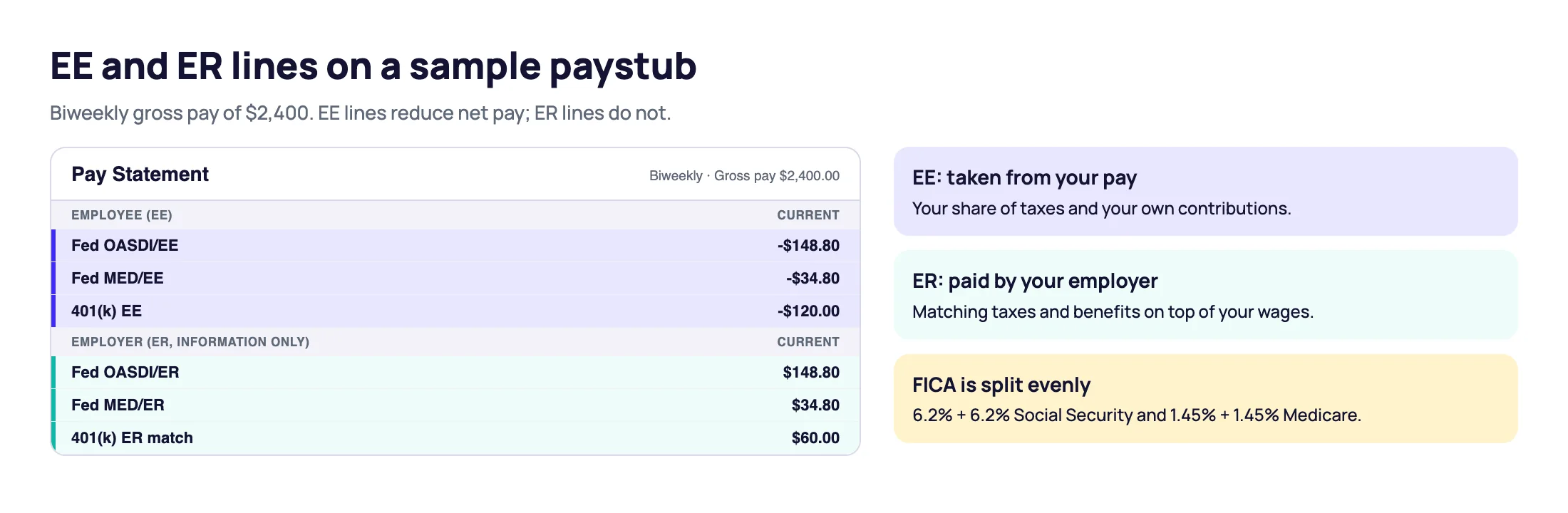
You pay 6.2% of your wages for Social Security and your employer pays a matching 6.2%. Both stop once your wages for the year reach the wage base, $184,500 in 2026. On a $2,400 paycheck that is $148.80 each. Rates are listed in IRS Topic 751.
Medicare: 1.45% + 1.45% (and the 0.9% Only You Pay)
Medicare is also split evenly at 1.45% each, with no wage limit. Above $200,000 of wages from one employer, your share rises by 0.9% but the employer's share does not, which is why MED EE can jump late in the year while MED ER stays flat. Some statements label the same employee tax Fed MWT EE.
Taxes Only Your Employer Pays (FUTA and SUTA)
Federal unemployment tax is paid only by employers: 6.0% of the first $7,000 of each employee's wages, reduced to 0.6% ($42 a year) for most employers through a credit for state unemployment tax (IRS Topic 759). Because it is purely an employer cost, FUTA rarely appears on an employee's statement. State unemployment tax (SUTA or SUI) is also employer-paid in most states; only Alaska, New Jersey and Pennsylvania take a small employee share. These lines may appear as ER items on your stub or not at all.
ER Benefits: Health Insurance, 401(k) Match, HSA and Life Insurance
- Health insurance: the employer's share of your premium, shown as Medical ER. Not taxable to you.
- 401(k) match: money your employer adds to your retirement account. It is not taxed until you withdraw it.
- HSA: employer contributions to your health savings account, reported in box 12 with code W.
- Life insurance: employer-paid coverage above $50,000 creates GTL imputed income, the only ER benefit here that adds a little tax to your paycheck.
Do ER Amounts Reduce Your Take-Home Pay?
No. Net pay is gross pay minus your EE taxes and EE deductions. ER amounts sit outside that calculation.
Red Flag Checklist: Is an ER Amount Coming Out of Your Net Pay?
- Recalculate net pay: gross pay minus every EE line. ER lines should not be part of the subtraction.
- Check FICA: below the Social Security wage base, your Social Security and Medicare together should be about 7.65% of your FICA wages. If they come to about 15.3%, the employer's share is being taken from you too.
- Ask payroll if either check fails.
What Your Employer Really Spends on You: A Total Cost Example
Assume a $50,000 salary, single health coverage at the national average and a 401(k) where the employee contributes 5% and the employer matches half.
| Item | Amount | Assumption |
|---|---|---|
| Gross salary | $50,000 | |
| ER Social Security (6.2%) | $3,100 | |
| ER Medicare (1.45%) | $725 | |
| FUTA | $42 | Full state credit |
| SUTA | $189 | Example rate 2.7% on the first $7,000; varies by state |
| ER health insurance | About $7,885 | KFF 2025 average employer share, single coverage |
| 401(k) match | $1,250 | Half of a 5% employee contribution |
| Total employer cost | About $63,191 |
In this example the employer spends about 26% more than the salary itself. Most of that never appears in the employee's net pay, which is why ER lines are worth reading.
Common EE and ER Codes and Where to Learn More
- Fed MWT EE: the employee Medicare tax under a less common label.
- MED EE and MED ER: Medicare tax for you and your employer.
- OASDI EE and ER: Social Security tax, 6.2% each.
- Medical ER: your employer's health insurance contribution.
- GTL: employer-paid life insurance above $50,000.
- SIT: state income tax, always an EE line.
- SDI: state disability insurance in CA, NY, NJ, RI and HI.
Any other code is likely in this list of pay stub abbreviations. If you run payroll for a small team, you can create a paystub that keeps employee deductions clearly separated. Use real payroll figures only.
This article is general information about payroll, not tax advice.
Need a paystub that separates employee deductions clearly? Create one in minutes.
Create a Pay Stub Now