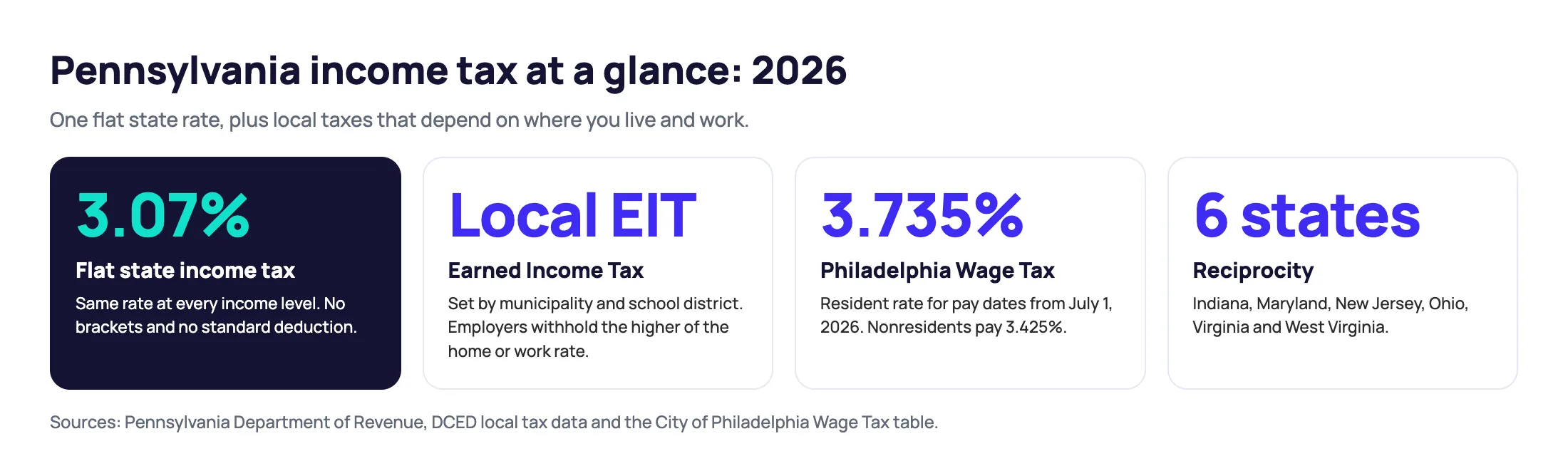
Pennsylvania has a flat state income tax rate of 3.07% in 2026. Most taxable income is taxed at the same rate no matter how much a person earns. Unlike states with progressive brackets, Pennsylvania does not raise its rate as income rises.
Pennsylvania residents and employees may also pay local taxes such as the Earned Income Tax (EIT), the Local Services Tax (LST) and the Philadelphia Wage Tax. These can push the total income tax withheld from a paycheck above the state's 3.07%.
This guide covers the 2026 rate, paycheck withholding, local taxes, tax returns, deductions and reciprocity agreements for employees, employers and freelancers.
What Is the Pennsylvania State Income Tax Rate in 2026?
Pennsylvania's personal income tax rate for 2026 is 3.07%. It applies to taxable income in each of the state's eight classes of income, under Pennsylvania's own rules for working out the taxable amount.
Because the system is flat, someone earning $40,000 and someone earning $100,000 face the same 3.07% state rate on their taxable income.
| Annual PA taxable income | State tax rate | Estimated state income tax |
|---|---|---|
| $20,000 | 3.07% | $614 |
| $30,000 | 3.07% | $921 |
| $40,000 | 3.07% | $1,228 |
| $50,000 | 3.07% | $1,535 |
| $60,000 | 3.07% | $1,842 |
| $75,000 | 3.07% | $2,302.50 |
| $100,000 | 3.07% | $3,070 |
| $150,000 | 3.07% | $4,605 |
These figures assume the whole amount is taxable under Pennsylvania law. They leave out local income taxes, tax forgiveness and other adjustments.
The flat rate keeps the state calculation simple. Deciding which income is taxable and which local taxes apply still takes some care. To see how Pennsylvania stacks up nationally, compare state income taxes across the country.
Does Pennsylvania Have Income Tax Brackets?
No. Pennsylvania has no progressive income tax brackets in 2026. A single 3.07% rate applies to taxable income at every income level.
A resident with $45,000 of taxable income would generally owe $1,381.50 in state income tax. A resident with $90,000 would generally owe $2,763. The percentage is the same for both.
That does not mean every taxpayer pays the same share of total income in tax. Local taxes, federal income tax, qualifying deductions and tax forgiveness all change the final amount.
What Income Is Taxable in Pennsylvania?
Pennsylvania recognizes eight classes of taxable income. Each class has its own rules for expenses, losses and exclusions.
Compensation
Wages, salaries, bonuses, commissions, tips and similar pay for work. Most employees have Pennsylvania income tax withheld from each paycheck.
Interest
Taxable interest from bank accounts and other sources. Some interest, such as interest on qualifying U.S. government obligations, is exempt.
Dividends
Dividends from stocks and certain other investments are generally taxable, with some exclusions.
Net Profits From a Business, Profession or Farm
Self-employed people, independent contractors and business owners may owe tax on net profits. The calculation follows Pennsylvania rules, which can differ from the federal ones.
Net Gains From the Sale or Exchange of Property
Gains from selling taxable property or investments may be taxable. Some sales, including a qualifying sale of a principal residence, are excluded.
Rents, Royalties, Patents and Copyrights
Net income from rental property, royalties and certain intellectual property rights can be taxable.
Income From Estates or Trusts
Beneficiaries may have to report certain taxable income received from estates or trusts.
Gambling and Lottery Winnings
Gambling and lottery winnings are taxable in Pennsylvania. That includes Pennsylvania Lottery cash prizes, which have been taxable since 2016. Noncash prizes from the Pennsylvania Lottery are not taxed. The Department of Revenue explains the details on its gambling and lottery winnings page.
These classes matter because Pennsylvania does not follow every federal rule. Income excluded federally can be treated differently at the state level and the reverse is also true.
How Does Pennsylvania State Income Tax Withholding Work?
Pennsylvania employers generally withhold state income tax at a flat 3.07% of the employee's Pennsylvania-taxable compensation for each pay period.
Unlike federal withholding, the amount does not depend on brackets or on the dependents claimed on a federal Form W-4. The Department of Revenue tells employers to multiply compensation subject to withholding by the state rate; its employer withholding page has the details.
An employee with $2,000 of Pennsylvania-taxable wages every two weeks would generally have $61.40 withheld.
Pennsylvania Income Tax Withholding by Pay Period
| Pay frequency | Taxable pay | PA income tax withheld |
|---|---|---|
| Weekly | $1,000 | $30.70 |
| Biweekly | $2,000 | $61.40 |
| Semimonthly | $2,500 | $76.75 |
| Monthly | $5,000 | $153.50 |
These figures cover state income tax only. Federal income tax, Social Security, Medicare, local taxes and other deductions are not included.
On a paystub the state line is usually labeled PA SIT, State Income Tax or PA Withholding. If those letters are new to you, here is what SIT stands for on an earnings statement.
How to Calculate Pennsylvania Income Tax in 2026
Once you know the income subject to Pennsylvania tax, the math is short.
PA income tax = Pennsylvania taxable income × 0.0307
The result is the state tax before any credits or tax forgiveness.
Example: Pennsylvania Income Tax on a $60,000 Salary
Take an employee who lives and works in Pennsylvania and earns $60,000 a year. Assume the whole salary is taxable, there is no other income and no credits or forgiveness apply.
| Calculation | Amount |
|---|---|
| Annual gross salary | $60,000 |
| Monthly gross salary | $5,000 |
| Pennsylvania tax rate | 3.07% |
| Annual PA income tax | $1,842 |
| Monthly PA income tax | $153.50 |
| Biweekly PA income tax | $70.85 |
| Annual salary after PA state income tax | $58,158 |
The $58,158 is not take-home pay. Federal income tax, Social Security, Medicare, local taxes and other deductions still come out.
Calculate Your Pennsylvania Paycheck
Use the calculator below to estimate the state tax and an assumed local EIT on each paycheck.
Pennsylvania Paycheck Tax Calculator 2026
Enter your own local rate. The default 1% is an illustration, not a statewide rate.
Illustrative only. Leaves out federal taxes, FICA, LST, Philadelphia rules, credits and other deductions.
Employers preparing payroll records can use the Pennsylvania paystub generator to show earnings and each deduction on its own line.
Does Pennsylvania Have a State W-4 Form?
Pennsylvania has no general state W-4 for choosing withholding allowances. Employers figure Pennsylvania withholding with the flat 3.07% rate.
The state does have a separate form for employees who qualify to stop Pennsylvania income tax withholding.
What Is Pennsylvania Form REV-419?
Form REV-419, the Employee's Nonwithholding Application Certificate, lets eligible employees ask their employer not to withhold Pennsylvania personal income tax. It is not a replacement for the federal W-4. It covers specific situations such as:
- Employees who qualify for tax forgiveness and meet the nonwithholding requirements.
- Residents of reciprocal states whose wages are taxed by their home state.
- Certain military spouses covered by the Servicemembers Civil Relief Act.
Employees give REV-419 to their employer, who must follow the retention, submission and withholding rules. A new form may be needed each year or when circumstances change, although residents of reciprocal states whose residence stays the same are an exception.
Do not assume you are exempt just because your income is low or you work remotely.
Pennsylvania Local Income Taxes in 2026
The 3.07% state tax is only part of the picture. Many municipalities and school districts add their own taxes on earned income. What you owe depends on where you live, where you work and the local rules.
Local Earned Income Tax (EIT)
The local EIT generally applies to wages and certain net profits. Rates vary by municipality and school district.
Under the Act 32 collection system, employers compare the employee's resident EIT rate with the nonresident rate of the work location and withhold the higher of the two.
Here is an employee with $50,000 of taxable wages and an illustrative 1% local EIT:
| Tax type | Annual amount |
|---|---|
| Pennsylvania state income tax (3.07%) | $1,535 |
| Local Earned Income Tax (1%) | $500 |
| Combined state and local EIT | $2,035 |
| Combined rate | 4.07% |
The example leaves out federal taxes, FICA and the Local Services Tax. Real EIT rates must be checked for the employee's home and work locations.
Local Services Tax (LST)
The LST is a separate tax that some municipalities and school districts charge people who work within their borders. Unlike the EIT, it is a fixed annual amount rather than a percentage of pay. It cannot exceed $52 a year.
Where it applies, employers usually collect it through payroll. Exemptions depend on local rules, including low-income exemptions. Look for an LST line on your paystub and confirm the amount with your employer or local tax collector.
Philadelphia Wage Tax
Philadelphia runs its own Wage Tax outside the Act 32 EIT system. Residents owe the resident rate on taxable pay wherever they work. Nonresidents owe the nonresident rate on pay for work done in the city.
| Pay dates from | Resident rate | Nonresident rate |
|---|---|---|
| July 1, 2025 | 3.74% | 3.43% |
| July 1, 2026 | 3.735% | 3.425% |
The city has scheduled further small cuts, so check the current table on the City of Philadelphia's Wage Tax page for employers before you run payroll. Do not apply a general Pennsylvania EIT rate to Philadelphia wages.
How to Find Your Pennsylvania Local Tax Rate
The state rate tells you nothing about local rates. The Department of Community and Economic Development lists PSD codes and EIT rates by county, municipality and school district, along with the tax collector for each area.
Does Pennsylvania Have a Standard Deduction?
No. Pennsylvania has no general standard deduction like the federal one. You cannot subtract the federal standard deduction to reach Pennsylvania taxable income. The state does not broadly follow federal itemized deductions either.
Some items still get favorable treatment, such as qualifying retirement plan contributions, certain health savings account contributions and allowable expenses tied to specific classes of income. The treatment depends on the class of income.
Pennsylvania Tax Forgiveness
Pennsylvania's tax forgiveness program can reduce or wipe out state income tax for qualifying people and families. Eligibility depends on family size, dependents and eligibility income.
Eligibility income is not the same as taxable income. Some amounts excluded from taxable income still count toward the forgiveness test. Taxpayers claim it on Form PA-40 with Schedule SP. For lower-income households it can matter more than the rate itself.
Pennsylvania Income Tax for Residents and Nonresidents
Pennsylvania treats residents, part-year residents and nonresidents differently.
Pennsylvania Residents
Residents generally report taxable income from all sources, including income earned in other states. A resident who works for an out-of-state employer may still owe Pennsylvania tax, though credits for tax paid to other states help prevent double taxation.
Pennsylvania Nonresidents
Nonresidents generally owe tax only on Pennsylvania-source income. That can include wages for work done in the state, Pennsylvania business income and income from Pennsylvania property. A nonresident should check for a reciprocity agreement or another exemption first.
Part-Year Residents
People who move into or out of Pennsylvania during the year generally report all income for the resident period plus Pennsylvania-source income for the nonresident period.
Pennsylvania Income Tax Reciprocity Agreements
Pennsylvania has reciprocal agreements with six states. Qualifying employees pay state income tax on wages to their home state instead of the state where they work.
| State | Reciprocity with Pennsylvania |
|---|---|
| Indiana | Yes |
| Maryland | Yes |
| New Jersey | Yes |
| Ohio | Yes |
| Virginia | Yes |
| West Virginia | Yes |
The agreements cover qualifying employee compensation, not every kind of income. There is also a specific exception involving Ohio. A New Jersey resident working in Pennsylvania, for example, may have New Jersey tax withheld instead of Pennsylvania tax by giving the employer Form REV-419.
Reciprocity does not remove local taxes. It is also different from the credits residents claim for tax paid to states without an agreement. The Pennsylvania Personal Income Tax Guide explains the limits.
How to File a Pennsylvania State Income Tax Return
Most individuals who must file use Form PA-40, the Pennsylvania Personal Income Tax Return. The state's free myPATH system handles electronic filing.
Step 1: Gather Your Income Documents
Collect your Form W-2, any Forms 1099, business records and statements for investment or rental income.
Step 2: Work Out Your Pennsylvania Taxable Income
Sort your income into the eight classes. Do not simply use federal adjusted gross income, because the two can differ.
Step 3: Calculate the Tax
Apply 3.07% to taxable income, then account for credits, tax forgiveness and other adjustments.
Step 4: Report Tax Already Withheld
Use your W-2 and other documents to total the Pennsylvania tax already withheld or paid.
Step 5: Submit Form PA-40
File through myPATH, tax software or another accepted method. Filing information is on the Department of Revenue site.
When Is Pennsylvania State Income Tax Due?
Returns for tax year 2025 were due April 15, 2026. Returns for income earned in 2026 are generally due April 15, 2027, unless the state announces a change.
An extension gives more time to file but generally not more time to pay. People with income that has little or no withholding may need to make estimated payments during the year.
How to Check Your Pennsylvania Income Tax on a W-2
Form W-2 shows the state and local tax withheld during the year. The relevant boxes, as the IRS W-2 instructions describe them:
| W-2 box | Information |
|---|---|
| Box 15 | State and employer's state ID number |
| Box 16 | State wages, tips and other compensation |
| Box 17 | State income tax withheld |
| Box 18 | Local wages, tips and other compensation |
| Box 19 | Local income tax withheld |
| Box 20 | Locality name |
For Pennsylvania employees, Box 17 generally shows the state income tax withheld. Box 19 may show local EIT or Philadelphia Wage Tax. Box 16 can differ from federal wages in Box 1 because the state and federal rules treat some income and deductions differently. Employers should reconcile payroll records before issuing W-2s.
How to Get a Pennsylvania State Income Tax Refund
You may get a refund when your payments and credits exceed your final state tax. Common reasons are over-withholding, tax forgiveness or a correction to income reported earlier.
If $1,800 was withheld during the year and the final tax is $1,500, the refund is $1,800 − $1,500 = $300, assuming the figures are right and nothing else changes.
Claim it by filing Form PA-40 with your withholding, payments and credits. Processing time depends on the filing method and on whether the return needs review. myPATH also shows refund status.
Pennsylvania vs. New York State Income Tax
Pennsylvania applies one flat rate. New York's income tax uses progressive brackets instead.
| Feature | Pennsylvania | New York |
|---|---|---|
| State income tax structure | Flat | Progressive |
| Single state tax rate | 3.07% | No |
| Progressive brackets | No | Yes |
| General state standard deduction | No | Yes |
| Local income taxes | Yes, depending on locality | Yes, in NYC and Yonkers |
| State tax withholding | Yes | Yes |
A lower rate does not always mean a lower total bill. Income level, local taxes, deductions, credits and residency all shape the comparison.
Final Thoughts
Pennsylvania's flat 3.07% rate keeps the state calculation simple in 2026. The full picture also depends on local EIT, the LST, the Philadelphia Wage Tax, residency, reciprocity and tax forgiveness.
Employees should review their paystubs and W-2 to confirm state and local withholding. Employers should verify the local rates and rules for each employee. Clean records make that easier. Online Paystub lets you create paystubs that show earnings and every deduction.
This article is general information about Pennsylvania income tax, not tax advice. Rates and withholding rules change; check the Pennsylvania Department of Revenue or a tax professional for your situation.
Frequently Asked Questions
What is the Pennsylvania income tax rate for 2026?
Pennsylvania's personal income tax rate is 3.07% in 2026. It is a flat rate applied to Pennsylvania-taxable income regardless of income level. Local taxes may apply on top of it depending on where you live and work.
Is Pennsylvania income tax flat or progressive?
Pennsylvania uses a flat state income tax. It has no progressive individual income tax brackets.
How much Pennsylvania income tax do I pay on $50,000?
If the full $50,000 is subject to Pennsylvania income tax, the state tax is $1,535 before credits or tax forgiveness. Local income taxes and federal payroll taxes are not included.
Does Pennsylvania have a state W-4?
Pennsylvania has no general state W-4 for withholding allowances. Employees who qualify to stop Pennsylvania income tax withholding use Form REV-419.
Does Pennsylvania have a standard deduction?
No. Pennsylvania has no general standard deduction like the federal one. Some state-specific exclusions, deductions and tax forgiveness rules may apply.
Do Pennsylvania residents pay local income tax?
Many do. Most municipalities and school districts levy a local Earned Income Tax on top of the 3.07% state tax. Philadelphia uses its own Wage Tax instead.
Is Social Security income taxable in Pennsylvania?
Social Security benefits are generally not subject to Pennsylvania personal income tax. Qualifying retirement income can also be excluded when the state's conditions are met.
Do nonresidents pay Pennsylvania income tax?
Nonresidents generally pay Pennsylvania income tax on Pennsylvania-source income. Wages of residents of the six reciprocal states can be exempt.
Which states have income tax reciprocity with Pennsylvania?
Indiana, Maryland, New Jersey, Ohio, Virginia and West Virginia. The agreements cover qualifying employee compensation.
How do I know how much Pennsylvania income tax was withheld?
Check Box 17 of your Form W-2 or the state income tax line on your paystub. Box 17 shows the state income tax your employer withheld.
Can I get a Pennsylvania state income tax refund?
Yes. If your withholding, payments and credits exceed your final Pennsylvania tax, you can claim a refund by filing Form PA-40.
Written by Alexander Caldwell and reviewed by Ethan Reynolds.

About the author
View all articles by Alexander
Reviewed by
View all articles by Ethan
Add your info
Use our secure online forms to enter your Company & Personal details in the fields provided.

Preview your document
Make edits before you order. Get documents delivered to your inbox in minutes.

Download your paystubs
Download and print the secure PDF. We'll print and mail your pay stubs and W2s.