
Quick answer
SIT withheld is the state income tax your employer takes out of each paycheck and sends to your state on your behalf. The amount depends on your taxable wages, how often you are paid and the state withholding form you filed. If you live and work in a state with no income tax, your SIT line shows $0.
SIT is one of the most common abbreviations on a paystub and one of the least explained. If you are trying to work out the SIT withheld meaning on your own statement, this guide covers what the line is, how the number is calculated, the state codes you might see next to it and how it connects to your W-2.
What Does SIT Mean on a Paystub?
SIT stands for state income tax. On a paystub it means the state income tax withheld from that paycheck. Your employer does not keep it: the money is sent to your state's tax agency and credited to you when you file your state return.
Think of SIT withholding as a prepayment. Your actual state income tax for the year is worked out on your return. SIT withheld during the year is what you have already paid toward it, so it either covers the bill, leaves a small balance or produces a refund.
SIT, SWT, SITW: Same Tax, Different Labels
Payroll systems use different short labels for the same deduction. All of these mean state income tax withholding:
| Label on the paystub | Stands for |
|---|---|
| SIT | State income tax |
| SWT | State withholding tax |
| SITW or SIT W/H | State income tax withheld |
| ST or State Tax | State income tax, written out |
| CA SIT, NY SIT, IL SIT | State income tax with the state's postal code in front |
Most other codes on a statement follow the same logic of a short tax name plus a two-letter state code, which makes the rest of the shorthand on a pay stub easier to decode once you know SIT.
How SIT Withholding Is Calculated
Every state that has an income tax publishes its own withholding method, but they all start the same way. Your employer takes your gross pay, subtracts pre-tax deductions such as 401(k) contributions and health premiums to reach taxable wages, then applies the state's formula for your pay frequency and the choices on your withholding form.
Your Federal W-4 and State Withholding Form
Many states have their own certificate. California uses Form DE 4, New York uses Form IT-2104 and Illinois uses Form IL-W-4. A few states, such as Utah, have no state form and use the filing status on your federal W-4 instead. In many states, if you never hand in the state form, your employer withholds as if you were single with no allowances, which tends to take more SIT than necessary. The state forms are listed by the California EDD and the New York Department of Taxation and Finance, among other state agencies.
Flat-Rate vs. Progressive-Rate States
Flat-rate states apply one percentage to taxable wages, usually after a small allowance. Illinois is a simple example: subtract $112.50 for each IL-W-4 allowance on a biweekly check, then multiply the rest by 4.95%.
Progressive-rate states annualize your pay, subtract a standard deduction and apply tax brackets, then divide the annual figure back down to one paycheck. In Virginia, where rates run from 2% to 5.75%, a single employee earning $2,240 every two weeks with no exemptions has $99.55 of SIT withheld per check, about 4.4% of gross pay.
SIT on Bonuses and Supplemental Pay
Bonuses, commissions and other supplemental pay are often withheld differently from regular wages. Many states set a separate flat supplemental rate, while others add the bonus to your regular pay and run the normal formula. Either way, a large bonus check can show a much higher SIT amount than usual. The federal rules for supplemental wages are in IRS Publication 15.
SIT Example: Reading the SIT Line on a Sample Paystub
Here is how the SIT line looks on an actual earnings statement. The employee works in Illinois, is paid $2,400 every two weeks and claimed one allowance on Form IL-W-4.
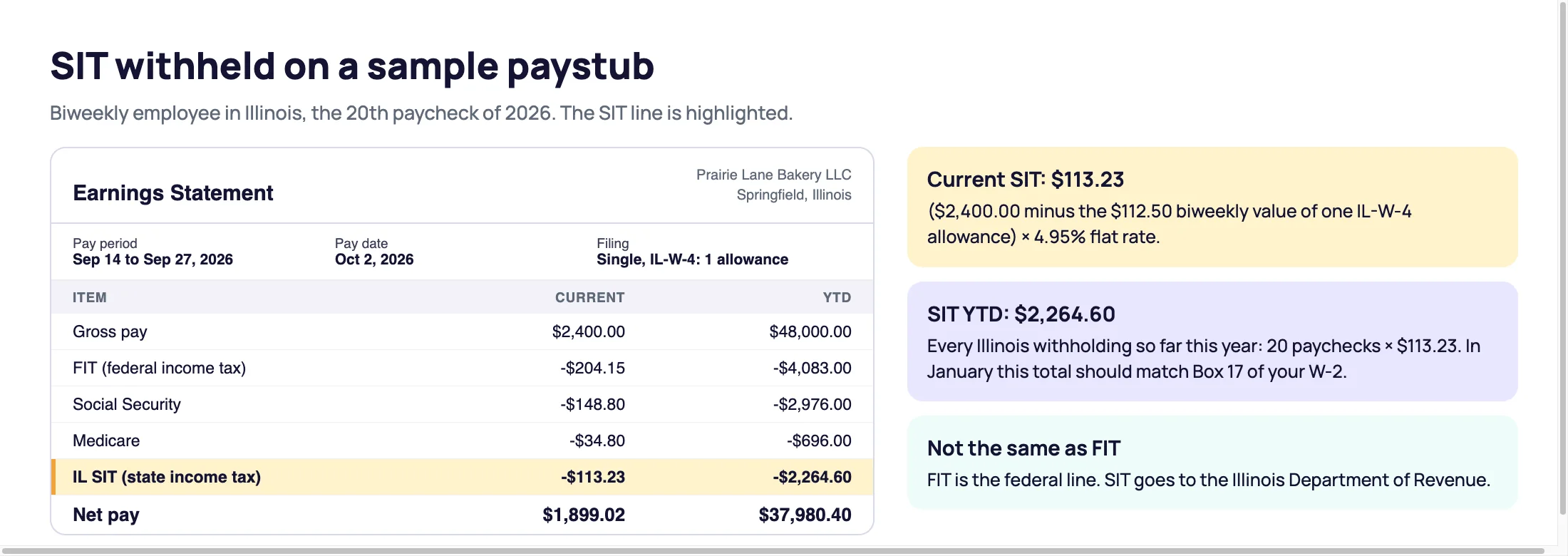
- Current SIT: $2,400.00 minus $112.50 for the allowance leaves $2,287.50. At 4.95%, that is $113.23 for this paycheck.
- SIT YTD: $2,264.60, the total withheld over 20 paychecks this year. This is the running figure to check against your W-2 in January.
- FIT next to it: the $204.15 federal income tax line is a separate tax that goes to the IRS.
Together the SIT and FIT lines take about 13% of this employee's gross pay; Social Security and Medicare take another 7.65%.
State Codes You May See: CA SIT, NY SIT, RES SIT and More
When a paystub covers more than one tax jurisdiction, the SIT line usually carries a state code. These are the labels you are most likely to see:
| Code | What it means | Where you see it |
|---|---|---|
| CA SIT | California state income tax withheld | California. CA SDI, the disability insurance deduction, is a separate line. |
| NY SIT | New York State income tax withheld | New York. New York City and Yonkers residents also see a separate local line. |
| IL SIT | Illinois state income tax withheld | Illinois, at a flat 4.95%. |
| PA SIT | Pennsylvania state income tax withheld | Pennsylvania, often next to a local earned income tax line. |
| NJ SIT | New Jersey state income tax withheld | New Jersey, usually with separate NJ SDI and family leave lines. |
| MI SIT | Michigan state income tax withheld | Michigan, plus a city tax line in cities such as Detroit. |
| RES SIT | Tax withheld for your state of residence | When you live in one state and work in another. |
| WORK SIT | Tax withheld for the state where you work | Shown next to RES SIT for cross-border workers. |
| LIT or Local | Local income tax | Cities, counties and school districts that tax wages. |
On a California paystub the SIT line sits right next to CA SDI, while a New York paystub can carry state, city and paid family leave lines in the same block.
RES SIT vs. WORK SIT: Living in One State, Working in Another
If you work in a different state from the one you live in, you can owe tax to both. The work state usually taxes the wages earned there and your home state gives you a credit for that tax. Your paystub may show both: WORK SIT for the state where you work and RES SIT for your home state, which takes only the difference when its rate is higher.
Some neighboring states have reciprocity agreements that simplify this. Pennsylvania and New Jersey are the best-known pair. A Pennsylvania resident working in New Jersey files Form NJ-165 with the employer and has only Pennsylvania tax withheld. A New Jersey resident working in Pennsylvania files Form REV-419 to do the same in reverse.
Which States Have No SIT Withholding?
Nine states do not tax wages in 2026, so employers there withhold no state income tax:
- Alaska
- Florida
- Nevada
- New Hampshire
- South Dakota
- Tennessee
- Texas
- Washington
- Wyoming
Washington taxes some capital gains but not wages. New Hampshire repealed its tax on interest and dividends from 2025. Rates for the other 41 states, from flat 2.5% in Arizona to brackets topping 13.3% in California, are compared state by state.
Why Your Paystub Shows $0 SIT
- You work in a state with no income tax. Some payroll systems hide the SIT line; others print it as $0.00.
- You claimed exemption on your state withholding form because you expect to owe no state tax this year.
- Your pay is below the threshold where withholding starts after the state's allowances.
- A reciprocity form is on file, so the tax goes to your home state under a different line.
- Your employer has not set up the state, which happens when you move or start working remotely from a new state. Tell payroll right away.
SIT vs. FIT, SDI and SUI: What's the Difference?
| Line | What it is | Who pays | Where it goes |
|---|---|---|---|
| SIT | State income tax withholding | Employee | State tax agency, credited on your state return |
| FIT | Federal income tax withholding | Employee | IRS, credited on your federal return |
| SDI | State disability insurance, in states such as California, New Jersey, New York, Rhode Island and Hawaii | Employee (in some states shared with the employer) | State disability and paid family leave programs |
| SUI | State unemployment insurance | Employer in most states; employees also pay in Alaska, New Jersey and Pennsylvania | State unemployment fund |
Only SIT and FIT are income tax. SDI and SUI are insurance programs and are not credited against the income tax you owe. In California, for example, SDI is 1.3% of wages in 2026 and appears on its own line beside CA SIT.
Why Did My SIT Withholding Change?
- A raise or more hours. Higher taxable wages mean more SIT. In progressive-rate states the percentage itself can rise too.
- A bonus or commission. Supplemental pay is often withheld at a separate rate.
- A new state withholding form. Changing your filing status or allowances changes the amount.
- A move. A new home or work state means a new formula and sometimes two state lines.
- New tables in January or mid-year. States update their withholding methods when rates or deductions change. Several states, including Georgia and Utah, cut their rates during 2026.
- A change in pre-tax deductions. Raising your 401(k) contribution lowers taxable wages and therefore SIT.
Where SIT Shows Up on Your W-2 (Boxes 15, 16 and 17)
At the end of the year your SIT withholding moves from your paystubs to your Form W-2:
| W-2 box | What it shows |
|---|---|
| Box 15 | The state and your employer's state ID number |
| Box 16 | State wages: the wages your state taxes |
| Box 17 | State income tax: the total SIT withheld for the year |
| Boxes 18 to 20 | Local wages, local income tax and the name of the locality |
The SIT YTD amount on your last paystub of December should match Box 17. If you worked in two states, the W-2 has a separate row for each one. When the numbers do not line up, ask payroll before you file: a missing state or a wrong amount is much easier to fix before the return goes in.
Creating a Paystub With Accurate SIT Withholding
If you are self-employed or run payroll for a small team, the SIT line is where homemade statements most often go wrong. You can create a paystub by entering the work state with the pay details; the state withholding line is added for you, labeled with the state code and carried forward in the year-to-date column next to the federal and FICA lines found on every paystub.
Use real payroll figures only. A paystub is a record of wages that were actually paid.
This article is general information about payroll withholding, not tax advice. For your own situation, check your state tax agency or a tax professional.
Need a paystub that shows SIT correctly for your state? Create a paystub in minutes.
Create a Pay Stub Now