Living in a state without income tax can make a noticeable difference in what you take home each payday. Most states take a percentage of your earnings through an individual income tax. A handful let residents keep their wages free of state income tax withholding.
In 2026, nine U.S. states do not tax wages: Alaska, Florida, Nevada, New Hampshire, South Dakota, Tennessee, Texas, Washington and Wyoming. Eight of them have no individual income tax at all. Washington is the ninth because it does not tax wages, though it does tax certain capital gains.
Living in one of these states does not mean avoiding taxes entirely. Residents still pay federal income tax, Social Security and Medicare plus sales taxes, property taxes and other state or local charges.
These differences matter if you are thinking about relocating, comparing job offers or working out your take-home pay.
Which States Have No Income Tax in 2026?
Nine states have no broad individual income tax on wages in 2026. Here is the complete list.
| State | State income tax on wages | Worth knowing |
|---|---|---|
| Alaska | 0% | No statewide sales tax; local sales taxes may apply |
| Florida | 0% | 6% state sales tax plus county surtaxes; property taxes vary |
| Nevada | 0% | Sales taxes are relatively high in some areas |
| New Hampshire | 0% | No general sales tax; property taxes can be significant |
| South Dakota | 0% | State and local sales taxes apply |
| Tennessee | 0% | Relatively high combined sales taxes |
| Texas | 0% | Property taxes can be substantial |
| Washington | 0% | Taxes certain capital gains; new tax on income above $1 million from 2028 |
| Wyoming | 0% | Low statewide sales tax |
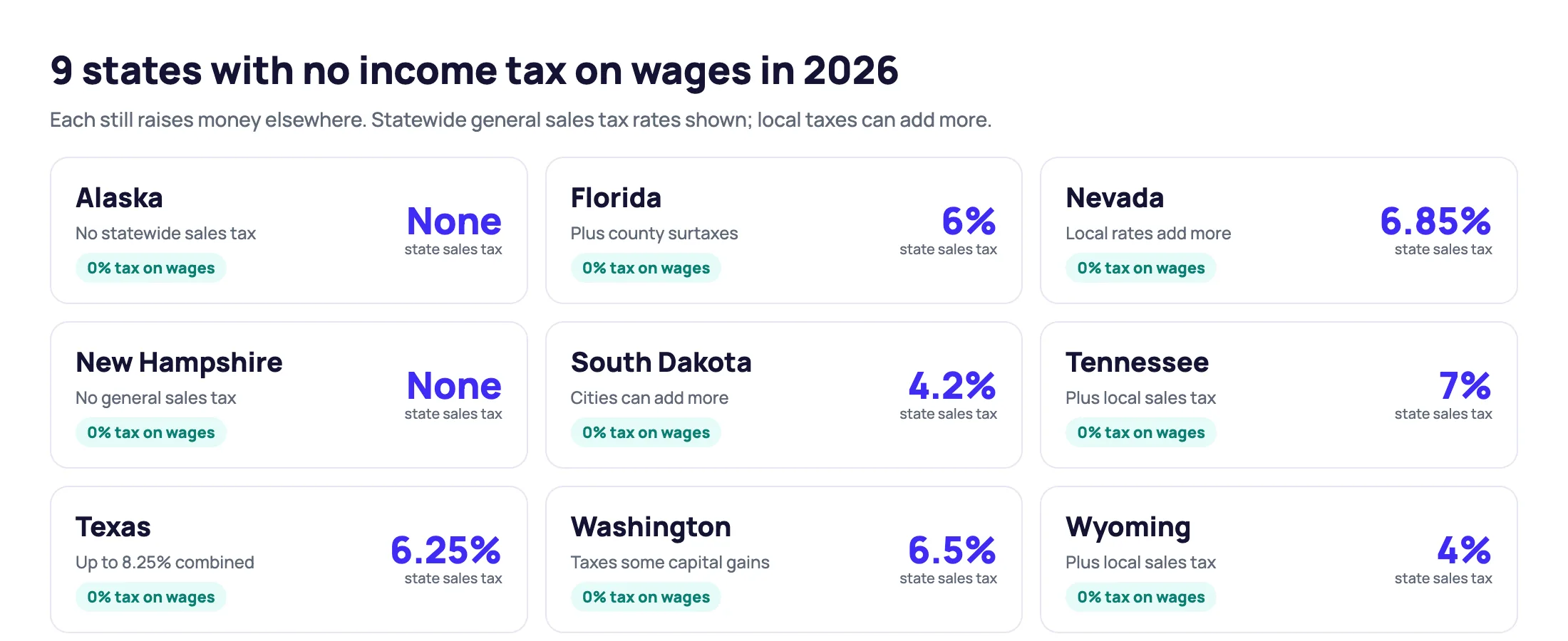
These states are often called tax-free states, but that label is misleading. Each one raises money through other taxes and fees.
For workers the main advantage is simple: ordinary wages are not subject to a state individual income tax.
A Closer Look at Each State With No Income Tax
All nine states leave ordinary wages untaxed, but their tax systems are different. Some lean on sales taxes. Others collect more through property taxes, business taxes or natural resources.
1. Alaska
Alaska is one of the few states with neither a personal income tax nor a statewide general sales tax.
That combination is rare. Cities and boroughs can still charge local sales taxes. Groceries, transportation and utilities often cost more than in the lower 48.
Alaska also pays eligible residents an annual Permanent Fund Dividend funded by the state's investment earnings. The dividend is taxable income on your federal return.
- No state income tax on wages or salaries.
- No statewide general sales tax.
- Local sales taxes may apply.
- Property taxes depend on the municipality.
- Federal income and payroll taxes still apply.
The tax advantages are real, but location and living costs deserve a close look before a move.
2. Florida
Florida is one of the best-known states with no income tax. Residents pay no state income tax on salaries, wages or most other personal income. The details are in our overview of Florida state income tax.
Florida does charge a 6% statewide sales tax. Many counties add discretionary sales surtaxes.
Property taxes vary by county, city and property value. Homeowners may qualify for a homestead exemption that lowers their taxable value.
The setup appeals to employees, business owners and retirees alike, though housing costs and homeowners insurance can eat into the savings.
3. Nevada
Nevada does not tax wages or salaries. The state raises revenue through sales taxes, gaming taxes and business taxes instead.
The statewide sales tax rate is 6.85%. Local rates push the total higher in many counties.
For employees, no Nevada state income tax means no state withholding on wages. Employers still have state obligations such as unemployment insurance contributions and, where it applies, the Modified Business Tax.
4. New Hampshire
New Hampshire has no income tax on wages and no general statewide sales tax.
The state used to tax certain interest and dividend income. The New Hampshire Department of Revenue Administration confirms that the Interest and Dividends Tax was repealed for tax periods beginning on or after January 1, 2025. As a result, New Hampshire has no broad individual income tax in 2026.
New Hampshire relies heavily on property taxes to fund local services. Homeowners should compare property tax bills carefully when looking at different towns.
The state suits people who want to avoid both wage taxes and a general sales tax, but housing costs remain a key consideration.
5. South Dakota
South Dakota does not collect individual income tax from residents.
The state charges a 4.2% general sales tax. Cities may add their own sales taxes.
Property taxes also apply. The amount depends on property classification, location and assessed value.
For workers and retirees, no income tax keeps state tax obligations simple. Sales taxes, property taxes and fees still belong in the budget.
6. Tennessee
Tennessee does not tax wages, salaries or investment income.
The state once collected the Hall Income Tax on certain interest and dividends, but that tax was fully repealed starting in 2021.
Tennessee has a 7% statewide sales tax. Local sales taxes raise the combined rate further.
Residents save on income tax but pay relatively high taxes on taxable purchases. Anyone thinking about a move should compare yearly spending and housing costs, not just income tax savings.
7. Texas
Texas is another major state without an individual income tax.
Employees do not have state income tax taken out of their paychecks at any salary level. Our guide to Texas state income tax walks through a full paycheck.
Texas relies heavily on property and sales taxes instead. The statewide sales tax is 6.25%. Local jurisdictions can add up to 2% for a combined rate as high as 8.25%.
Property taxes can be a substantial expense, especially for homeowners in areas with higher property values. Compare housing costs, insurance and local property tax rates before counting on the savings.
8. Washington
Washington does not impose a general income tax on wages or salaries in 2026.
It differs from the other eight states because it taxes certain long-term capital gains. The Washington capital gains tax is 7% above an annual deduction, with an extra 2.9% on taxable gains above $1 million.
Washington has also enacted a 9.9% tax on income above $1 million, signed in March 2026 and scheduled to take effect January 1, 2028. It does not apply to 2026 income.
For ordinary employees, Washington remains a no-wage-tax state in 2026. People with large investment income should review the capital gains rules before assuming all of their income is exempt.
9. Wyoming
Wyoming does not impose an individual income tax.
Its 4% statewide sales tax is one of the lowest in the country, although local taxes can raise the combined rate.
Wyoming draws revenue from mineral production, sales taxes and property taxes.
No income tax makes Wyoming appealing to workers, retirees and some business owners. Housing, jobs, transportation and living costs still vary a lot from one community to the next.
What Does No State Income Tax Actually Mean?
A state with no income tax does not collect a broad individual income tax on residents' wages and salaries.
In states that have one, employers withhold part of each paycheck and send it to the state tax agency. In a no-income-tax state that deduction is simply missing.
Federal taxes and other payroll deductions do not go away. An employee earning $60,000 a year in Florida owes no Florida income tax on those wages but still owes federal income tax, Social Security tax and Medicare tax.
No state income tax is not the same as no income tax at all.
How Much Can You Save by Living in a No Income Tax State?
Your savings depend on your earnings, filing status, deductions and the tax rules of the state you live in now.
As a simple illustration, take someone earning $80,000 a year.
| Hypothetical state rate | Annual state income tax | Annual savings at 0% |
|---|---|---|
| 3% | $2,400 | $2,400 |
| 4% | $3,200 | $3,200 |
| 5% | $4,000 | $4,000 |
| 6% | $4,800 | $4,800 |
| 7% | $5,600 | $5,600 |
These examples assume the rate applies to the whole $80,000 salary. They are not calculations of any particular state's tax.
Real state income taxes involve graduated brackets, deductions, exemptions and credits. For a closer comparison, check the state income tax rates for 2026 in every state.
Do You Still Pay Federal Income Tax in States With No Income Tax?
Yes. Federal income tax applies no matter whether your state has an income tax.
The IRS administers federal income tax rules in all 50 states. Your federal tax depends on taxable income, filing status, deductions and credits.
Living in a state without income tax does not lower your federal income tax. Two employees with the same taxable income and filing status owe the same federal tax even if one lives in Texas and the other in Pennsylvania.
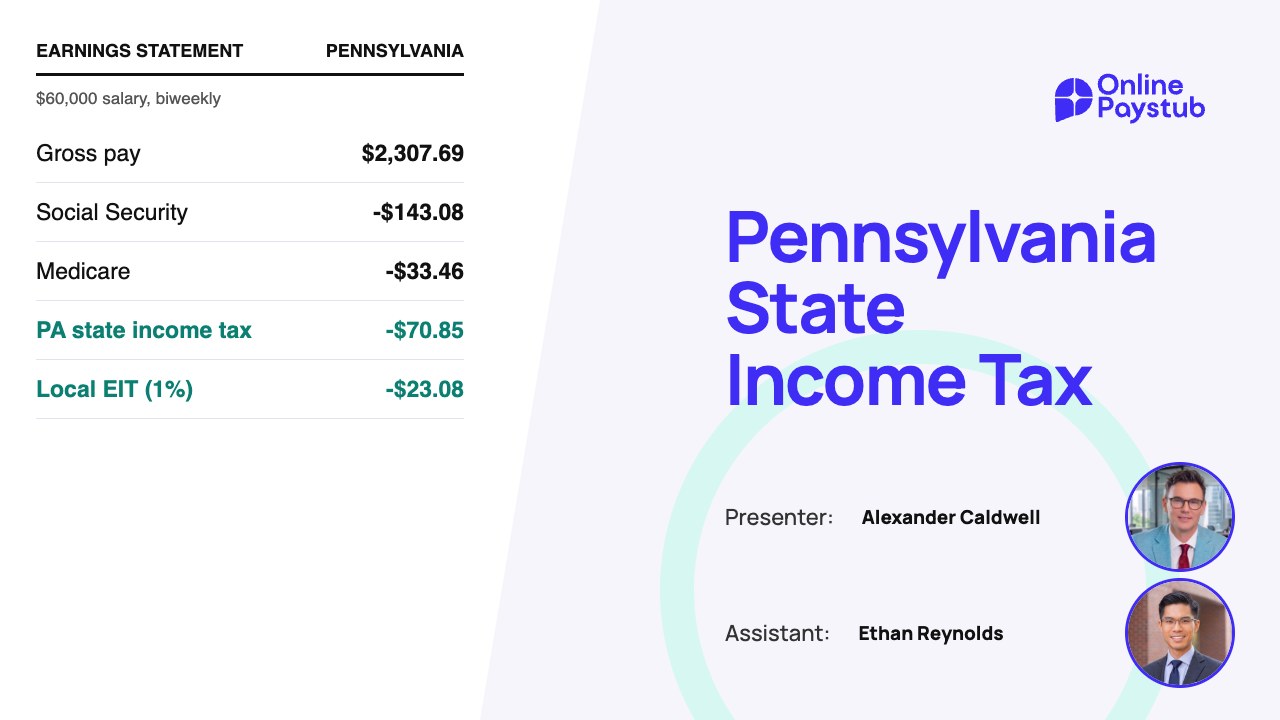
The difference is that Pennsylvania adds a flat 3.07% Pennsylvania income tax on top, while Texas adds nothing.
What Taxes Are Deducted From Your Paycheck in a No Income Tax State?
Even without a state income tax, several deductions still show up on your paystub.
Federal Income Tax Withholding
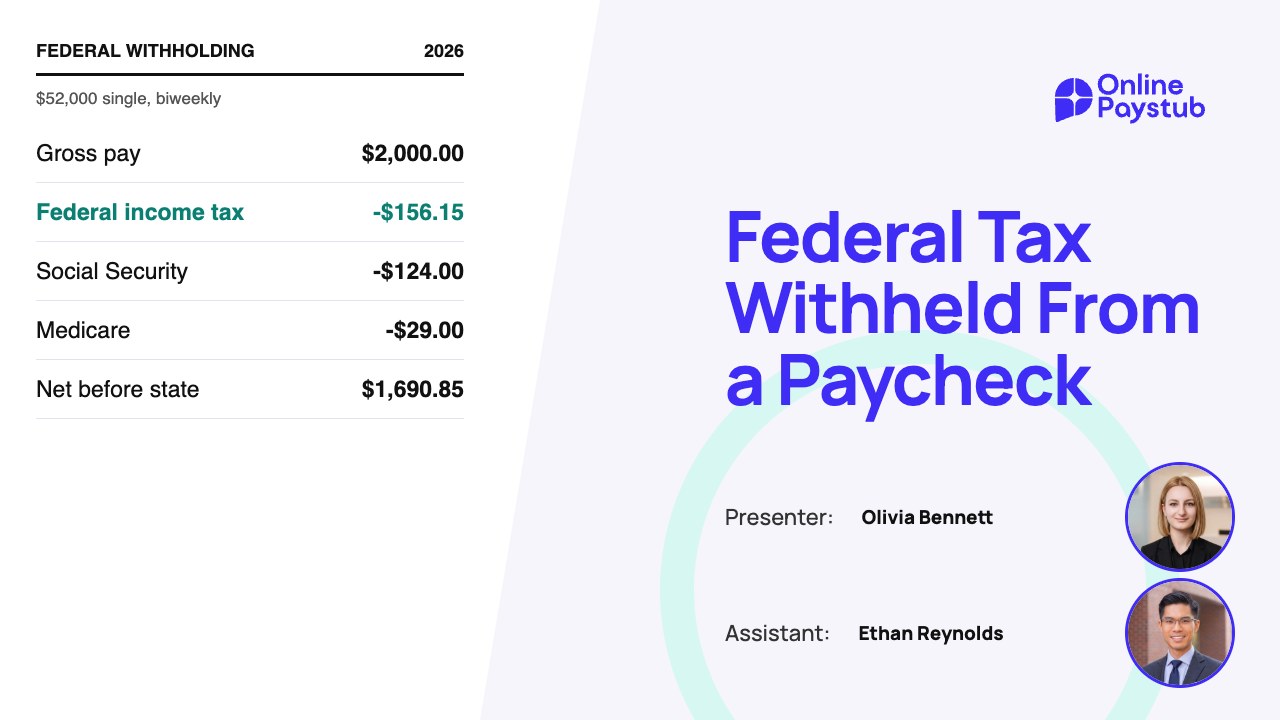
Federal income tax withholding is the amount your employer takes from your wages and sends to the IRS. It depends on your earnings, pay frequency and your Form W-4. The IRS sets the method in Publication 15. Our guide to how much federal tax is withheld shows it with examples.
Social Security Tax
Social Security tax is part of the Federal Insurance Contributions Act, known as FICA. In 2026 employees pay 6.2% of covered wages up to the $184,500 wage base. Employers pay another 6.2%. The tax applies in every state.
Medicare Tax
Medicare tax is the other part of FICA. Employees pay 1.45% of covered wages and employers pay another 1.45%. Regular Medicare tax has no wage cap. An Additional Medicare Tax of 0.9% applies to wages above the threshold. The full split is laid out in payroll taxes explained.
Other Payroll Deductions
Depending on your employer and benefits, your paycheck may also include:
- Health insurance premiums.
- Retirement plan contributions.
- Dental and vision insurance.
- Other voluntary benefits.
- State payroll programs where they apply, such as Washington's Paid Family and Medical Leave premium.
Not all of these are taxes, but each one lowers your net pay.
Example of a Paycheck in a No Income Tax State
Take an employee in Florida earning $5,000 a month.
| Paycheck item | Monthly amount |
|---|---|
| Gross monthly salary | $5,000.00 |
| State income tax | $0.00 |
| Social Security (6.2%) | $310.00 |
| Medicare (1.45%) | $72.50 |
| Federal income tax | Depends on withholding |
| Other deductions | Depends on benefits |
| Net pay | Depends on total deductions |
The employee pays $382.50 in employee FICA for the month, assuming all wages are covered and the Social Security wage base has not been reached.
Federal income tax withholding and any other deductions still come out before you reach the actual net paycheck. A Florida paystub generator lays these lines out with the state tax line at zero.
Are States With No Income Tax Really Cheaper to Live In?
Not necessarily. Skipping state income tax raises your take-home pay, but other taxes and living costs can offset it.
States without an income tax often lean more on sales taxes, property taxes or other revenue. Compare the total cost of living rather than income tax alone.
Sales Tax vs. Income Tax
Income tax is based on what you earn. Sales tax is collected when you buy taxable goods or services.
Tennessee has no income tax but a relatively high sales tax. Alaska has neither an income tax nor a statewide sales tax, although local sales taxes may apply.
Spending habits matter here. A household that spends most of its income on taxable purchases pays more sales tax than one that saves or invests a larger share.
Property Taxes
Property taxes matter most for homeowners. Texas and New Hampshire are two states where property taxes can be a significant yearly cost.
Even without a state income tax, homeowners may pay thousands of dollars a year in local property taxes. The bill depends on assessed value, local rates, exemptions and school district funding.
Renters feel it too, because landlords build property taxes into rent.
Housing and Everyday Expenses
Taxes are only one piece of the cost of living. Housing, transportation, healthcare, insurance, utilities and groceries vary widely between states and cities.
Moving from New York to Florida may end state income tax on wages, but housing and insurance costs can shrink the benefit. Moving to Alaska may bring tax advantages along with higher everyday costs.
The best choice depends on your own situation.
Which No Income Tax State Is Best for Taxes in 2026?
There is no single best state for everyone. It depends on your income, spending, housing and financial priorities.
| Financial priority | States worth comparing | Main reason |
|---|---|---|
| Avoiding state tax on wages | All nine states | No general state income tax on wages |
| Avoiding a statewide sales tax | Alaska and New Hampshire | Neither has a statewide general sales tax |
| Lower statewide sales tax rates | Wyoming and South Dakota | Lower state rates than most other no-income-tax states |
| Retirement planning | Florida, Tennessee and Wyoming | No individual income tax on retirement income |
| High salary jobs | Texas, Florida and Washington | No state tax on ordinary wages in 2026 |
| Owning a home | All nine states | Compare local property taxes and housing costs |
Treat these as starting points for research, not rankings. Your overall tax burden depends on your own situation.
A high earner who rents may care most about avoiding wage tax. A retired homeowner on a fixed income may care more about property taxes, insurance and healthcare costs.
Should You Move to a State With No Income Tax?
A move can make financial sense, especially if you pay a lot of state income tax today. Moving only to avoid that tax may not save as much as you expect.
Before you move, weigh these factors:
- Current state income tax: estimate what you actually pay each year after deductions and credits.
- Housing costs: compare rent, mortgage payments, property taxes and homeowners insurance.
- Sales taxes: estimate how much you spend on taxable purchases.
- Jobs: consider salary differences, career options and job stability.
- Residency rules: learn how your current and future states decide tax residency.
- Income sources: check whether investment income, business income or income earned in another state may still be taxed.
Becoming a resident of a no-income-tax state does not always end tax obligations elsewhere. Someone living in Florida who physically works in New York may still owe New York income tax.
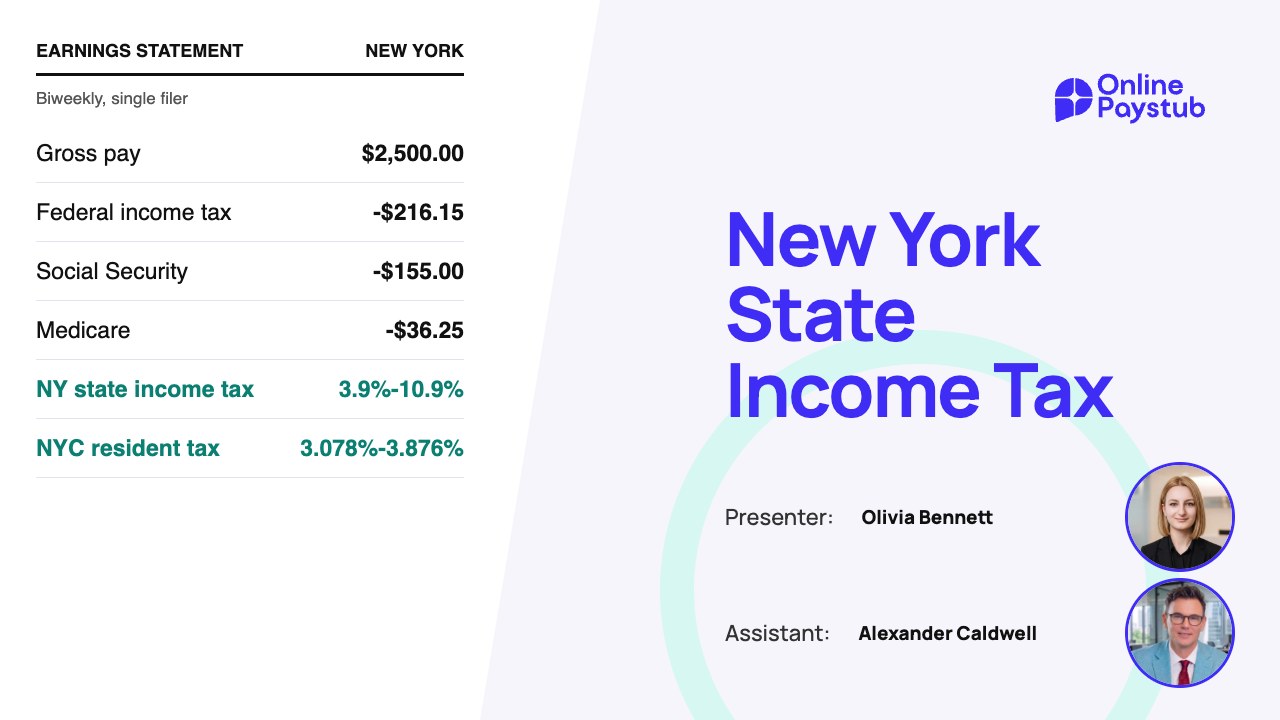
New York also has special rules for some remote employees of New York employers. The New York income tax rates and brackets are covered separately.
Can You Work Remotely From a State With No Income Tax?
Yes. Many employees work remotely from states without an income tax.
The state you live in is not always the only one that can tax your pay. Obligations can depend on where you physically work, where your employer is located, your residency status and each state's rules. Some states have special sourcing rules for remote employees.
A remote employee who moves from Pennsylvania to Texas may stop owing Pennsylvania resident tax after properly ending Pennsylvania residency. Pay for work done in Pennsylvania can still be taxed there.
Employers should review payroll registration, unemployment insurance and withholding requirements whenever an employee relocates. Workers should not assume a move to a no-income-tax state ends every state tax obligation.
Final Thoughts
The nine states that do not tax wages in 2026 offer a real financial advantage for employees who want to lower their state tax bill. Alaska, Florida, Nevada, New Hampshire, South Dakota, Tennessee, Texas, Washington and Wyoming all let workers earn ordinary wages without a broad state income tax.
No income tax does not guarantee a lower cost of living. Sales taxes, property taxes and housing costs can change how much residents actually save.
Before relocating or comparing job offers, look at your total tax burden and expected take-home pay. Employees and employers who need records of earnings and deductions can use our state paystub generators to prepare paystubs that match their payroll.
Sources: Tax Foundation state income tax rates for 2026, the New Hampshire Department of Revenue Administration, the Washington Department of Revenue and the IRS.
This article is general information about state taxes, not tax advice. Tax rules change; check your state revenue department or a tax professional for your situation.
Frequently Asked Questions
How many states have no income tax in 2026?
Nine states do not tax wages in 2026: Alaska, Florida, Nevada, New Hampshire, South Dakota, Tennessee, Texas, Washington and Wyoming. Eight of them have no individual income tax at all. Washington taxes certain long-term capital gains.
Is Florida a tax-free state?
No. Florida has no individual income tax, but residents still pay sales tax, property tax and federal taxes.
Does Texas have a state income tax?
No. Texas does not tax wages, salaries or other personal income. Residents still pay sales taxes, property taxes and other applicable taxes.
Does Washington have an income tax in 2026?
Washington does not tax wages in 2026. It does tax certain long-term capital gains. A separate 9.9% tax on income above $1 million is scheduled to start in 2028.
Are Social Security and Medicare taken out in states with no income tax?
Yes. Employees in these states still pay Social Security and Medicare under FICA. The lack of a state income tax does not change federal payroll taxes.
Do you get a bigger paycheck in a state with no income tax?
Often, yes. If your employer would otherwise withhold state income tax, your take-home pay can be higher. Federal taxes, benefits and other deductions still affect your net pay.
Do retirees pay state income tax in these states?
The eight states without any individual income tax do not tax retirement distributions. Washington's capital gains tax does not apply to retirement accounts either. Federal income tax can still apply to pensions, traditional retirement account withdrawals and Social Security benefits.
What is the difference between no income tax and tax-free?
No income tax means the state does not tax wages or other personal income. Tax-free would mean no taxes at all, which is not true of any U.S. state. Residents still owe federal taxes, payroll taxes, sales taxes and property taxes.
Written by Alexander Caldwell and reviewed by Olivia Bennett.

About the author
View all articles by Alexander
Reviewed by
View all articles by Olivia
Add your info
Use our secure online forms to enter your Company & Personal details in the fields provided.

Preview your document
Make edits before you order. Get documents delivered to your inbox in minutes.

Download your paystubs
Download and print the secure PDF. We'll print and mail your pay stubs and W2s.