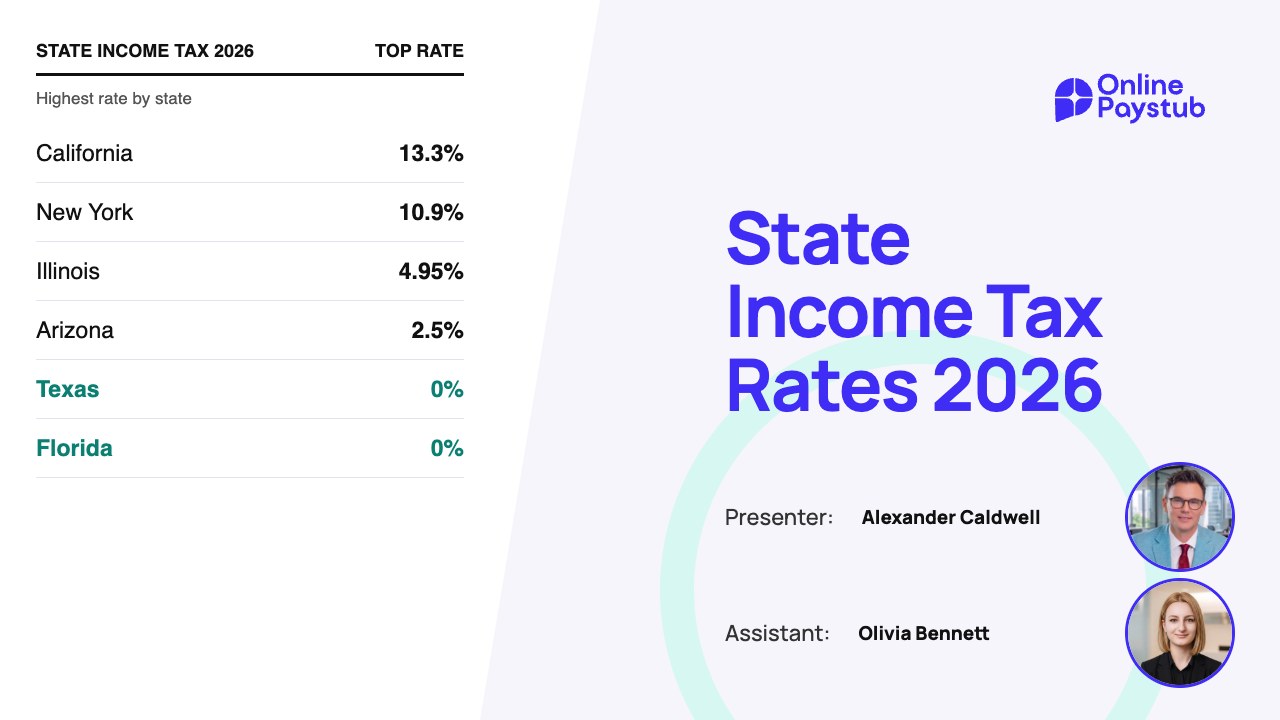

State income tax rates in 2026 range from 0% in states without a broad personal income tax to 13.3% in California, the highest top marginal rate in the country. Some states charge one flat rate; others use progressive brackets that rise with taxable income.
Eight states have no individual income tax at all. Washington does not tax wages but has a separate capital gains tax. Among states that tax wages, Arizona and North Dakota have the lowest top rates at 2.5%.
What you actually owe depends on more than the published rate. Income, filing status, deductions, credits and sometimes the city where you live or work all change the result. Below are the 2026 rates for all 50 states, how the different systems work and how state withholding shows up on a paycheck.
State Income Tax Rates by State in 2026
The table shows the statutory individual income tax rates for tax year 2026, not the share of income every resident pays. For progressive states it gives the lowest and highest rates; flat-tax states apply one rate to taxable income after their own deductions and exemptions.
| State | 2026 income tax rate | Tax structure |
|---|---|---|
| Alabama | 2% to 5% | Progressive |
| Alaska | No income tax | None |
| Arizona | 2.5% | Flat |
| Arkansas | 2% to 3.7% | Progressive |
| California | 1% to 13.3% | Progressive |
| Colorado | 4.4% | Flat |
| Connecticut | 2% to 6.99% | Progressive |
| Delaware | 2.2% to 6.6% | Progressive |
| Florida | No income tax | None |
| Georgia | 4.99% | Flat |
| Hawaii | 1.4% to 11% | Progressive |
| Idaho | 5.3% | Flat |
| Illinois | 4.95% | Flat |
| Indiana | 2.95% | Flat |
| Iowa | 3.8% | Flat |
| Kansas | 5.2% to 5.58% | Progressive |
| Kentucky | 3.5% | Flat |
| Louisiana | 3% | Flat |
| Maine | 5.8% to 9.15% | Progressive with a surcharge over $1 million |
| Maryland | 2% to 6.5% | Progressive |
| Massachusetts | 5% to 9% | Flat base rate plus surtax |
| Michigan | 4.25% | Flat |
| Minnesota | 5.35% to 9.85% | Progressive |
| Mississippi | 4% | Flat |
| Missouri | 2% to 4.7% | Progressive |
| Montana | 4.7% to 5.65% | Progressive |
| Nebraska | 2.46% to 4.55% | Progressive |
| Nevada | No income tax | None |
| New Hampshire | No income tax | None |
| New Jersey | 1.4% to 10.75% | Progressive |
| New Mexico | 1.5% to 5.9% | Progressive |
| New York | 3.9% to 10.9% | Progressive |
| North Carolina | 3.99% | Flat |
| North Dakota | 1.95% to 2.5% | Progressive |
| Ohio | 2.75% above $26,050 | Single positive rate |
| Oklahoma | 2.5% to 4.5% | Progressive |
| Oregon | 4.75% to 9.9% | Progressive |
| Pennsylvania | 3.07% | Flat |
| Rhode Island | 3.75% to 5.99% | Progressive |
| South Carolina | 1.99% to 5.21% | Progressive |
| South Dakota | No income tax | None |
| Tennessee | No income tax | None |
| Texas | No income tax | None |
| Utah | 4.45% | Flat |
| Vermont | 3.35% to 8.75% | Progressive |
| Virginia | 2% to 5.75% | Progressive |
| Washington | No tax on wages | Capital gains tax only |
| West Virginia | 2.11% to 4.58% | Progressive |
| Wisconsin | 3.5% to 7.65% | Progressive |
| Wyoming | No income tax | None |
Rates are based on the Tax Foundation's 2026 state income tax table and each state's 2026 tax laws and withholding guides, including changes signed during 2026. Local income taxes, special taxes and deductions are not included.
Washington is listed separately because its capital gains tax does not apply to wages. Ohio's rate applies only above $26,050 of taxable income. Several states also have zero-rate brackets or tax-free amounts that a simple range does not show.
What Is State Income Tax?
State income tax is a tax a state government charges on individual income. Depending on the state, it can cover wages, self-employment earnings, investment income and some retirement distributions.
It is separate from federal income tax. The IRS runs the federal system, while each state's revenue or taxation department runs its own. States also tax different kinds of income: some exempt retirement income, others treat capital gains differently or offer deductions found nowhere else.
For employees the tax is usually collected through payroll withholding. Your employer takes an estimate out of each paycheck and sends it to the state; at filing time the amount withheld is compared with what you actually owe.
Which States Have the Highest Income Tax Rates in 2026?
California has the highest top marginal rate at 13.3%, followed by Hawaii at 11% and New York at 10.9%. These rates apply only to income above set thresholds, not to every dollar.
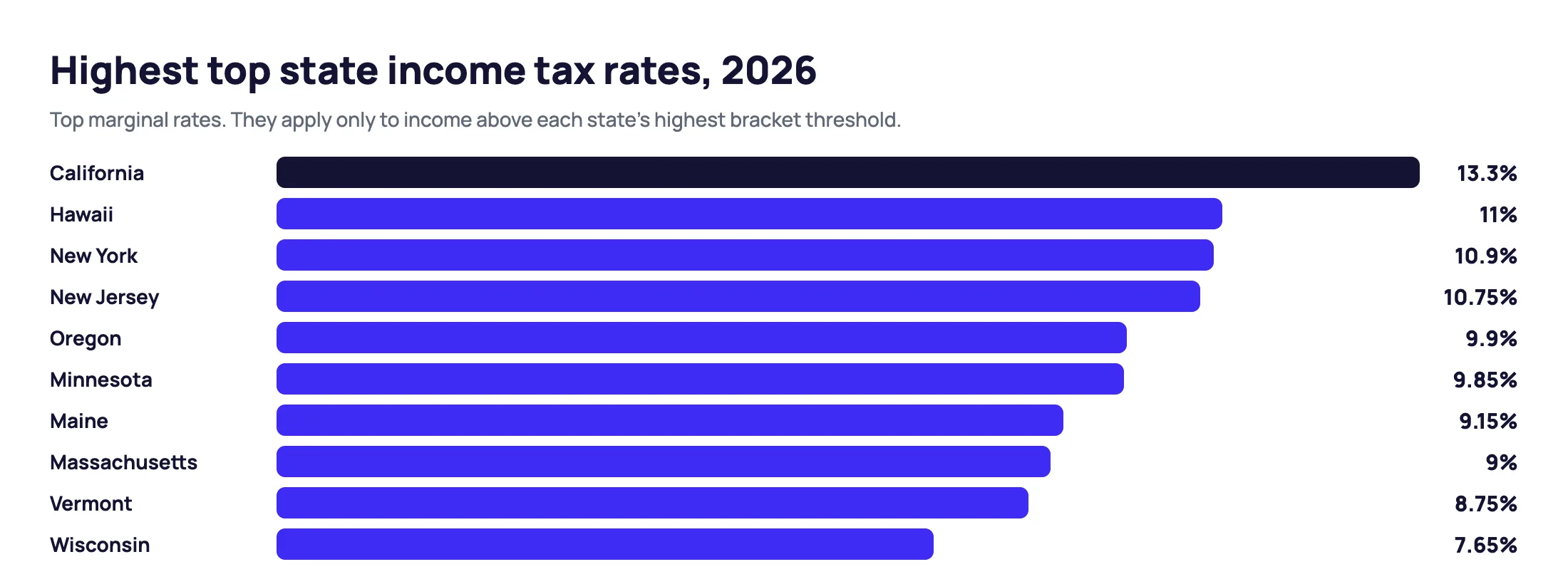
| State | Highest 2026 rate |
|---|---|
| California | 13.3% |
| Hawaii | 11% |
| New York | 10.9% |
| New Jersey | 10.75% |
| Oregon | 9.9% |
| Minnesota | 9.85% |
| Maine | 9.15% |
| Massachusetts | 9% |
| Vermont | 8.75% |
| Wisconsin | 7.65% |
Washington, D.C., which is not a state, has a top rate of 10.75%. Maine joins the list for 2026 because of a new 2% surcharge on taxable income above $1 million ($1.5 million for joint filers). None of these figures is the rate an average resident pays; effective rates are usually much lower.
Why Does California Have the Highest State Income Tax?
California taxes income in nine brackets from 1% to 12.3%, plus an extra 1% on taxable income above $1 million, which makes 13.3% the top marginal rate. Most Californians never pay 13.3% on their income, because lower slices fall into lower brackets and deductions and credits reduce the bill. California's bracket system also sits next to State Disability Insurance on the paystub, a payroll deduction that is not income tax.
Why High Rates Do Not Always Mean Higher Tax Bills
A state with a 9% top rate may apply it only to very high incomes, while a state with a 5% flat rate applies it to most of an employee's taxable income. Standard deductions, exemptions, credits and local taxes change the result too, so the effective rate is a better comparison than the top rate.
Which States Have the Lowest Income Tax Rates in 2026?
Among states that tax wages, Arizona and North Dakota have the lowest top rates at 2.5%. Ohio, Indiana, Louisiana, Pennsylvania, Kentucky, Arkansas and Iowa are also low.
| State | Top 2026 rate |
|---|---|
| Arizona | 2.5% |
| North Dakota | 2.5% |
| Ohio | 2.75% |
| Indiana | 2.95% |
| Louisiana | 3% |
| Pennsylvania | 3.07% |
| Kentucky | 3.5% |
| Arkansas | 3.7% |
| Iowa | 3.8% |
| North Carolina | 3.99% |
These compare top rates, not total tax burden. North Dakota taxes nothing on the first part of taxable income, while Arizona applies its flat 2.5% to all state taxable income. Pennsylvania's 3.07% flat rate does not make it cheaper than every higher-rate state either: local earned income taxes and property taxes can change the picture.
Which States Have No Income Tax in 2026?
Eight states have no individual income tax in 2026: Alaska, Florida, Nevada, New Hampshire, South Dakota, Tennessee, Texas and Wyoming. Washington is often added to the list because it does not tax wages, but it does tax certain capital gains.
Employees in these states have no state income tax withheld from their wages. Federal income tax, Social Security, Medicare and any other payroll deductions still apply.
Florida and Texas
Neither state taxes wages. An employee earning $60,000 in either state has no state income tax withheld, though federal withholding still affects take-home pay. Florida has no state income tax on individuals. The Texas Constitution bans one outright. Both still collect sales and property taxes; Texas property tax in particular is among the highest in the country.
Nevada and Wyoming
Nevada and Wyoming do not tax individual income either. Nevada's revenue comes mostly from sales, gaming and business taxes; Wyoming relies on property, sales and mineral taxes. Neither state requires state income tax withholding from wages.
Washington's Special Tax Treatment
Washington has no general income tax on wages or salaries, but it taxes certain long-term capital gains above set exclusions. Its Paid Family and Medical Leave premium can still appear as a payroll deduction.
Flat Tax States vs. Progressive Tax States
A flat-tax state applies one rate to taxable income. A progressive state splits taxable income into brackets, with higher rates on higher slices.
How a Flat State Income Tax Works
Arizona's 2026 flat rate is 2.5%. With $50,000 of Arizona taxable income, a simple calculation is $50,000 × 2.5% = $1,250. That assumes all $50,000 is taxable under Arizona's rules and ignores credits. Flat-tax states still have their own deductions, exemptions and credits, so the tax is rarely just gross pay times the rate.
How a Progressive State Income Tax Works
Take a hypothetical state with these brackets:
| Taxable income | Marginal rate |
|---|---|
| First $10,000 | 2% |
| $10,001 to $40,000 | 4% |
| Above $40,000 | 6% |
A taxpayer with $50,000 of taxable income owes $200 on the first $10,000, $1,200 on the next $30,000 and $600 on the last $10,000, a total of $2,000. Even though part of the income reaches the 6% bracket, the effective rate is 4%. These brackets are only an example, not any state's 2026 schedule.
Marginal Tax Rate vs. Effective Tax Rate
Your marginal rate is the rate on your next dollar of taxable income. Your effective rate is your total tax divided by your income. In the example, $2,000 of tax on $50,000 is an effective rate of 4%, which is why two people with similar salaries in states with similar top rates can owe very different amounts.
How Does State Income Tax Affect Your Paycheck?
In states that tax wages, employers withhold an estimate of state income tax from each paycheck, which lowers take-home pay. Gross pay is what you earn before deductions; net pay is what is left after taxes and other deductions.
A State Withholding Example
Two employees each earn $60,000 a year. One works in a state without an income tax on wages. For the other, assume an estimated state income tax of $2,400 a year.
| Payroll item | No-income-tax state | Income-tax state |
|---|---|---|
| Annual gross wages | $60,000 | $60,000 |
| Illustrative state income tax | $0 | $2,400 |
| Monthly equivalent | $0 | $200 |
The second employee has about $200 less each month before any other differences. The figures are illustrative; real withholding depends on each state's tables and can differ from the final tax.
Where State Income Tax Appears on a Paystub
State withholding usually sits in the taxes section of the stub, under labels such as State Income Tax, State Withholding or SIT, often with the state's abbreviation. It appears as its own line next to federal income tax, Social Security and Medicare.
What Form W-2 Box 17 Shows
On the W-2, Box 15 lists the state and the employer's state ID number, Box 16 shows state wages and Box 17 shows the state income tax withheld, as the IRS W-2 instructions describe. Box 17 is withholding, not your final state tax: when you file, the actual tax may be higher or lower. These boxes matter most for people who worked in more than one state.
State Income Tax vs. Federal Income Tax
| Feature | Federal income tax | State income tax |
|---|---|---|
| Tax authority | IRS | State tax agency |
| Coverage | Nationwide | Varies by state |
| Structure | Progressive | Flat, progressive or none |
| Brackets | Federal brackets | State-specific brackets |
| Payroll withholding | Generally required | Depends on the state |
| Annual return | Federal return | State return where required |
Federal income tax rates for 2026 run from 10% to 37%. State tax is figured separately, often starting from federal income with state additions and subtractions. Some states follow federal definitions closely; others have their own deductions and exclusions.
State Income Tax Changes for 2026
Several states cut their rates or changed their tax structure for 2026, which affects withholding, estimated payments and the tax you owe.
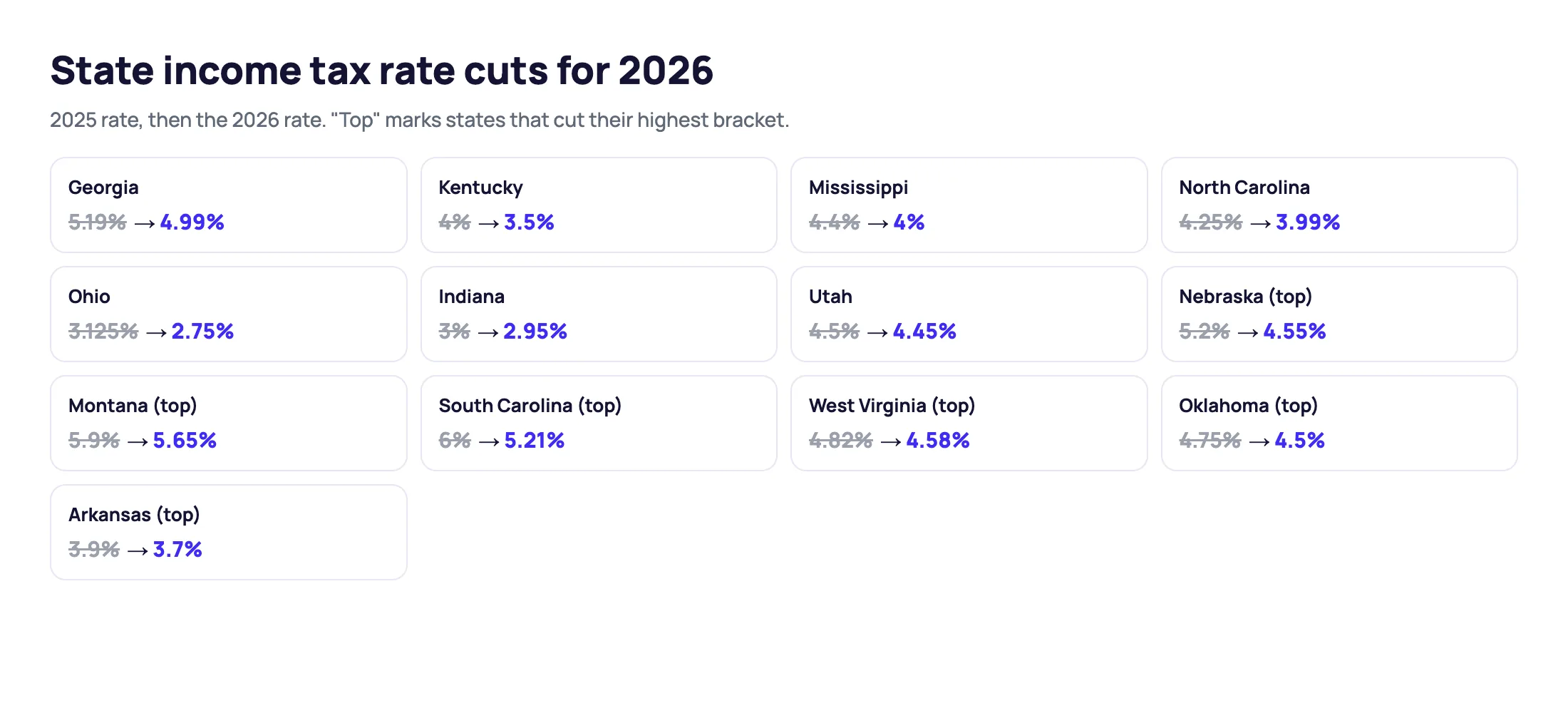
| State | 2025 rate | 2026 rate |
|---|---|---|
| Arkansas | Top rate 3.9% | Top rate 3.7% |
| Georgia | 5.19% | 4.99% |
| Indiana | 3% | 2.95% |
| Kentucky | 4% | 3.5% |
| Mississippi | 4.4% | 4% |
| Montana | Top rate 5.9% | Top rate 5.65% |
| Nebraska | Top rate 5.2% | Top rate 4.55% |
| New York | Lowest rate 4% | Lowest rate 3.9% |
| North Carolina | 4.25% | 3.99% |
| Ohio | Top rate 3.125% | 2.75% |
| Oklahoma | Top rate 4.75% | Top rate 4.5% |
| South Carolina | Top rate 6% | Top rate 5.21% |
| Utah | 4.5% | 4.45% |
| West Virginia | Top rate 4.82% | Top rate 4.58% |
The table covers selected rate changes, not every change to deductions, credits or withholding. Some states have also scheduled future cuts that depend on revenue targets; treat those as possible, not guaranteed.
Why State Tax Changes Matter for Payroll
When a state changes its rate, employers update their withholding tables. A rate cut does not always change take-home pay by the same percentage, because taxable wage rules, withholding tables, filing status and allowances also matter. After a change, compare your stubs and year-to-date deductions with what you expect to owe.
What Are State and Local Income Taxes?
Some cities, counties and school districts tax income on top of the state. Many Pennsylvania municipalities levy a local earned income tax, New York City taxes its residents on top of New York State income tax and Maryland's counties and Baltimore City add a local income tax through the state return. Ohio and Michigan cities also tax wages. So the statewide rate does not always describe the full income tax an employee pays. People who live in one place and work in another should also check residency and reciprocity rules.
Income Tax vs. Sales Tax vs. Property Tax
Income tax is only part of the state and local tax burden. A state with no income tax may collect a lot through sales, property and excise taxes.
- Income tax is based on taxable earnings and other income.
- Sales tax is charged on taxable purchases of goods and some services.
- Property tax is based on the taxable value of real estate and, in some places, other property.
Texas has no income tax on wages, but homeowners there can face high local property taxes. Oregon taxes income but has no general sales tax. Which is cheaper depends on income, housing costs, spending and local rules.
How to Calculate State Income Tax
- Identify the state or states that can tax your income.
- Work out state taxable income after the state's adjustments and deductions.
- Apply the 2026 rates and brackets for your filing status.
- Subtract the state credits you qualify for.
- Compare the result with the state tax already withheld.
In progressive states, each slice of taxable income is taxed at its own rate. Flat-tax states are simpler, though taxable income adjustments and credits still matter. When estimating take-home pay, remember that state income tax is only one of several payroll deductions.
Do You Pay State Income Tax If You Work in Another State?
You may owe tax to two states if you live in one and work in another. Your home state can usually tax all of your income, while the state where you work can tax what you earn there. Reciprocal agreements between some neighboring states let commuters pay tax on wages only to their home state. Where two states tax the same income, the home state usually gives a credit for tax paid to the other. Remote workers should check where the work is done, where the employer is and any special sourcing rules; moving during the year can mean part-year returns in both states.
Can You Deduct State Income Taxes on Your Federal Return?
If you itemize, state and local taxes can be deducted on your federal return under the SALT deduction. Eligible amounts include state and local income taxes or sales taxes plus property taxes. For 2026 the cap is $40,400, reduced for incomes above $505,000 but not below $10,000; married people filing separately get half. The IRS page on deductible taxes has the details. The deduction lowers federal taxable income; it does not reduce federal tax dollar for dollar. It is not available with the standard deduction either.
Final Thoughts
State income tax rates for 2026 vary widely. California has the highest top rate at 13.3%, eight states have no individual income tax and Washington taxes capital gains but not wages. The published rate is a starting point; taxable income, filing status, deductions, credits and local taxes decide the final amount.
For employees it also helps to know how the state line appears on a paycheck and how it relates to the tax owed for the year. Each state paystub generator on our site applies that state's withholding rules, so you can create a paystub for real payroll records with the right state line.
This article is general information about state income taxes, not tax advice. Rates and withholding rules change; check the state tax agency or a tax professional for your situation.
See your state's income tax line on a clear, itemized pay stub.
Create a Pay Stub Now