Summary
- The IRS released the 2027 inflation adjustments in Revenue Procedure 2026-35 on November 5, 2026. They cover almost 70 tax provisions and generally apply to returns filed in 2028.
- The seven federal rates stay at 10% to 37%. Bracket thresholds rise: the 12% bracket for single filers now runs to $52,025 and the 37% rate starts above $661,375 ($793,650 for joint filers).
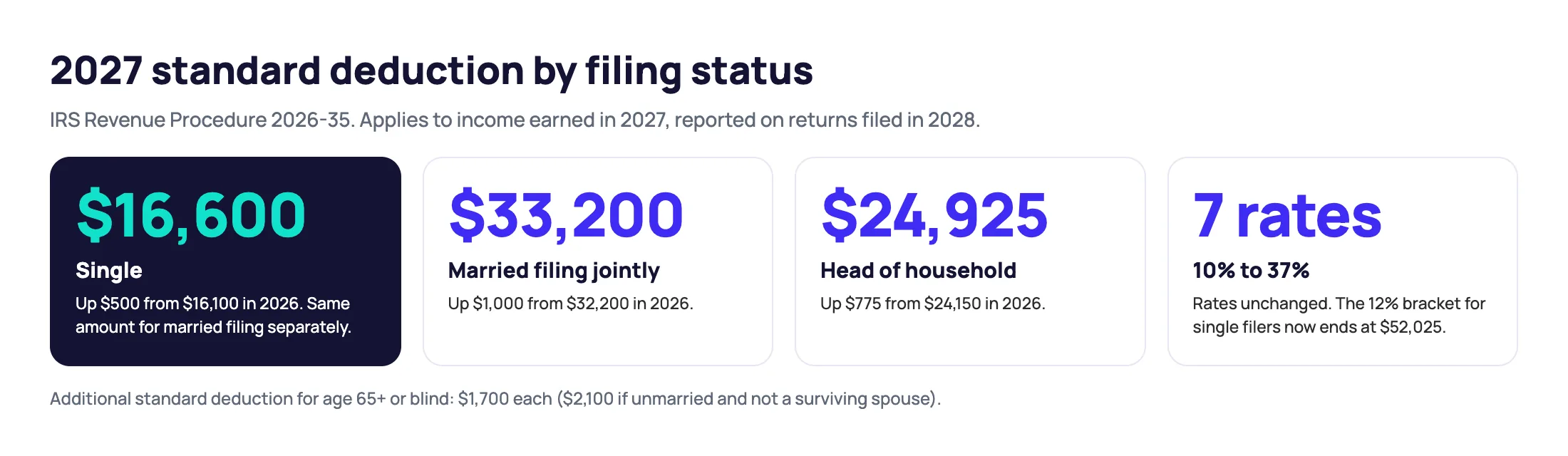
- The standard deduction climbs to $16,600 for single filers, $33,200 for married couples filing jointly and $24,925 for heads of household.
- The Child Tax Credit rises to $2,300 per child with up to $1,800 refundable. The top EITC reaches $8,496.
- A single filer earning $70,000 with no other adjustments would owe $280.50 less in regular federal income tax under 2027 rules.
- Social Security and Medicare rates do not change with the brackets. Paycheck withholding changes depend on the W-4 and the 2027 withholding tables.
The IRS has announced its federal income tax inflation adjustments for 2027, bringing higher standard deductions, updated income tax brackets and increased limits for several popular tax credits.
On November 5, 2026, the Internal Revenue Service released Revenue Procedure 2026-35, outlining inflation adjustments affecting nearly 70 tax provisions. The changes reflect the annual adjustments required under federal tax law, including provisions associated with the Working Families Tax Cuts.
For many taxpayers, these adjustments could mean a smaller federal income tax bill in 2027 compared with what they would pay under 2026 rules, assuming their income and other circumstances remain the same.
The changes also affect employers, families with children, self-employed individuals and businesses preparing for the next tax year.
This guide explains the 2027 tax brackets, standard deduction amounts, tax credit increases and other important IRS updates, along with what they could mean for your paycheck and tax return.
What Are the New IRS Tax Changes for 2027?
The IRS adjusts various federal tax provisions annually to account for inflation. Without these adjustments, rising wages could push taxpayers into higher tax brackets even when their purchasing power has not increased.
This situation is commonly called bracket creep.
For the 2027 tax year, the IRS has increased several income thresholds, deductions and tax credits. The seven federal income tax rates remain unchanged at 10%, 12%, 22%, 24%, 32%, 35% and 37%.
Key IRS Tax Changes for 2027
| Tax provision | 2026 | 2027 |
|---|---|---|
| Standard deduction, single | $16,100 | $16,600 |
| Standard deduction, married filing jointly | $32,200 | $33,200 |
| Standard deduction, head of household | $24,150 | $24,925 |
| Maximum Child Tax Credit | $2,200 | $2,300 |
| Maximum refundable Child Tax Credit portion | $1,700 | $1,800 |
| Maximum EITC, three or more qualifying children | $8,231 | $8,496 |
| Health FSA contribution limit | $3,400 | $3,500 |
| Monthly qualified transportation benefit limit | $340 | $350 |
| Estate tax basic exclusion | $15,000,000 | $15,480,000 |
| Annual gift tax exclusion | $19,000 | $20,000 |
| Section 179 expensing limit | $2,560,000 | $2,640,000 |
These adjustments generally apply to income earned between January 1 and December 31, 2027.
Important: Tax year 2027 is not the same as the 2027 filing season. Most individuals will file their 2027 federal income tax returns in 2028. Returns filed in early 2027 generally report income earned during 2026.
2027 Standard Deduction Increases
One of the most significant changes is the increase in the standard deduction.
The standard deduction reduces the amount of income subject to federal income tax. Taxpayers generally choose between taking the standard deduction and itemizing eligible deductions, depending on which option provides a greater tax benefit.
For 2027, the IRS has increased the standard deduction for every major filing status.
2027 Standard Deduction by Filing Status
| Filing status | 2026 deduction | 2027 deduction | Increase |
|---|---|---|---|
| Single | $16,100 | $16,600 | $500 |
| Married filing jointly | $32,200 | $33,200 | $1,000 |
| Married filing separately | $16,100 | $16,600 | $500 |
| Head of household | $24,150 | $24,925 | $775 |
For example, a single taxpayer earning $60,000 in 2027 could subtract the $16,600 standard deduction, leaving $43,400 in federal taxable income before considering other adjustments.
In 2026, the same taxpayer would have received a standard deduction of $16,100, resulting in $43,900 of taxable income under otherwise identical circumstances.
The higher deduction reduces taxable income by $500.
That does not mean the taxpayer automatically saves $500 in taxes. The actual tax savings depend on the marginal tax rates that apply to the income being excluded.
Additional Standard Deduction for Older or Blind Taxpayers
Some taxpayers qualify for an additional standard deduction because they are age 65 or older or legally blind.
For 2027, the additional standard deduction is $1,700 for each qualifying condition. The amount increases to $2,100 if the taxpayer is unmarried and not a surviving spouse.
These amounts are separate from the additional senior deduction introduced under the Working Families Tax Cuts, which has its own eligibility requirements.
2027 Federal Income Tax Brackets
The federal government uses a progressive income tax system. This means different portions of a taxpayer's taxable income are subject to different tax rates.
Although the percentages have not changed for 2027, the income thresholds for each bracket have increased.
Complete 2027 Federal Tax Bracket Table
| Tax rate | Single | Married filing jointly | Head of household | Married filing separately |
|---|---|---|---|---|
| 10% | $0 to $12,800 | $0 to $25,600 | $0 to $18,250 | $0 to $12,800 |
| 12% | Over $12,800 to $52,025 | Over $25,600 to $104,050 | Over $18,250 to $69,650 | Over $12,800 to $52,025 |
| 22% | Over $52,025 to $109,125 | Over $104,050 to $218,250 | Over $69,650 to $109,100 | Over $52,025 to $109,125 |
| 24% | Over $109,125 to $208,325 | Over $218,250 to $416,650 | Over $109,100 to $208,300 | Over $109,125 to $208,325 |
| 32% | Over $208,325 to $264,550 | Over $416,650 to $529,100 | Over $208,300 to $264,550 | Over $208,325 to $264,550 |
| 35% | Over $264,550 to $661,375 | Over $529,100 to $793,650 | Over $264,550 to $661,350 | Over $264,550 to $396,825 |
| 37% | Over $661,375 | Over $793,650 | Over $661,350 | Over $396,825 |
These brackets apply to federal taxable income, not necessarily total wages or gross annual salary.
Your taxable income is determined after accounting for applicable adjustments and deductions.
2027 Tax Brackets for Single Filers
For taxpayers filing as single, the first $12,800 of taxable income is subject to the 10% federal income tax rate.
The 12% bracket extends to $52,025, compared with $50,400 in 2026.
The 22% bracket applies to taxable income above $52,025 and up to $109,125. The top 37% bracket begins when taxable income exceeds $661,375.
2027 Tax Brackets for Married Couples Filing Jointly
Married couples filing jointly have different income thresholds.
The 10% bracket covers their first $25,600 of taxable income, while the 12% bracket extends to $104,050.
The 22% bracket applies to taxable income above $104,050 and up to $218,250.
The highest federal marginal rate of 37% applies to joint taxable income exceeding $793,650, compared with $768,700 in 2026.
How Do Marginal Tax Rates Work?
A common misunderstanding is that moving into a higher tax bracket causes all income to be taxed at the higher rate.
That is not how progressive federal income taxation works.
Suppose a single taxpayer has $60,000 in federal taxable income for 2027. Their regular federal income tax is calculated across three brackets:
| Income portion | Tax rate | Tax |
|---|---|---|
| First $12,800 | 10% | $1,280.00 |
| Next $39,225 | 12% | $4,707.00 |
| Remaining $7,975 | 22% | $1,754.50 |
| Total | $7,741.50 |
Although the taxpayer's marginal rate is 22%, their effective federal income tax rate on taxable income is approximately 12.9%.
This example excludes tax credits, additional taxes and other special tax provisions.
Understanding the difference between marginal and effective rates can help taxpayers make sense of their federal income tax liability.
How Much Could You Save With the 2027 Tax Brackets?
The combined effect of higher standard deductions and expanded tax brackets may reduce federal income tax liability for some taxpayers.
Consider a single employee earning $70,000 annually with no additional adjustments, deductions, credits or other taxes.
Example: $70,000 Annual Salary in 2026 vs. 2027
| Calculation | 2026 | 2027 |
|---|---|---|
| Gross annual income | $70,000 | $70,000 |
| Standard deduction | $16,100 | $16,600 |
| Federal taxable income | $53,900 | $53,400 |
| Regular federal income tax | $6,570.00 | $6,289.50 |
Under these assumptions, the employee's calculated federal income tax liability would be $280.50 lower in 2027 than in 2026.
The difference comes from both the higher standard deduction and inflation-adjusted tax brackets.
This is a simplified illustration, not an estimate of an actual refund or paycheck increase. Actual tax liability depends on many factors, including other income, deductions, credits and applicable taxes.
A reduction in calculated annual income tax liability also does not guarantee an immediate or identical reduction in every paycheck's withholding.
2027 Child Tax Credit Increases to $2,300
Families with qualifying children may benefit from a higher Child Tax Credit in 2027.
The IRS increased the maximum credit from $2,200 in 2026 to $2,300 per qualifying child in 2027. The maximum refundable portion also rises from $1,700 to $1,800 per qualifying child.
| Child Tax Credit | 2026 | 2027 |
|---|---|---|
| Maximum credit per qualifying child | $2,200 | $2,300 |
| Maximum refundable portion | $1,700 | $1,800 |
A tax credit differs from a tax deduction because it directly reduces eligible federal income tax liability.
For example, a qualifying family with two eligible children could potentially receive up to $4,600 in credits for the 2027 tax year, subject to income restrictions and other requirements.
Who Qualifies for the Child Tax Credit?
Eligibility generally depends on the child's age, relationship to the taxpayer, residency, dependency status and other requirements.
A qualifying child generally must be under age 17 at the end of the tax year. The taxpayer and qualifying child must also satisfy applicable Social Security number requirements.
The credit begins phasing out for taxpayers with modified adjusted gross income exceeding $200,000 ($400,000 for married couples filing jointly).
The refundable amount is not automatic. It depends on eligibility, earned income and the calculation rules for the Additional Child Tax Credit.
Families should review the applicable IRS instructions when preparing their 2027 returns.
Earned Income Tax Credit Updates for 2027
The Earned Income Tax Credit, commonly known as the EITC, provides tax relief to qualifying workers with low to moderate earnings.
For 2027, the IRS increased the maximum credit amounts across qualifying family categories.
Maximum EITC Amounts for 2027
| Qualifying children | Maximum 2027 EITC |
|---|---|
| No qualifying children | $685 |
| One qualifying child | $4,573 |
| Two qualifying children | $7,552 |
| Three or more qualifying children | $8,496 |
The maximum credit for taxpayers with three or more qualifying children increases from $8,231 in 2026 to $8,496 in 2027.
Not every taxpayer receives the maximum amount. The actual credit depends on earned income, adjusted gross income, filing status and the number of qualifying children.
For 2027, the IRS also sets an investment income limitation of $12,600. Taxpayers whose specified investment income exceeds this threshold are not eligible for the EITC.
Taxpayers should verify all eligibility requirements rather than assuming they qualify based on wages alone.
Additional Tax Credits and Deductions Changing in 2027
The 2027 inflation adjustments extend beyond standard deductions and income tax brackets. Several provisions related to adoption, health benefits, transportation and other expenses have also been updated.
Adoption Tax Credit
For 2027, the maximum adoption tax credit increases to $18,250 in qualified adoption expenses, compared with $17,670 in 2026. The maximum refundable portion is $5,280.
The credit may help eligible families offset qualifying adoption expenses, subject to the applicable rules and income limitations.
Health Flexible Spending Accounts
Employees participating in an employer-sponsored health Flexible Spending Account (FSA) may be able to set aside more money in 2027.
The annual employee salary reduction contribution limit increases to $3,500, compared with $3,400 in 2026. For employer plans that permit unused FSA funds to carry over, the maximum carryover amount rises to $700.
Actual carryover availability depends on the employer's plan terms.
A health FSA generally allows eligible medical expenses to be paid using funds contributed through payroll under favorable tax treatment. Employees should review their employer's benefits enrollment information before selecting a contribution amount.
Qualified Transportation and Parking Benefits
The monthly exclusion limit for qualified transportation fringe benefits increases to $350 in 2027. The monthly exclusion for qualified parking benefits also increases to $350.
Both amounts are $10 higher than their respective 2026 limits. These exclusions can affect eligible employer-sponsored commuter and parking benefit arrangements.
Medical Savings Account Limits
The IRS has also updated qualifying deductible and out-of-pocket thresholds for Medical Savings Accounts.
For 2027, self-only coverage has an annual deductible ranging from $3,000 to $4,550, with a maximum out-of-pocket expense amount of $6,050.
For family coverage, the qualifying deductible ranges from $6,050 to $9,050, with an out-of-pocket limit of $11,050.
These Medical Savings Account provisions should not be confused with the separate contribution and eligibility limits applicable to Health Savings Accounts.
2027 Alternative Minimum Tax Adjustments
The Alternative Minimum Tax (AMT) is a separate federal income tax calculation intended to limit certain tax advantages available to taxpayers.
Depending on a taxpayer's financial circumstances, the AMT system can produce a tax liability different from the regular federal income tax calculation.
The IRS adjusted AMT exemption amounts for 2027.
| Filing status | 2027 AMT exemption |
|---|---|
| Single | $93,000 |
| Married filing jointly | $144,700 |
| Married filing separately | $72,350 |
For unmarried individuals, the exemption begins phasing out at $515,950. For married taxpayers filing jointly, the phaseout begins at $1,031,900.
The exemption reduces income considered under the AMT calculation. The rules are more complex than simply subtracting the exemption from regular taxable income.
Taxpayers with substantial capital gains, certain deductions or other complex income circumstances may benefit from reviewing their AMT exposure with a qualified tax professional.
Estate and Gift Tax Exclusions Increase in 2027
The IRS has also increased important federal estate and gift tax thresholds.
Estate Tax Exclusion
For individuals who die during 2027, the federal estate tax basic exclusion amount increases to $15,480,000. That is $480,000 higher than the 2026 exclusion of $15,000,000.
The exclusion determines the amount that may be sheltered from federal estate tax, subject to applicable estate and gift tax rules.
Annual Gift Tax Exclusion
The annual gift tax exclusion rises from $19,000 in 2026 to $20,000 in 2027.
Generally, a person can give up to the annual exclusion amount to each recipient without using their lifetime gift and estate tax exclusion. Certain gifts may require additional reporting even when no immediate gift tax is owed.
The annual exclusion for qualifying gifts to a spouse who is not a U.S. citizen also increases to $201,000 in 2027.
What Changes for Businesses and Self-Employed Taxpayers in 2027?
The IRS adjustments are not limited to employees and individual tax filers. Businesses may also benefit from increased deduction limits and employer-related tax credits.
Section 179 Deduction Limit Increases
Section 179 generally allows qualifying businesses to deduct the cost of certain eligible property placed in service during the tax year, subject to statutory requirements and limitations.
For 2027, the maximum Section 179 expensing limit increases to $2,640,000. The corresponding 2026 limit is $2,560,000.
The special Section 179 deduction limit for qualifying sport utility vehicles also increases from $32,000 in 2026 to $33,100 in 2027.
These figures represent maximum statutory limits. The amount an individual business can deduct depends on the property, purchase costs, business use, income limitations and other applicable rules.
Employer-Provided Childcare Tax Credit
The maximum employer-provided childcare tax credit increases to $515,943.67 for 2027. Eligible small businesses may qualify for a higher maximum credit of $619,132.40.
This credit is intended to encourage qualifying employer-supported childcare programs and expenditures. The actual credit depends on qualified expenses and eligibility requirements.
Foreign Earned Income Exclusion
For qualifying taxpayers working abroad, the foreign earned income exclusion increases to $137,300 in 2027. The 2026 amount is $132,900.
Eligibility generally requires satisfying applicable foreign residence or physical presence requirements and other IRS rules. The exclusion is particularly relevant to certain U.S. taxpayers living and working outside the United States.
Which Tax Provisions Are Not Changing in 2027?
Not every federal tax provision is adjusted annually. Some limits remain unchanged because federal law restricts or eliminates inflation adjustments.
Personal Exemptions Remain at Zero
The federal personal exemption remains $0 for 2027.
The personal exemption was eliminated under the Tax Cuts and Jobs Act of 2017. The elimination was made permanent under the Working Families Tax Cuts.
This should not be confused with the standard deduction, which has increased. It is also separate from the deduction available to certain qualifying seniors.
Itemized Deduction Limitations
The previous overall limitation on itemized deductions was eliminated for tax years 2018 through 2025. That elimination was made permanent.
The Working Families Tax Cuts also include a limitation on the federal income tax benefit of itemized deductions for taxpayers in the highest 37% tax bracket.
Taxpayers who itemize should evaluate the applicable rules rather than assuming every deductible expense produces the same tax savings.
Lifetime Learning Credit Income Thresholds
The income phaseout thresholds for the Lifetime Learning Credit remain unchanged.
For single taxpayers, the credit phases out between modified adjusted gross income of $80,000 and $90,000. For married taxpayers filing jointly, the phaseout range remains $160,000 to $180,000.
These amounts have not been adjusted for inflation for tax years beginning after December 31, 2020.
How Will the 2027 Tax Changes Affect Your Paycheck?
The 2027 federal tax changes may affect the amount of federal income tax withheld from employee wages.
A change in tax brackets or standard deductions does not necessarily translate into an identical change in take-home pay.
Employers generally calculate federal income tax withholding based on IRS withholding rules, an employee's Form W-4, the employee's earnings and payroll frequency.
As the applicable withholding rules are implemented for 2027, employees may notice differences in the federal income tax withholding shown on their pay stubs.
Understanding Federal Tax Withholding on a Pay Stub
A pay stub provides information about earnings and deductions during a specific pay period.
The document may include gross pay, federal income tax withholding, state income tax withholding, Social Security taxes, Medicare taxes, employee benefits and net pay.
Federal income tax withholding may appear under labels such as FIT, FITW, Federal Tax or Fed Withholding.
Social Security and Medicare taxes, commonly referred to as FICA taxes, are separate from federal income tax withholding.
The new 2027 federal income tax brackets do not, by themselves, change Social Security or Medicare tax rates.
State and local income taxes also operate under separate rules.
Does a Higher Standard Deduction Increase Take-Home Pay?
Potentially. The effect depends on the employee's circumstances and applicable withholding calculations.
An employee with an unchanged salary may see less federal income tax withheld if the updated withholding calculation produces a lower amount.
Multiple jobs, bonuses, changes to Form W-4, other income and additional withholding requests may affect the result.
The actual annual federal income tax liability is generally reconciled when the taxpayer files their federal income tax return.
Why Employees Should Review Their Pay Stubs
The beginning of a new tax year is a useful opportunity to examine payroll deductions.
Employees can review their gross wages, federal income tax withholding, Social Security and Medicare deductions, benefit contributions and year-to-date totals.
For additional context, employees can compare their existing payroll records and learn how to make a pay stub using accurate earnings and withholding information.
A pay stub should reflect actual payroll details. Estimated tax savings or projected withholding changes should not be entered as actual amounts in official payroll records.
How to Prepare for the 2027 Tax Year
Although most taxpayers will not file their 2027 returns until 2028, planning before the tax year begins may help prevent unexpected tax issues.
Here are several practical steps worth considering:
- Review your filing status. Confirm whether you expect to file as single, married filing jointly, married filing separately or head of household.
- Estimate your annual income. Consider wages, self-employment income, interest and other taxable income sources.
- Compare deduction options. Determine whether the 2027 standard deduction or eligible itemized deductions may be more beneficial.
- Check potential tax credits. Review eligibility for the Child Tax Credit, Earned Income Tax Credit, adoption credit and other applicable benefits.
- Examine your Form W-4. Employees should make sure their withholding information reflects their circumstances. Use the IRS Tax Withholding Estimator when it supports the relevant tax year. IRS Publication 505 explains withholding and estimated tax.
- Review employer benefits. Check health FSA elections, commuter benefits and other payroll-related arrangements.
- Maintain accurate payroll records. Keep pay stubs, employment income documents and relevant financial records organized throughout the year.
Taxpayers with more complicated situations, including substantial investment income, business ownership or international income, may require additional planning.
Final Thoughts
The 2027 IRS inflation adjustments bring higher standard deductions, expanded federal income tax brackets and increased tax credits for many eligible taxpayers.
For employees, the changes may affect federal income tax withholding and annual tax liability. Families may benefit from larger Child Tax Credits and Earned Income Tax Credits, while qualifying businesses have access to higher Section 179 deduction limits and other adjusted provisions.
The biggest distinction to remember is that tax brackets, deductions and credits affect different parts of the federal tax calculation. A higher deduction does not automatically produce an equivalent dollar-for-dollar reduction in taxes. A lower annual tax liability does not guarantee an identical change in every paycheck.
Reviewing your tax situation and keeping accurate income records can make it easier to understand these changes and prepare for the 2027 tax year.
Official Sources
- IRS, Tax Year 2027 Inflation Adjustments, November 5, 2026
- IRS, Revenue Procedure 2026-35
- IRS, Working Families Tax Cuts: Individuals and Workers
- IRS, Publication 505, Tax Withholding and Estimated Tax
Disclaimer: This article provides general educational information based on IRS guidance available as of November 12, 2026. It is not individualized tax or legal advice. Tax rules and eligibility requirements may change. Readers should consult current IRS guidance or a qualified tax professional for their circumstances.
Frequently Asked Questions
What are the federal tax brackets for 2027?
The 2027 federal income tax rates are 10%, 12%, 22%, 24%, 32%, 35% and 37%. These percentages are unchanged from 2026. The taxable income thresholds have increased to reflect inflation.
What is the standard deduction for 2027?
The 2027 standard deduction is $16,600 for single filers and married individuals filing separately, $33,200 for married couples filing jointly and $24,925 for heads of household. Certain taxpayers may also qualify for additional deductions.
Did the IRS change federal income tax rates for 2027?
No. The seven federal marginal income tax percentages remain unchanged. The IRS increased the income thresholds at which the different rates apply.
What is the Child Tax Credit for 2027?
The maximum Child Tax Credit is $2,300 per qualifying child in 2027. Up to $1,800 may be refundable under the applicable rules. Actual eligibility and credit amounts depend on household circumstances, income and other requirements.
Will I pay less federal income tax in 2027?
Possibly. Higher standard deductions and expanded tax brackets may lower federal income tax liability compared with 2026 rules when income and other relevant circumstances remain the same. Individual results depend on earnings, deductions, credits and other tax provisions.
Will my paycheck be bigger in 2027?
Not necessarily. Updated tax rules may change federal income tax withholding. Actual take-home pay also depends on wages, payroll settings, benefit deductions, Social Security and Medicare taxes and applicable state or local taxes.
When do the 2027 tax brackets take effect?
The 2027 federal tax brackets generally apply to taxable income earned during the 2027 tax year. Most individual taxpayers will report that income on federal tax returns filed in 2028.
Do the 2027 tax brackets apply to returns filed in 2027?
Generally, no. Most federal individual income tax returns filed during 2027 cover income earned in 2026, so the 2026 tax rules generally apply.
What is the highest federal income tax rate in 2027?
The highest federal marginal income tax rate remains 37%. For single filers that rate applies to taxable income over $661,375. For married couples filing jointly it applies to taxable income over $793,650.
Are Social Security and Medicare taxes included in the 2027 tax brackets?
No. The federal income tax brackets apply to regular federal income tax. Social Security and Medicare payroll taxes are calculated separately and are not determined by these seven income tax brackets.
Where can I find the official IRS 2027 tax tables?
The IRS published the 2027 inflation adjustments in Revenue Procedure 2026-35 on November 5, 2026. The document contains detailed tax rate tables and adjusted amounts for numerous provisions of the Internal Revenue Code.
Written by Alexander Caldwell and reviewed by Olivia Bennett.

About the author
View all articles by Alexander
Reviewed by
View all articles by Olivia
Add your info
Use our secure online forms to enter your Company & Personal details in the fields provided.

Preview your document
Make edits before you order. Get documents delivered to your inbox in minutes.

Download your paystubs
Download and print the secure PDF. We'll print and mail your pay stubs and W2s.