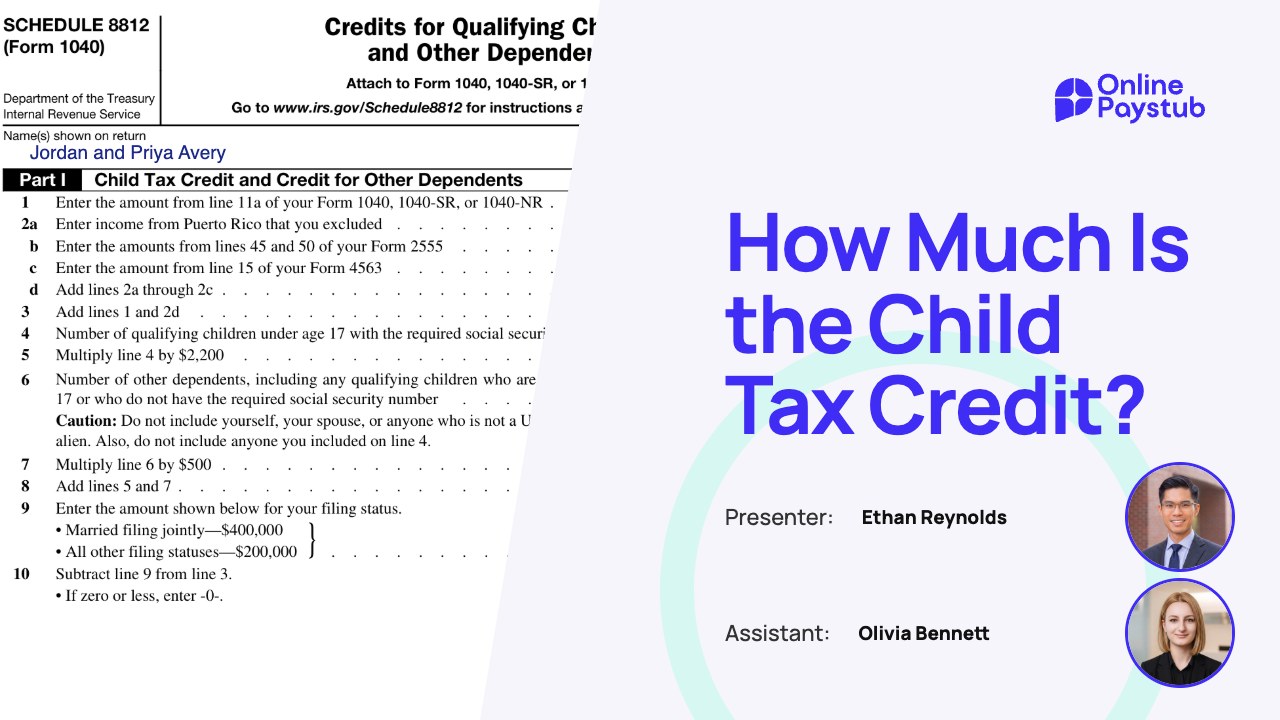

If you have children, the Child Tax Credit (CTC) is probably the single largest line that lowers your federal income tax. For 2025 returns filed in early 2026 and for 2026 returns filed in early 2027, the credit is worth up to $2,200 per qualifying child, with up to $1,700 of that amount refundable even if you owe no tax.
This guide explains exactly how much the credit is, who qualifies, where the income limits sit, how the refundable part is calculated, how to see the credit in your paycheck through Form W-4 and when to expect the refund. All figures come from the IRS inflation adjustments for tax year 2026 (Rev. Proc. 2025-32) and the current Schedule 8812 instructions.
How Much Is the Child Tax Credit for 2025 and 2026?
The One Big Beautiful Bill Act, signed in July 2025, raised the credit from $2,000 to $2,200 per child starting with tax year 2025 and made the higher amount permanent. From 2026 onward the $2,200 is indexed for inflation in $100 steps. Inflation was not high enough to trigger a step for 2026, so the amount stays at $2,200.
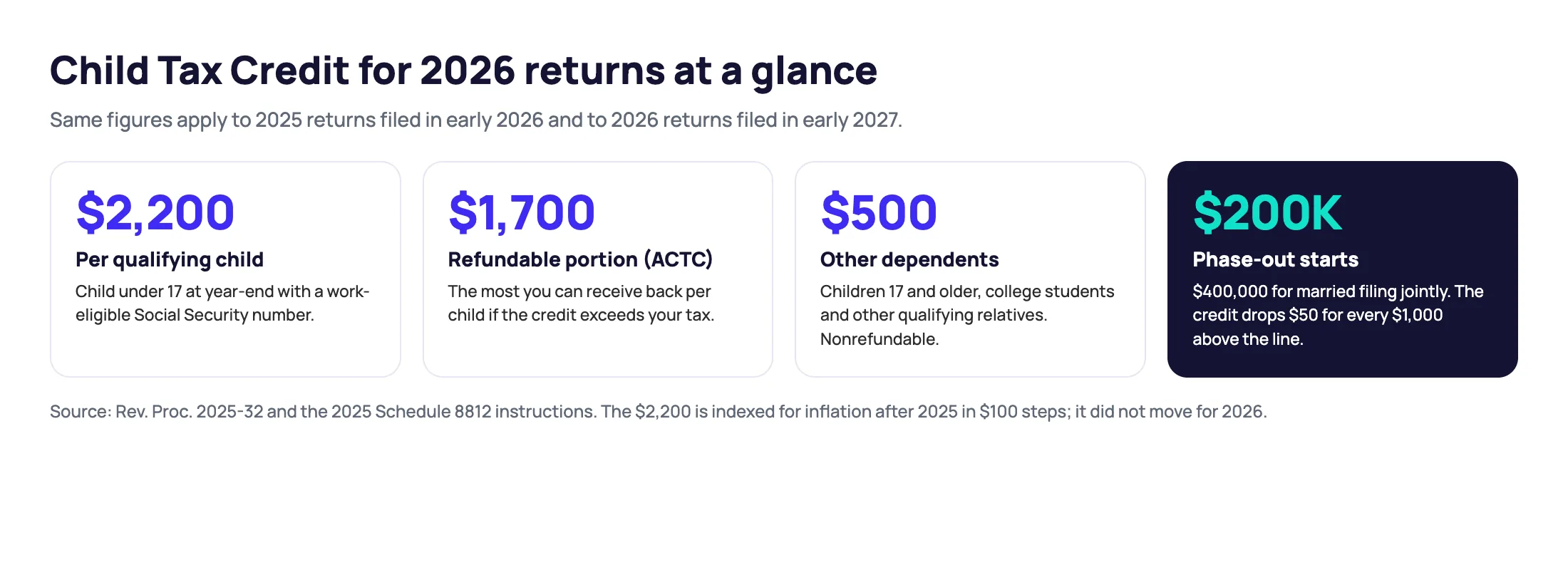
| Item | Tax year 2025 (filed in 2026) | Tax year 2026 (filed in 2027) |
|---|---|---|
| Maximum credit per qualifying child | $2,200 | $2,200 |
| Maximum refundable amount per child (Additional Child Tax Credit) | $1,700 | $1,700 |
| Credit for Other Dependents | $500 (nonrefundable) | $500 (nonrefundable) |
| Phase-out begins (modified AGI) | $200,000 ($400,000 married filing jointly) | $200,000 ($400,000 married filing jointly) |
| Earned income needed for the refundable part | More than $2,500 | More than $2,500 |
A family with two qualifying children can therefore reduce their federal tax by up to $4,400. Three children means up to $6,600. There is no cap on the number of children you can claim.
Who Counts as a Qualifying Child?
The IRS applies seven tests. A child must meet all of them for the year you are claiming:
- Age: under 17 at the end of the tax year, so 16 or younger on December 31.
- Relationship: your son, daughter, stepchild, eligible foster child, brother, sister, stepsibling, half sibling or a descendant of any of them, such as a grandchild, niece or nephew.
- Support: the child did not provide more than half of their own support during the year.
- Residency: the child lived with you for more than half the year. Temporary absences for school, medical care or vacation count as time at home.
- Dependent: you claim the child as a dependent on your return.
- Joint return: the child does not file a joint return for the year, except to claim a refund of withheld tax.
- Citizenship: the child is a U.S. citizen, U.S. national or U.S. resident alien.
The Social Security number rules
The child needs a Social Security number that is valid for employment and was issued before the due date of your return, including extensions. An ITIN is not enough for the $2,200 credit, although a dependent with an ITIN may still qualify for the $500 Credit for Other Dependents.
New for 2025 returns: the taxpayer also needs a work-eligible SSN. On a joint return, at least one spouse must have one. Before 2025 only the child's number was checked, so some families who claimed the credit in the past will find it unavailable when they file in 2026.
Income Limits: How the Phase-Out Works
The full credit is available when your modified adjusted gross income (MAGI) is at or below:
- $400,000 if you are married filing jointly
- $200,000 for single, head of household, qualifying surviving spouse and married filing separately
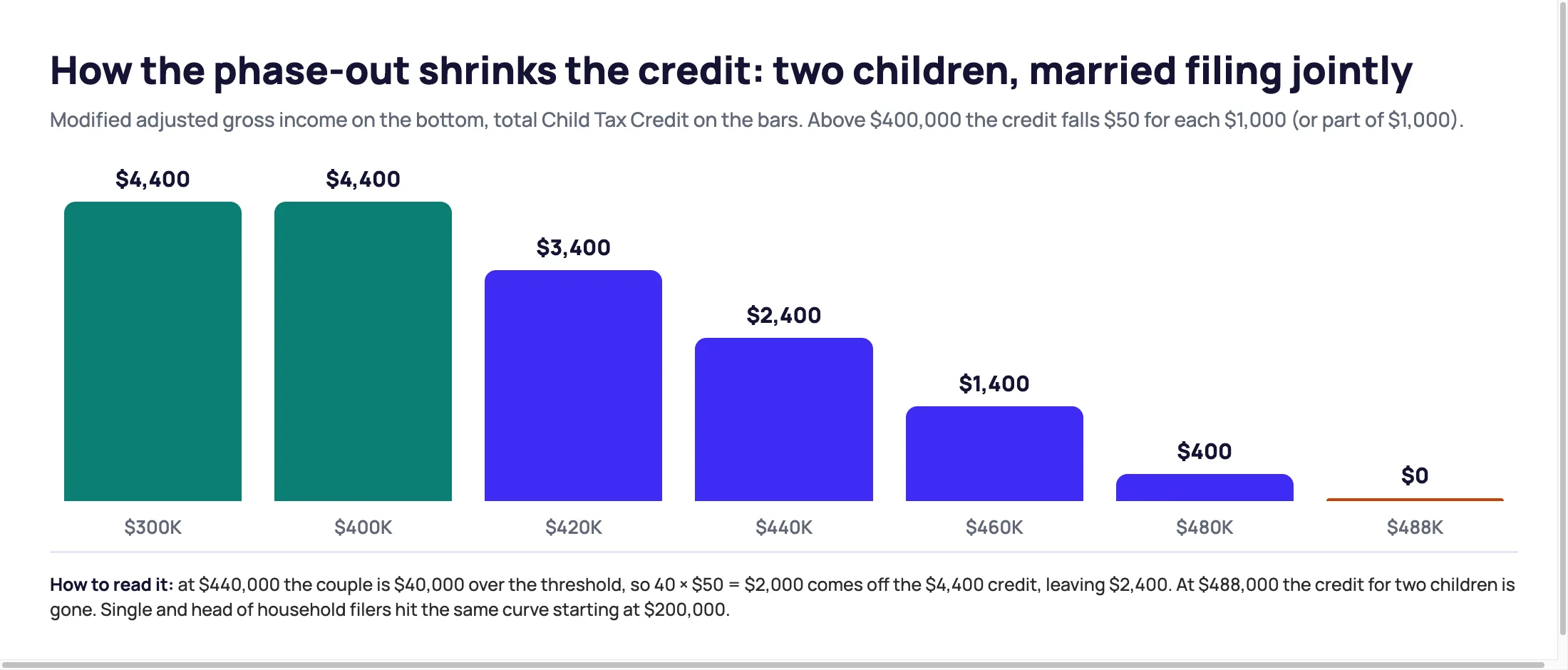
Above those amounts the total credit, including any Credit for Other Dependents, is reduced by $50 for every $1,000 of MAGI over the threshold. A fraction of $1,000 counts as a full $1,000. These thresholds are permanent and are not indexed for inflation, so more families cross them each year as wages rise.
Worked example
Jordan and Priya Avery file jointly, have two children aged 6 and 9 and report MAGI of $427,500 for 2026. Their starting credit is 2 × $2,200 = $4,400. They are $27,500 over the threshold, which rounds up to 28 units of $1,000. The reduction is 28 × $50 = $1,400, so their credit is $3,000.
For single parents the same math starts at $200,000. One child at $212,000 of MAGI: $2,200 minus 12 × $50 = $1,600.
How Much of the Credit Is Refundable?
The Child Tax Credit has two layers:
- The nonrefundable layer reduces your federal income tax, but not below zero.
- The refundable layer, called the Additional Child Tax Credit (ACTC), pays out any credit left over, up to $1,700 per child for 2025 and 2026.
The refundable amount is limited to 15% of your earned income above $2,500. Earned income means wages, salary, tips and net self-employment earnings. It does not include unemployment benefits, Social Security, interest or child support.
Example: a parent with low tax but steady wages
Maria earns $26,000, files as head of household and has one child. After the $24,150 standard deduction for 2026 her taxable income is $1,850 and her tax is $185. The nonrefundable part of the credit wipes out that $185. The remaining $2,015 is tested against the earned income rule: 15% × ($26,000 minus $2,500) = $3,525, which is more than the $1,700 cap. Maria receives the maximum refundable amount, $1,700, on top of the $185 of tax eliminated. Of her $2,200 credit, $315 goes unused.
Families with three or more qualifying children have a second way to compute the refundable amount: the Social Security and Medicare taxes they paid, minus any Earned Income Tax Credit. Schedule 8812 uses whichever method gives the larger refund.
The $500 Credit for Other Dependents
Children who turned 17 during the year, college students you still support, elderly parents and dependents with an ITIN instead of an SSN do not qualify for the $2,200 credit. They may qualify for the Credit for Other Dependents, worth $500 per person. It is nonrefundable and phases out at the same $200,000 and $400,000 thresholds. It is now permanent.
How to Claim the Credit: Form 1040 and Schedule 8812
You claim the Child Tax Credit when you file your federal return:
- List each child in the Dependents section of Form 1040 and tick the "Child tax credit" box.
- Complete Schedule 8812, Credits for Qualifying Children and Other Dependents. Line 4 is the number of qualifying children, line 5 multiplies by $2,200 and Part II works out the refundable amount.
- The nonrefundable credit flows to Form 1040 line 19 and the Additional Child Tax Credit to line 28.
Keep records that prove each child lived with you: school or medical records, lease agreements or childcare statements. The IRS can ask for them if two taxpayers claim the same child. Your pay stubs matter here too, because the wages on your final stub of the year should match the W-2 you use for earned income. If they do not, the guide to what a W-2 form shows box by box explains the usual reasons.
How the Child Tax Credit Changes Your Paycheck
The credit is paid once a year through your tax return, but you do not have to wait until April to feel it. Step 3 of Form W-4 lets you tell your employer about qualifying children so less federal income tax is withheld from every paycheck.
The 2026 Form W-4 instructs: if your total income will be $200,000 or less ($400,000 or less if married filing jointly), multiply the number of qualifying children under 17 by $2,200 and the number of other dependents by $500, then enter the total on line 3. Payroll divides that total across your pay periods.
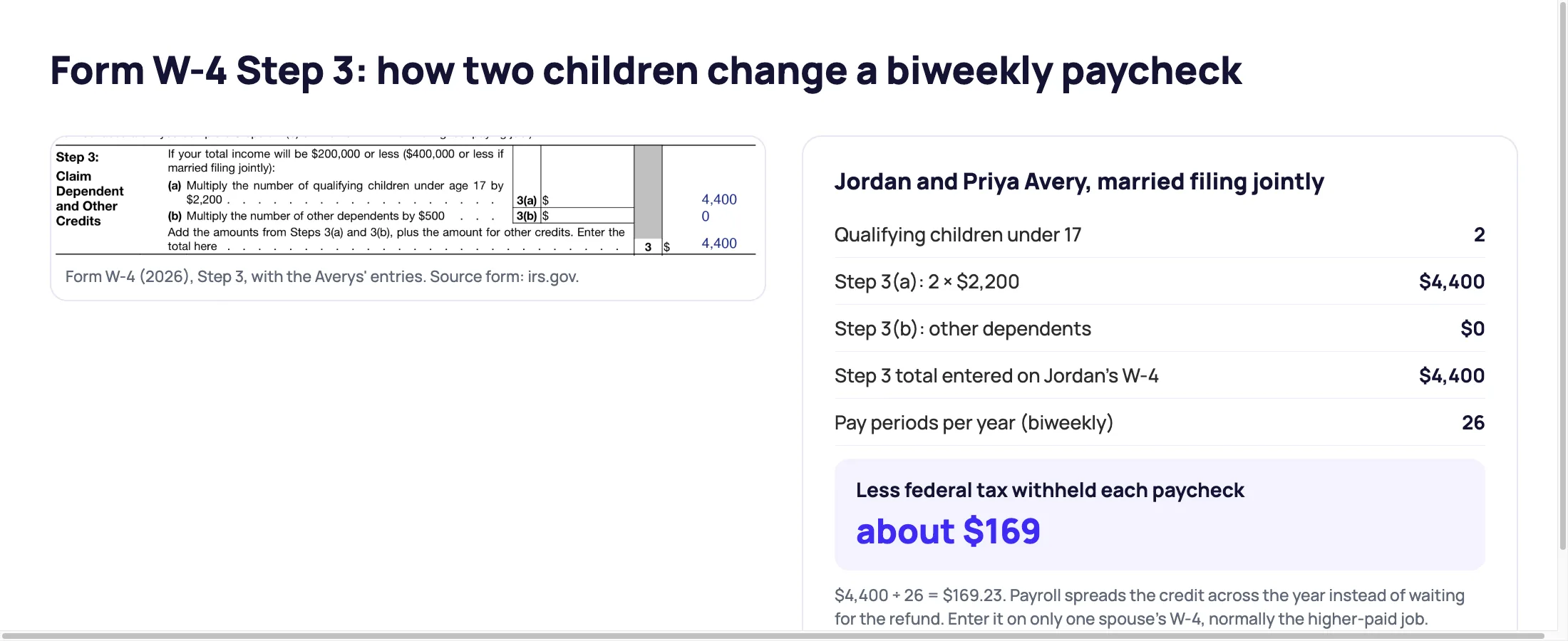
Jordan Avery earns $26 an hour and is paid every two weeks. With $4,400 on line 3, each paycheck carries roughly $169 less federal income tax ($4,400 ÷ 26). Over the year that is the full credit, delivered as higher take-home pay instead of a lump-sum refund. If both spouses work, enter the children on only one W-4, normally the higher-paying job. Otherwise the credit is counted twice and you may owe at filing time.
You can see the effect on your stub: the federal income tax line drops while Social Security and Medicare stay the same, because the credit never touches FICA. If your federal line is already zero, the W-4 entry cannot reduce it further and the refundable part arrives with your return. Our guide on why no federal income tax was withheld from a paycheck covers that situation in detail.
When Does the Child Tax Credit Refund Arrive?
Under the PATH Act the IRS cannot issue any refund that includes the Additional Child Tax Credit or the Earned Income Tax Credit before mid-February. The hold applies to the entire refund, not just the credit portion. For the 2026 filing season the IRS opened on January 26 and said most ACTC and EITC refunds would be in bank accounts by March 2, 2026, with Where's My Refund updating by February 21. Expect the same pattern for returns filed in 2027.
Filing electronically with direct deposit is the fastest route. Paper returns and mailed checks add weeks. Make sure the wages you report match your W-2; a mismatch is one of the most common reasons a refund with the Child Tax Credit is delayed for manual review.
State Child Tax Credits You May Also Qualify For
Several states add their own credit on top of the federal one. Amounts and age limits differ widely, so check your state return:
| State | Credit | Key limits |
|---|---|---|
| New York | Empire State Child Credit: $1,000 per child under 4 and $500 per child aged 4 to 16 for 2026 returns | Full-year residents; reduced above $110,000 of federal AGI for joint filers |
| Minnesota | $1,750 per child under 18 for 2025 returns, no cap on the number of children | Phase-out begins at $37,910 for joint filers |
| Vermont | $1,000 per child aged 6 or younger, fully refundable | Reduced above $125,000 of AGI, gone at $175,000 |
| Colorado | Colorado Child Tax Credit up to $1,200 per child aged 5 or younger | For 2026, AGI under $77,000 ($87,000 joint) |
| Massachusetts | Child and Family Tax Credit: $440 per dependent under 13, disabled dependent or dependent aged 65 and older | No cap on dependents |
| California | Young Child Tax Credit up to $1,189 per return for 2025 | Child under 6; must qualify for CalEITC |
These state credits are claimed on your state return and do not reduce the federal amount.
Common Mistakes That Cost Families the Credit
- Counting a child who turned 17. Age is measured on December 31. A 17-year-old moves to the $500 Credit for Other Dependents.
- Missing or late SSNs. A number issued after the return's due date does not count for that year. Apply early for newborns.
- Both spouses entering the children on Form W-4. That doubles the reduction in withholding and usually ends in a balance due.
- Confusing the Child Tax Credit with the Child and Dependent Care Credit. The care credit is a separate credit for daycare and after-school costs.
- Confusing it with Trump Accounts. Those are new savings accounts with a one-time $1,000 federal deposit for children born from 2025 through 2028. They are not a tax credit and do not affect the $2,200.
- Divorced parents both claiming the same child. Only the custodial parent may claim the credit unless they sign Form 8332 releasing it.
Keep Your Pay Records Straight
Every piece of the Child Tax Credit depends on numbers that start on a pay stub: earned income for the refundable part, federal withholding for the W-4 adjustment and year-to-date wages for the W-2 match. If you are paid by direct deposit and rarely see a stub, read our guide to what YTD means on a pay stub so you can confirm your year-end totals and what a paystub includes if you need to rebuild one from your payroll records. Employers running payroll from a spreadsheet can create itemized pay stubs with Online Paystub in minutes, including the reduced federal withholding that follows a new W-4.
For the official rules see the IRS Child Tax Credit page and the Schedule 8812 instructions.
See how your withholding changes on a clear, professional pay stub.
Create a Pay Stub Now