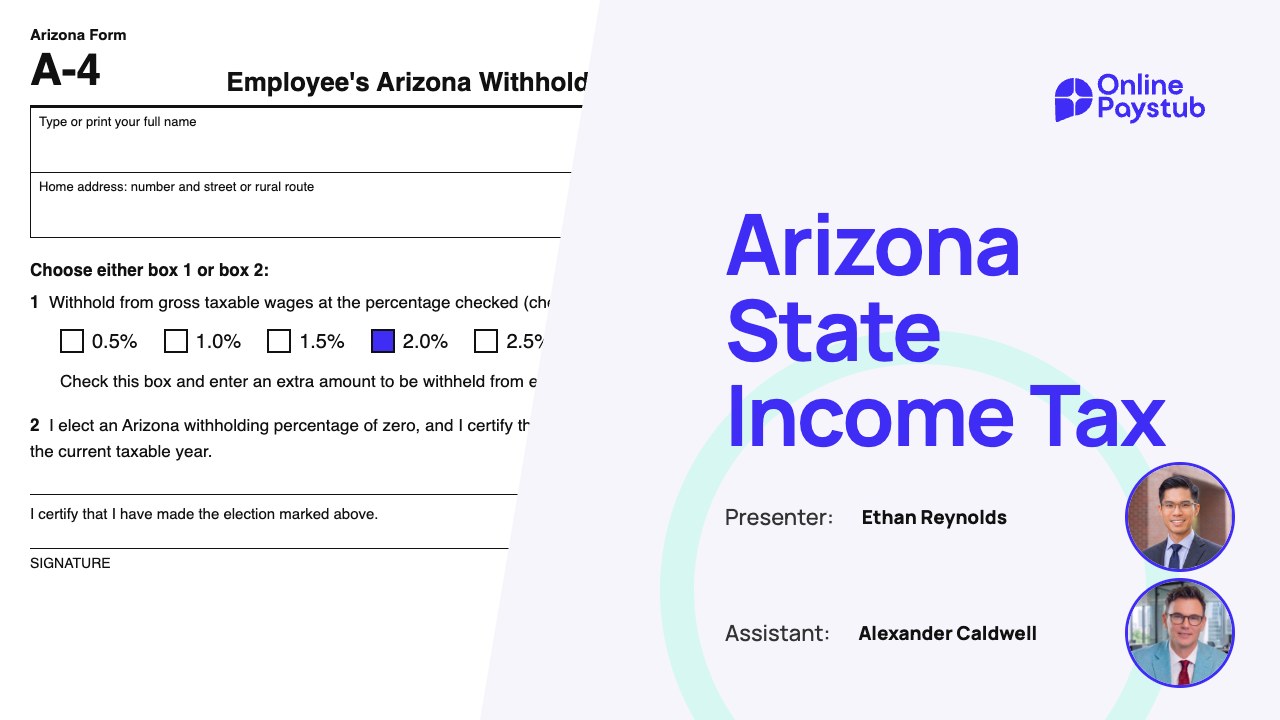

Arizona has one of the simplest state income taxes in the country. Everyone pays the same 2.5% rate, no city adds its own income tax and you decide how much is withheld from each paycheck by picking a percentage on Form A-4.
2026 still brought real changes. In June the Legislature passed a law that lines Arizona up with the 2025 federal tax changes: tips, overtime and the new senior deduction can now be subtracted on the Arizona return. The dependent credit goes up as well. This guide covers the rate, the deductions, how withholding works and who has to file, with figures taken from Arizona law and the Arizona Department of Revenue.
Arizona Income Tax Rate for 2026
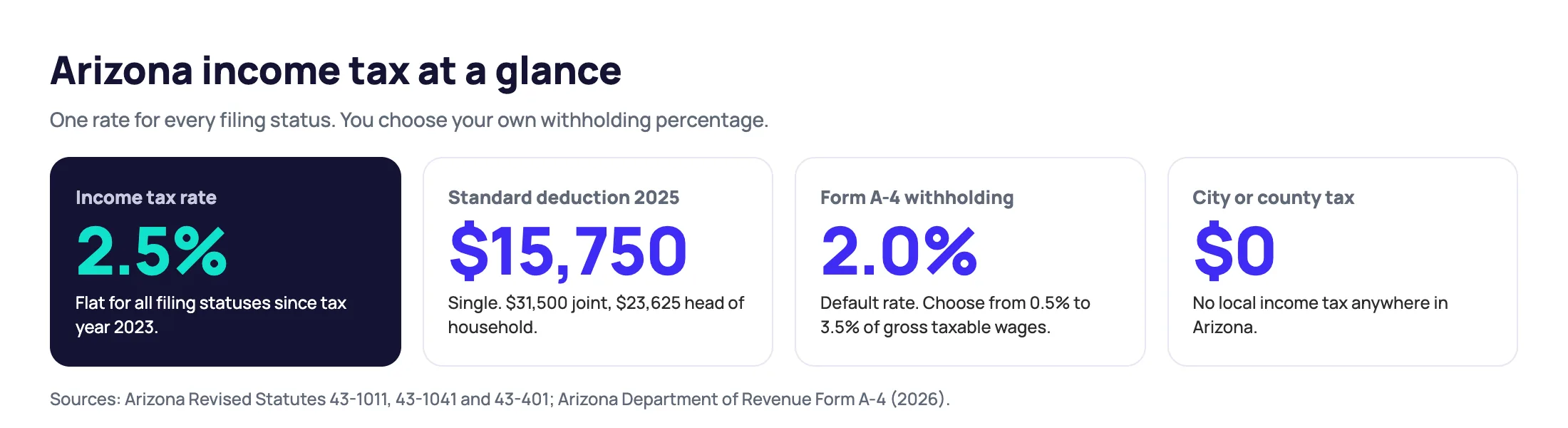
- Rate: a flat 2.5% on Arizona taxable income for every filing status.
- Standard deduction for 2025: $15,750 single, $23,625 head of household, $31,500 married filing jointly.
- Withholding form: Form A-4, with seven rates from 0.5% to 3.5%.
- Default withholding: 2.0% of gross taxable wages.
- Local income tax: none.
- Return: Form 140 (or 140A / 140EZ), due April 15.
Arizona did not always have a flat tax. Until 2021 it used brackets with a top rate of 4.5%. A 2021 law replaced them with two rates for 2022 (2.55% and 2.98%) and moved to the single 2.5% rate from tax year 2023 once state revenue targets were met.
| Tax year | Rates | Structure |
|---|---|---|
| 2021 | 2.59% to 4.5% | Four brackets |
| 2022 | 2.55% and 2.98% | Two brackets |
| 2023 onward | 2.5% | Flat rate |
Arizona Standard Deduction
Arizona sets its standard deduction in its own law, but it now matches the federal amounts. For tax year 2025 the figures are written into Arizona Revised Statutes 43-1041:
| Filing status | 2025 | 2026 (expected) |
|---|---|---|
| Single or married filing separately | $15,750 | $16,100 |
| Head of household | $23,625 | $24,150 |
| Married filing jointly | $31,500 | $32,200 |
The statute indexes the deduction the same way as the federal one, so the 2026 amounts should equal the federal 2026 figures. The Department of Revenue had not published them when this guide was written; treat the 2026 column as expected until the 2026 forms come out.
Two more changes take effect for tax year 2026:
- Charitable add-on. If you take the standard deduction you can add 100% of your charitable gifts, up to $1,000 for single filers and $2,000 for joint filers. This replaces the old rule that allowed 25% of donations.
- SALT cap for itemizers. If you itemize, state and local taxes are capped at $10,000 on the Arizona return.
How Arizona Income Tax Is Calculated
Arizona starts from the adjusted gross income on your federal return.
- Start with federal adjusted gross income.
- Add and subtract the Arizona adjustments, such as the Social Security subtraction or the new tips and overtime subtractions.
- Subtract exemptions, for example $2,100 for each spouse who is 65 or older.
- Subtract the standard deduction or your itemized deductions.
- Multiply the result by 2.5%.
- Subtract credits, then compare the result with what was withheld during the year.
Example: a $62,400 salary
Daniel is single, has no dependents and earns $62,400 in Phoenix. For tax year 2025 his Arizona taxable income is $62,400 minus $15,750, which is $46,650. At 2.5% his tax is $1,166.25. With the expected 2026 deduction of $16,100 the same salary would produce $1,157.50.
His employer withholds at the default 2.0%, which is $1,248 over 26 paychecks. Because that is a little more than he owes, Daniel gets about $90 back when he files.
New for 2025 and 2026: Tips, Overtime and Senior Subtractions
On June 13, 2026 the Governor signed Laws 2026, Chapter 140, which updates Arizona's tax law to the federal Internal Revenue Code as of January 1, 2026. Most of it applies back to tax year 2025.
| Change | Amount | Tax years |
|---|---|---|
| Qualified tips subtraction | Same as the federal deduction, up to $25,000 | 2025 onward |
| Qualified overtime subtraction | Same as the federal deduction, up to $12,500 ($25,000 joint) | 2025 onward |
| Senior subtraction | Same as the federal deduction, $6,000 per person 65 or older | 2025 onward |
| Car loan interest subtraction | Same as the federal deduction, up to $10,000 | 2025 only |
| Dependent credit, under 17 | $125 per dependent (was $100) | 2026 onward |
These subtractions follow the federal rules, including the federal income phase-outs. You claim them on Form 140; Forms 140A and 140EZ do not allow them.
They do not change your paycheck. Arizona tax is still withheld from tips and overtime during the year and the W-2 still reports those wages in full. The savings arrive with your refund.
Before the law passed, the Department of Revenue had already built these items into the 2025 forms through its Middle Class Tax Cuts Package worksheet. If you filed a 2025 return without claiming them, you can amend; the Department has said it will not charge penalties or interest on 2025 returns amended by October 15, 2027.
How Arizona Income Tax Is Withheld From a Paycheck
Arizona withholding does not use tax tables. Instead you choose a percentage on Form A-4, the Employee's Arizona Withholding Election. Your employer applies it to your gross taxable wages. Those are generally the wages in Box 1 of your W-2, so pretax 401(k) contributions and health premiums are left out first.
- Rates: 0.5%, 1.0%, 1.5%, 2.0%, 2.5%, 3.0% or 3.5%. You can also ask for an extra dollar amount on each check.
- Deadline: a new employee has five days after starting work to turn in an A-4.
- Default: without an A-4 the employer withholds 2.0%.
- Zero withholding: allowed only if you expect no Arizona tax for the year. The election expires and must be renewed by February 15 of the next year.
- Changes: give your employer a new A-4 at any time. The form goes to the employer, not to the Department of Revenue.
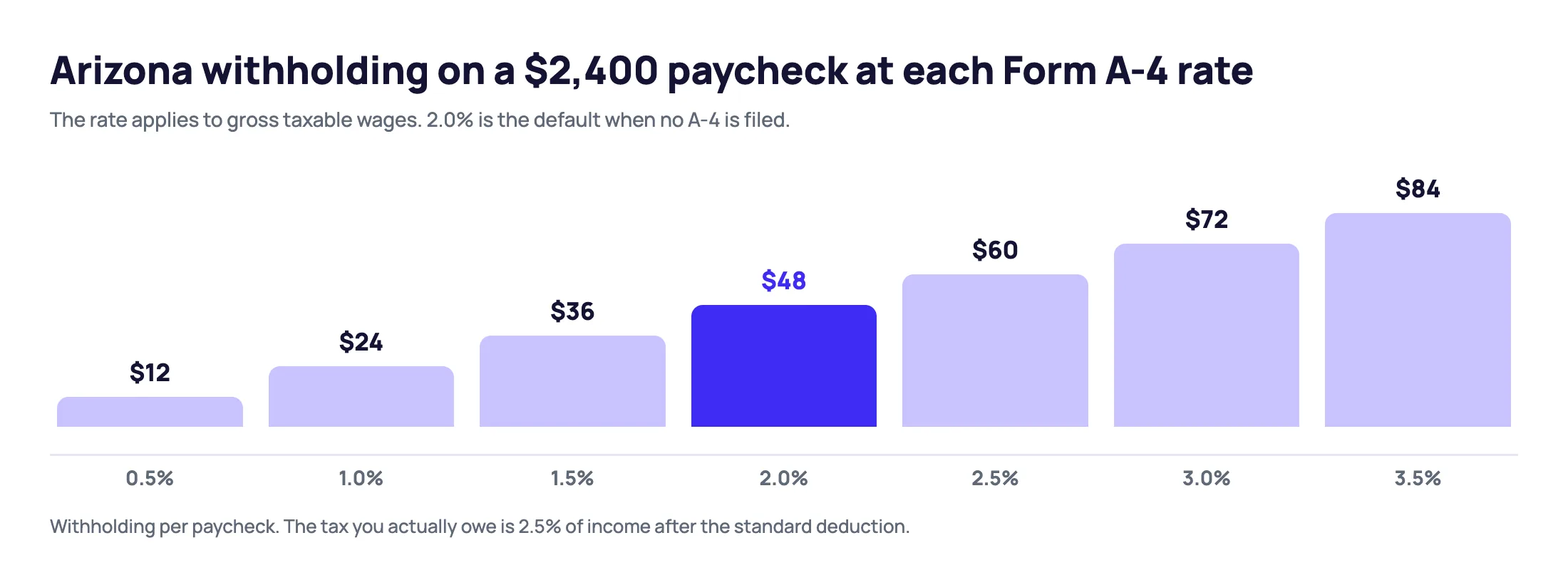
Which rate should you pick? Your actual tax is 2.5% of income after deductions, so for a typical single filer the right withholding rate is below 2.5%. Someone with large other income, such as investment gains or a second job, may need 3.0% or 3.5%.
Example: a $2,400 biweekly paycheck
Daniel earns $2,400 every two weeks and never filed an A-4, so his employer uses 2.0%. His Arizona withholding is $48.00 per paycheck.
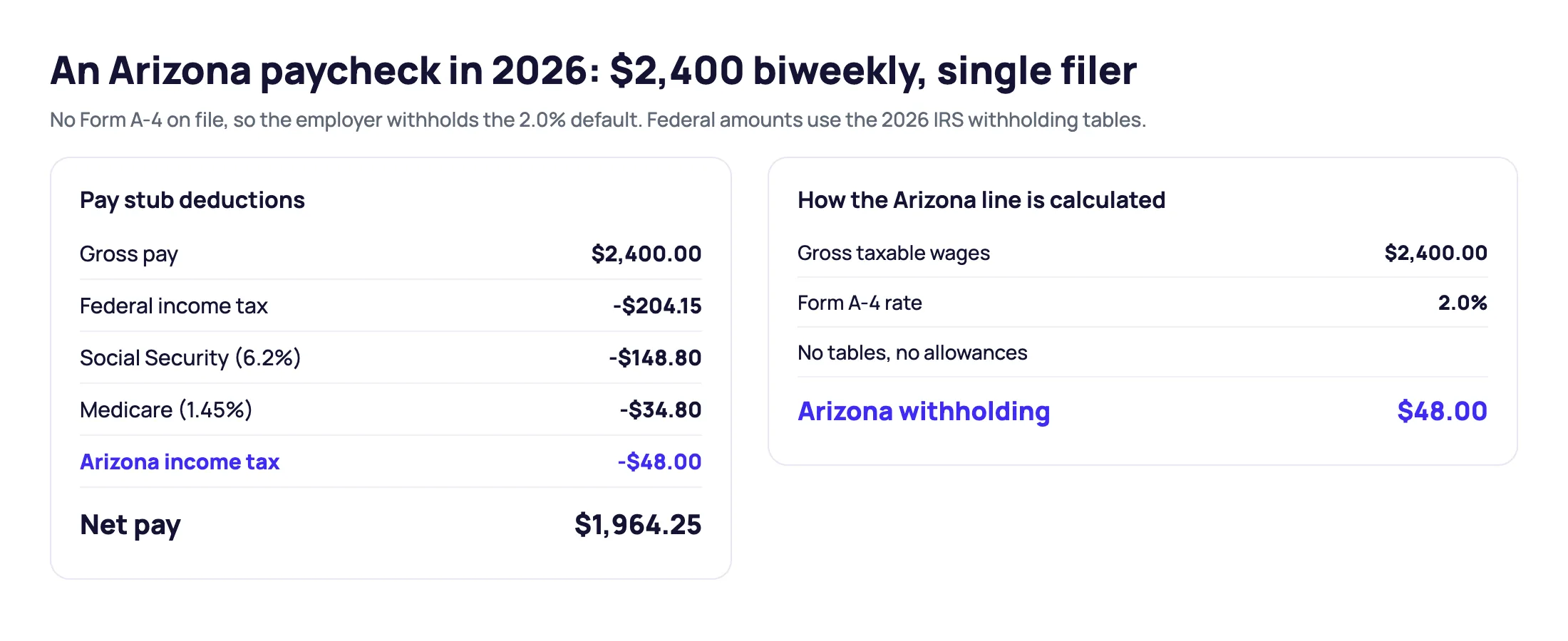
On an itemized statement the state line is often labeled AZ SIT, next to FICA for Social Security and Medicare. Building an Arizona paystub from your own figures shows exactly where each amount lands.
Bonuses and commissions are wages under Arizona law, so they are withheld at the same A-4 percentage as regular pay.
Arizona Credits and Exemptions
| Item | Amount |
|---|---|
| Dependent credit, under 17 | $125 each for 2026 ($100 for 2025) |
| Dependent credit, 17 and older | $25 each |
| Age 65 or older exemption | $2,100 per person |
| Blind exemption | $1,500 |
| Qualifying parent or ancestor living with you | $10,000 |
| Family income tax credit | Up to $120 single, up to $240 joint or head of household |
| Public school tax credit | Up to $200 single, $400 joint |
The dependent credit shrinks by 5% for each $1,000 of federal adjusted gross income above $200,000 ($400,000 for joint filers). The family income tax credit is for low-income households, with limits starting at $10,000 of income for single filers.
Arizona is also known for dollar-for-dollar credits for gifts to qualifying charities. For 2025 the maximum was $495 for single filers and $987 for joint filers, rising to $506 and $1,009 for 2026. A separate credit for qualifying foster care charities allowed up to $618 single and $1,234 joint for 2025.
Retirement Income and Other Exempt Income
- Social Security and railroad retirement: fully subtracted.
- Military retired pay: fully subtracted since tax year 2021.
- Active duty, Reserve and National Guard pay: subtracted.
- Federal, Arizona state and local government pensions: up to $2,500 subtracted.
- Unemployment benefits: taxable, because Arizona starts from federal adjusted gross income.
- Arizona lottery winnings: taxable. The old $5,000 subtraction was repealed from tax year 2019.
Who Has to File an Arizona Return?
A full-year resident must file if gross income is more than the standard deduction for their filing status: $15,750 single, $23,625 head of household or $31,500 joint for tax year 2025. File anyway if Arizona tax was withheld and you are due a refund.
- Form 140 works for everyone and is required for itemized deductions, the tips and overtime subtractions and most credits.
- Forms 140A and 140EZ are shorter versions for taxable income under $50,000 with no adjustments.
- Part-year residents file Form 140PY; nonresidents with Arizona income file Form 140NR.
The 2025 return was due April 15, 2026. Form 204 or a federal extension gives you until October 15, but at least 90% of the tax still has to be paid by April 15 to avoid a penalty.
Estimated payments
You must make estimated payments if your Arizona gross income was more than $75,000 ($150,000 for joint filers) in both the current year and the year before and withholding will not cover the tax. Payments on Form 140ES for 2026 are due April 15, June 15 and September 15, 2026 and January 15, 2027. Together with withholding they need to reach 90% of this year's tax or 100% of last year's.
Nonresidents, Commuters and Remote Workers
Arizona taxes nonresidents on wages earned for work done in Arizona. A few rules soften that:
- The 60-day rule. A nonresident who works in Arizona fewer than 60 days in a year for an in-state employer is not subject to Arizona withholding. Athletes and entertainers are excluded.
- Form WEC. Residents of California, Indiana, Oregon and Virginia who work in Arizona can file Form WEC with their employer to stop Arizona withholding, because Arizona gives them a credit for tax paid to their home state. The form is renewed every calendar year.
- Credit for tax paid elsewhere. An Arizona resident who pays tax to another state can usually claim a credit. If the other state is one that credits Arizona residents, such as California, the credit is claimed on that state's return instead.
Other Items on an Arizona Paycheck
Besides the Arizona line, an employee sees the usual federal deductions: federal income tax, 6.2% Social Security on wages up to $184,500 and 1.45% Medicare.
Arizona unemployment insurance is paid by employers only, on the first $8,000 of each worker's wages, with new employers starting at 2.0%. Arizona has no state disability or paid leave payroll deduction. The state minimum wage for 2026 is $15.15 an hour; Flagstaff's is $18.35 and Tucson's is $15.45.
Arizona's 5.6% transaction privilege tax, the state's version of a sales tax, is charged to businesses and never appears on a pay stub.
That is very different from California's bracket system, which climbs to 13.3%. It is also different from Florida, where paychecks carry no state income tax line at all.
Keep Your Arizona Pay Records
Because you pick your own withholding rate, your year-to-date Arizona withholding is the number to check before tax season. If it looks too low for your income, raise your A-4 percentage early in the year rather than facing a bill in April. If you run a small Arizona business, each employee should get a statement showing gross wages, every deduction and net pay. Online Paystub turns real payroll figures into that document. It is intended for genuine payroll and recordkeeping only.
See Arizona withholding at your A-4 rate on a clear, itemized pay stub.
Create a Pay Stub Now