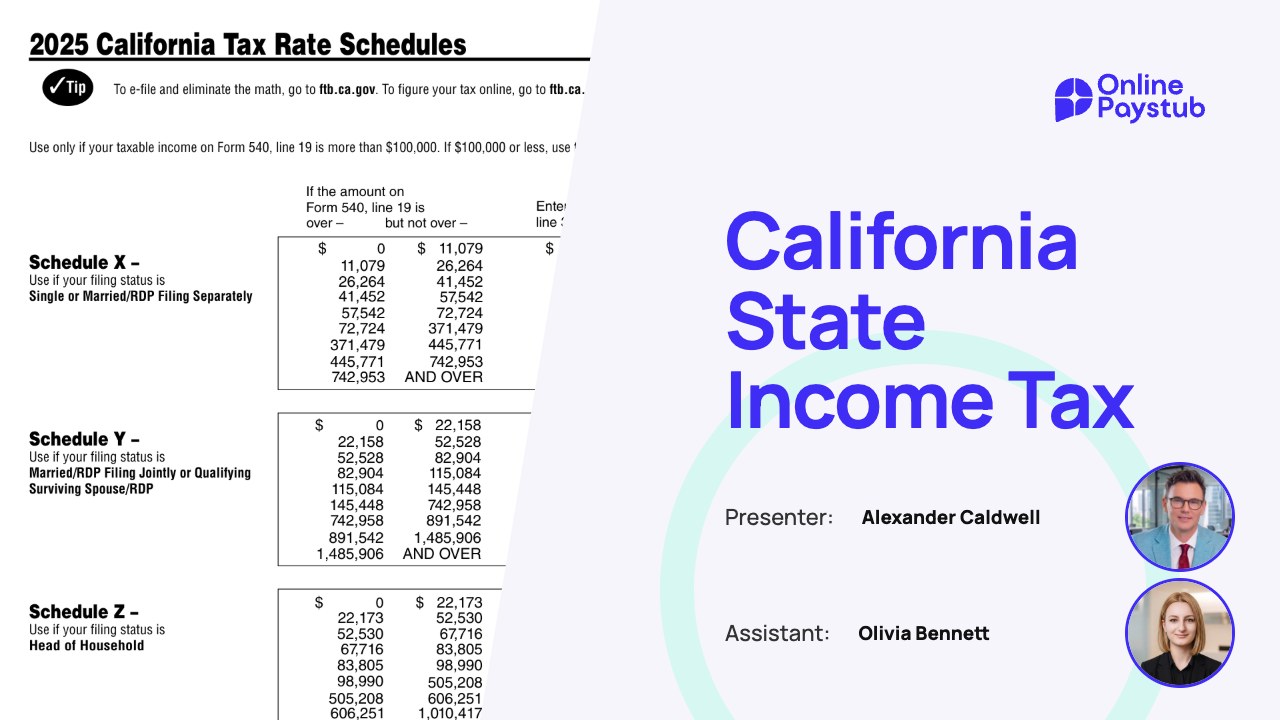

California has the highest top state income tax rate in the country, but most residents pay far less than the headline number suggests. The state uses nine marginal brackets that start at 1% and rise to 12.3%, with one more percentage point on taxable income above $1 million. The brackets were adjusted for inflation again for 2026.
This guide covers the 2026 and 2025 brackets for every filing status, the standard deduction, a worked example, how the tax is withheld from a paycheck and when estimated payments are due. Figures come from the Franchise Tax Board (FTB) and the Employment Development Department (EDD).
California Income Tax Rates at a Glance
- Nine marginal rates: 1%, 2%, 4%, 6%, 8%, 9.3%, 10.3%, 11.3% and 12.3%.
- Extra 1% above $1 million: the Behavioral Health Services Tax, known as the Mental Health Services Tax before 2025, applies to taxable income over $1,000,000. The FTB worksheet subtracts the same $1,000,000 whatever the filing status.
- Top marginal rate: 13.3% on taxable income above $1 million.
- Brackets are indexed: the dollar thresholds move with California inflation every year. For 2026 they rose 3.4%. The rates themselves did not change.
- Standard deduction for 2026: $5,900 for single filers and $11,800 for joint filers.
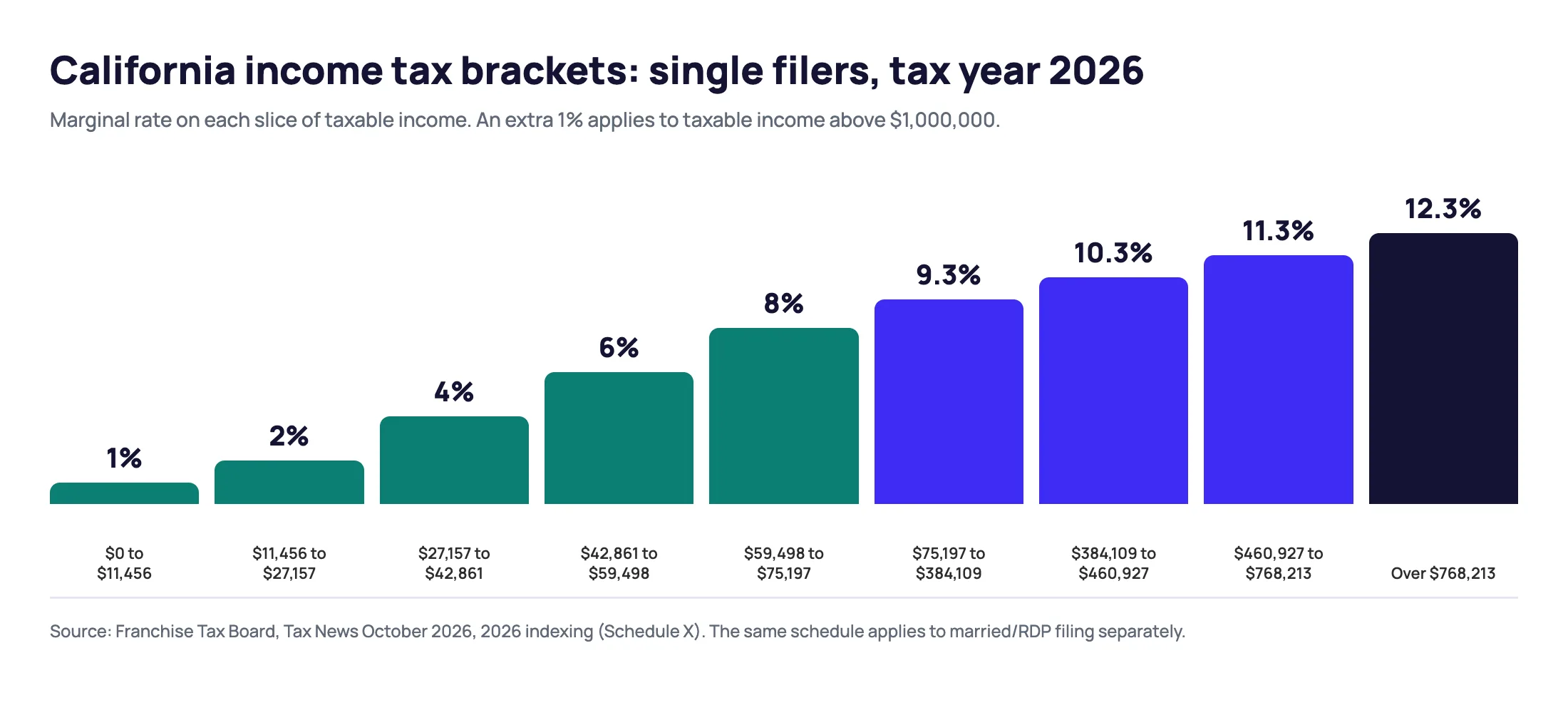
California Income Tax Brackets for 2026
These brackets apply to income earned in 2026, reported on the return you file in early 2027. The Franchise Tax Board announced them in its October 2026 Tax News after measuring 3.4% inflation from June 2025 to June 2026.
Single or married/RDP filing separately
| Taxable income (2026) | Marginal rate |
|---|---|
| $0 to $11,456 | 1% |
| $11,456 to $27,157 | 2% |
| $27,157 to $42,861 | 4% |
| $42,861 to $59,498 | 6% |
| $59,498 to $75,197 | 8% |
| $75,197 to $384,109 | 9.3% |
| $384,109 to $460,927 | 10.3% |
| $460,927 to $768,213 | 11.3% |
| Over $768,213 | 12.3% |
Married/RDP filing jointly or qualifying surviving spouse
| Taxable income (2026) | Marginal rate |
|---|---|
| $0 to $22,912 | 1% |
| $22,912 to $54,314 | 2% |
| $54,314 to $85,722 | 4% |
| $85,722 to $118,996 | 6% |
| $118,996 to $150,394 | 8% |
| $150,394 to $768,218 | 9.3% |
| $768,218 to $921,854 | 10.3% |
| $921,854 to $1,536,426 | 11.3% |
| Over $1,536,426 | 12.3% |
Head of household
| Taxable income (2026) | Marginal rate |
|---|---|
| $0 to $22,927 | 1% |
| $22,927 to $54,316 | 2% |
| $54,316 to $70,018 | 4% |
| $70,018 to $86,654 | 6% |
| $86,654 to $102,356 | 8% |
| $102,356 to $522,385 | 9.3% |
| $522,385 to $626,864 | 10.3% |
| $626,864 to $1,044,771 | 11.3% |
| Over $1,044,771 | 12.3% |
The FTB will post the complete 2026 tax tables and forms in late December 2026.
California Income Tax Brackets for 2025
Use these for a 2025 return, including one filed on extension by October 15, 2026. They come from the 2025 California Tax Rate Schedules.
Single or married/RDP filing separately
| Taxable income (2025) | Marginal rate |
|---|---|
| $0 to $11,079 | 1% |
| $11,079 to $26,264 | 2% |
| $26,264 to $41,452 | 4% |
| $41,452 to $57,542 | 6% |
| $57,542 to $72,724 | 8% |
| $72,724 to $371,479 | 9.3% |
| $371,479 to $445,771 | 10.3% |
| $445,771 to $742,953 | 11.3% |
| Over $742,953 | 12.3% |
Married/RDP filing jointly or qualifying surviving spouse
| Taxable income (2025) | Marginal rate |
|---|---|
| $0 to $22,158 | 1% |
| $22,158 to $52,528 | 2% |
| $52,528 to $82,904 | 4% |
| $82,904 to $115,084 | 6% |
| $115,084 to $145,448 | 8% |
| $145,448 to $742,958 | 9.3% |
| $742,958 to $891,542 | 10.3% |
| $891,542 to $1,485,906 | 11.3% |
| Over $1,485,906 | 12.3% |
Head of household
| Taxable income (2025) | Marginal rate |
|---|---|
| $0 to $22,173 | 1% |
| $22,173 to $52,530 | 2% |
| $52,530 to $67,716 | 4% |
| $67,716 to $83,805 | 6% |
| $83,805 to $98,990 | 8% |
| $98,990 to $505,208 | 9.3% |
| $505,208 to $606,251 | 10.3% |
| $606,251 to $1,010,417 | 11.3% |
| Over $1,010,417 | 12.3% |
How California Income Tax Works
The rates are marginal. Moving into a higher bracket does not raise the tax on the income below it; only the dollars inside the new bracket are taxed at the new rate. California also runs its own system. It does not copy the federal brackets, the federal standard deduction or every federal deduction.
A California return follows these steps:
- Start with federal adjusted gross income and apply California adjustments to reach California adjusted gross income.
- Subtract the California standard deduction or your California itemized deductions.
- Apply the tax table or rate schedule to the taxable income that is left.
- Subtract exemption credits and any other California credits.
- Add other taxes that apply, then subtract withholding and estimated payments.
California Standard Deduction and Exemption Credits
The California standard deduction is far smaller than the federal one, which is why state taxable income is usually higher than federal taxable income.
| Item | Tax year 2025 | Tax year 2026 |
|---|---|---|
| Standard deduction: single or married/RDP filing separately | $5,706 | $5,900 |
| Standard deduction: joint, head of household or surviving spouse | $11,412 | $11,800 |
| Personal exemption credit: single, separate or head of household | $153 | $158 |
| Personal exemption credit: joint or surviving spouse | $306 | $316 |
| Dependent exemption credit, per dependent | $475 | $491 |
California does not use personal exemptions as a deduction. It gives exemption credits instead, which come straight off the tax. The credits phase out at higher incomes.
Example: California Tax on an $80,000 Salary in 2026
Maya is single, lives in San Diego and earns $80,000 in 2026 with no other income. Her California taxable income is $80,000 minus the $5,900 standard deduction, which leaves $74,100.
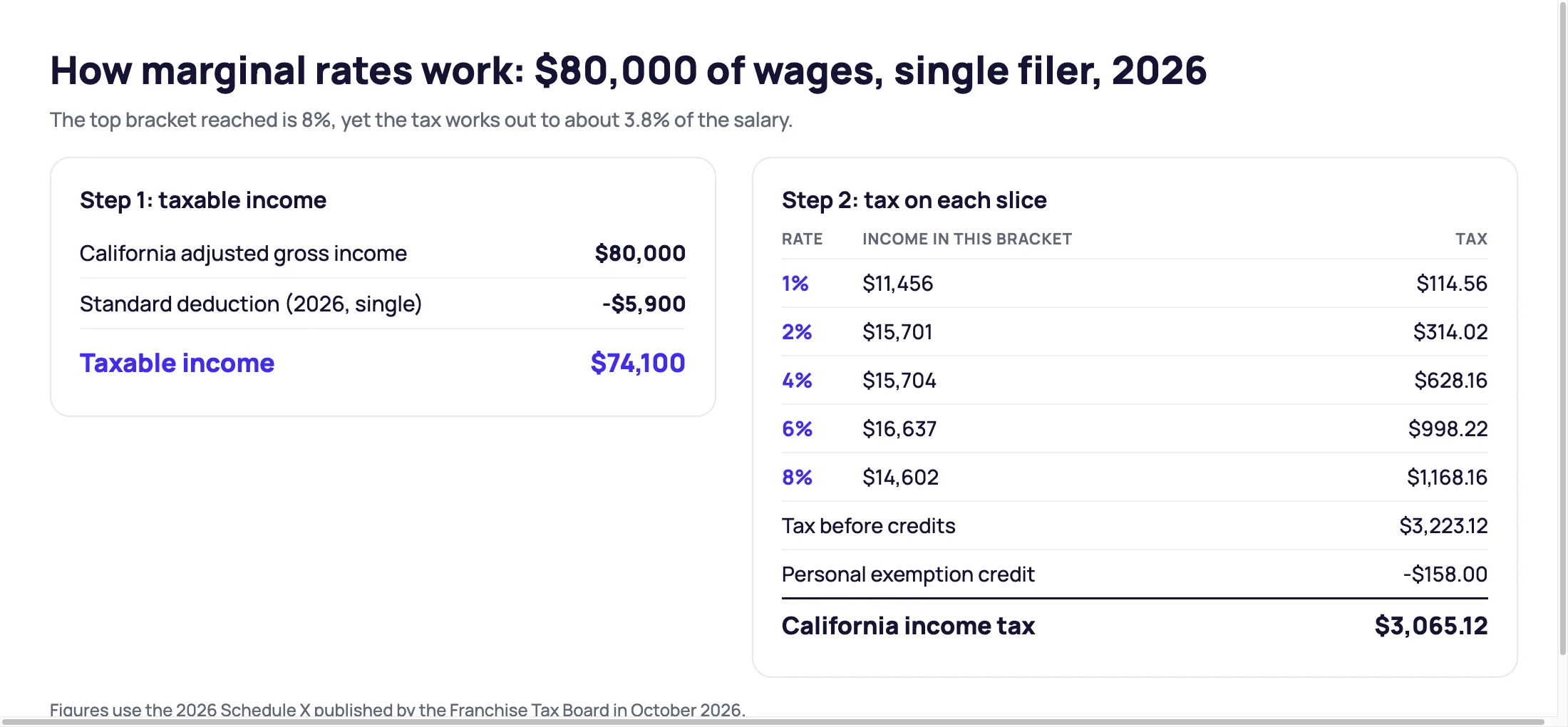
Adding the slices gives $3,223.12. Her $158 personal exemption credit brings the tax to $3,065.12, about 3.8% of her salary. With the 2025 thresholds the same salary would have produced $3,194.98 after the credit, so indexing saves her about $130.
How California Income Tax Is Withheld From a Paycheck
Employers withhold California Personal Income Tax (PIT) from every paycheck and send it to the EDD. The amount depends on your pay, your pay frequency and the filing status and allowances on your Form DE 4, the California Employee's Withholding Allowance Certificate. The DE 4 is separate from the federal Form W-4, so changing one does not change the other.
A California pay stub usually shows these employee deductions:
- Federal income tax, based on your Form W-4.
- Social Security and Medicare, 6.2% and 1.45% of wages.
- California income tax (CA PIT), from the EDD withholding schedules and your DE 4.
- CA SDI, State Disability Insurance at 1.3% of wages in 2026 with no wage cap. It funds disability and Paid Family Leave benefits.
Supplemental wages paid separately from regular pay can be withheld at a flat rate: 10.23% for bonuses and stock options and 6.6% for other types such as overtime, commissions and severance.
Withholding is an advance payment, not the final bill. The EDD's 2026 withholding schedules were published before the 2026 brackets were indexed, so they still use the earlier thresholds and the $5,706 and $11,412 standard deductions. If too much was withheld you receive a refund when you file. If too little was withheld you pay the difference. To see each of these lines on a statement, create one with the California paystub generator, which applies the 2026 state withholding and SDI rates. Our guide to pay stub abbreviations explains codes such as CA PIT and CASDI.
Who Has to File a California Return?
Whether you must file depends on your residency, your filing status, your age and your income. Three groups are taxed differently:
- Residents are taxed on all income, wherever it is earned. They file Form 540.
- Part-year residents are taxed on all income received while they were residents plus California-source income received while they were not.
- Nonresidents are taxed only on income from California sources, such as wages for work physically performed in the state, rent from California property or income from a California business.
Part-year residents and nonresidents file Form 540NR. The 2025 return was due April 15, 2026, with an automatic extension to file until October 15, 2026. Even if you are below the filing threshold, file a return when California income tax was withheld from your pay; it is the only way to get that money back.
Does California Tax Remote Workers?
Having a California employer does not by itself make your wages taxable by California. For a nonresident employee, wages are California-source income only for the days the work is physically performed in California. Someone who moves to Nevada and works entirely from home there generally owes no California tax on those wages. If the same person flies back to the Los Angeles office for two weeks, the pay for those days is California income.
Independent contractors follow a different rule. Their income can be sourced to California when the customer receives the benefit of the service in California, even if the work is done elsewhere. Deferred compensation and stock awards earned while living in California can also stay taxable after a move.
Does California Tax Capital Gains?
Yes, as ordinary income. California has no separate long-term capital gains rate, so a gain is added to your other income and taxed through the same nine brackets. A large stock or property sale can push part of your income into the 9.3% bracket or higher in the year of the sale.
California Estimated Tax Payments for 2026
You generally need to make estimated payments if you expect to owe at least $500 for 2026 ($250 if married/RDP filing separately) after withholding and credits. To avoid a penalty, withholding and estimated payments must cover the smaller of:
- 90% of the tax on your 2026 return.
- 100% of the tax on your 2025 return. This becomes 110% if your 2025 California adjusted gross income was more than $150,000 ($75,000 if married/RDP filing separately).
Taxpayers with 2026 California adjusted gross income of $1 million or more ($500,000 if married/RDP filing separately) must base their payments on their 2026 tax. The 2026 worksheet was issued before indexing, so it uses the 2025 tax table and the 2025 standard deduction.
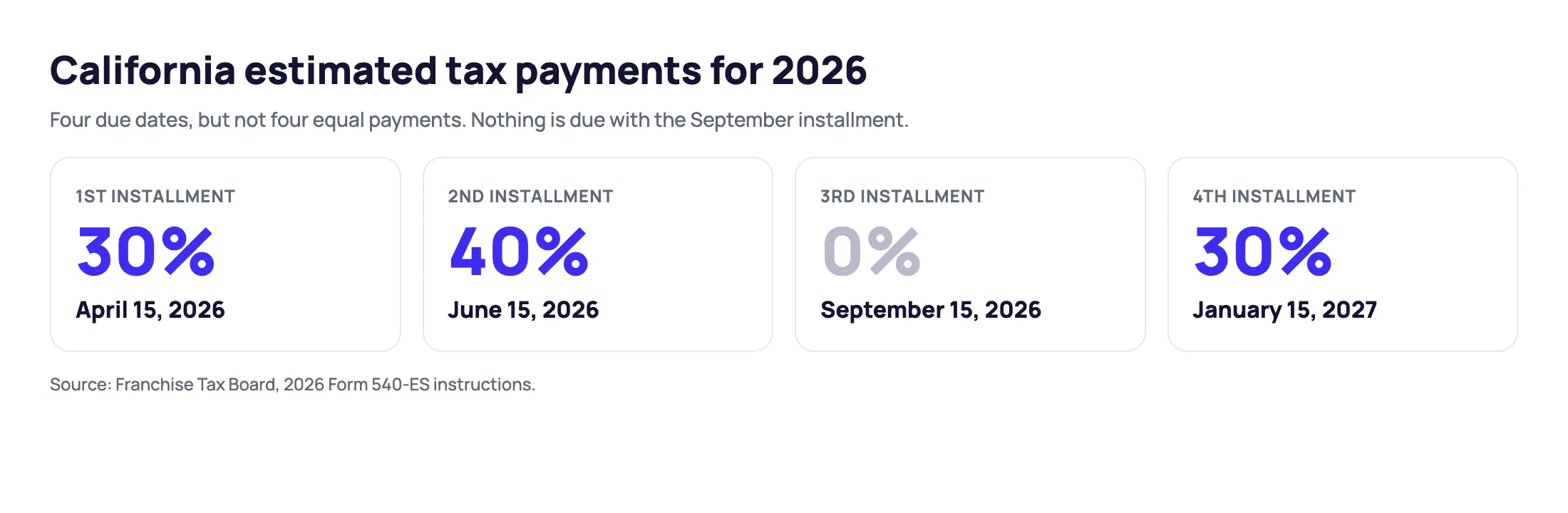
| Installment | Share of the annual amount | Due date |
|---|---|---|
| First | 30% | April 15, 2026 |
| Second | 40% | June 15, 2026 |
| Third | 0% | September 15, 2026 |
| Fourth | 30% | January 15, 2027 |
Use Form 540-ES and its worksheet to work out the amounts.
California Income Tax vs Payroll Taxes
State income tax is only one of the deductions on a California paycheck. Federal income tax goes to the IRS. Social Security and Medicare are federal payroll taxes. SDI is a California payroll contribution that pays for disability and family leave benefits; it is not income tax and it is not refunded when you file.
Employers also pay Unemployment Insurance and the Employment Training Tax for each worker. Those are employer costs and never appear as deductions from your pay. If you are new to reading these lines, start with what a paystub is and what it includes.
Keep Your Payroll Records in Order
Your year-to-date California withholding is the number you need at tax time, whether you are checking a W-2, estimating a refund or deciding if estimated payments are necessary. Keep every pay stub until the return for that year is filed and accepted.
If you run payroll for a small California business, each employee should receive an itemized statement showing gross wages, every deduction and net pay. Online Paystub turns real payroll figures into that document. It is intended for genuine payroll and recordkeeping only.
See California income tax and SDI on a clear, itemized pay stub.
Create a Pay Stub Now