
Quick answer
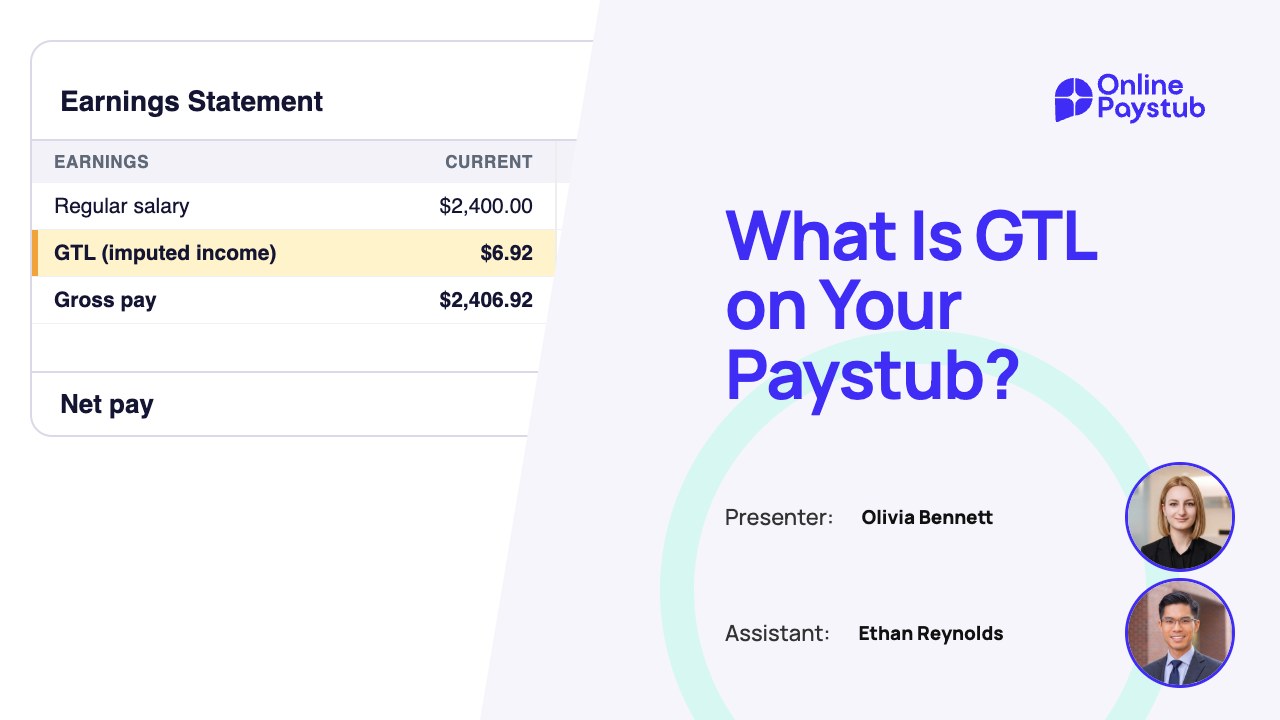
GTL stands for group term life insurance. When your employer pays for more than $50,000 of life insurance coverage, the IRS treats the cost of the extra coverage as income, called imputed income. GTL shows up on your paystub so that amount can be taxed. You don't receive it as cash, but you pay Social Security and Medicare tax on it.
Seeing GTL on a paycheck for the first time is confusing. It looks like extra pay, then it looks like a deduction and your net pay barely moves. This guide explains what the GTL line means, why it appears twice, how the amount is calculated with the IRS table and how little it actually costs you.
What Does GTL Mean on a Paystub?
GTL on your paystub is short for group term life insurance, life insurance your employer buys for a group of employees. The number next to it is not a premium you pay. It is imputed income: the value the IRS assigns to the part of your employer-paid coverage that is above $50,000.
Imputed income is a benefit that counts as income for tax purposes even though you never receive it as money. Because it counts as income, your employer has to run it through payroll so the right taxes are applied.
Other Labels for GTL (GTLI, GROUP LIF, LIFE IMP, GL50K+)
Payroll systems shorten GTL in different ways. These all refer to the same thing:
| Label | Meaning |
|---|---|
| GTL or GTLI | Group term life (insurance) imputed income |
| GROUP LIF or GRP LIFE | Group life insurance value |
| LIFE IMP or IMP LIFE | Imputed income from life insurance |
| GL50K+ or GTL>50K | Value of coverage above $50,000 |
| GTL OFFSET or GTL ADJ | The matching deduction that removes the non-cash amount |
The short label system works the same way for state tax, where a code such as SIT withheld stands for state income tax; the rest of the common codes are collected in this list of pay stub abbreviations.
Why GTL Shows Up as Both an Earning and a Deduction
This is where most of the confusion comes from. Payroll systems need to add the GTL amount to your taxable wages so Social Security and Medicare can be calculated on it. But you never received that money, so it cannot be part of your net pay.
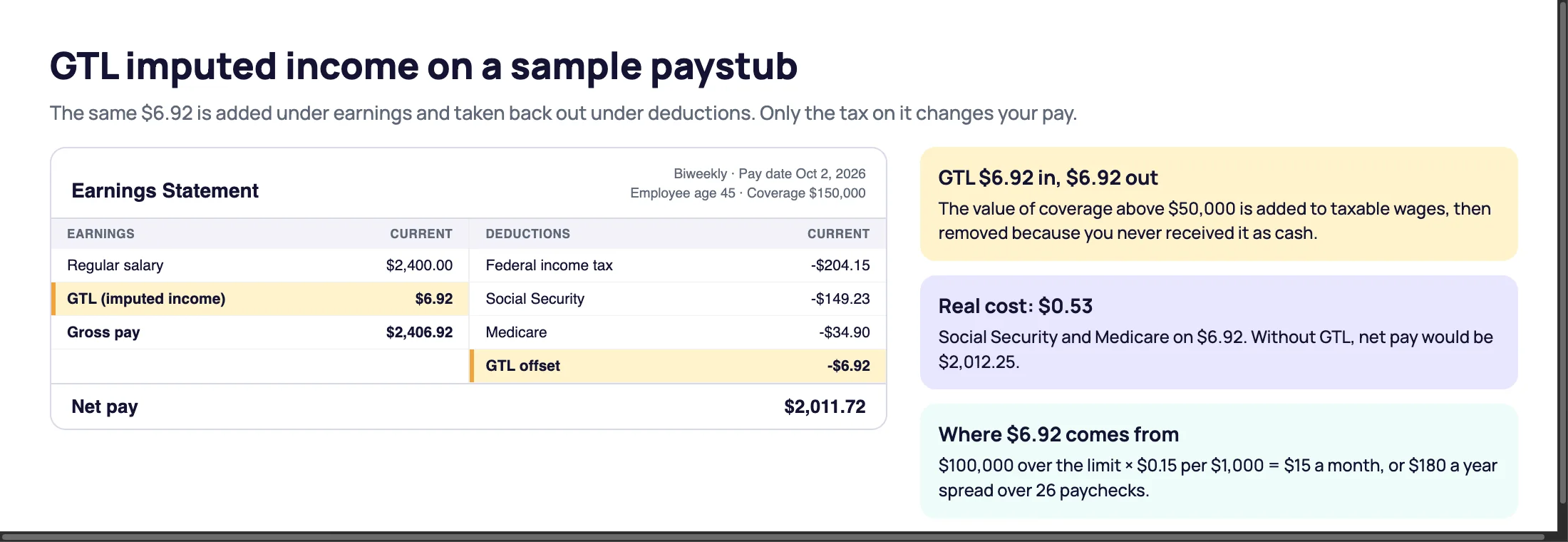
The solution is a pair of lines. GTL is added on the earnings side, which raises your gross pay and taxable wages. The same amount is then subtracted on the deductions side, often labeled GTL offset. The two cancel out. What is left is the extra tax.
In the sample statement above, a 45-year-old employee with $150,000 of coverage has $6.92 of GTL added and removed each biweekly paycheck. Social Security and Medicare on that $6.92 come to $0.53, which is the only real change to net pay. Some statements skip the offset line and show GTL only as a memo item; the effect on your pay is the same. If the layout of earnings, deductions and the memo section is new to you, an annotated sample pay stub walks through each block.
How Group Term Life Insurance Works
Group term life insurance is a common workplace benefit. Your employer buys one policy that covers eligible employees and pays some or all of the premiums.
- Coverage amount: often a flat amount such as $50,000 or a multiple of salary, such as one or two times your annual pay.
- No medical exam: basic coverage is usually guaranteed for everyone who is eligible.
- Term only: it pays a death benefit while you are covered and builds no cash value.
- Tied to the job: coverage typically ends when you leave, though many plans let you convert it to an individual policy.
Because coverage often grows with salary, GTL imputed income tends to appear after a raise pushes your coverage past $50,000.
When Is GTL Taxable? The $50,000 Rule
Under Section 79 of the tax code, the cost of up to $50,000 of employer-provided group term life coverage is tax-free. Only the coverage above $50,000 creates taxable GTL imputed income. If your total coverage is $50,000 or less, you will not see GTL on your paystub at all.
Two details lower the amount:
- Your own contributions. If you pay part of the premium with after-tax money, that amount is subtracted from the imputed income. If you pay enough, the GTL line can disappear.
- Age is measured once a year. The rate is based on your age on the last day of the tax year, so a birthday that moves you into a new age band changes the rate for the whole year.
Coverage for Your Spouse or Dependents
Employer-paid life insurance on a spouse or child is tax-free as a small (de minimis) benefit if the coverage is no more than $2,000 per person. Above that amount, the full cost of the dependent coverage is taxable income to you and is usually added to the same GTL line.
How GTL Imputed Income Is Calculated
The IRS does not use the premium your employer actually pays. It uses a fixed rate per $1,000 of coverage from Table 2-2 in IRS Publication 15-B, often called the uniform premium table.
The formula is: (total coverage minus $50,000) ÷ 1,000 × monthly rate for your age × 12 months, minus anything you paid after tax.
| Age on December 31 | Monthly cost per $1,000 of coverage |
|---|---|
| Under 25 | $0.05 |
| 25 to 29 | $0.06 |
| 30 to 34 | $0.08 |
| 35 to 39 | $0.09 |
| 40 to 44 | $0.10 |
| 45 to 49 | $0.15 |
| 50 to 54 | $0.23 |
| 55 to 59 | $0.43 |
| 60 to 64 | $0.66 |
| 65 to 69 | $1.27 |
| 70 and older | $2.06 |
Notice the jumps. The rate rises by half at 45, almost doubles at 55 and keeps climbing quickly after 60, so the same coverage produces much more GTL imputed income as you get older.
Example 1: Age 32 With $60,000 Coverage
$10,000 is above the limit. 10 × $0.08 = $0.80 a month ($9.60 a year). The extra Social Security and Medicare tax is about six cents a month.
Example 2: Age 45 With $150,000 Coverage
$100,000 is above the limit. 100 × $0.15 = $15.00 a month ($180 a year). Paid every two weeks, that is $6.92 per paycheck and $0.53 of extra FICA tax, the case shown in the sample paystub.
Example 3: Age 60 With $100,000 Coverage
$50,000 is above the limit. 50 × $0.66 = $33.00 a month ($396 a year). The extra Social Security and Medicare tax is about $2.52 a month.
| Example | Age | Coverage | Taxable coverage | Monthly GTL | Yearly GTL | Monthly FICA cost |
|---|---|---|---|---|---|---|
| 1 | 32 | $60,000 | $10,000 | $0.80 | $9.60 | $0.06 |
| 2 | 45 | $150,000 | $100,000 | $15.00 | $180.00 | $1.15 |
| 3 | 60 | $100,000 | $50,000 | $33.00 | $396.00 | $2.52 |
How Much Does GTL Reduce Your Take-Home Pay?
Very little. Two taxes matter:
- Social Security and Medicare (FICA): always withheld on GTL imputed income, 7.65% in total for most employees. On $6.92 that is $0.53 per paycheck.
- Federal income tax: your employer does not have to withhold it on GTL and many do not. The amount is still included in your taxable wages, so it is taxed when you file your return. At a 12% or 22% bracket, $180 of GTL imputed income adds roughly $22 to $40 to your federal tax for the year.
Compared with buying $100,000 of life insurance on your own, the tax on GTL is usually a small price for the coverage.
How GTL Appears on Your W-2 (Box 12, Code C)
At the end of the year your total GTL imputed income is reported on your W-2 in two ways. It is included in Box 1 (wages, tips and other compensation), Box 3 (Social Security wages) and Box 5 (Medicare wages). It is also listed on its own in Box 12 with code C, so you can see how much of your wages came from group term life coverage. The IRS group-term life insurance page describes the same reporting rules for employers.
Check Your December Paystub Against Your W-2
- Find the GTL year-to-date amount on your last paystub of the year.
- Compare it with the code C amount in Box 12 of your W-2. They should match.
- If they do not, ask payroll whether a late-year adjustment was made, for example a December true-up or a change in your coverage.
Showing GTL on a Paystub You Create
If you run payroll for a small business that offers group term life insurance above $50,000, each employee's statement should show the GTL amount with its offset and the extra Social Security and Medicare tax. When you create a paystub, check that the GTL amount follows the age table above and that it carries into the year-to-date column, because that total ends up in Box 12 code C. Use real payroll figures only.
This article is general information about payroll reporting, not tax advice. For your own situation, check with your employer's benefits team or a tax professional.
Need to show GTL on a paystub? Create one in minutes.
Create a Pay Stub Now