
Florida is one of nine states that do not tax wages. The state income tax rate for individuals is 0%: there are no brackets, no state withholding form and no Florida return to file each spring.
That does not make a Florida paycheck tax-free. Federal income tax, Social Security and Medicare still come out and the state raises its money in other ways. This guide explains what a Florida worker actually pays in 2026, what an employer withholds and what changes when you move in or out of the state.
Florida Income Tax at a Glance
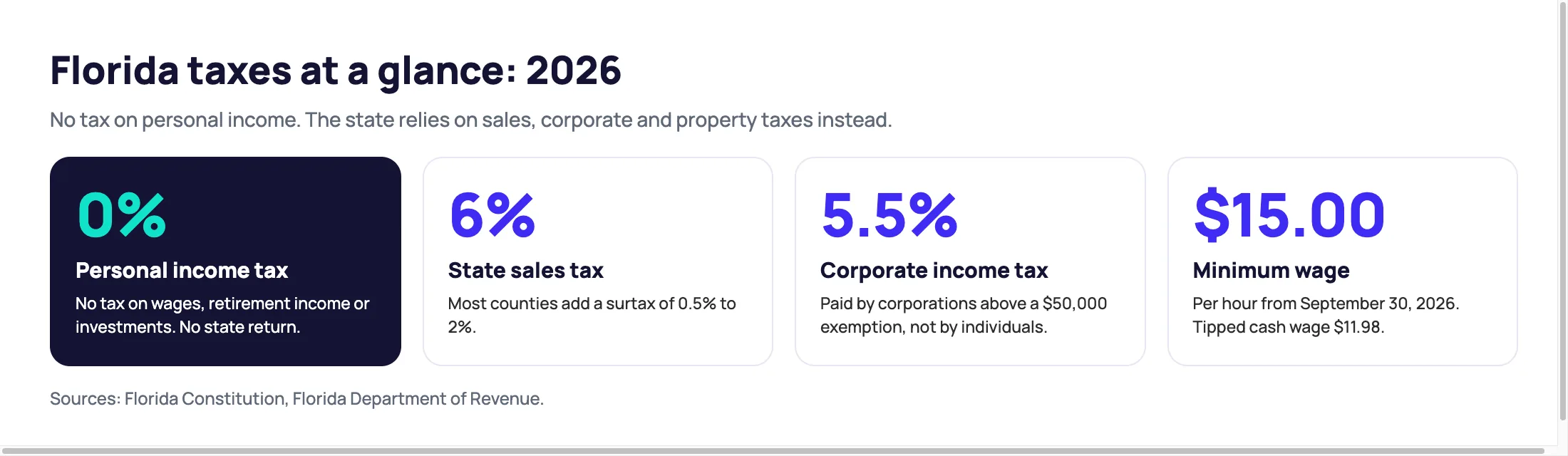
- Personal income tax rate: 0%. Wages, tips, bonuses, retirement income and investment income are not taxed by the state.
- Brackets and standard deduction: none, because there is no tax to calculate.
- State withholding: none. Employees complete only the federal Form W-4.
- State return: none for individuals.
- Still withheld: federal income tax, 6.2% Social Security and 1.45% Medicare.
Why Florida Has No State Income Tax
The rule is written into the state constitution, not just a statute. Article VII, Section 5 of the Florida Constitution says no tax on the income of natural persons may be levied in excess of the amount that can be credited against a similar federal or other state tax. In practice that amount is zero, which leaves no room for a personal income tax. Changing it would take a constitutional amendment approved by voters.
The Florida Department of Revenue puts it plainly: Florida does not impose a personal income tax, so individuals have no filing requirements. The same applies to capital gains, since there is no income tax for them to fall under.
What Still Comes Out of a Florida Paycheck
Three federal deductions apply to almost every Florida employee:
| Deduction | 2026 rate | Notes |
|---|---|---|
| Federal income tax | 10% to 37% brackets | Withheld under IRS Publication 15-T using your Form W-4 |
| Social Security | 6.2% | On wages up to $184,500 |
| Medicare | 1.45% | No wage limit; an extra 0.9% applies above $200,000 |
| Florida income tax | 0% | Nothing is withheld |
Example: a $2,400 biweekly paycheck in Orlando
Luis earns $30 an hour and works 80 hours in a two-week pay period. He is single with a standard Form W-4.
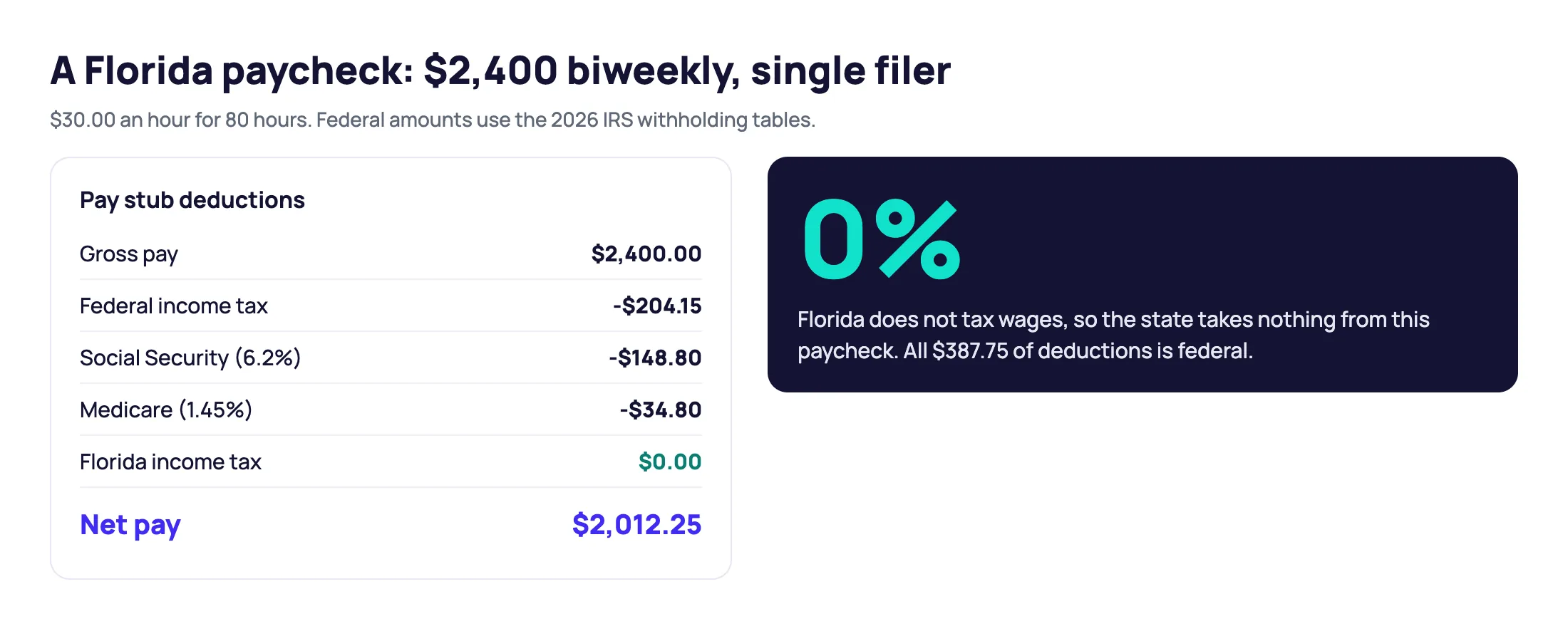
Luis keeps $2,012.25 of his $2,400. On the same pay in a state with an income tax he would lose more: under California's 2026 brackets his state income tax would come to about $1,717 for the year, roughly $66 per paycheck. Our guide to California state income tax shows how that is calculated.
To see these lines on a statement, create one with the Florida paystub generator, which itemizes federal tax and FICA and leaves out the state line.
What Florida Employers Withhold and Pay
A Florida employer has a shorter payroll checklist than most:
- Withhold federal income tax, Social Security and Medicare from each paycheck.
- Do not withhold any state or local income tax. There is no Florida version of Form W-4.
- Pay reemployment tax to the Department of Revenue. This is Florida's unemployment tax. It is charged on the first $7,000 of each employee's wages, new employers start at 2.7% and it is paid by the employer only. It must never be deducted from an employee's pay.
- Pay at least the minimum wage: $15.00 an hour from September 30, 2026, with a direct cash wage of $11.98 for tipped employees. That rate stays in place through December 31, 2027; inflation adjustments resume on January 1, 2028.
Because nothing is withheld for the state, a missing state line on a Florida stub is correct. If the federal line is also empty, see why no federal income tax was withheld from a paycheck.
The Taxes Florida Does Have
No income tax does not mean no taxes. Florida funds itself mostly through what people buy and own:
| Tax | Rate | Who pays |
|---|---|---|
| State sales and use tax | 6% | Buyers of most goods and some services; most counties add a surtax of 0.5% to 2% |
| Corporate income tax | 5.5% | Corporations, on Florida net income above a $50,000 exemption |
| Property tax | Set by counties, cities and school districts | Property owners |
| Reemployment tax | 0.1% to 5.4% on the first $7,000 of wages | Employers only |
Florida does not impose an inheritance or gift tax. Its estate tax has not applied to anyone who died after December 31, 2004 and the annual tax on intangible personal property such as stocks and bonds was repealed in 2007. Property tax is the one to watch: a constitutional amendment that would raise the homestead exemption is on the November 3, 2026 ballot. None of this changes what is withheld from a paycheck.
Do You File a Florida Tax Return?
Not as an individual. There is no Florida equivalent of Form 1040. You still file a federal return with the IRS every year and your W-2 will show no state wages or state tax in Boxes 15 to 17.
Businesses are different. A corporation may owe Florida corporate income tax, a shop collects and remits sales tax and any employer files quarterly reemployment tax reports.
Remote Work, Moving and Part-Year Residents
Florida does not tax you for living or working there, whatever state your employer is in. The other state may still have a claim:
- You live in Florida and travel to work in another state. That state can tax the wages you earn while physically working there.
- You work remotely from Florida for an out-of-state employer. Most states do not tax those wages. A few apply a "convenience of the employer" rule, so check the employer's state.
- You moved to Florida during the year. File a part-year return with your former state for the income earned before the move. Florida has no part-year return.
States with an income tax look at where you actually live, not only what you claim. People who move to Florida commonly file a Declaration of Domicile with the county clerk, get a Florida driver license, register to vote and keep records of the days spent in each state.
How Florida Compares With Other States
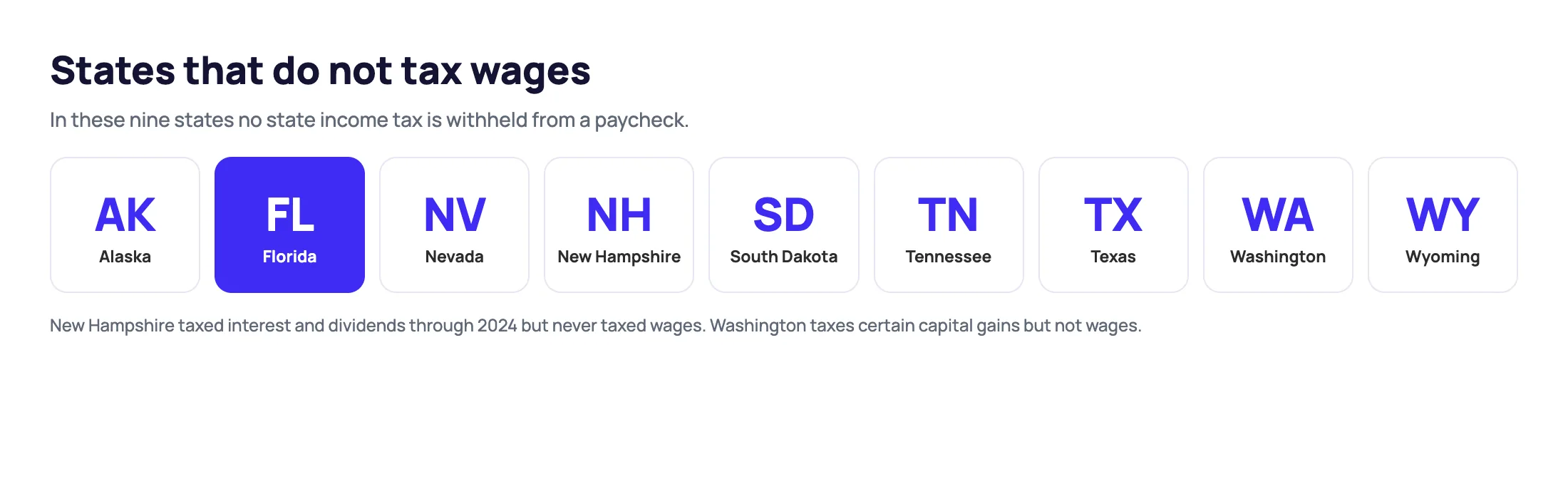
Florida, Alaska, Nevada, New Hampshire, South Dakota, Tennessee, Texas, Washington and Wyoming do not tax wages. A worker in any of them has a pay stub with only federal deductions unless a state program such as Washington's paid leave premium applies.
Pay Stubs and Proof of Income in Florida
A Florida pay stub is simpler to read than most: gross pay, three federal lines, any benefit deductions and net pay. Landlords and lenders still read it closely, so the year-to-date totals should match your deposits. See what counts as proof of income for an apartment if you are applying for a lease.
If you are self-employed or run a small Florida business, Online Paystub turns real payroll figures into an itemized statement. It is intended for genuine payroll and recordkeeping only.
See a Florida pay stub with federal tax and FICA itemized and no state line.
Create a Pay Stub Now