
You open your credit card app and there it is: a charge you did not expect, sitting in the pending section with a gray label and no way to click cancel. Maybe it is a hotel hold three times the room rate, a subscription you thought you turned off or a restaurant that swiped your card twice. The money is not gone yet, but your available credit just shrank.
The honest answer surprises most people: you cannot cancel a pending credit card transaction yourself and neither can your card issuer. A pending charge is not a payment at all. It is a reservation placed by the merchant and only the merchant holds the switch that turns it off. That one fact changes the entire playbook, because it means your first call should almost never be to the number on the back of your card.
Here is what a pending charge actually is, the right order of steps to get one released, how long holds normally last, what to do when the merchant stops answering and when a pending charge is fraud rather than a billing mix-up.
What a Pending Transaction Actually Is
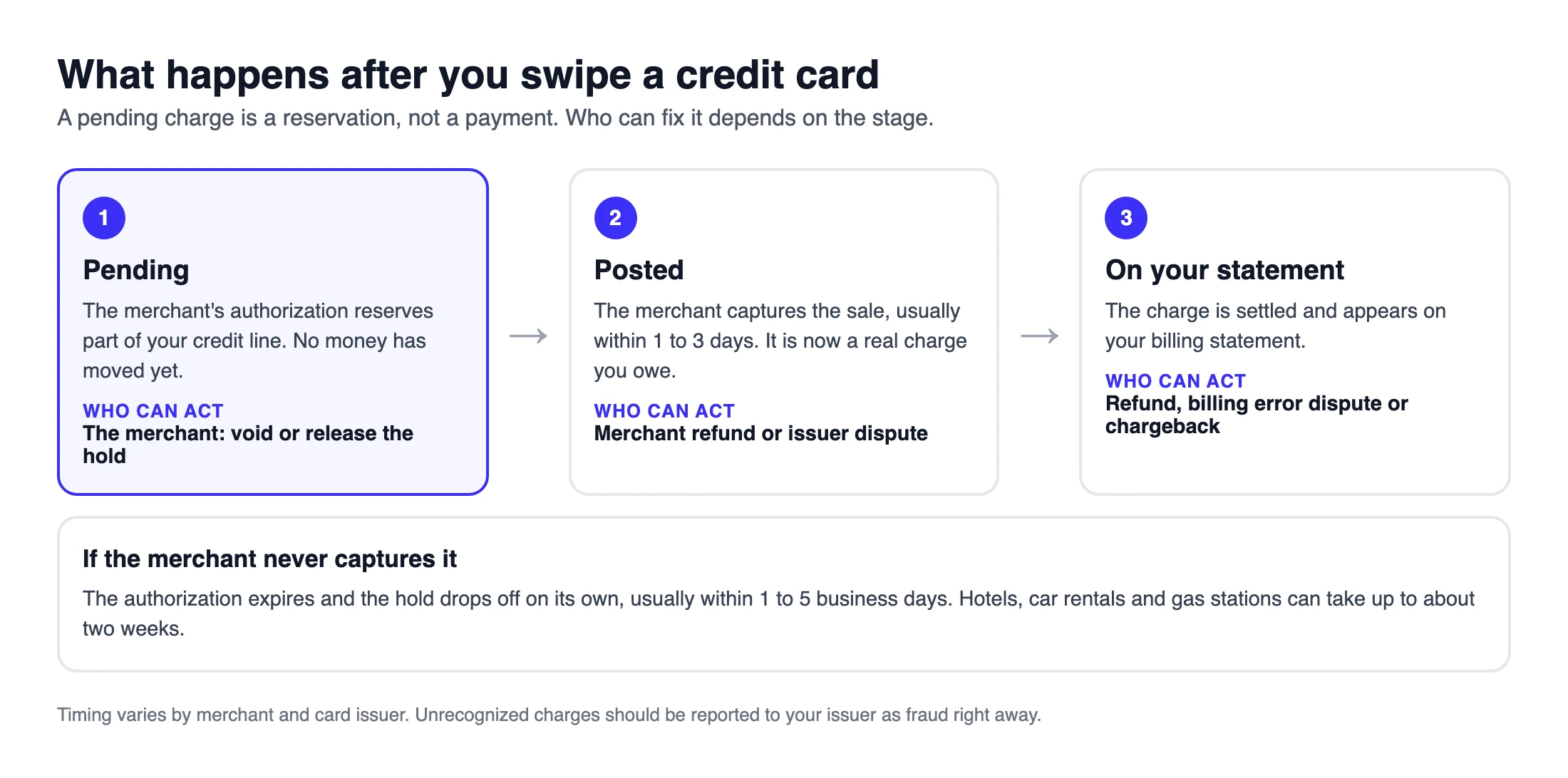
When you hand over a credit card, the merchant does not immediately take your money. Their terminal sends an authorization request through the card network to your issuing bank, asking whether you have the credit available. If the answer is yes, your issuer places an authorization hold: it sets aside part of your credit line so nobody else can spend it. That hold is what you see labeled pending. No funds have moved and your balance owed has not officially increased.
Later, usually within a day or two, the merchant submits the transaction for settlement. Only then does the charge post, appear on your statement and become something you owe. This two-step design exists because the final amount is often unknown at the swipe: a restaurant does not know your tip yet, a gas station does not know how many gallons you will pump. That is also why the pending amount and the posted amount frequently differ.
| Stage | What it means | What you can do |
|---|---|---|
| Pending (authorized) | Merchant reserved part of your credit line; no money has moved | Ask the merchant to void or release the authorization |
| Posted | Merchant captured the sale; it appears on your account and statement | Request a merchant refund or dispute it with your issuer |
| Settled | Funds have moved between banks and the billing cycle has closed | Refund or formal dispute only |
| Expired authorization | Merchant never captured the sale in time | Nothing; the hold falls off and your credit is restored |
Why Your Card Issuer Cannot Cancel a Pending Charge
People call the bank first because the bank is showing them the charge. But the bank is only reporting what the merchant asked for. Card network rules put the merchant in control of an authorization: the merchant can void it, reverse it or let it expire and the issuer is expected to honor the reservation until one of those happens.
So when a representative says they cannot remove a pending transaction, they are not brushing you off. They lack the authority. What they can do is confirm the merchant descriptor and exact amount, give you an expected drop-off window, note the account and close the card if you believe the charge is fraudulent. That last item is a fraud process, not a cancellation.
How to Cancel a Pending Transaction, Step by Step
Step 1: Identify the merchant first
Card descriptors are often cryptic, especially for online sellers billing under a parent company or processor name. Search the exact descriptor string online. A surprising share of mystery charges turn out to be a forgotten subscription, an authorized user or a store billing under a different legal name.
Step 2: Ask the merchant to void the authorization
Use those words: void the authorization or release the hold. That is the language their payment system uses. Asking for a refund on a pending charge confuses the conversation, because a refund is a separate transaction that only makes sense after the sale is captured. If the merchant voids before capture, nothing ever posts.
Step 3: Get the cancellation in writing
Ask for an email confirmation, a cancellation number or a chat transcript stating the order was cancelled and the authorization voided. Note the date, time and who you spoke with. If the charge posts anyway, this is the single most useful thing you can hand your issuer.
Step 4: Wait, then verify
Even after a merchant voids an authorization, the release is not always instant on your side. Give it a few business days, then confirm your available credit was restored and no matching charge posted. Set a calendar reminder rather than trusting yourself to remember.
Step 5: If it posts anyway, escalate
A charge that posts despite a written cancellation is now a billing dispute and at that point your issuer can genuinely help. Go back to the merchant once for a refund and if that fails, file a dispute using the confirmation you saved.
How Long Do Credit Card Holds Last?
Most everyday pending charges clear within one to five business days. Certain industries hold longer because the final amount is uncertain or the service spans several days. Treat the ranges below as planning numbers, not guarantees, since timing depends on the merchant, the processor and your issuer.
| Merchant type | Why the hold exists | Typical release window |
|---|---|---|
| Retail store or restaurant | Estimate first, captured with the final total or tip | 1 to 3 business days |
| Online retailer | Authorized at order, captured at shipment | 1 to 5 business days, longer for backorders |
| Gas station (pay at pump) | Flat pre-authorization above your actual fill | 1 to 3 business days, sometimes a week |
| Hotel | Room rate plus an incidentals cushion per night | Several days after checkout, sometimes two weeks |
| Car rental | Rental estimate plus a deposit-style hold | Up to two weeks after the car is returned |
| Airline or travel booking | Fare authorized at booking, captured at ticketing | 1 to 7 business days if cancelled |
| Free trial signup | Small verification hold, often around $1 | 1 to 5 business days, then it usually vanishes |
One travel tip: hotels and rental agencies release the deposit portion only after they close out your folio, which can happen days after you leave. If you are stacking trips back to back, a lingering hold can eat the credit you need for the next booking.
When the Merchant Refuses or Will Not Answer
Sometimes the merchant will not void the hold, will not pick up the phone or only issues refunds after a sale settles. Frustrating as it is, the right move is to stop fighting the pending stage and wait. You cannot dispute a charge that has not posted, because the card networks require a completed transaction before a chargeback can be filed.
While you wait, build your file: the order page, the cancellation policy as it appeared when you bought, emails, chat logs, tracking showing goods were never delivered and a screenshot of the pending charge. Once it posts, report it to your issuer as a billing error and submit that evidence. Most issuers now let you open a dispute directly in the app.
The Fair Credit Billing Act gives credit card holders a formal process for billing error disputes, covering charges for goods never delivered or never accepted, charges for the wrong amount and unauthorized charges. According to the FTC, your written notice must reach the issuer within 60 days after the first bill with the error was sent to you and issuers must acknowledge and investigate within set timeframes. Procedures vary, so read your cardholder agreement and file early rather than waiting. This is general information, not legal advice.
Merchant Refund vs Chargeback
These two get used interchangeably and should not be. A refund is voluntary and comes from the merchant. A chargeback is forced, runs through your issuer and the card network and pulls money back from the merchant whether they agree or not.
| Merchant refund | Chargeback / dispute | |
|---|---|---|
| Who starts it | You ask, the merchant agrees | You file with your card issuer |
| Typical speed | 3 to 10 business days to appear | Provisional credit fast, final resolution takes weeks |
| Merchant impact | Routine, no penalty | Fees and a dispute ratio that threatens card acceptance |
| Best used when | The merchant is responsive | The merchant refuses, ignores you or is unreachable |
| Evidence needed | Minimal | Receipts, cancellation confirmations, delivery records |
Always try the refund route first. Filing a chargeback against a merchant who would have refunded you anyway wastes weeks and some merchants respond by banning the account.
When a Pending Charge Is Fraud, Not a Mistake
If you do not recognize the merchant at all, if the charge comes from a country you have never visited or if you see a tiny test charge followed by a large one, treat it as fraud rather than a billing dispute. Card thieves routinely run a small authorization to confirm a stolen number works before attempting a real purchase.
Call your issuer immediately and report the card as compromised. They will close the number, ship a replacement and handle the charges through the fraud process instead of merchant negotiation. Federal law caps a cardholder's liability for unauthorized credit card use at $50 and all major US issuers advertise zero liability for verified fraud. Do not contact the fraudulent merchant yourself. Afterward, change the password on any account where that card was stored and review your other cards.
Pending Charges That Never Post at All
Not every authorization becomes a real charge. If the merchant never captures the sale within the window the card network allows, the authorization expires and your issuer releases the reserved credit automatically. The pending line disappears with no matching posted transaction and nothing is required from you.
This is common with cancelled online orders, flexible hotel reservations you never used and verification holds from streaming and rideshare apps. It is also why patience is the right strategy for small amounts. Duplicates are where it matters: if the same merchant and amount appear twice, one is usually a stale authorization that will expire. If both actually post, that is a clean billing error and an easy dispute.
Why Debit Card Holds Hurt More
Everything above applies to debit cards, with one painful difference: a debit hold ties up real money in your checking account, not a slice of a credit line. A $400 rental deposit on a credit card is an inconvenience. The same hold on a debit card can bounce your rent and trigger overdraft fees. A payroll card works the same way, since a hold reduces the wages available on the card until it drops off.
The protections differ too. Credit card billing errors fall under the Fair Credit Billing Act and you are disputing money you have not yet paid. Debit errors fall under the Electronic Fund Transfer Act and Regulation E, where your maximum liability can increase sharply the longer you wait to report and where you are chasing money that already left your account. The practical rule: use a credit card for hotels, rentals, gas stations, deposits and free trials.
How to Avoid Unwanted Holds
- Cancel free trials at least two full days before renewal and screenshot the confirmation page instead of trusting the email to arrive.
- Turn on real-time transaction alerts so a new authorization reaches you within seconds, while the merchant can still void it easily.
- Use virtual or single-merchant card numbers for online signups where your issuer offers them.
- Keep a list of every recurring subscription with its renewal date and price and review it quarterly.
- Read your full statement each month rather than glancing at the total, because small recurring charges are designed to be skimmed past.
- At gas stations, pay inside or use credit so the flat pre-authorization does not lock up your cash.
- At hotel check-in, ask what the incidentals hold will be and how long after checkout it releases.
Holds are easier to absorb when you know exactly what is coming in each month. Budget from your real net pay per pay period rather than your gross monthly income, since taxes and deductions come out first. Freelancers and gig workers can do the same with monthly pay stubs for independent contractors that turn scattered payouts into one readable record. Once you know your true cash flow, deciding whether a two-week rental hold is survivable takes two seconds instead of causing a week of anxiety.
Know exactly what each paycheck brings in before a hold catches you off guard.
Create a Pay Stub Now