
An LLC operating agreement is the internal contract that sets out who owns a limited liability company, how it is managed, how money comes in and goes out and what happens when a member leaves. It is signed by the members and kept with the company records. It is not usually filed with the state.
Without one, your LLC runs on your state's default LLC rules, which may split profits, votes and buyouts in ways nobody intended. This guide explains what an operating agreement covers, whether you are required to have one, the clauses that matter most and how the agreement connects to the way owners actually get paid.
What an Operating Agreement Does
- Records ownership: each member's percentage and what they contributed to get it.
- Sets the management model: member-managed, where owners run the business or manager-managed, where appointed managers do.
- Controls the money: how profits and losses are allocated and when cash is distributed.
- Settles decisions in advance: which votes need a majority and which need everyone.
- Plans the exits: buyouts, transfers, death or disability of a member and dissolution.
Because the agreement overrides many default state rules, it lets members choose terms that fit the business, such as giving a member who runs daily operations a larger profit share than their ownership percentage.
Do You Need an Operating Agreement?
Most states do not require one, but a few do. New York, for example, requires members to adopt a written operating agreement before, at the time of or within 90 days after filing the articles of organization. Check your own state's LLC statute or secretary of state guidance before you rely on the defaults.
Even where it is optional, every LLC should have one, including a single-member LLC:
- Banks often ask for it before opening a business account or extending credit.
- It shows the LLC is run as a separate entity, which supports your limited liability protection if someone tries to reach your personal assets.
- It proves who owns the company if a member dies, divorces or leaves.
- It prevents state default rules from deciding disputes for you.
Key Clauses to Include
| Clause | What it settles | Why it matters |
|---|---|---|
| Members and ownership | Names, percentages and capital contributed | The baseline for votes and profit shares |
| Management | Member-managed or manager-managed and who can sign contracts | Stops one member from binding the company alone |
| Capital contributions | Initial money, property or services, plus rules for future capital calls | Avoids arguments when the business needs cash |
| Allocations and distributions | How profits and losses are split and when cash is paid out | Can differ from ownership percentages if agreed |
| Voting | Majority, supermajority or unanimous thresholds by decision type | Protects minority members on big decisions |
| Transfers and buy-sell | Right of first refusal, buyout price formula, triggering events | Keeps ownership in friendly hands |
| Owner compensation | Guaranteed payments, salaries or draws for working members | Rewards members who work in the business |
| Dissolution | How the LLC winds down and who gets what | Prevents a messy breakup |
How LLC Owners Get Paid
The operating agreement decides when and how cash leaves the business. Your tax classification decides whether that money counts as wages that run through payroll.
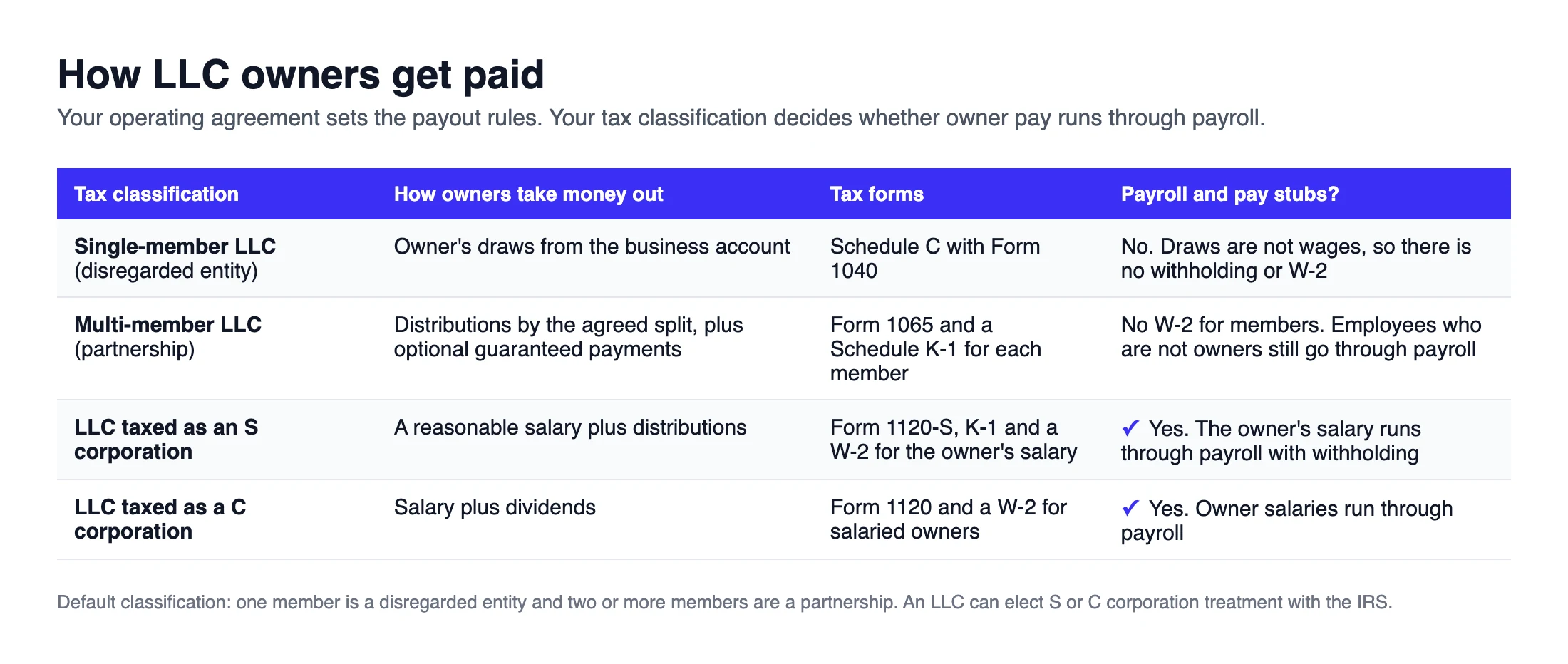
Owners of a default single-member or multi-member LLC take draws or distributions, not wages, so nothing is withheld and no W-2 is issued. They pay income tax and self-employment tax themselves and lenders judge their gross monthly income from net profit on their tax returns.
If the LLC elects S corporation treatment, an owner who works in the business must receive a reasonable salary through payroll, with withholding and a pay stub for each pay date. Knowing how to make a paystub correctly matters here and a small LLC with one owner-employee can often run that payroll without an expensive subscription, since several cheap payroll options cost little for a single employee.
Tax Classification and Your Agreement
An LLC is not its own tax category. By default, the IRS treats a single-member LLC as a disregarded entity reported on the owner's return and an LLC with two or more members as a partnership that files Form 1065 and issues each member a Schedule K-1. An LLC can instead elect to be taxed as an S corporation or a C corporation.
Your operating agreement should reflect the choice. Partnership-taxed LLCs usually include capital account and allocation language, while S corporation LLCs must keep distributions proportional to ownership to protect the election.
Single-Member vs. Multi-Member Agreements
| Single-member LLC | Multi-member LLC | |
|---|---|---|
| Main purpose | Proves separation between you and the business | Sets the deal between the members |
| Length | Often a few pages | Usually longer and more negotiated |
| Most important clauses | Management, succession, banking authority | Distributions, voting, buy-sell, dispute resolution |
| Signed by | The sole member | All members |
How to Create an Operating Agreement
- Confirm your state's rules. Check whether your state requires a written agreement and any deadline.
- Agree on the business terms first. Ownership, contributions, roles, pay for working members and how profits are split.
- Draft the document. Start from a reputable template for your state and customize every clause rather than leaving defaults.
- Plan for exits. Add buyout triggers and a valuation method now, while everyone still agrees.
- Have it reviewed. An attorney review is worth it for multi-member LLCs and any LLC with outside investors.
- Sign and store it. Every member signs. Keep it with your articles of organization, EIN letter and tax elections.
Amending the Agreement
Update the agreement when members join or leave, ownership changes, the management model changes or the LLC changes its tax classification. Follow the amendment procedure the agreement itself sets, which is often a majority or unanimous vote and keep each signed amendment with the original.
Common Mistakes
- Using a generic template without adjusting it to your state
- Leaving out a buyout price formula
- Mixing personal and business money, which undercuts liability protection even with a good agreement
- Paying an S corporation owner only through distributions instead of a reasonable salary
- Never updating the agreement after ownership changes
Paying yourself or your first employee through payroll? Create an accurate pay stub in minutes.
Create a Pay Stub Now