
An envelope arrives in March with your employer's name on it and inside is a form that looks almost like the W-2 you already filed with. The heading says Form W-2c, Corrected Wage and Tax Statement. Something on your original W-2 was wrong and payroll has fixed it. The obvious question is whether this is minor paperwork or something that will cost you time, money or a delayed refund.
It depends entirely on which box changed. A corrected Social Security number and a corrected wage figure arrive on the same form, but one can quietly affect your retirement benefits decades from now while the other may change what you owe this year. Neither should be filed away unread.
This guide explains what a W-2c is, why employers issue them, what the corrections actually affect and what to do depending on whether the form reached you before or after you filed. It also covers how to request a correction your employer has not noticed yet and how to catch these errors yourself before filing season starts.
What Form W-2c Actually Is
Form W-2c, Corrected Wage and Tax Statement, is what an employer uses to fix information already reported on a W-2 that was filed with the Social Security Administration and given to the employee. It does not erase the original W-2. It amends it.
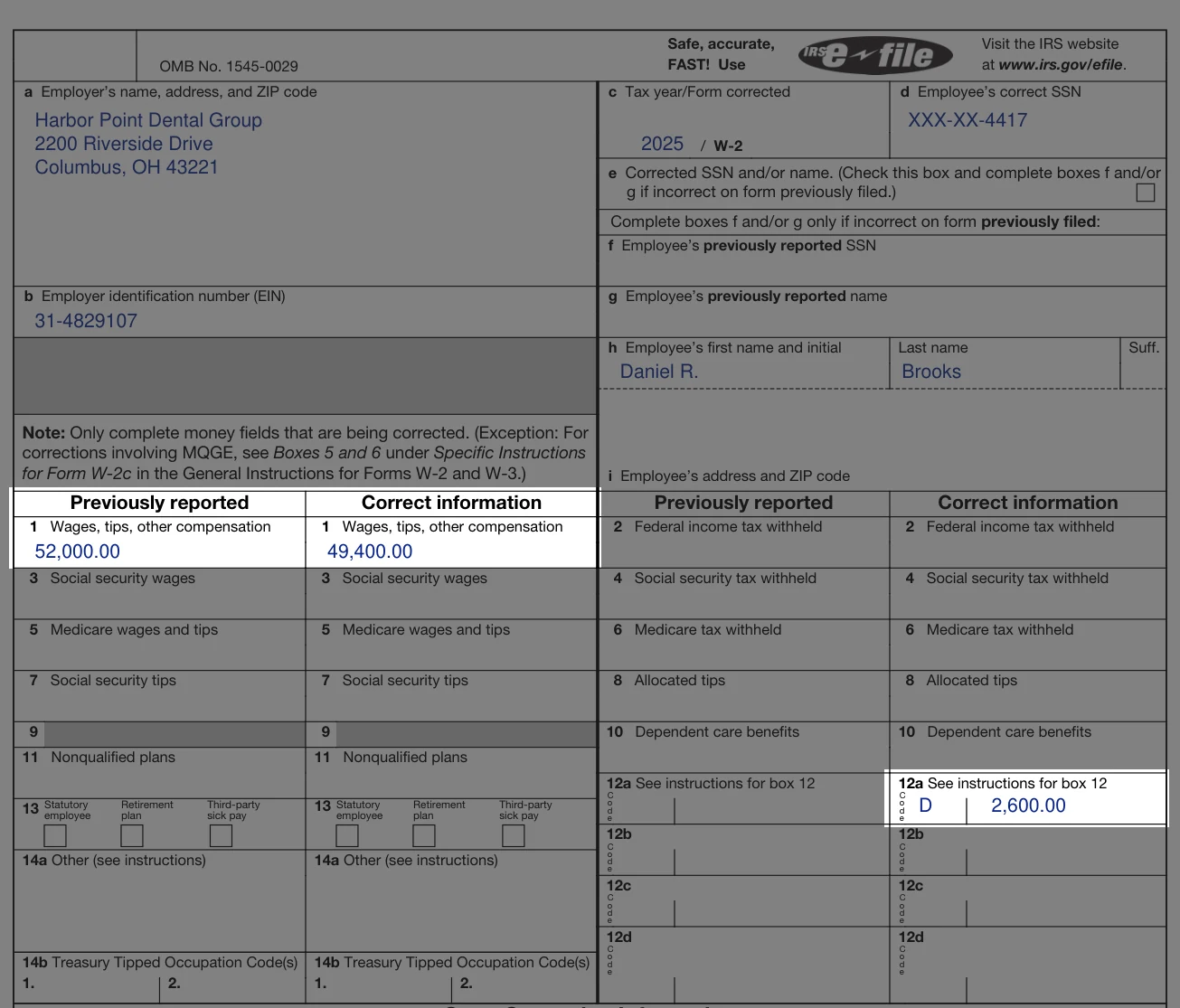
The layout is what makes the form distinctive. Instead of a single set of boxes, a W-2c shows two versions of every corrected item: the amount previously reported and the correct amount. Boxes that were already right are generally left blank, so a W-2c is often mostly empty. That side-by-side design lets the SSA and the IRS see exactly what moved and by how much and it means you can read a W-2c in about thirty seconds and know precisely what was wrong.
How a W-2c Differs From the Original W-2
| Feature | Form W-2 | Form W-2c |
|---|---|---|
| Purpose | Reports wages and withholding for the year | Corrects information already reported on a W-2 |
| Boxes filled in | All applicable boxes | Generally only the boxes being corrected |
| Amount columns | One amount per box | Previously reported amount and correct amount |
| Transmittal to SSA | Filed with Form W-3 | Filed with Form W-3c |
| Who prepares it | The employer or its payroll provider | The employer or its payroll provider |
| How many you can receive | One per employer per tax year | As many as needed if further errors are found |
The current version of the form and its instructions are on the IRS About Form W-2c page.
Who Issues a W-2c and What Else Gets Filed
Only the employer or the payroll provider acting on its behalf, can issue a W-2c. An employee cannot correct a W-2 alone and neither the IRS nor the SSA will edit an employer filing at your request. The correction has to come from the company that issued the form.
When an employer sends corrected forms to the Social Security Administration, paper W-2c forms go in with Form W-3c, Transmittal of Corrected Wage and Tax Statements, which summarizes the batch the same way Form W-3 summarizes a batch of original W-2 forms. Employers filing electronically follow the electronic equivalent.
Two consequences follow. Corrections that change wage or tax totals may also require the employer to amend its quarterly employment tax filings, which is why payroll departments sometimes take longer than employees expect. And because state and local agencies receive their own copies, a correction to state wages usually has to be reported to the state as well.
Common Reasons a W-2c Is Issued
Most W-2c forms come from a small set of recurring problems. Recognizing which category yours falls into tells you almost everything about how much attention it deserves.
- Wrong Social Security number. A transposed digit or a number pulled from an old record. One of the most consequential errors, because the SSA uses the SSN to credit earnings to the right person.
- Misspelled or outdated name. Common after a marriage, divorce or legal name change, especially when the employee updated the employer record but not the Social Security record or the reverse.
- Wrong wage amounts. A pay run posted to the wrong year, a manual check that never reached the payroll system or a reversed adjustment applied twice.
- Misapplied pre-tax deductions. A 401(k) contribution, HSA amount or Section 125 health premium treated as post-tax when it should have been pre-tax or the reverse. This shifts taxable wages in Boxes 1, 3, 5 and often 16.
- Missed taxable fringe benefits. Employer-paid group-term life insurance above the excludable threshold, personal use of a company car and similar items that should have been added to taxable wages before year-end.
- Incorrect state wages or withholding. Frequent for employees who moved mid-year, worked in more than one state or were coded to the wrong work location.
- Wrong employer identification number. Common in companies with several related legal entities or in a year with an acquisition or restructuring.
- Retroactive pay adjustments. A raise, settlement or corrected overtime calculation applied to a prior year rather than the year the payment was actually made.
- Excess 401(k) or 403(b) deferrals. If elective deferrals exceeded the annual limit, correcting and distributing the excess can require reporting changes.
Error Types and How Each Is Corrected
| Error on the original W-2 | How it is fixed | Does it usually change your tax? |
|---|---|---|
| Wrong or transposed SSN | Employer issues W-2c showing prior and correct SSN | No, but it affects your SSA earnings record |
| Misspelled or changed name | Employer issues W-2c with the corrected name | Usually no |
| Wrong employer EIN | Employer issues W-2c correcting the EIN | Usually no |
| Understated or overstated wages | W-2c shows previously reported and correct Box 1, 3, 5 and 16 amounts | Yes, very likely |
| Pre-tax deduction treated as post-tax | W-2c adjusts taxable wage boxes and the related Box 12 or 14 codes | Yes, likely |
| Missed taxable fringe benefit | W-2c increases taxable wages and may adjust Social Security and Medicare wages | Yes, likely |
| Wrong state wages or withholding | W-2c corrects Boxes 15 through 17 and the employer reports to the state | Possibly, on the state return |
| Incorrect federal withholding in Box 2 | W-2c corrects the withholding figure | Yes, it changes your refund or balance due |
| Address is wrong | Generally no W-2c needed, just update employer records | No |
Why a Corrected W-2 Genuinely Matters
It is tempting to treat a W-2c as administrative noise, especially when the dollar change looks small. Two separate systems make that a bad instinct.
Your Social Security Earnings Record
The SSA builds your lifetime earnings record from the W-2 forms employers file under your name and Social Security number and future retirement, disability and survivor benefits are calculated from that record. If wages are posted under a wrong SSN or a name mismatch prevents the SSA from matching the filing to you, that year of earnings may not be credited to your record at all.
A single missing year usually has a modest effect, but errors repeating across several years or occurring during your highest earning years, matter more. Corrections also get harder to document as time passes and employers change payroll systems or close. After any W-2c involving your name or SSN, review your earnings statement through your personal my Social Security account.
IRS Matching and Notices
The IRS compares the income you report against the information returns it receives, including W-2 forms. When your return says one number and the employer filing says another, the mismatch can generate an automated underreporter notice, commonly a CP2000, proposing changes to your tax. Responding to one takes far more effort than getting the numbers right up front. Mismatches can also slow a refund while the return is reviewed.
What to Do If the W-2c Arrives Before You File
This is the easy case. Use the corrected figures. Prepare your return from the correct amounts on the W-2c plus the unchanged boxes on the original W-2 and file normally. No amended return is involved, because you never filed with the wrong numbers.
Two practical points. If you use tax software, enter one W-2 as corrected rather than two separate forms. And if you already imported the original W-2 electronically, overwrite the imported figures, because an import will not update itself when a W-2c is issued.
What to Do If the W-2c Arrives After You File
The first step is to work out whether the correction actually changes your tax liability. Many do not. A corrected spelling of your last name or a fixed employer EIN changes the employer filing without changing a single number on your Form 1040.
If taxable wages, withholding or state wages did change, you generally evaluate whether to file Form 1040-X, Amended U.S. Individual Income Tax Return, plus any state amended return. Whether amending is required in your situation depends on facts the form alone will not tell you, so this is the point to check current IRS guidance or speak with a tax professional.
Before Filing Versus After Filing
| Situation | What to do | Amended return needed? |
|---|---|---|
| W-2c arrives before you file | File using the corrected amounts | No |
| W-2c arrives after filing, name or SSN only | Keep it with your records, verify your SSA earnings record | Generally no |
| W-2c arrives after filing, EIN corrected only | Keep it with your records | Generally no |
| W-2c arrives after filing, federal wages or withholding changed | Compare the corrected figures to what you filed and evaluate Form 1040-X | Often yes |
| W-2c arrives after filing, state wages changed | Review your state return and that state amended return process | Possibly, at the state level |
| You already received a notice from the IRS | Respond to the notice by its stated deadline and include the W-2c | Follow the notice instructions |
Timing: When Corrections Happen and How Fast
Employers are expected to correct errors as soon as they discover them and the IRS instructions for Forms W-2 and W-2c reflect that. Corrections can be filed for prior tax years too, which is why it is possible to receive a W-2c for a year you closed out long ago.
For employees there is no strict deadline attached to simply receiving a W-2c, because you are not the filer. What does have time limits is any refund you might claim by amending a prior-year return. Generally you must file a claim for refund within three years from the date you filed the original return or two years from the date you paid the tax, whichever is later.
In practice, most corrections land between late January and April, when employees compare forms to their own records and payroll finds year-end posting problems. Corrections tied to fringe benefits or excess deferrals often surface slightly later.
How to Request a Correction From Your Employer
If you spot the error first, the process is simple but works best when you make it easy for payroll to verify.
- Identify the specific box that is wrong and what it should be, rather than reporting that the form looks off.
- Gather supporting documents: your final pay stub of the year, bonus or commission statements, benefit enrollment confirmations and your Social Security card if the SSN or name is the issue.
- Contact payroll or HR in writing, not only by phone, so the request and its date are documented.
- Ask specifically for a Form W-2c and confirm the correction will also be reported to the SSA and your state.
- Follow up in writing if nothing arrives within a reasonable period and keep copies of every exchange.
If Your Employer Will Not Correct It
Sometimes an employer disputes the error, stops responding or is no longer in business. The same route used to get your W-2 from a previous employer applies here. The IRS provides a route for employees in this position: after you have tried to get the correction from your employer, you can contact the IRS, which will typically ask for your employer information, your wage details and an estimate based on your records and may then contact the employer on your behalf.
If the filing deadline approaches with no corrected form, a substitute wage statement process using Form 4852, Substitute for Form W-2, lets you file using your own best figures. The details and required documentation change over time, so check the current IRS instructions or work with a tax professional before relying on it.
Catching Errors Yourself Before Filing
The most reliable way to avoid a W-2c entirely is to check your W-2 against your own records the day it arrives. Your final pay stub of the calendar year is the natural reference point, because it carries year-to-date totals for gross pay, each tax withheld and each deduction.
The comparison is not a straight match and that is the part people get wrong. Box 1 will normally be lower than your YTD gross pay, because pre-tax deductions such as traditional 401(k) contributions and Section 125 health premiums reduce federal taxable wages. Boxes 3 and 5 follow different rules again, since 401(k) deferrals do not reduce Social Security and Medicare wages and Box 3 is capped at the annual Social Security wage base. What should match closely is Box 2 against your YTD federal withholding and the Social Security and Medicare withheld against their YTD figures.
Run this check every year and read your name and SSN character by character while you are at it. If the paper W-2 is lost, you can also get a copy of your W-2 online or pull an IRS wage and income transcript to run the same check.
Recordkeeping After a Correction
Keep the original W-2 and the W-2c together, in the same folder, for the same tax year. A W-2c on its own is often incomplete, because it shows only the boxes that changed, so a future lender, auditor or tax preparer needs the original alongside it to see the full picture. Keep the correspondence that produced the correction, your final pay stub for the year and a copy of any amended return you filed as a result. General IRS guidance on how long to keep tax records applies and the period can be longer in certain situations.
One last note for employers: document what caused the error, not just the fix. Most W-2c forms trace back to a process gap, such as a fringe benefit nobody adds to payroll before year-end or a new-hire data entry step with no verification. Fixing the process is what stops the same correction from repeating next January.
Check every W-2 against clear, itemized pay stubs so errors are caught before tax season.
Create a Pay Stub Now