
Every rental application comes with the same request: show us you can pay the rent. Proof of income for an apartment is the set of documents that answers that question. For most applicants it is a few recent pay stubs. For others it is a tax return, a bank statement, an offer letter or a benefits award letter.
This guide covers what landlords accept, how much income they expect, what they look at on a pay stub, how they verify what you send, your rights during screening and what to do when your income does not fit the standard template.
What Is Proof of Income for an Apartment?
Proof of income is any document from a reliable source that shows how much money you receive, how often and from whom. Landlords and property managers use it for one purpose: to estimate whether the rent will be paid on time every month. The stronger and more recent the document, the less follow-up you will get.
A good proof of income document has four features:
- It is recent. Pay stubs from the last 30 to 60 days, bank statements from the last two or three months, tax returns from the last one or two years.
- It names the payer. The employer, the agency or the client, with an address or phone number the landlord can check.
- It shows gross income. Income requirements are almost always based on gross pay, before taxes and deductions.
- It can be verified. A document the landlord can confirm with a call, a database lookup or a matching bank deposit carries far more weight than a screenshot.
How Much Income Do Landlords Require? The 3x Rule
The most common standard is gross monthly income equal to at least three times the monthly rent. Greystar's resident qualification criteria, for example, require applicants to "collectively have verifiable income in an amount not less than 3 times the rental rate," and Invitation Homes asks for a combined income of 3.0 times the monthly rent. Some communities use 2.5x, affordable programs often use 2x and in New York City the convention is an annual income of 40 times the monthly rent, which works out to the same 3.3x.
A few states now cap how much a landlord can demand. Colorado bars landlords from requiring income above 200% of the annual rent, which is a 2x standard.
How to turn a pay stub into monthly income
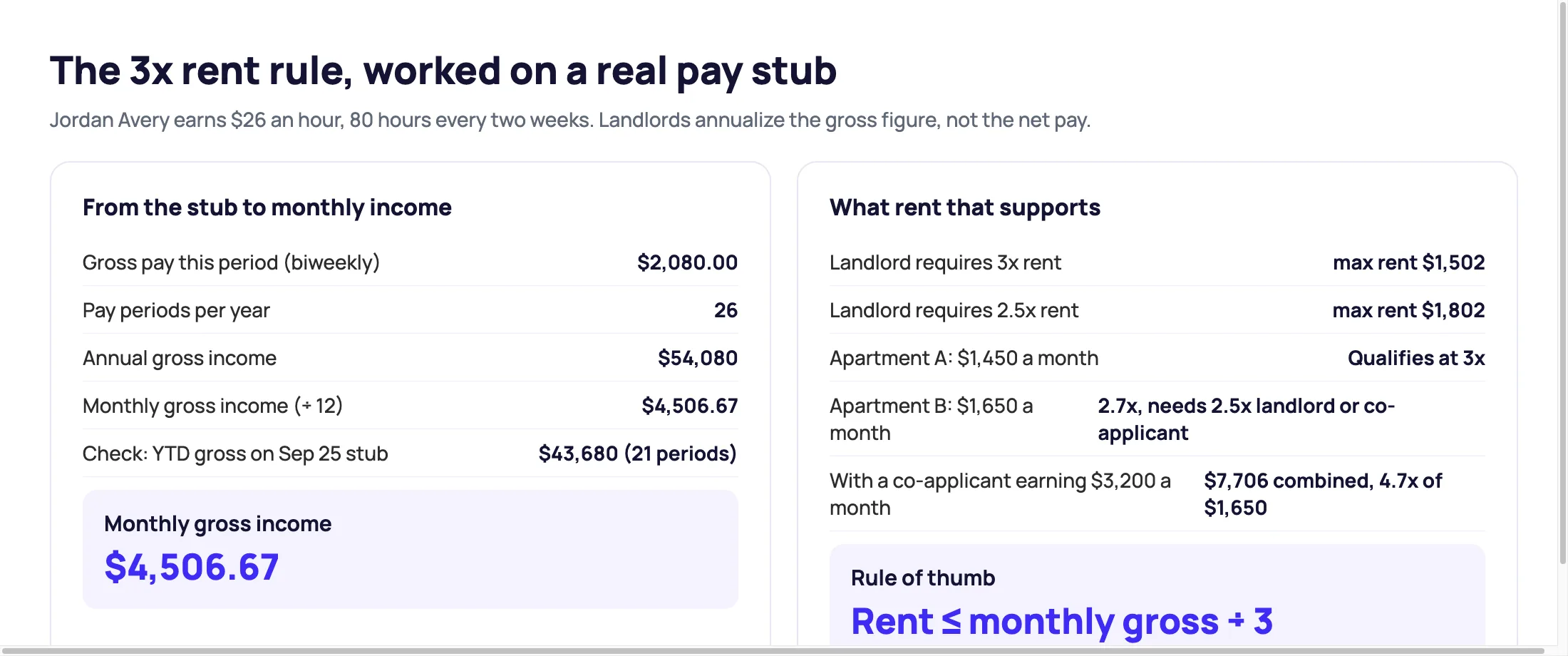
Landlords annualize the gross pay on your stub and divide by 12:
- Weekly pay: gross × 52 ÷ 12
- Biweekly pay (every two weeks): gross × 26 ÷ 12
- Semimonthly pay (twice a month): gross × 24 ÷ 12
- Monthly pay: gross as shown
Jordan Avery earns $26 an hour for 80 hours every two weeks, so each stub shows $2,080 of gross pay. Annualized that is $54,080 a year, which is $4,506.67 a month. Under a 3x rule Jordan qualifies for rent up to $1,502; under 2.5x, up to $1,802. The year-to-date column is the landlord's cross-check: by late September, after 21 pay periods, YTD gross should be close to $43,680. On Jordan's stub it is exactly that.
Overtime, bonuses and commissions are usually counted only when they appear consistently across several stubs or on last year's W-2. If a big part of your pay is variable, bring the W-2 as well as the stubs. Our guide to how to calculate gross monthly income walks through the math for hourly, salaried and variable pay.
Documents Landlords Accept as Proof of Income
1. Pay stubs
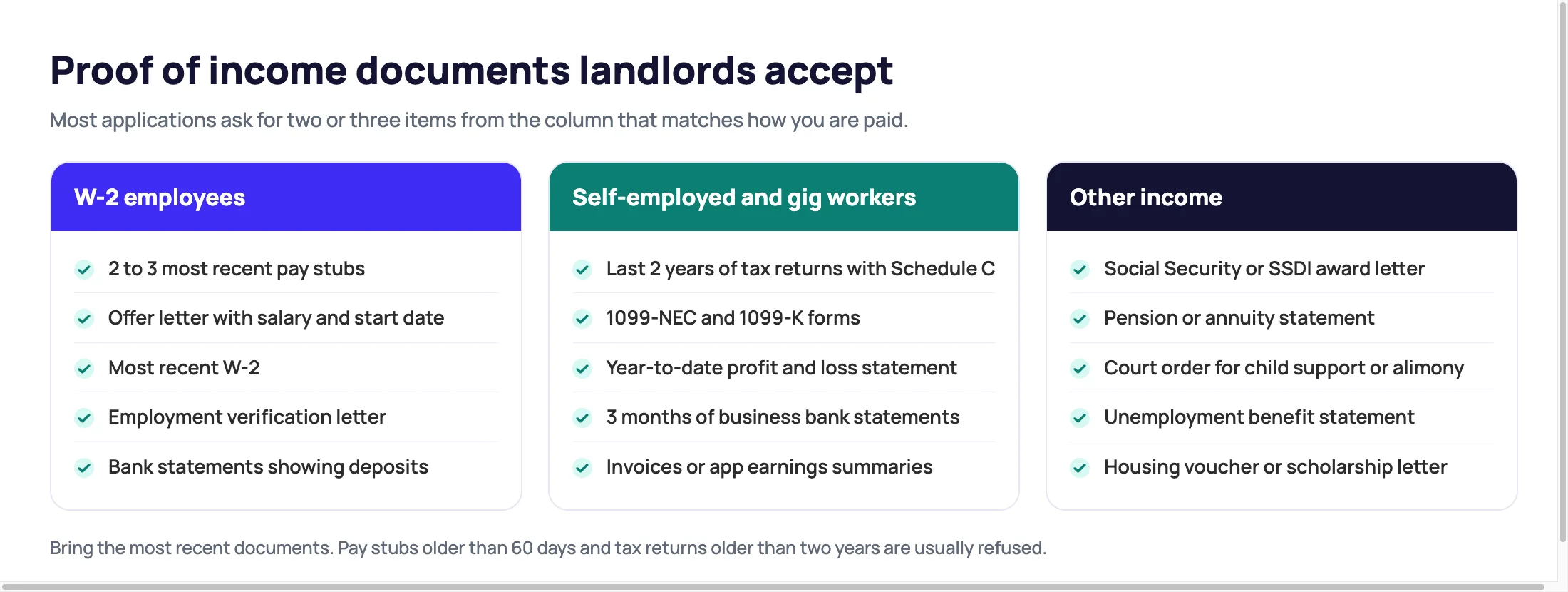
The default document for anyone paid as an employee. Screening services such as TransUnion SmartMove recommend three months of dated stubs; RentSpree suggests two to three months; Invitation Homes accepts one recent stub for salaried applicants and verifies the rest electronically. Bring consecutive stubs, not a random selection, so the pay dates and year-to-date totals line up.
2. Form W-2
Last year's W-2 confirms annual wages from a single employer and is the quickest way to prove variable pay such as overtime or commission. Box 1 will usually be lower than your final year-to-date gross because pre-tax benefits are excluded, which the box-by-box guide to what a W-2 form shows explains.
3. Tax returns
Form 1040 with schedules, typically the last two years, is standard for self-employed applicants and anyone with several income sources. Landlords focus on total income and, for business owners, the net profit on Schedule C.
4. Bank statements
Two or three months of statements show deposits actually arriving. Invitation Homes, for instance, accepts one current month of full statements, does not count tax refunds or prepaid-card balances and will not accept joint accounts unless every owner applies. Statements are most convincing when the deposits match the stubs or invoices you provided.
5. Offer letter or employment verification letter
If you are starting a new job, a signed offer letter on company letterhead with your salary, position and start date stands in for pay stubs. An employment verification letter from HR serves the same purpose for a current job. Expect the landlord to call and confirm.
6. 1099 forms, invoices and profit and loss statements
Contractors and freelancers can show Form 1099-NEC or 1099-K from clients and platforms, recent invoices and a year-to-date profit and loss statement. Note that from 2026 the 1099-NEC is only required when a client pays you $2,000 or more, so smaller clients may not issue one at all. Bank deposits and app earnings summaries fill that gap.
7. Benefit award letters and other income
Social Security and SSDI benefit verification letters (available instantly from a my Social Security account), VA benefit summary letters, pension or annuity statements, unemployment benefit statements and court orders for child support or alimony all count as income. Housing vouchers and other rental assistance count too and, as covered below, in many states the landlord must accept them.
What Landlords Look for on a Pay Stub
A leasing agent spends about a minute on each stub. These are the six things they check, in roughly this order:
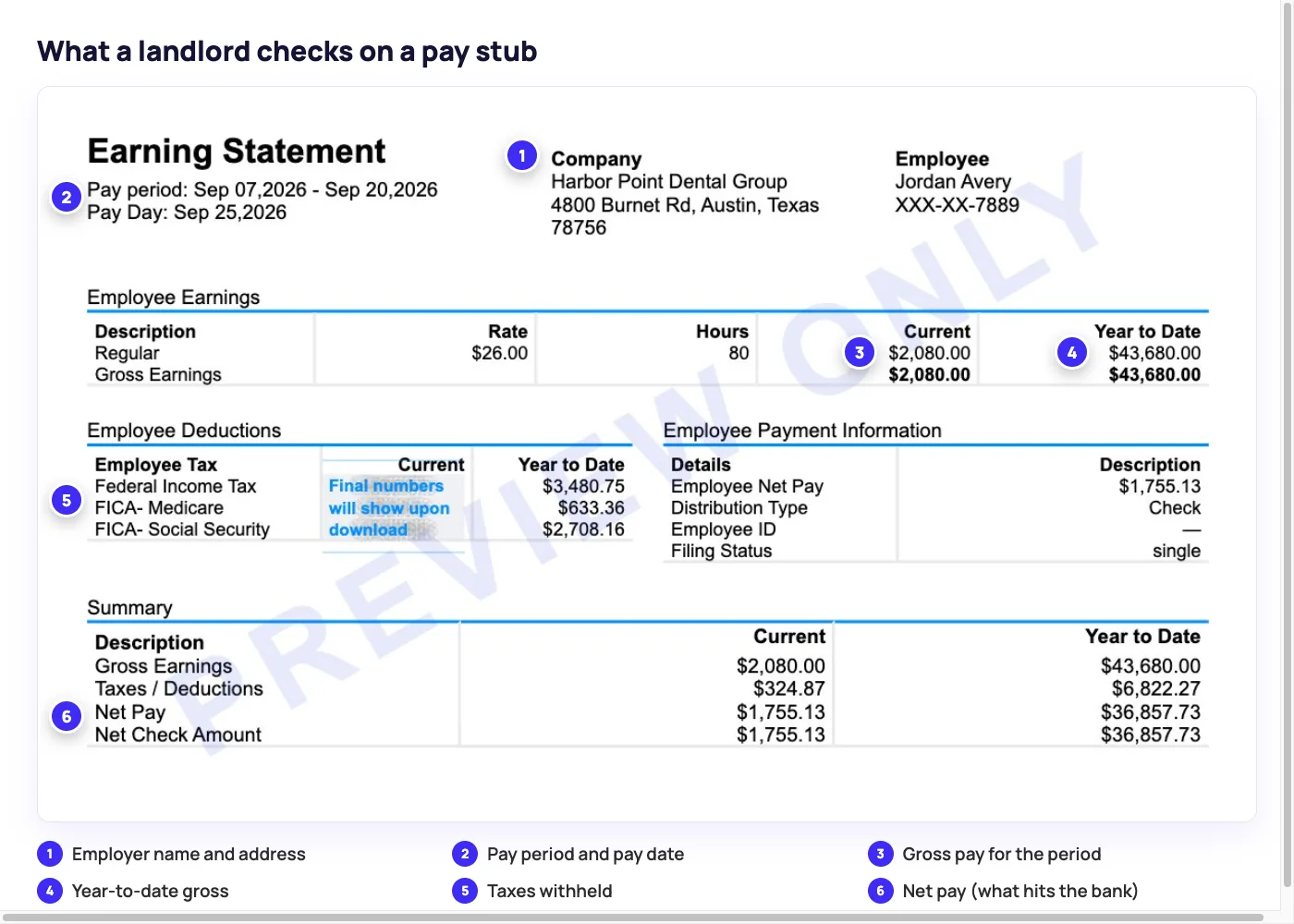
- Employer name and address. Does it match the application and can it be found and called?
- Pay period and pay date. Are the stubs recent and on a regular weekly, biweekly or semimonthly cycle?
- Gross pay for the period. The number that feeds the 3x calculation.
- Year-to-date gross. Does it make sense for the number of pay periods so far this year? Does it grow consistently from one stub to the next?
- Taxes withheld. Federal income tax, Social Security at 6.2% and Medicare at 1.45% should be present for an employee. Missing FICA lines are a classic sign of a fabricated stub.
- Net pay. Gross minus taxes and deductions should equal net. Net should match the deposits on your bank statement.
If a stub uses codes you do not recognize, decode them before the landlord asks: see the list of common pay stub abbreviations.
How Landlords Verify Proof of Income
Verification has moved well beyond a glance at the paperwork. According to the National Multifamily Housing Council's fraud survey, 93% of property operators dealt with application fraud in a single year and 84% saw falsified pay stubs or income documents, so most now use at least one of these methods:
- Math and consistency checks. Gross minus deductions must equal net; YTD totals must rise by the right amount between consecutive stubs; pay dates must follow a pattern.
- Bank deposit matching. Net pay on the stub should appear as a deposit of the same amount on or near the pay date.
- Employer calls. Using a phone number found independently, not the one on the application.
- Employment databases. The Work Number by Equifax reports employer, job title, start date, pay rate and year-to-date earnings for hundreds of millions of employee records.
- Bank-linked income verification. Services such as Plaid let applicants connect a bank or payroll account so the landlord sees verified deposits, often returning a decision in minutes.
Expect the whole process to take one to three business days after a complete application. Incomplete or inconsistent income documents are the most common reason it takes longer.
Proof of Income When You Are Self-Employed or a Gig Worker
Without an employer to call, you have to build the picture yourself. The combination that works for most landlords:
- Last two years of Form 1040 with Schedule C
- Every 1099-NEC and 1099-K you received for the most recent year
- A year-to-date profit and loss statement, ideally prepared or signed by an accountant
- Two to three months of business bank statements
- Platform earnings summaries: Uber drivers can download monthly statements and an annual tax summary; DoorDash routes income verification requests through Truework
Because 1099-K forms are now issued only above $20,000 and 200 transactions while the 1099-NEC starts at $2,000 per client, many gig workers receive few or no forms. In that case the bank statements and platform summaries carry the application. If you want a single, readable document that summarizes the payments you received, you can create a contractor payment statement from those real figures; the guide to creating pay stubs for independent contractors explains what it should and should not show.
Your Rights During Income Screening
Source-of-income protections
More than 20 states, plus the District of Columbia and dozens of cities, have source-of-income laws. In these places a landlord cannot refuse an applicant because the rent would be paid with a housing voucher, Social Security, disability benefits, child support or other lawful income. The landlord must also count that income toward the requirement. The list includes California, New York, New Jersey, Massachusetts, Connecticut, Illinois, Maryland, Virginia, Washington, Oregon, Colorado, Michigan, Delaware, Rhode Island, Vermont, Utah, Oklahoma, North Dakota and Hawaii, with Chicago, Philadelphia, Seattle, Minneapolis, Denver and Los Angeles among the cities with their own ordinances.
HUD's 2024 guidance on rental screening goes further: it tells landlords that minimum income requirements should not be applied to the portion of rent covered by a voucher and that applicants should be given a chance to present additional information before a denial.
Screening reports and adverse action
When a landlord uses a tenant screening report and then denies you, asks for a co-signer or charges a higher deposit, the Fair Credit Reporting Act requires an adverse action notice naming the screening company, so you can request a free copy of the report within 60 days and dispute errors. The FTC's guidance for landlords spells out the rule.
Application fee caps
Several states limit what you can be charged to apply: New York caps application and background fees at $20, Colorado and Washington limit them to the actual cost of screening and require landlords to accept a reusable screening report. California indexes its cap each year (about $66 for 2026) with a requirement to refund applicants who were never screened.
What to Do If You Do Not Have Traditional Proof of Income
Students, new arrivals, recent graduates, retirees living on savings and people between jobs all run into the same wall. These options work:
- A co-signer or guarantor. Most landlords want the guarantor to earn four to five times the rent (Invitation Homes asks for 4x, Greystar 5x) and to sign the lease.
- A guarantor service. Companies such as TheGuarantors, Insurent and Leap stand in as the guarantor for a one-time fee that typically runs between roughly 70% and 110% of one month's rent, depending on your credit history.
- Proof of assets. Some landlords accept savings instead of income. Invitation Homes accepts an account with an average balance of three times the total rent for the lease term; New York City landlords sometimes ask for 40 to 80 times the monthly rent in liquid assets.
- A larger deposit or prepaid rent. Useful where allowed, but check your state: California caps deposits at one month's rent for most landlords and New York bars both extra deposits and advance rent.
- An offer letter. If you have a job lined up, the signed offer letter is proof of future income.
- A letter of explanation. A short note on a gap in employment or an irregular income pattern, with supporting documents, is exactly the mitigating information HUD encourages landlords to consider.
Why You Should Never Submit a Fake or Edited Pay Stub
Inventing or altering a pay stub to qualify for a lease is fraud. The consequences have grown sharper. Invitation Homes automatically declines any application with a document it judges to have been altered. Florida made it a third-degree felony from October 1, 2026 to use forged pay stubs, bank statements or IDs on a rental application, with up to five years in prison. The same law allows landlords to terminate the lease with a seven-day non-curable notice. In February 2026 federal prosecutors in Massachusetts charged five people with wire and bank fraud for using fabricated pay stubs and bank statements to obtain dozens of apartment leases.
Fake stubs are also easy to catch: round net pay, missing Social Security and Medicare lines, YTD totals that do not add up and employers that cannot be reached are the first things a screener looks for. If you are paid in cash or by direct deposit and simply do not have a stub, the honest fix is to create one from your real pay records. Our guide to how to make a pay stub shows what to enter so the result matches your W-2 and bank deposits exactly.
Proof of Income Checklist Before You Apply
- Two or three consecutive pay stubs from the last 60 days (or the equivalent for your income type)
- Last year's W-2 or 1099s, plus tax returns if you are self-employed
- Two to three months of bank statements with deposits that match your stubs
- Offer letter or employment verification letter if you changed jobs recently
- Award letters for Social Security, disability, pension or other benefits
- Contact details for your employer or clients that the landlord can verify independently
- A note on anything that needs context: a gap, a bonus, a second job
Scan everything into clear PDFs with your name visible on each page and keep the originals. A complete, consistent file is the difference between a one-day approval and a week of follow-up questions. If you need to turn payroll records into a professional earnings statement that shows gross pay, taxes and year-to-date totals the way a leasing office expects, Online Paystub builds it from the figures you enter in a few minutes.
Need a clean, itemized pay stub for your rental application? Create one from your real pay data.
Create a Pay Stub Now