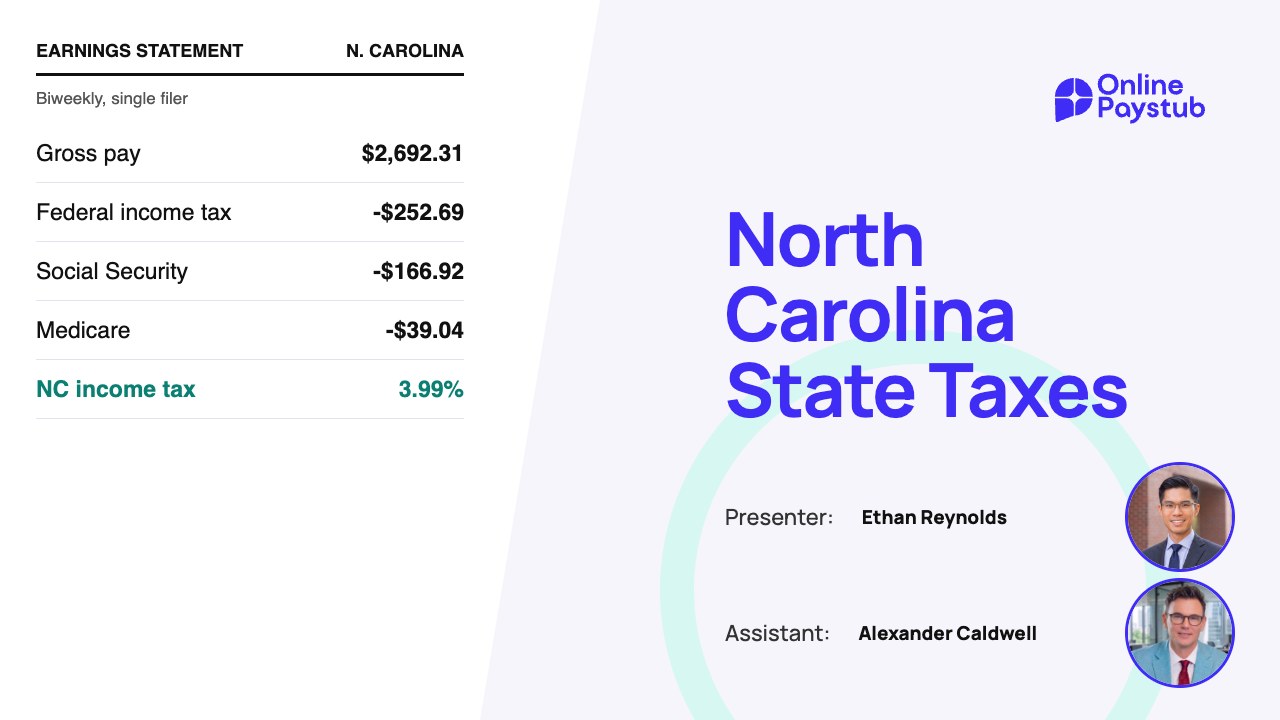

North Carolina has spent more than a decade cutting and simplifying its tax system. The state replaced its graduated income tax with a flat rate in 2014, repealed its estate tax and has lowered the flat rate in steps since then. For 2026 the rate is 3.99%. Another cut is already scheduled.
For employees, the flat rate directly affects take-home pay. The North Carolina paystub generator shows gross pay, state income tax withholding, federal deductions and net pay on one statement.
North Carolina Income Tax Rate (2026)
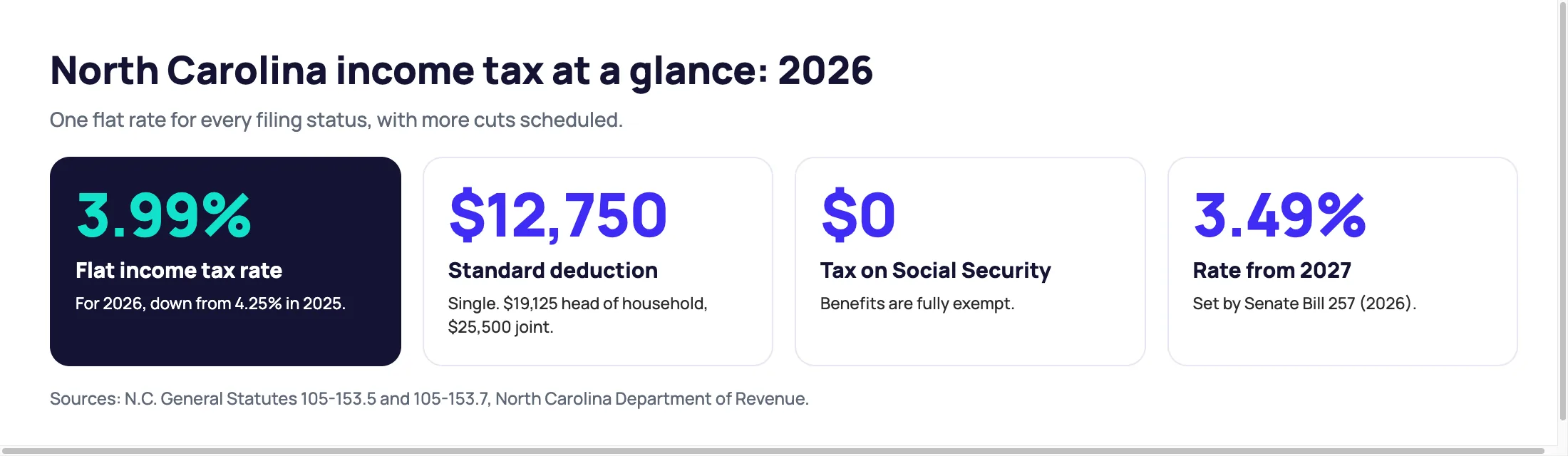
North Carolina taxes individual income at a flat rate of 3.99% for tax year 2026. Every filer pays the same percentage regardless of income: a single person earning $40,000 and a married couple earning $400,000 both pay 3.99% on their taxable income.
The rate is the result of a phased reduction plan written into state law:
| Tax year | Flat rate |
|---|---|
| 2024 | 4.50% |
| 2025 | 4.25% |
| 2026 | 3.99% |
| 2027 to 2029 | 3.49% |
| 2030 to 2032 | 3.24% |
| 2033 and later | 2.99% |
The rates from 2027 come from Senate Bill 257, signed in July 2026.
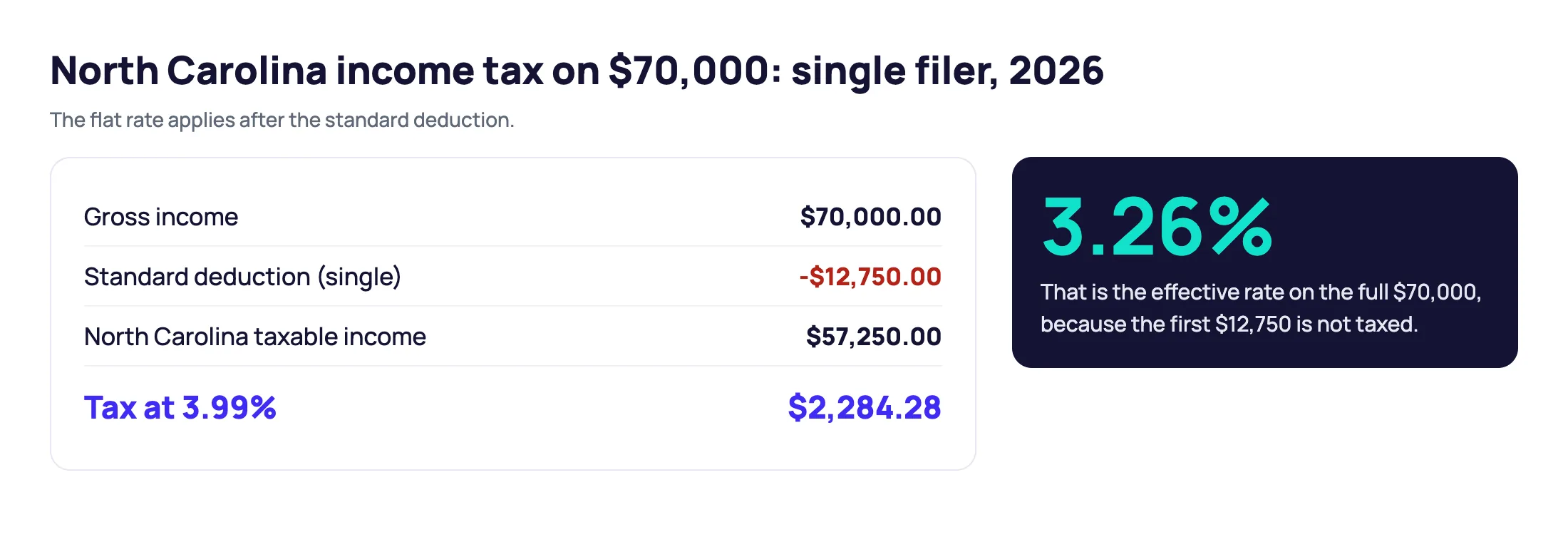
Example: a single filer earning $70,000
North Carolina ranks 13th overall on the 2026 State Tax Competitiveness Index published by the Tax Foundation. In fiscal year 2023 the state and its local governments raised 29.0% of their tax revenue from individual income taxes, 28.8% from general sales taxes and 22.3% from property taxes.
North Carolina Standard Deduction and Itemized Deductions
The North Carolina standard deduction is $12,750 for single filers, $19,125 for head of household and $25,500 for married couples filing jointly. There is no personal exemption for the filer, a spouse or dependents. Most people take the standard deduction.
If your deductible expenses are higher, you can itemize. North Carolina allows:
- Charitable contributions
- Mortgage interest and property taxes, capped at $20,000 combined
The list is short by design. It makes filing simpler but leaves fewer options for tax planning than states with longer lists of deductions.
Is Social Security Income Taxed in North Carolina?
No. North Carolina does not tax Social Security benefits, whatever your other income. The benefits are fully exempt from state income tax.
Federal tax can still apply. If your combined income (adjusted gross income plus tax-exempt interest plus half your Social Security benefits) is above $25,000 as a single filer or $32,000 as a married couple, part of your benefits becomes federally taxable. North Carolina adds nothing on top.
How North Carolina Taxes Retirement and Pension Income
Most retirement income is taxed at the flat 3.99% rate in 2026. That includes withdrawals from 401(k) plans and traditional IRAs as well as private pensions, regardless of your age or the size of the withdrawal.
There are two important exceptions:
- Government pensions under the Bailey settlement: retirees of North Carolina state and local government systems and some federal retirees can deduct their benefits if they had five or more years of service by August 12, 1989. The Department of Revenue explains who qualifies.
- Military retirement pay: retirees who served at least 20 years or who were medically retired can deduct their military retirement pay. Survivor Benefit Plan payments to a surviving spouse or former spouse can also qualify.
North Carolina Capital Gains Tax
North Carolina has no separate capital gains rate. Short-term and long-term gains are taxed as ordinary income at the flat 3.99% rate for 2026.
That differs from the federal system, where long-term gains on assets held more than a year are taxed at 0%, 15% or 20%. A North Carolina resident who sells an investment property at a $200,000 gain pays the federal capital gains rate plus $7,980 (3.99%) to North Carolina.
North Carolina Sales Tax (2026)
The state sales tax rate is 4.75%. Every county adds a local rate, so the combined rate runs from 6.75% to 8.25% depending on where you shop. The statewide average is about 7%.
| County | Combined rate |
|---|---|
| Alamance, Avery, Brunswick, Camden, Dare and others | 6.75% |
| Most counties, including Cabarrus and Chatham | 7.00% |
| Wake | 7.25% |
| Durham and Orange | 7.50% |
| Mecklenburg (from July 1, 2026) | 8.25% |
Key exemptions and special rates:
- Groceries: exempt from the 4.75% state rate but subject to a 2% local rate.
- Candy and soft drinks: taxed at the full rate.
- Prescription drugs: exempt. Over-the-counter medicine is taxed at the full rate.
- Prepared food: taxed at the full combined rate. A few places, including Mecklenburg, Wake, Dare and Cumberland counties, add a 1% meals tax.
North Carolina Property Tax (2026)
North Carolina's effective property tax rate is 0.66% of home value, according to the Tax Foundation. Rates vary widely by county because property tax is set and collected by counties and cities.
Counties also tax vehicles and business property such as equipment and machinery. Through the Tag and Tax Together program, the annual vehicle registration and the vehicle property tax are paid together to the Division of Motor Vehicles.
Property tax relief for older and disabled homeowners
North Carolina offers three programs. A homeowner can use only one at a time.
- Homestead exclusion: for homeowners 65 or older or totally and permanently disabled, with 2025 income of $38,800 or less. It excludes the greater of $25,000 or 50% of the home's appraised value.
- Circuit breaker deferral: for qualifying homeowners 65 or older or disabled. Property tax is limited to 4% of income for incomes up to $38,800 and to 5% for incomes up to $58,200. Tax above the limit is deferred. The deferred amount for the last three years plus interest becomes due when the home is sold or no longer the owner's residence.
- Disabled veteran exclusion: honorably discharged veterans with a total and permanent service-connected disability can exclude $45,000 of the home's value. Their unmarried surviving spouse can also qualify. There is no age or income limit.
Applications for 2026 were due by June 1, 2026.
North Carolina Gas Tax and Excise Taxes (2026)
Gas tax: the motor fuels tax is 41.0 cents per gallon for 2026, up from 40.3 cents in 2025. Diesel is taxed at the same rate. The fuel tax generally replaces sales tax on fuel.
Cigarette tax: $0.45 per pack of 20, well below most states. The federal cigarette tax adds about $1.01.
| Beverage | North Carolina excise tax |
|---|---|
| Beer | About $0.62 per gallon |
| Unfortified wine | About $0.26 per liter |
| Fortified wine | About $0.29 per liter |
| Liquor | 30% of the price, sold only in state-run ABC stores |
North Carolina runs a state-controlled liquor system: spirits are sold only through Alcoholic Beverage Control stores.
Unauthorized substances tax: North Carolina also taxes illegal drugs and untaxed liquor. Anyone who acquires them owes the tax within 48 hours. Few states have a tax like it.
North Carolina Estate and Inheritance Tax
North Carolina has no estate tax and no inheritance tax. The inheritance tax was repealed in 1999 and the estate tax for deaths on or after January 1, 2013. Heirs owe no North Carolina tax on what they inherit.
The federal estate tax applies only to estates above $15 million per person in 2026, so most North Carolina estates owe no estate tax at all.
Lottery winnings
Lottery winnings are taxed as ordinary income at the flat rate: 4.25% for 2025 and 3.99% for 2026. North Carolina withholds state tax at that rate on winnings of $600 or more. For federal tax, 24% is withheld on winnings above $5,000.
North Carolina Tax Filing Deadline and How to File
The 2025 North Carolina return was due April 15, 2026, the same day as the federal return. If you get an automatic federal extension, North Carolina automatically extends your filing deadline to October 15, 2026. Without a federal extension, you can request a North Carolina extension on Form D-410.
An extension to file is not an extension to pay. Tax owed must be paid by April 15 to avoid penalties and interest. Self-employed residents and others without enough withholding may also need to make estimated payments during the year.
You can check a refund with the Where's My Refund tool from the Department of Revenue, using your Social Security number and the exact refund amount.
If you run payroll for a small North Carolina business, you can create a paystub that shows state income tax on its own line next to federal tax and FICA. Use your real payroll figures.
This article reflects North Carolina law and Department of Revenue guidance as of October 2026, plus Tax Foundation data for rankings and averages. It is general information, not tax advice.
See North Carolina state tax withheld on a clear, itemized pay stub.
Create a Pay Stub Now