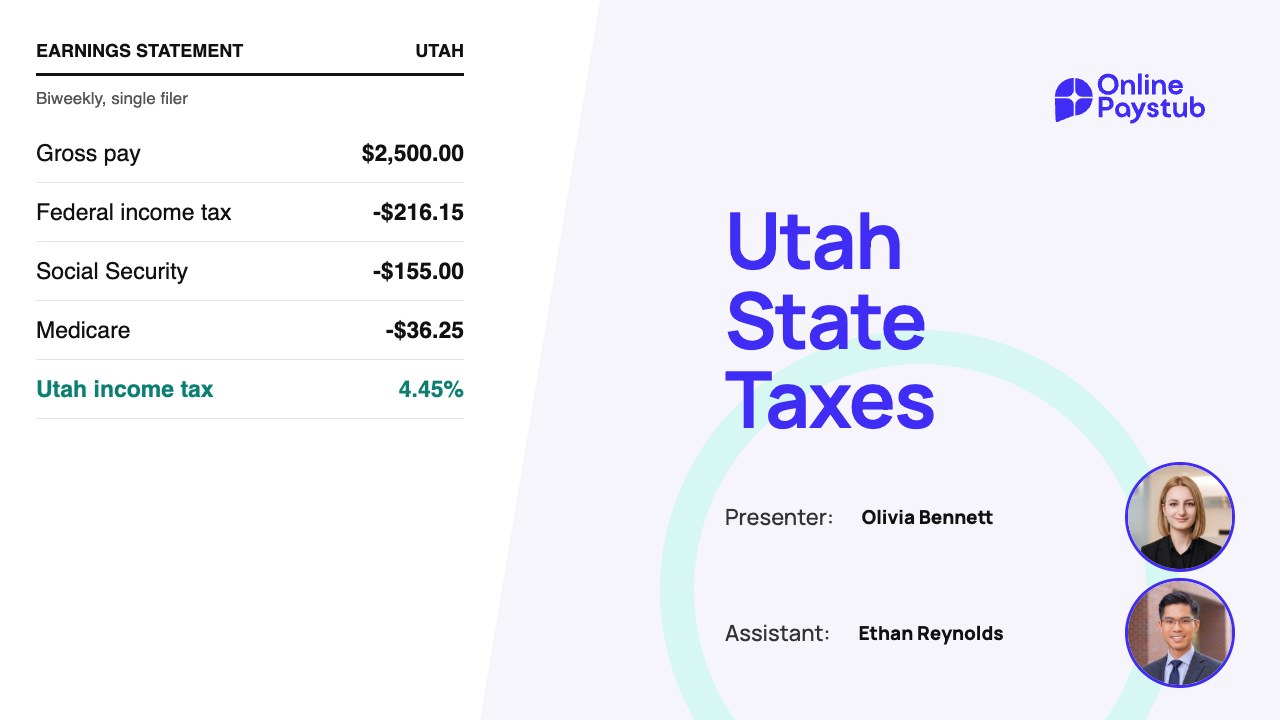

Utah runs one of the most straightforward tax systems in the country. A single flat income tax rate, a below-average property tax and a fully funded public pension system put Utah in a strong fiscal position. The state ranks 15th overall on the 2026 State Tax Competitiveness Index published by the Tax Foundation.
What makes Utah worth understanding in detail is not just the headline rate. It is the credit system, which lowers the tax for most filers and gives targeted relief to retirees, families and lower-income workers in ways the flat rate alone does not show.
Utah Income Tax Rate (2026)
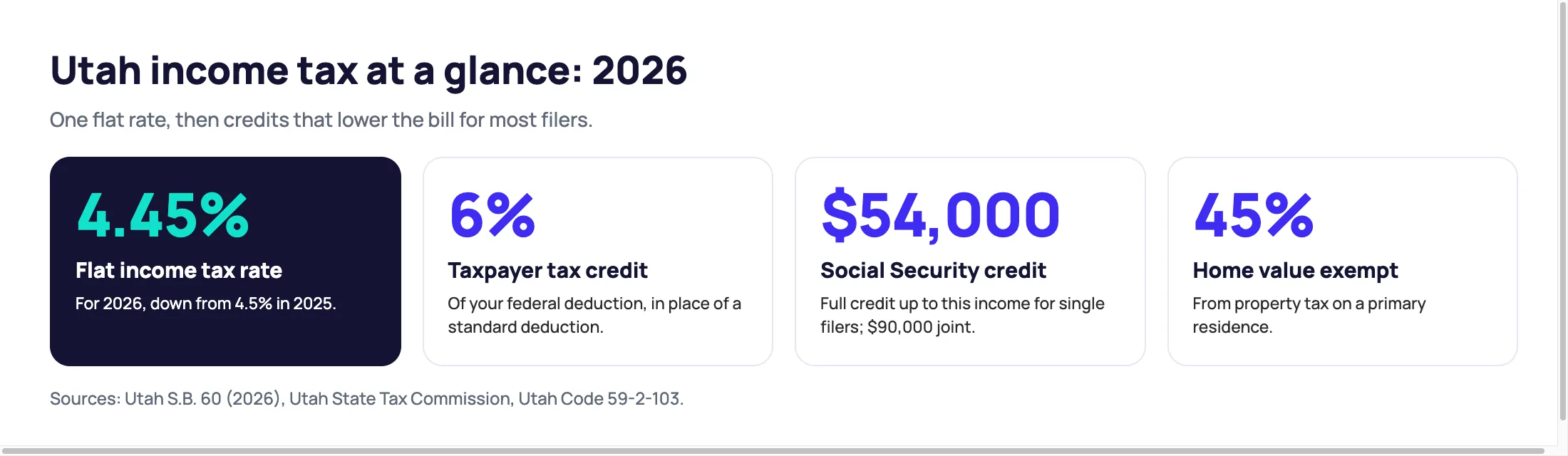
Utah taxes individual income at a flat rate of 4.45% for 2026, down from 4.5% in 2025. Every resident pays the same percentage regardless of income. The same rate applies to corporate income tax, keeping business and individual taxes aligned.
No standard deduction: the taxpayer tax credit
Utah does not have its own standard deduction. Your Utah taxable income starts from federal adjusted gross income, with Utah additions and subtractions. Utah then applies the flat rate and subtracts a taxpayer tax credit:
- The credit starts at 6% of your federal standard deduction (or itemized deductions) plus an amount for each dependent.
- It shrinks by 1.3% of income above a base amount. For 2025 the base was $18,213 for single filers, $27,320 for head of household and $36,426 for married couples filing jointly.
Example: a single filer with $65,000 of income
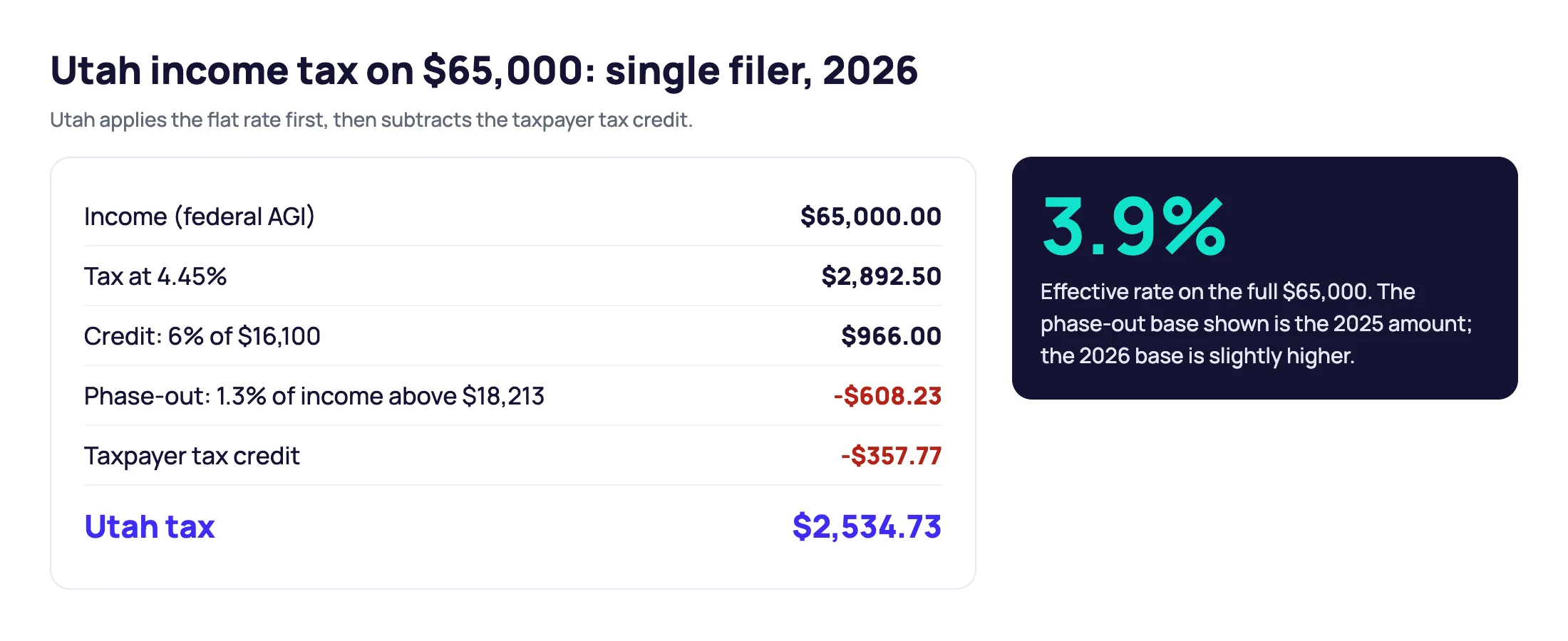
The tax is $65,000 × 4.45% = $2,892.50. The credit starts at $966 (6% of the $16,100 federal standard deduction). It is reduced by $608.23, which is 1.3% of the income above $18,213. That leaves a $357.77 credit and $2,534.73 of Utah tax, an effective rate of about 3.9%. The 2026 phase-out base will be slightly higher once the state publishes it, which lowers the tax by a few dollars.
On a Utah paystub, state withholding appears as its own line during the year. Your final Utah tax is settled on the return, where these credits apply.
Utah raises its state and local tax revenue from three main sources (fiscal year 2023, Tax Foundation): individual income taxes 30.5%, general sales taxes 29.9% and property taxes 23.0%. The state collects $6,239 in state and local tax per person and carries $7,036 in debt per person. Its public pension plans are 100% funded, a sign of long-term fiscal discipline.
Does Utah Tax Social Security Benefits?
Yes, but a credit removes or reduces the tax for most retirees. Social Security benefits included in your federal adjusted gross income are taxed at 4.45%. The Social Security benefits credit then offsets that tax in full at these income levels:
| Filing status | Full credit if modified income is |
|---|---|
| Single | $54,000 or less |
| Married filing separately | $45,000 or less |
| Married filing jointly | $90,000 or less |
| Head of household or qualifying surviving spouse | $90,000 or less |
Above those amounts the credit shrinks by 2.5 cents for every dollar of extra income until it is gone. For retirees with modest income, Social Security faces little or no Utah tax. You cannot claim both the Social Security credit and the retirement tax credit in the same year; you choose the one that saves more.
Utah Retirement and Pension Income Tax
Most retirement income received as a Utah resident is taxed at the flat 4.45% rate, including 401(k) and traditional IRA withdrawals, private pensions and annuities. Utah has no broad retirement income exclusion like Georgia's.
The main relief is the retirement tax credit for people born on or before December 31, 1952. It is worth up to $450 per person and shrinks by 2.5 cents per dollar of income above $25,000 for single filers, $32,000 for joint filers and heads of household and $16,000 for married filing separately. It cannot be combined with the Social Security credit or the military retirement credit.
Military retirement pay: Utah gives a credit equal to taxable military retirement pay times the tax rate, which removes the Utah tax on that income.
Utah Capital Gains Tax
Utah has no separate capital gains rate. Short-term and long-term gains included in federal adjusted gross income are taxed at 4.45%, the same as wages. A Utah resident who sells a rental property at a $150,000 gain owes the federal capital gains tax plus about $6,675 to Utah.
Utah Sales Tax (2026)
Utah's base sales tax rate is 6.10%: a 4.85% state rate plus a 1.25% local rate charged everywhere in the state. Cities and counties can add more, which brings the average combined rate to 7.19%, according to the Tax Foundation.
- Groceries: taxed at a reduced combined rate of 3% instead of the full rate.
- Prescription drugs and medical equipment: exempt.
- Alcohol: regular sales tax applies. Liquor and wine sold in state-run stores also carry a markup set by the Department of Alcoholic Beverage Services.
- No lottery: the Utah Constitution bans games of chance, so there is no state lottery.
Utah Property Tax (2026)
Utah has one of the lowest property tax rates in the country. The effective rate on owner-occupied homes is 0.48%, according to the Tax Foundation.
A large part of the reason is the primary residential exemption: 45% of a primary home's market value is exempt, so only 55% is taxed. Second homes are taxed on full value. On a $450,000 home, a 0.48% effective rate works out to about $2,160 a year; the same home in Texas, at a 1.40% effective rate, would cost about $6,300.
Utah Gas Tax, Cigarette Tax and Excise Taxes (2026)
Gas tax: Utah's gas tax was 37.9 cents per gallon from January 1, 2026. A 2026 law lowered it to 31.9 cents from July 1 through December 31, 2026. The federal gas tax adds 18.4 cents.
Cigarette tax: $1.70 per pack of 20. The federal tax adds about $1.01, for roughly $2.71 per pack before sales tax.
Alcohol: most liquor and wine is sold through state-controlled stores, so prices reflect both taxes and state markups.
Utah Estate and Inheritance Tax
Utah has no estate tax and no inheritance tax. The federal estate tax applies only to estates above $15 million per person in 2026, so most Utah families plan around federal rules alone, unlike in states such as Oregon or Massachusetts that tax estates of $1 million or $2 million.
Utah Tax Credits Worth Knowing
- Taxpayer tax credit: 6% of your federal deduction plus dependents, reduced as income rises.
- Social Security benefits credit: removes the tax on benefits below the income limits above.
- Retirement tax credit: up to $450 per person born on or before December 31, 1952.
- Military retirement credit: equal to the Utah tax on taxable military retirement pay.
- Health benefit plan credit: for people who buy their own health insurance and cannot get employer coverage; up to $300 single, $600 married and $900 with dependents.
- my529 credit: 4.45% of contributions to Utah's my529 college savings plan, up to $113.92 per beneficiary for single filers or $227.84 on a joint return in 2026.
- Utah child tax credit: $1,000 per qualifying child under age 6. A 2026 law raised the income levels where it starts to shrink to $49,000 for single filers and heads of household and $61,000 for joint filers.
- At-home parent credit: $100 per child 12 months old or younger, for families with federal income of $50,000 or less where the parent at home earned $3,000 or less.
- Utah earned income tax credit: 20% of the federal credit. It is nonrefundable, so it can reduce your Utah tax to zero but not below.
Utah Tax Filing Deadline and How to File
The 2025 Utah return was due April 15, 2026. Utah grants an automatic six-month extension to October 15, 2026 with no form to file. The extension only avoids penalties if you prepay at least 90% of this year's tax or 100% of last year's tax by April 15; otherwise a penalty of 2% per month applies.
Self-employed residents and others without enough withholding may need to make estimated payments during the year.
Short work trips into Utah: a nonresident who works in Utah for 20 days or fewer in a year, with no other Utah income, generally does not owe Utah tax if their home state offers the same treatment or has no income tax. Athletes, entertainers, construction workers and some key employees are excluded.
If you run payroll for a small Utah business, you can create a paystub that shows Utah withholding on its own line next to federal tax and FICA. Use your real payroll figures.
This article reflects Utah law and Utah State Tax Commission guidance as of October 2026, plus Tax Foundation data for rankings and averages. It is general information, not tax advice.
See Utah state tax withheld on a clear, itemized pay stub.
Create a Pay Stub Now