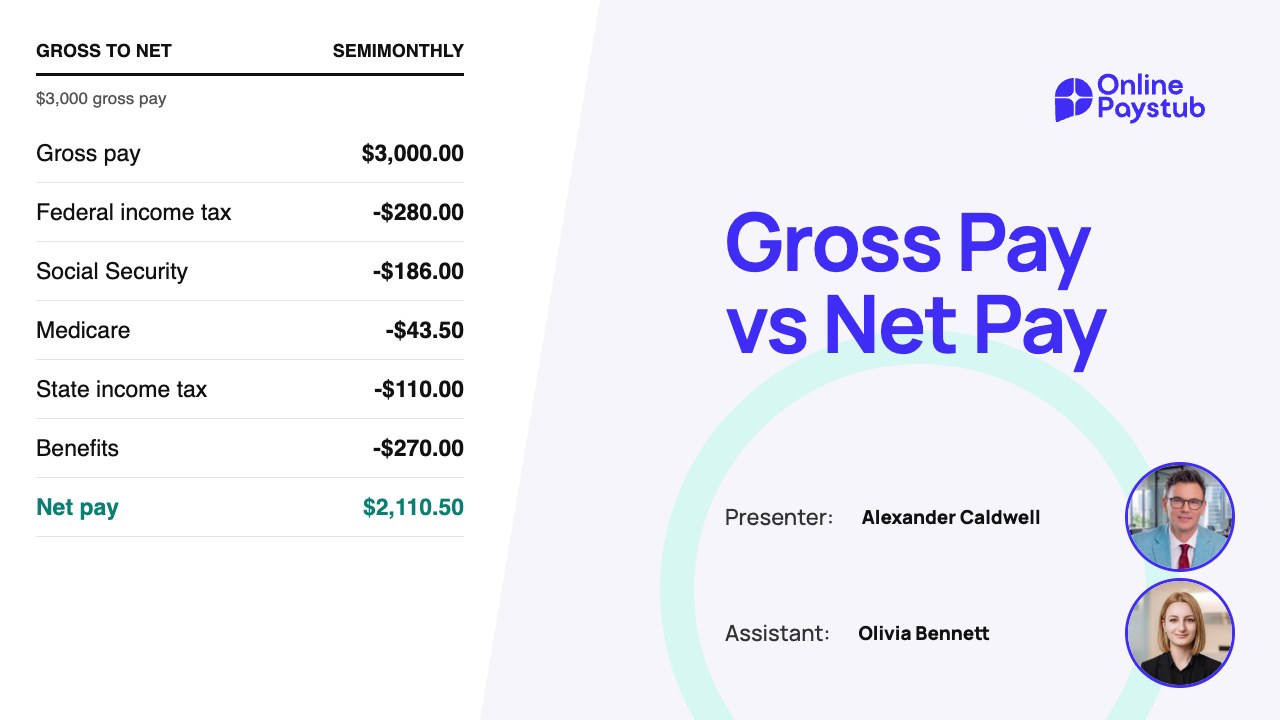

Gross pay is the total you earn before taxes and deductions, while net pay is the money you actually take home after them. If your paycheck shows $3,000 of gross pay and $650 of taxes and other deductions, your net pay is $2,350.
Knowing the difference between gross pay and net pay helps you read your paystub, estimate take-home pay, compare job offers and spot payroll errors.
The gap is rarely one tax percentage. Federal income tax, Social Security, Medicare, state income tax, health insurance and retirement contributions can all change the final amount.
What Is Gross Pay?
Gross pay is everything an employee earns in a pay period before taxes and employee deductions. For hourly workers it is hours worked times the hourly rate. Salaried employees receive a fixed amount based on their annual salary and pay frequency. Gross pay can include regular wages, overtime, bonuses, commissions and other taxable compensation.
How to Calculate Gross Pay for Hourly Employees
Gross Pay = Hours Worked × Hourly Rate
An employee working 40 hours at $25 an hour earns 40 × $25 = $1,000 of gross pay for the week. If overtime applies, calculate it separately and add it to regular earnings. Suppose the same employee works 45 hours and is owed time and a half:
| Earnings | Calculation | Amount |
|---|---|---|
| Regular wages | 40 × $25 | $1,000.00 |
| Overtime wages | 5 × $37.50 | $187.50 |
| Total gross pay | Regular + overtime | $1,187.50 |
The example assumes the employee is covered by overtime rules and qualifies for 1.5 times the regular rate.
How to Calculate Gross Pay for Salaried Employees
Gross Pay per Period = Annual Salary ÷ Pay Periods
For an employee earning $72,000 a year:
| Pay frequency | Pay periods | Gross pay per period |
|---|---|---|
| Weekly | 52 | $1,384.62 |
| Biweekly | 26 | $2,769.23 |
| Semimonthly | 24 | $3,000.00 |
| Monthly | 12 | $6,000.00 |
These figures assume a full year of regular salary payments with no adjustments.
What Is Net Pay?
Net pay is what the employee receives after taxes and deductions come out of gross earnings. It is also called take-home pay. For employees paid by direct deposit it is usually the amount that lands in the bank account.
Common deductions include federal income tax withholding, Social Security, Medicare, state and local income taxes, health insurance premiums, retirement contributions and other authorized payroll deductions. Not every deduction applies to every employee.
How to Calculate Net Pay
Net Pay = Gross Pay − Taxes − Employee Deductions
Nontaxable reimbursements paid through payroll outside gross wages are added back to the final payment. Suppose an employee earns $3,000 of gross pay in a semimonthly period:
| Paycheck item | Amount |
|---|---|
| Gross pay | $3,000.00 |
| Federal income tax withholding | $280.00 |
| Social Security | $186.00 |
| Medicare | $43.50 |
| State income tax withholding | $110.00 |
| Health insurance | $120.00 |
| Retirement contribution | $150.00 |
| Net pay | $2,110.50 |
Total deductions are $889.50, so $3,000 − $889.50 = $2,110.50. The federal and state withholding figures are illustrative; real withholding depends on the employee's situation, the tax rules and whether benefits come out before or after each tax.
Gross Pay vs Net Pay: Key Differences
| Feature | Gross pay | Net pay |
|---|---|---|
| Definition | Earnings before deductions | Amount after deductions |
| Taxes deducted | No | Yes |
| Employee benefits deducted | No | Generally yes |
| Overtime and bonuses | Included | Included after deductions |
| Best for | Comparing salaries | Budgeting take-home pay |
| On the paystub | Yes | Yes |
| Equals the bank deposit | Usually no | Generally yes |
Gross pay describes what you earned. Net pay describes what you receive. Gross pay is the number to use when comparing compensation packages; net pay is the one to use when planning monthly expenses.
What Deductions Affect Net Pay?
Some deductions are mandatory taxes. Others depend on benefit elections or legal orders.
Federal Income Tax Withholding
Federal income tax withholding is your employer's estimate of the federal income tax you owe, taken from each paycheck. It depends on taxable wages, pay frequency, filing status and your Form W-4. Unlike Social Security and Medicare, it has no single percentage that fits everyone; employers follow the IRS Publication 15-T methods.
Social Security Tax
For 2026 the employee Social Security rate is 6.2% on wages up to the $184,500 wage base. On $3,000 of Social Security wages that is $3,000 × 6.2% = $186, assuming the employee has not reached the wage base.
Medicare Tax
The regular employee Medicare rate is 1.45% with no wage limit: $3,000 × 1.45% = $43.50. An extra 0.9% Additional Medicare Tax is withheld on wages above $200,000 paid by one employer in the calendar year, as the IRS page on Social Security and Medicare withholding explains.
State and Local Income Taxes
State income tax withholding depends on where the employee lives or works. Some states do not tax wages at all, others use a flat rate or progressive brackets and some cities add a local income tax.
Health Insurance and Retirement Contributions
Employee contributions for health, dental and vision coverage and for retirement plans lower net pay. Some come out before certain taxes and others after. Traditional 401(k) contributions, for example, lower wages subject to federal income tax but not Social Security or Medicare wages. The tax treatment of health premiums depends on the plan.
Pre-Tax vs Post-Tax Deductions
Pre-tax deductions lower the wages subject to one or more taxes before those taxes are calculated. Post-tax deductions come out after.
| Deduction | Common tax treatment |
|---|---|
| Traditional 401(k) contribution | Before federal income tax, not before FICA |
| Qualifying Section 125 health premiums | Often before income tax and FICA |
| Roth 401(k) contribution | After federal income tax |
| Wage garnishment | Generally after tax |
| Certain voluntary benefit premiums | Depends on the plan |
The distinction matters because pre-tax deductions lower taxable wages and change the income tax withheld. Not every pre-tax deduction lowers every payroll tax, though.
How to Convert Gross Pay to Net Pay
- Calculate gross wages for the pay period, including overtime, commissions and bonuses.
- Identify pre-tax deductions and which taxable wage bases they reduce.
- Calculate federal income tax withholding with the IRS method.
- Calculate Social Security and Medicare on the right taxable wages.
- Apply state and local income tax withholding where required.
- Subtract post-tax deductions and add any reimbursements paid outside gross wages.
What remains is your estimated net pay.
Gross to Net Pay Example for a $60,000 Salary
An employee earning $60,000 a year on 26 biweekly paychecks has $60,000 ÷ 26 = $2,307.69 of gross pay per check. With these illustrative deductions:
| Item | Amount |
|---|---|
| Gross pay | $2,307.69 |
| Federal income tax | $180.00 |
| Social Security | $143.08 |
| Medicare | $33.46 |
| State income tax | $75.00 |
| Health insurance | $100.00 |
| Retirement contribution | $115.00 |
| Estimated net pay | $1,661.15 |
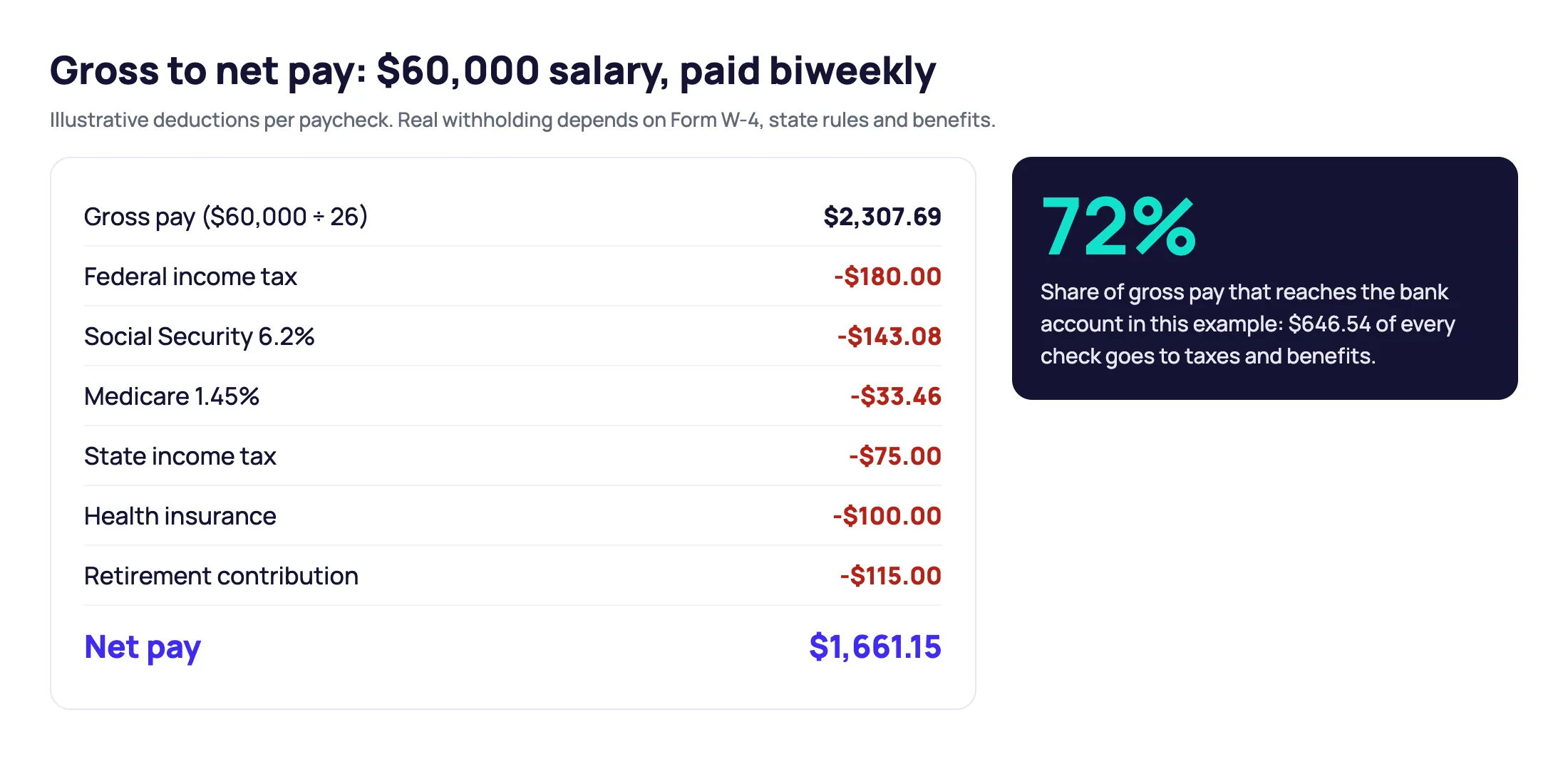
The withholding and benefit amounts are assumptions, not an individual tax estimate. Real results depend on Form W-4, state tax rules, benefit elections and filing status.
Gross Pay vs Net Pay on a Paystub
A paystub separates earnings from taxes and deductions. The earnings section shows regular wages, overtime, bonuses and total gross pay. The taxes and deductions section shows what was withheld for the period, often next to year-to-date totals. Net pay usually sits near the bottom and is the amount paid to the employee. Knowing what a pay stub looks like section by section makes the two numbers easy to find.
Why Is My Net Pay Lower Than Expected?
Net pay can change even when your salary does not. Updated withholding, benefit changes, retirement contribution changes, bonuses, unpaid time off or other deductions can all move it. A new Form W-4 changes federal withholding too. If a paycheck looks wrong, compare it with the previous stub and check each deduction.
Does Pay Frequency Affect Gross and Net Pay?
Weekly payroll means 52 paychecks a year, biweekly 26, semimonthly 24 and monthly 12. For a fixed salary, pay frequency changes the size of each paycheck rather than the annual salary. Withholding, benefit deduction timing and rounding can still make individual checks differ.
Frequency also affects when the money arrives. Bank holidays can delay processing, which is why people ask does Veterans Day affect direct deposit each November.
How Do Bonuses and Overtime Affect Net Pay?
Bonuses and overtime raise gross pay, but the extra take-home is smaller because of taxes and deductions. Employers can use special federal withholding methods for supplemental wages such as bonuses. Higher withholding on a bonus does not mean the bonus is taxed at that rate for good; your final tax is settled on the annual return.
Some overtime pay may qualify for a federal income tax deduction for 2026, but that deduction does not make overtime exempt from Social Security and Medicare.
Why Should Employers Track Gross and Net Pay?
Accurate gross and net pay keep payroll records straight, support tax forms and give employees clear earnings statements. The paystub should agree with payroll records, withholding calculations and the payment actually made. The IRS Publication 15 employer's tax guide covers the withholding and reporting side. To document a pay period, Online Paystub lays out earnings, taxes and deductions on one stub.
Employees should keep their payroll records too, including for checks they never cashed. Whether paychecks expire depends on the check, not on the wages owed.
Final Thoughts
Gross pay is total earnings before deductions; net pay is the money employees actually receive. Knowing the difference makes it easier to compare offers, estimate take-home pay, review deductions and catch payroll mistakes. For accurate records, both numbers should come from the correct wages, tax rules and deductions.
This article is general information about payroll, not tax advice. Payroll calculations depend on individual circumstances and current tax law.
See gross pay, every deduction and net pay on one clear, itemized pay stub.
Create a Pay Stub Now