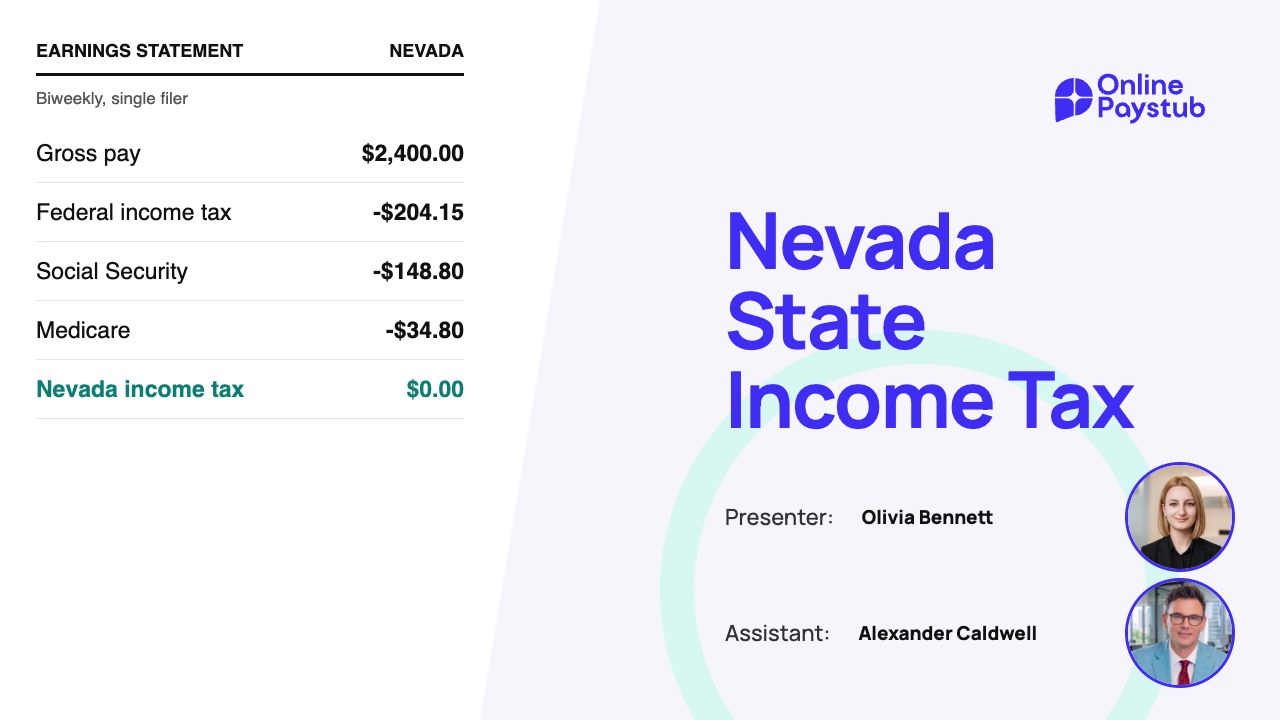

Nevada collects no personal income tax. That single fact drives more relocation decisions, retirement plans and business conversations about the Silver State than any other. But zero income tax does not tell the whole story. Nevada funds its government through sales taxes, excise taxes, a gross receipts tax on larger businesses and a gaming and hotel tax base that most other states do not have. Here is a clear breakdown of what you actually pay living in Nevada in 2026.
Does Nevada Have a State Income Tax?
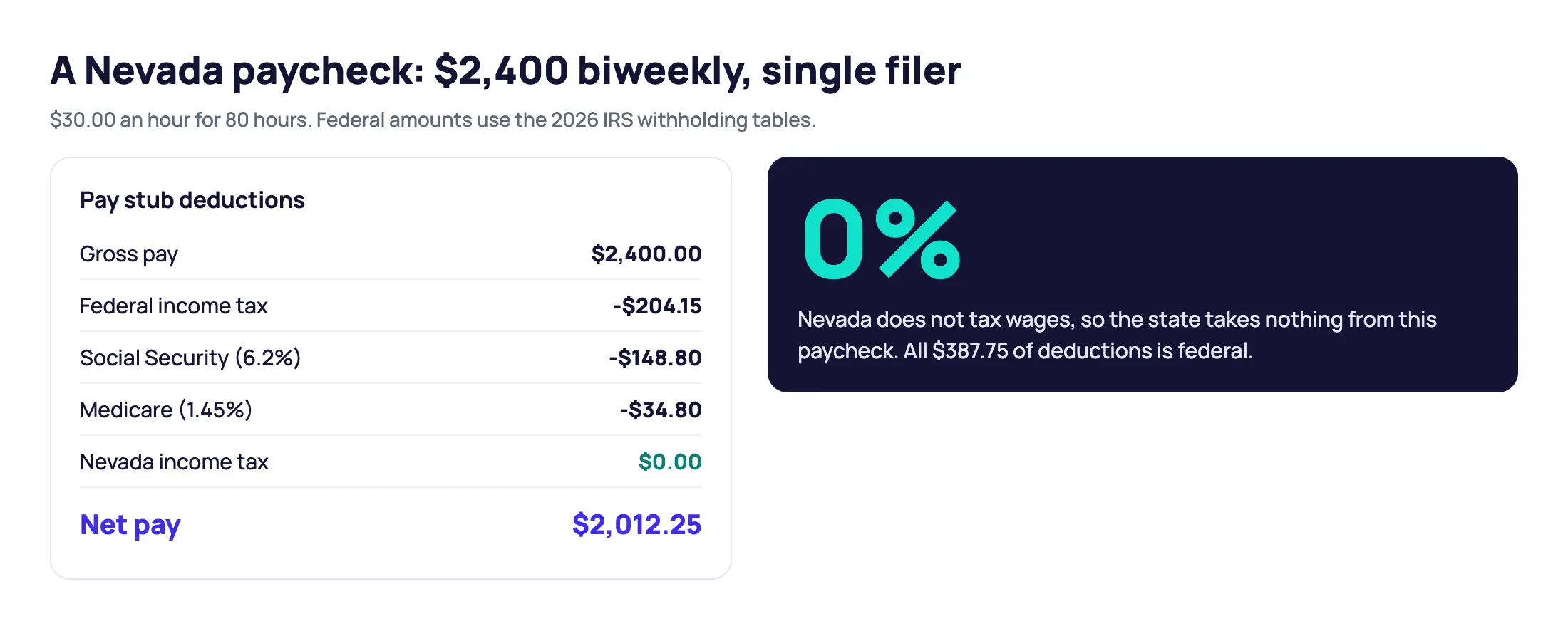
No. Nevada does not impose a personal income tax of any kind. Wages, salaries, freelance income, investment earnings, capital gains, retirement distributions and gambling winnings are all free from state income tax. Employees reviewing a Nevada paystub still see federal tax deductions, but no Nevada state income tax line. Nevada is one of nine states that do not tax wages, alongside Alaska, Florida, New Hampshire, South Dakota, Tennessee, Texas, Washington and Wyoming.
This protection runs deep. Article 10 of the Nevada Constitution says no income tax shall be levied upon the wages or personal income of natural persons. Changing that would take a constitutional amendment, which gives residents and businesses a high degree of long-term certainty. Someone earning $150,000 who moves from California, where the top marginal rate reaches 13.3%, can save $10,000 or more a year in state income tax depending on deductions and filing status.
Example: a $2,400 biweekly paycheck in Las Vegas
A single worker earns $30 an hour for 80 hours every two weeks, with a standard Form W-4.
The trade-off is real, though. Nevada leans hard on sales taxes, excise taxes and gaming revenue to pay for state services. Understanding those costs matters before concluding that Nevada is simply a low-tax state.
Nevada Sales Tax (2026)
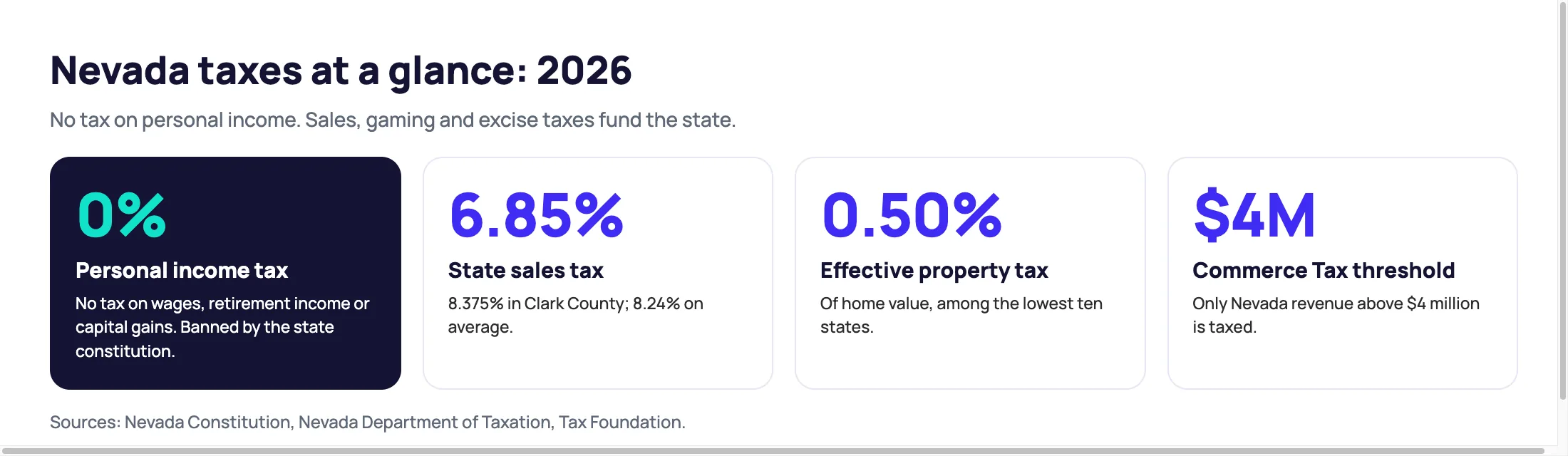
Nevada's statewide sales tax rate is 6.85%. Counties add their own rates on top, which brings the average combined state and local rate to 8.24%. Esmeralda, Eureka and Mineral counties charge only the 6.85% base rate. Clark County is the highest at 8.375%.
| County | Combined sales tax rate |
|---|---|
| Clark County (Las Vegas) | 8.375% |
| Washoe County (Reno) | 8.265% |
| Churchill County | 7.6% |
| Douglas County | 7.1% |
| Lyon County | 7.1% |
| Esmeralda, Eureka and Mineral counties | 6.85% |
Most goods are taxable. Groceries bought for home use, prescription drugs, prosthetic devices and other durable medical equipment are exempt, along with newspapers. Restaurant meals and other prepared food are taxable. Since January 1, 2025, diapers for children and adults have also been exempt.
Nevada Property Tax (2026)
Nevada has one of the lowest property tax rates in the country. The effective rate on owner-occupied homes is about 0.50%, according to the Tax Foundation, which places Nevada among the lowest ten states.
Rates depend on where you live, but Nevada also limits how fast your tax bill can grow. The annual increase in the property tax on a primary residence is capped at 3%. Rentals, commercial property and land can rise up to 8% a year. That protects long-term homeowners from sudden jumps when home values rise quickly.
For comparison, a $400,000 home in Nevada at a 0.50% effective rate costs about $2,000 a year in property tax. The same home in Texas, at a 1.40% effective rate, would cost about $5,600. Low property tax is one of the clearest advantages Nevada has over other no-income-tax states.
Are Social Security and Retirement Income Taxed in Nevada?
No. Because there is no personal income tax, Social Security benefits, pensions, 401(k) and IRA withdrawals, military retirement pay and every other kind of retirement income are free from Nevada tax. A retiree drawing $80,000 a year from Social Security and IRA withdrawals owes Nevada nothing in income tax.
That makes Nevada one of the most retirement-friendly states from a tax point of view. Federal income tax still applies to retirement income based on your total income, but Nevada adds nothing on top.
Are Capital Gains Taxed in Nevada?
No. Short-term and long-term capital gains are not taxed by Nevada. Profits from selling stocks, real estate or a business are exempt at the state level. Nevada has no investment income surtax either.
Federal tax still applies. Long-term capital gains are taxed federally at 0%, 15% or 20% depending on total taxable income. For investors and business owners planning a large sale, paying only the federal portion is a meaningful consideration.
Nevada Business Taxes: Commerce Tax and Modified Business Tax
Nevada has no traditional corporate income tax. Larger businesses pay the Commerce Tax, a tax on gross revenue rather than profit. Only Nevada gross revenue above $4 million a year is taxed; businesses below that amount owe nothing. Rates range from 0.051% to 0.331% depending on the industry.
Employers also pay the Modified Business Tax, a payroll tax on wages. Most businesses pay 1.17% of quarterly wages above $50,000. Financial institutions and mining companies pay 1.554%. Mining companies also pay a separate tax on net proceeds. The Modified Business Tax is an employer cost; it is not deducted from employee paychecks.
Together these taxes are lighter than corporate income taxes in most states, which is part of why Nevada attracts so many business incorporations relative to its population.
Nevada Gas Tax (2026)
Nevada's statewide gas tax is about 23.8 cents per gallon of gasoline. Counties can add local fuel taxes on top, which can raise the total considerably depending on where you live and drive. The federal gas tax adds 18.4 cents per gallon.
For a driver covering 15,000 miles a year in a car that averages 25 miles per gallon, the state gas tax alone comes to about $143 a year. That is modest next to the income tax savings, but it grows with how much you drive.
Nevada Excise Taxes on Cigarettes and Alcohol (2026)
Nevada's cigarette tax is $1.80 per pack of 20. Adding the federal cigarette tax of about $1.01 brings the total to roughly $2.81 per pack before sales tax.
| Beverage | Nevada excise tax |
|---|---|
| Beer | $0.16 per gallon |
| Wine up to 14% alcohol | $0.70 per gallon |
| Wine and other drinks from 14% to 22% alcohol | $1.30 per gallon |
| Liquor above 22% alcohol | $3.60 per gallon |
These taxes are collected at the wholesale level and built into retail prices; sales tax applies on top. Nevada also raises large sums from gaming taxes and hotel room taxes, which shifts part of its tax burden onto visitors rather than residents. That tourism-driven model sets Nevada apart from every other state without an income tax.
Nevada Estate and Inheritance Tax (2026)
Nevada has no estate tax and no inheritance tax. Its estate tax was tied to a federal credit that ended in 2005, so it has not applied to anyone who died on or after January 1, 2005, according to the Nevada Department of Taxation. Heirs owe no Nevada tax on cash, real estate, investments or business interests they inherit.
The federal estate tax applies only to estates above $15 million per person in 2026. For people with very large estates, Nevada residence removes a layer of tax that would apply in states such as Oregon (from $1 million) or Massachusetts (from $2 million).
Nevada's Overall Tax Ranking and Revenue Structure
Nevada ranks 20th overall on the 2026 State Tax Competitiveness Index published by the Tax Foundation. A top score for having no income tax is offset by weaker scores for sales and property taxes.
Nevada raises its state and local tax revenue from three main sources (fiscal year 2023, Tax Foundation):
| Revenue source | Share of total |
|---|---|
| General sales taxes | 45.3% |
| Other taxes (gaming, excise and more) | 32.6% |
| Property taxes | 22.1% |
Nevada collects $6,365 in state and local tax per person and carries $7,055 in debt per person. Its public pension plans are 86% funded.
Relying on sales tax for 45.3% of revenue is one of the highest shares in the country. Together with gaming revenue, that leaves Nevada's budget exposed to swings in consumer spending and tourism. During recessions its revenue can fall sharply, which is worth knowing if you are weighing Nevada for the long term.
Federal Income Tax Still Applies to Nevada Residents
Living in Nevada removes state income tax but does not change federal taxes. Most Nevada residents still file a federal return and pay federal income tax on wages, investment income and retirement distributions. For 2026 the federal brackets run from 10% on the first $12,400 of taxable income for a single filer to 37% above $640,600. The standard deduction is $16,100. Social Security (6.2%) and Medicare (1.45%) apply to earned income in every state.
The One Big Beautiful Bill Act also raised the federal cap on the state and local tax (SALT) deduction from $10,000 to $40,000 for 2025 and $40,400 for 2026, with a reduction for incomes above $500,000. Nevada residents who itemize can now deduct more of the sales tax and property tax they pay, which matters in a state that raises so much of its revenue from sales tax.
If you are self-employed or run payroll for a small Nevada business, you can create a paystub that itemizes federal tax and FICA with no state line. Use your real payroll figures.
This article is general information, not tax advice. Rates change; check the Nevada Department of Taxation and the IRS for current figures.
See a Nevada pay stub with federal tax and FICA itemized and no state line.
Create a Pay Stub Now