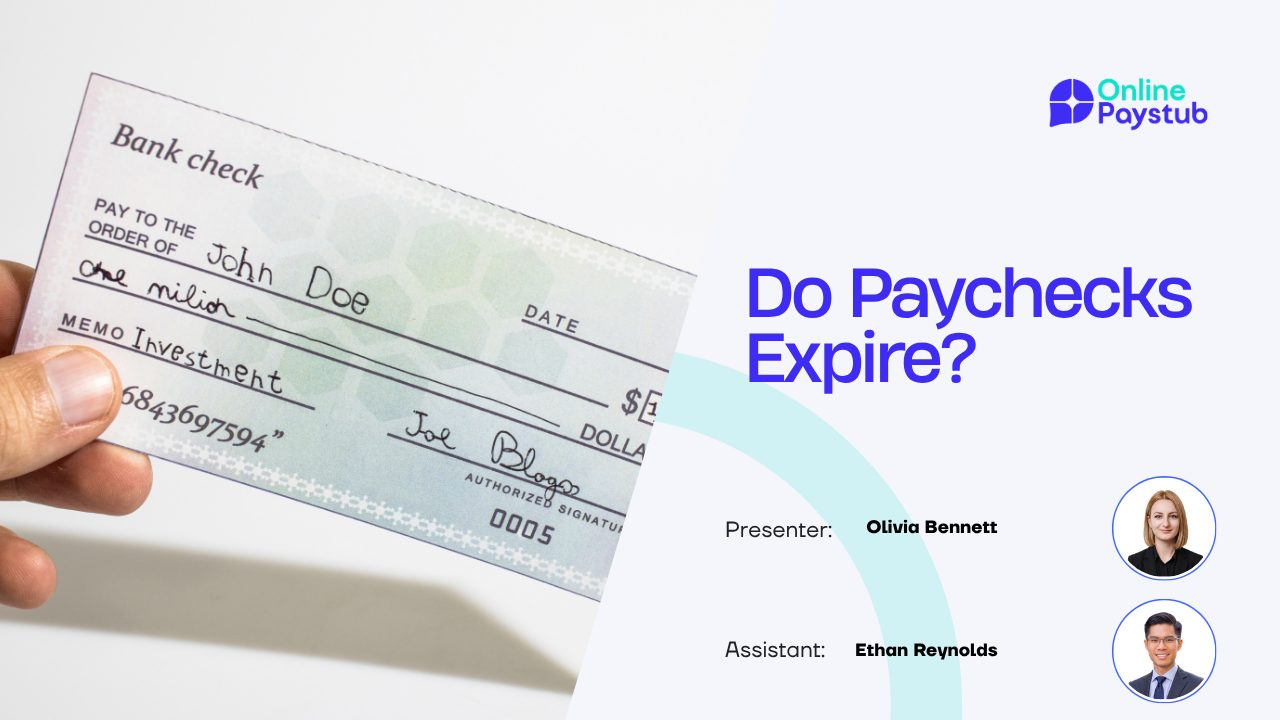

You clean out a coat pocket or an old file box and there it is: a payroll check from a job you left two years ago, never cashed, still in its envelope. The first question is always the same. Is this thing still good or did you just find a very expensive piece of scrap paper?
The short version is reassuring. Paychecks do not expire in the way that milk expires. What actually happens is narrower and more technical: after a certain point a bank is no longer required to cash the check and most banks will refuse it. That is very different from the money disappearing. The wages you earned are still owed to you and there is a well worn process for getting them.
Below: the six month rule, what "void after 90 days" really means, how the rules change for cashier's checks and government checks, where the money goes if nobody claims it and exactly what to do when you find an old paycheck.
The Core Answer: Six Months Is a Bank Rule, Not an Expiration Date
Under Article 4 of the Uniform Commercial Code, which every US state has adopted in some form, a bank is not obligated to pay a check that is presented more than six months after the date written on it. Six months is roughly 180 days and a check past that point is called "stale-dated." The exact wording matters: the bank has no obligation to pay. It is not forbidden from paying.
That distinction explains most of the confusion here. The same UCC provision says a bank may still charge its customer's account for a stale check if it pays in good faith. So a nine month old paycheck might sail through automated processing or a teller might refuse it on the spot. Both outcomes are legal and neither tells you anything about whether you are still owed the money.
In practice, banks handle stale checks inconsistently. Mobile deposit apps often do not check dates at all on smaller amounts, which is why some people successfully deposit year old checks. But it is a gamble: if the account was closed, if the employer placed a stop payment or if the funds were already turned over to the state, the item bounces back weeks later and your own bank may charge you a returned item fee.
What "Void After 90 Days" Actually Means
Many payroll checks carry a printed legend near the signature line: "Void after 90 days," "Void after 180 days," or "Not valid after 60 days." Employers add this deliberately. It shortens the window during which the check can clear, which makes bank reconciliation cleaner and reduces the risk of an old check surprising the account months later. Banks generally do honor the restriction, so a "void after 90 days" payroll check is realistically dead at your bank on day 91.
What that language does not do is cancel your wages. A printed void date limits the life of the payment instrument only. No employer can shorten its duty to pay earned wages by printing a deadline on a piece of paper and state wage payment laws generally do not allow wages to be forfeited that way. If a check goes void under its own terms, the correct response is a reissue.
Validity Periods by Check Type
Not every check follows the six month convention. Certified and cashier's checks sit in a different category because a bank stands behind them and government checks have their own statutory rules.
| Instrument | Typical validity | What happens after |
|---|---|---|
| Personal check | Banks not obligated after 6 months | Stale-dated; bank may still pay at its discretion |
| Payroll check | 6 months by default, often 90 days if printed on the check | Ask the employer for a reissue |
| Certified check | Does not go stale under the six month rule | Funds stay set aside; contact the issuing bank |
| Cashier's check | Generally no fixed expiration, some carry a 90 day legend | Bank obligation remains; may escheat if unclaimed |
| Money order (USPS) | Does not expire | Cashable indefinitely, no fee for age |
| Money order (private issuer) | Cashable but service fees may start after 1 to 3 years | Value erodes through monthly fees |
| US Treasury check | Void 1 year after the issue date | Request a replacement from the issuing federal agency |
| State-issued check | Varies by state, commonly 6 months to 1 year | Contact the issuing state agency for reissue |
Two entries deserve a note. A cashier's check is a bank obligation, so the money generally remains payable years later, though the bank may require an indemnity form. A US Treasury check, including a federal tax refund, is legally void one year after its issue date, but the government will reissue it: contact the IRS for a refund check or the agency that sent any other payment.
The Check Is Not the Debt
This is the idea people most often get wrong. A check is an instrument of payment, a set of instructions to a bank. It is not the debt itself. When your employer hands you a paycheck, the wage obligation is not extinguished until the check is actually paid.
So if the check goes stale, bounces or gets lost in a move, the employer still owes you the wages. The instrument failed; the obligation did not. That is why "sorry, that check expired" is not a legitimate answer from a payroll department. The correct answer is "we will void that one and cut you a new check."
One practical limit: every state has a statute of limitations for wage claims and for actions on a written instrument and those periods vary considerably by state. Waiting five years to raise the issue is riskier than raising it next Monday. If an employer refuses outright, your state labor department is the place to ask about your options.
Unclaimed Property: Where Old Paychecks Actually Go
Employers are not allowed to quietly pocket the value of uncashed payroll checks. Every state has unclaimed property laws, also called escheatment laws, requiring a business holding money that belongs to someone else to turn it over to the state after a dormancy period.
Unpaid wages are one of the most commonly escheated property types. Dormancy periods vary by state and many states use a shorter period for payroll than for other property, often around one year, while others use two or three. The employer is supposed to attempt due diligence contact first, usually by mail to your last known address, which is why a stale address after a move is such a common cause of lost paychecks.
How to search for your money
- Start with your state treasurer or comptroller unclaimed property site, searching every state where you have lived or worked.
- Use MissingMoney.com, run by the National Association of Unclaimed Property Administrators, which searches most participating states in one query.
- Search maiden names, former legal names, middle initial variations and common misspellings of your name.
- Search old addresses too, since records are often indexed by the address on file at the time.
- Never pay a finder service an upfront fee for something you can claim yourself for free through the state.
State claims are usually free and there is generally no deadline to claim escheated property, though you will need identity documents and often proof of your connection to the reported address or employer.
Exactly What to Do When You Find an Old Paycheck
Resist the urge to just walk it into a bank branch and hope. Work through the check's age first, then act accordingly.
| Age of the check | What to do | What to expect |
|---|---|---|
| Under 60 days | Deposit or cash it normally | Should clear without any issue |
| 60 to 90 days | Check the front for a void legend, then deposit | Usually fine unless a 60 day legend applies |
| 90 days to 6 months | Call payroll before depositing | May clear, but a stop payment may already exist |
| 6 months to 1 year | Do not deposit; request a reissue | Employer voids the original and cuts a new check |
| Over 1 year | Ask payroll, then search state unclaimed property | Funds may already have been turned over to the state |
| Employer out of business | Search unclaimed property; ask the state labor department | Claim through the state rather than the company |
Contacting the payroll department
Reach out in writing when you can, so there is a record. Give your full name as it appeared in payroll, your employee ID, the check number, the check date and the net amount. Say clearly that the check was never cashed and that you are requesting a reissue. Your pay stub has most of these details in one place:
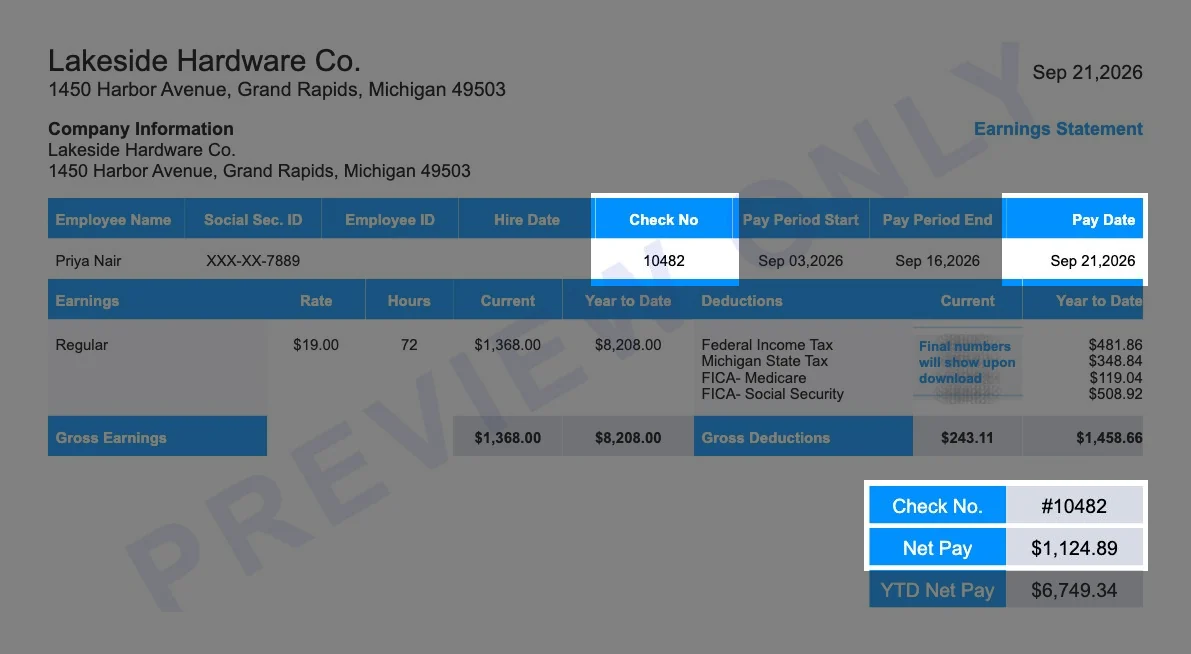
With those in hand, payroll can match the original check quickly. Ask them to confirm whether the funds were already remitted to the state as unclaimed property, because that changes where you file.
Expect a stop payment on the original
Before issuing a replacement, a careful employer will place a stop payment order on the original so it cannot be cashed twice and some ask you to sign an affidavit confirming the original is lost or uncashed. This is normal. Once a stop payment is in place, destroy the old check and never try to deposit it after a replacement arrives.
What Employers Need to Know
From the employer side, an outstanding payroll check is a liability that does not go away on its own. The payroll taxes were already withheld and deposited, the wages were already reported on the employee's Form W-2 and the net amount is money the company is holding on behalf of a worker.
- Reconcile the payroll bank account monthly and produce an outstanding check list so stale items surface early.
- Attempt due diligence contact at the last known address before the state dormancy period runs out.
- Never book an uncashed paycheck back into income; that is exactly what unclaimed property audits look for.
- Report and remit unclaimed wages to the correct state, which is generally the state of the employee's last known address.
- Keep payroll records for at least the periods required under federal and state law, commonly three years for payroll records and two years for the supporting time and earnings records.
- Reissue promptly when a former employee comes forward and stop payment on the original first.
Reissuing a net check normally does not change the tax year or the W-2, because the wages were reported when they were paid. Payroll software handles it as a void and reissue rather than as new earnings. Cases that cross tax years are worth running past your accountant.
How to Stop This From Happening Again
The most effective fix is direct deposit. Electronic payment removes the paper entirely, so there is nothing to misplace, nothing to go stale and nothing to escheat. Deposits land on payday even if you are traveling, on leave or between addresses.
- Enroll in direct deposit and confirm the routing and account numbers on your first electronic pay date. Without a bank account, a payroll card is another electronic option.
- Update your mailing address with payroll before you move and again after you leave a job, since final checks and tax documents follow that address.
- Ask specifically about the final paycheck when you resign or are let go, since timing rules for final wages vary by state.
- Download your pay stubs and year-end documents before your employee portal access is switched off. If a W-2 from a job you left never arrives, you can still get your W-2 from a previous employer.
- Reconcile each pay date against your bank account so a missing payment is caught in days, not years.
Keep the Pay Stub, Even After the Check Clears
A cashed check proves that money moved. It does not prove what the money was for. The pay stub is the actual record of the earnings: the pay period, gross wages, hours and rate, federal and state withholding, Social Security and Medicare and every deduction taken. That breakdown is what lenders, landlords and agencies ask to see.
Keep stubs at least until you have reconciled them against the Form W-2 for that year and longer if you are applying for a mortgage, an apartment, an auto loan or income based assistance, all of which commonly ask for recent pay history. If you run a small business and need to produce clean, consistent stubs for the people you pay, a pay stub generator handles the calculations and formatting so the record matches what actually hit the bank.
One last habit: when a replacement check is issued for a stale one, keep the paperwork for both. The void notice, the reissue confirmation and the matching stub together tell the whole story if anyone ever questions whether that pay period was settled.
Keep a clear record of every paycheck, including check numbers and pay dates, with a professional pay stub.
Create a Pay Stub Now