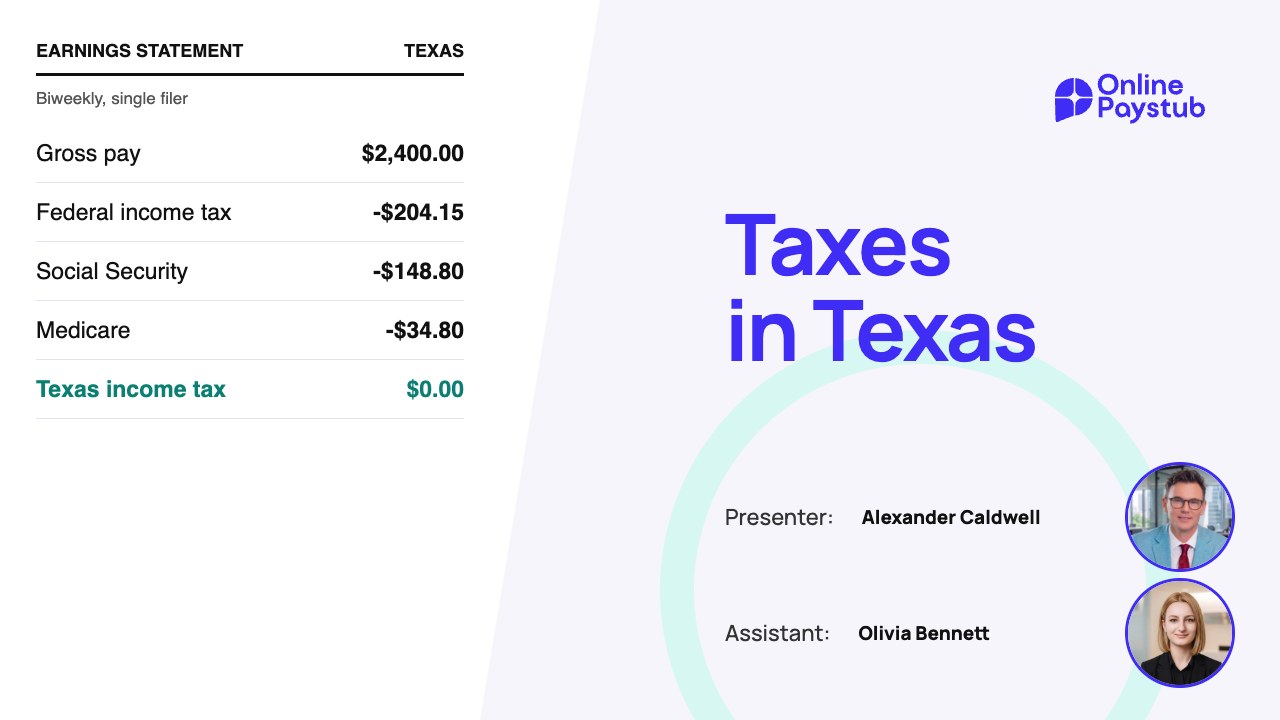

Texas has no personal income tax and that single fact shapes every conversation about money, relocation and retirement in the Lone Star State. But zero income tax does not mean zero tax burden. Texas funds its government through property taxes, sales taxes and a handful of excise taxes. Those costs add up fast. Before you call Texas a tax paradise, it is worth understanding the full picture of what you actually owe.
Texas Tax Rankings and Revenue Breakdown (2026)
Texas ranks 7th overall on the 2026 State Tax Competitiveness Index published by the Tax Foundation. That strong showing comes mostly from the absence of a personal income tax and a competitive business tax structure.
Texas raises its state and local tax revenue through three main channels (fiscal year 2023, Tax Foundation):
| Revenue source | Share of total |
|---|---|
| Property taxes | 40.7% |
| General sales taxes | 37.7% |
| Other taxes (excise, fees, licenses) | 21.6% |
Texas collects $5,737 in state and local tax per person. It also carries $12,170 in state and local debt per person, one of the higher figures in the country. Its public pension plans are 82% funded.
The revenue mix tells an important story. With no income tax, Texas relies on property and sales taxes to pay for schools, roads and emergency services. That shift is not neutral: it affects homeowners, renters and shoppers differently than an income tax would.
Does Texas Have a State Income Tax?
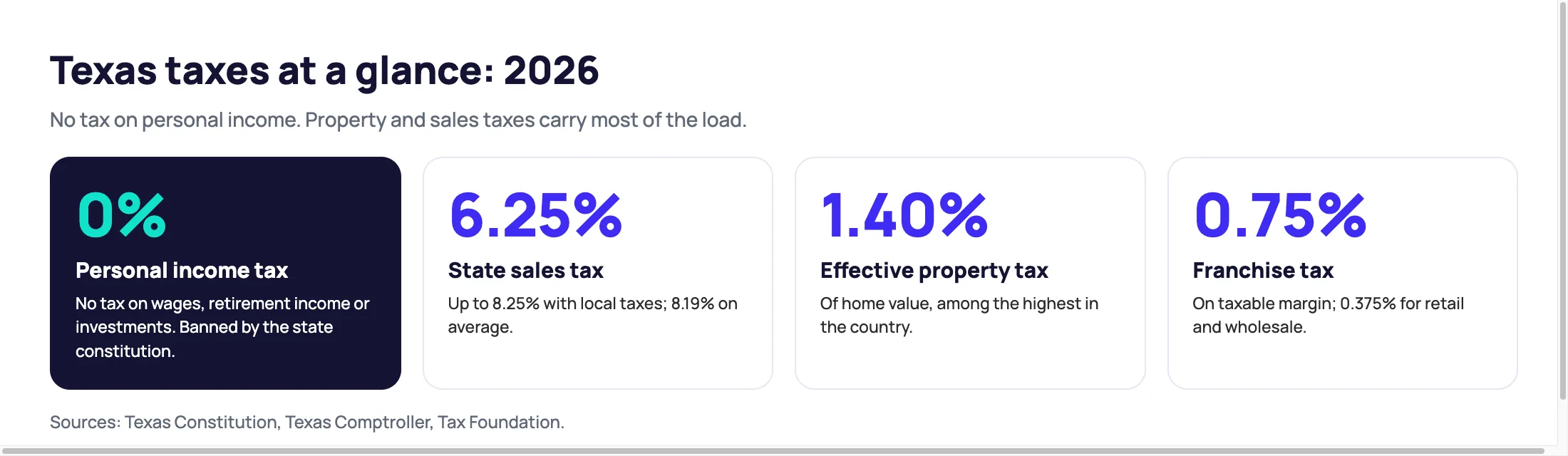
No. Texas does not impose a personal income tax on individuals. It is one of nine states that do not tax wages, alongside Alaska, Florida, Nevada, New Hampshire, South Dakota, Tennessee, Washington and Wyoming.
For Texas residents this means no state tax withholding on your paycheck, no state income tax return and no state tax on wages, salaries, freelance income, retirement distributions, Social Security benefits, capital gains, dividends or interest. When reviewing a Texas paystub, employees still see federal income tax, Social Security and Medicare deductions, but no Texas state income tax line.
This is not a policy that can change overnight. Article 8, Section 24-a of the Texas Constitution, added by voters in 2019, bans a tax on the net incomes of individuals. Lifting the ban would take a constitutional amendment: a two-thirds vote in both chambers of the Legislature plus approval by voters.
Example: a $2,400 biweekly paycheck in Houston
A single worker earns $30 an hour for 80 hours every two weeks, with a standard Form W-4.
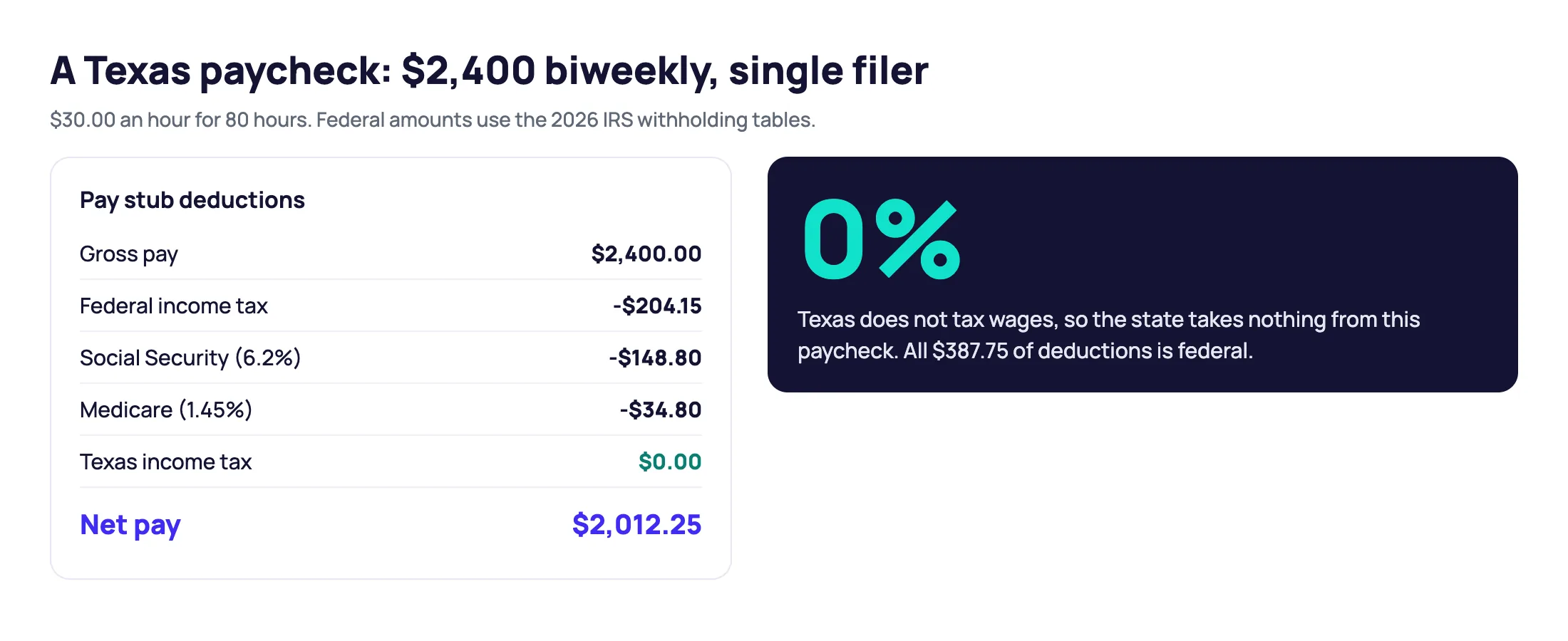
The same paycheck in a state with an income tax would lose more. Our guide to Florida state income tax shows how another no-tax state handles payroll. The California comparison there shows what a state income tax adds.
What this means for specific income types
Retirement and pension income, 401(k) and IRA distributions, Social Security benefits and military pay are all free of Texas income tax because there is no state income tax to begin with. Investment earnings and capital gains face no state tax either. For retirees and investors that is a real advantage over a state like California, where the top marginal rate reaches 13.3%.
Community property rules for married couples
Texas is a community property state. This affects how married couples report income on their federal returns when they file separately: community income must generally be split equally between the spouses. IRS Publication 555 explains the rules, which are worth reviewing with a tax professional before choosing married filing separately.
Nonresidents earning income in Texas
Because Texas has no income tax, people who live elsewhere owe Texas nothing on income earned there. Their home state may still tax it. A California resident who worked in Texas for three months must include those earnings on the California return, since California taxes residents on all of their income.
Texas Sales Tax (2026)
Texas charges a 6.25% state sales tax on most retail sales, leases and rentals of goods as well as some services. Cities, counties and special purpose districts can add up to 2% on top, for a maximum combined rate of 8.25%. The average combined state and local rate is 8.19%.
For a household spending $50,000 a year on taxable goods and services, an 8.19% rate works out to about $4,095 in sales tax. That is a real cost that partly offsets the income tax savings, especially for middle-income households.
Most groceries bought for home use are exempt, as are prescription drugs and some agricultural items. Restaurant meals and other prepared food are taxable. The rules for specific items follow how the Texas Comptroller classifies them and can be detailed for businesses.
The SALT deduction update
The One Big Beautiful Bill Act raised the federal cap on the state and local tax (SALT) deduction from $10,000 to $40,000 for 2025 and $40,400 for 2026, rising 1% a year through 2029 before returning to $10,000 in 2030. The higher cap shrinks for incomes above $500,000 ($505,000 for 2026) but never below $10,000. For Texas homeowners who itemize, more of their property tax and sales tax can now be deducted on the federal return.
Texas Property Tax (2026)
Property tax is where the no-income-tax trade-off shows most. Texas has an effective property tax rate of 1.40% of owner-occupied home value, according to the Tax Foundation, one of the higher rates in the country. On a $350,000 home that is about $4,900 a year; on a $400,000 home about $5,600.
The state itself does not levy a property tax. Counties, cities, school districts and special districts each set a rate per $100 of value and together they decide what a homeowner owes. School district taxes are usually the largest part of the bill.
Texas offers a homestead exemption on a primary residence. School districts must exempt $140,000 of the home's value. Homeowners who are 65 or older or disabled get an additional $60,000, for $200,000 in total. Veterans with service-connected disabilities can qualify for further exemptions.
The gap with low property tax states is large. California's effective rate is about 0.70%, so a $400,000 home there costs about $2,800 a year in property tax against roughly $5,600 in Texas. The income tax savings in Texas are real, but property tax is a direct offset that belongs in any relocation decision.
Texas Franchise Tax: The Corporate Tax Alternative
Texas does not have a traditional corporate income tax. Instead it charges a franchise tax based on a business's margin, a measure built from total revenue rather than net profit.
The franchise tax applies to most entities doing business in Texas, including corporations, LLCs and partnerships. Sole proprietorships and general partnerships owned entirely by individuals are exempt. For 2026 and 2027 reports, entities with total revenue of $2.65 million or less owe no tax and file only a short information report.
Taxable margin is the lowest of four amounts: 70% of total revenue, revenue minus cost of goods sold, revenue minus compensation or revenue minus $1 million. The standard rate is 0.75% of taxable margin. Retail and wholesale businesses pay 0.375%.
Whether this beats an income tax depends on the business. High-margin companies with modest revenue tend to do well, while high-revenue, low-margin businesses such as grocery distributors or staffing agencies can pay more than they would under a profit-based tax.
Texas Excise Taxes
Excise taxes are flat charges on specific goods, collected from sellers and passed on to buyers in higher prices.
- Gasoline: Texas charges 20 cents per gallon on gasoline and diesel. The federal tax adds 18.4 cents on gasoline and 24.4 cents on diesel.
- Cigarettes: $1.41 per pack of 20. The federal tax adds about $1.01, for roughly $2.42 per pack before sales tax.
- Alcohol: beer, wine and spirits are taxed at rates that depend on the type of drink and its alcohol content. The tax is collected at the wholesale level and built into retail prices.
- Estate and inheritance: Texas has neither. Heirs owe no Texas tax on what they inherit. The federal estate tax applies only to estates above $15 million per person in 2026.
Federal Income Tax Still Applies to Texas Residents
Living in Texas removes the state income tax, but it does not reduce federal taxes by a single dollar. A Texan and a Californian who both earn $150,000 pay the same federal income tax; the Texan simply avoids the state layer on top. The 2026 federal brackets are:
| Tax rate | Single filers | Married filing jointly |
|---|---|---|
| 10% | Up to $12,400 | Up to $24,800 |
| 12% | $12,401 to $50,400 | $24,801 to $100,800 |
| 22% | $50,401 to $105,700 | $100,801 to $211,400 |
| 24% | $105,701 to $201,775 | $211,401 to $403,550 |
| 32% | $201,776 to $256,225 | $403,551 to $512,450 |
| 35% | $256,226 to $640,600 | $512,451 to $768,700 |
| 37% | Over $640,600 | Over $768,700 |
Retirement income, pensions and investment income are still subject to federal tax based on your total income. You must file a federal return if your gross income is above the IRS threshold. For the 2025 return filed in 2026 that is $15,750 for a single filer under 65 and $31,500 for a married couple filing jointly, both under 65. For 2026 the amounts rise to $16,100 and $32,200.
If you are self-employed or run payroll for a small Texas business, you can create a paystub that itemizes federal tax and FICA with no state line. Use your real payroll figures.
This article is general information, not tax advice. Rates and exemptions change; check the Texas Comptroller and the IRS for current figures.
See a Texas pay stub with federal tax and FICA itemized and no state line.
Create a Pay Stub Now