
Quick answer
FTD on a paystub often means fiscal year to date: your totals since the start of your employer's fiscal year, such as July 1 for many school districts. It sits next to the YTD (calendar year to date) column. In payroll, FTD can also mean federal tax deposit, the employer's payment of withheld taxes to the IRS, which you won't usually see as a line on your stub.
FTD has two meanings in payroll: fiscal year to date and federal tax deposit. To tell which one is on your paystub, look at where it appears. A column headed FTD next to Current and YTD is a fiscal-year total. Federal tax deposits happen behind the scenes and rarely show up on an employee's statement at all.
The Two Meanings of FTD on a Paystub
FTD = Fiscal Year to Date
A fiscal year is the 12-month accounting year an organization uses for its budget. Many school districts, universities and public agencies run their fiscal year from July 1 to June 30. Their payroll systems often print an FTD column so employees can see earnings and deductions since July 1, alongside the usual calendar-year totals.
FTD = Federal Tax Deposit
For employers, FTD stands for federal tax deposit: the payment that sends withheld federal income tax, Social Security and Medicare to the IRS. Employers make these deposits through the Electronic Federal Tax Payment System (EFTPS) on a monthly or semiweekly schedule. It is an employer task, so the term mostly appears in payroll reports, not on your pay stub.
How to Tell Which FTD Is on Your Paystub
- FTD is a column header next to Current and YTD: it is fiscal year to date.
- FTD totals are smaller than YTD in the fall and larger in the spring: it is fiscal year to date, because the fiscal year started in July.
- FTD is a single deduction line with a dollar amount: your employer's system uses its own code. Ask payroll what it stands for before assuming it is a tax.
Why Teacher and School Paystubs Show FTD
School budgets follow the school year, not the calendar year. A district that plans its spending from July to June wants its payroll reports on the same cycle, so its statements show fiscal-year totals. Federal tax forms still use the calendar year, so the same statement also needs a YTD column. That is why teacher pay stubs often show both.
Fiscal Year vs. Calendar Year: A Quick Example
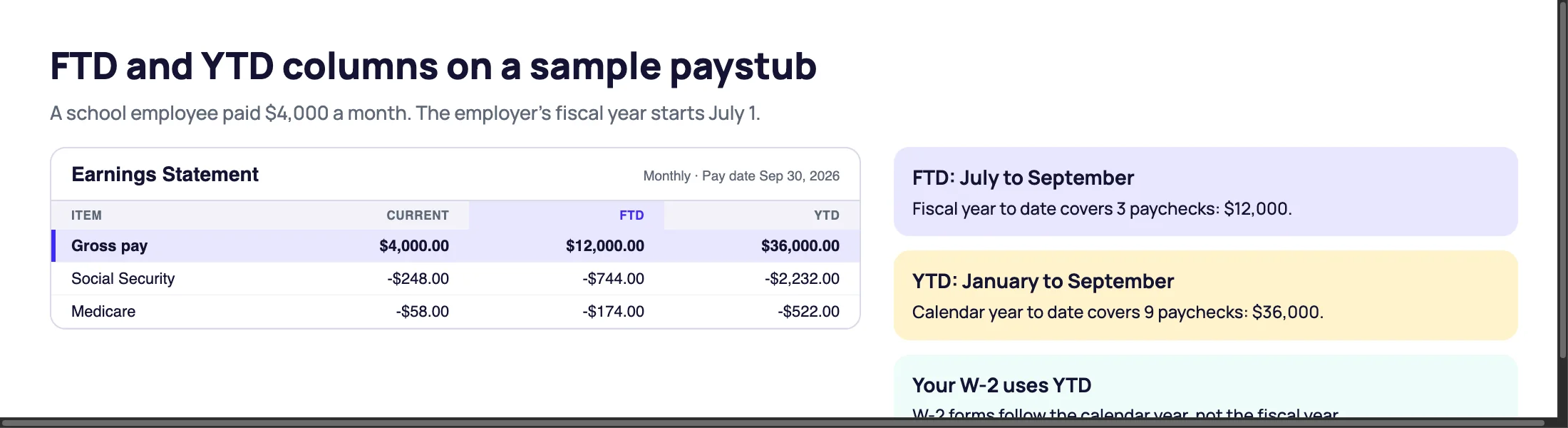
Take a school employee paid $4,000 a month, with a fiscal year that starts July 1. On the September paycheck:
- Current: $4,000, the September paycheck.
- FTD: $12,000, the July, August and September paychecks.
- YTD: $36,000, every paycheck from January through September.
In July both numbers reset differently: FTD starts over at the first July paycheck, while YTD keeps counting until December.
FTD vs. YTD, MTD and QTD
| Abbreviation | Meaning | Period covered | Matches your W-2? |
|---|---|---|---|
| Current | This paycheck | One pay period | No |
| MTD | Month to date | Since the first of the month | No |
| QTD | Quarter to date | Since the start of the quarter | No |
| FTD | Fiscal year to date | Since the start of the fiscal year, such as July 1 | No |
| YTD | Calendar year to date | Since January 1 | Usually, on your December paystub |
The running totals on any statement work the same way; the column for year-to-date (YTD) totals is the one tax forms rely on. The other short codes you might see are collected in this list of pay stub abbreviations.
Why Your FTD Total Won't Match Your W-2
Your W-2 reports wages and taxes for the calendar year, January through December. An FTD total mixes two calendar years: the second half of one and the first half of the next. To check your W-2, compare it with the YTD column on your last paystub of December, not with FTD. The boxes are explained in our guide to the W-2 form.
What Federal Tax Deposits Mean for You as an Employee
Every paycheck, your employer withholds federal income tax based on your Form W-4, plus 6.2% Social Security and 1.45% Medicare. It then deposits those amounts, together with its own matching Social Security and Medicare, with the IRS. Smaller employers usually deposit monthly; employers that reported more than $50,000 of these taxes in their lookback period deposit semiweekly. Any day with $100,000 or more due triggers a next-day deposit. The rules are summarized in IRS Topic 757.
For you, the only practical point is that withheld tax is credited to you on your W-2 whether or not the deposit was made on time. Deposit schedules are your employer's responsibility.
If you prepare statements for staff whose employer runs on a fiscal year, label each total column clearly. When you create a paystub, the year-to-date figures follow the calendar year, which is what the W-2 will use.
Need a clear paystub with year-to-date totals? Create one in minutes.
Create a Pay Stub Now