
Quick answer
Medical ER (also shown as ER Health or ER Medical) is the amount your employer pays toward your health insurance each pay period. It is listed for your information and is not taken out of your paycheck. Your own share appears separately as Medical EE. Employer-paid health coverage is generally not taxable income to you.
The ER Medical amount on your paystub is not money taken from you. It shows what your employer spends on your health insurance, which is part of your total compensation. This guide explains the label, how to turn the per-paycheck figure into a yearly total and how it compares with what most employers pay.
What Does ER Medical Mean on a Paystub?
ER stands for employer and EE for employee. ER Medical is the employer's share of the health insurance premium for your coverage in that pay period. ER health lines usually appear in a section called employer contributions, employer-paid benefits or memo.
Other Labels: ER Health, ER Med, ER Health Cov
| Label | Meaning |
|---|---|
| ER Medical, ER Med | Employer's share of medical insurance |
| ER Health, ER Health Cov | Employer's share of health coverage, sometimes including dental and vision |
| ER Cost of Medical | Same amount, written out |
| Medical EE, EE Health | Your share of the premium, taken from your pay |
Does Medical ER Reduce Your Take-Home Pay?
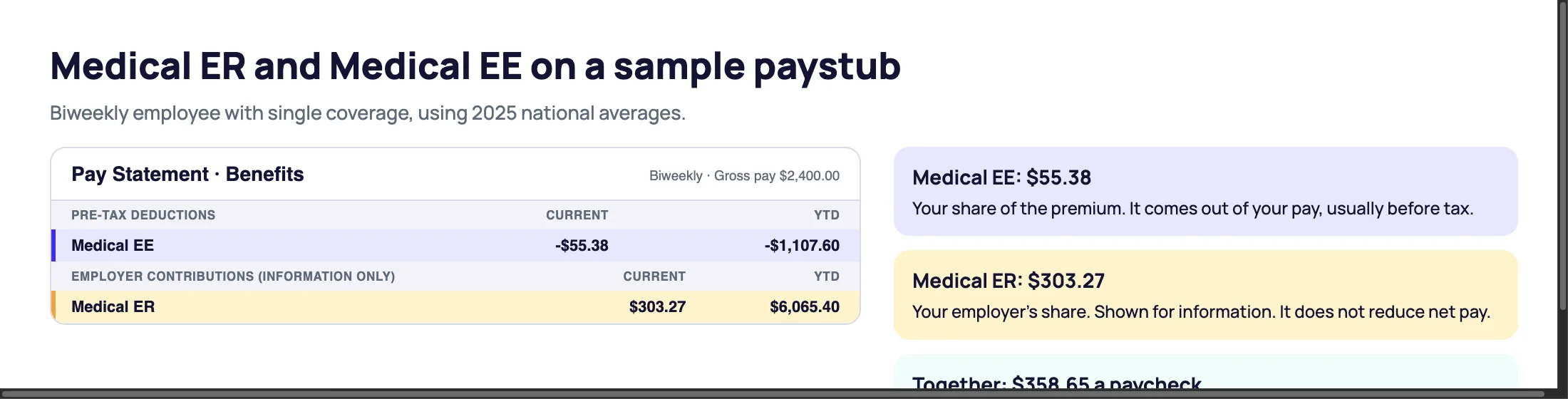
No. Net pay is gross pay minus taxes and your own deductions. The ER medical amount is paid by your employer on top of your wages, so it is not part of that calculation. In the sample above, the employee's pay is reduced by the $55.38 Medical EE premium only. The $303.27 ER line is there so you can see the full value of your health benefit.
Medical ER vs. Medical EE
| Medical EE | Medical ER | |
|---|---|---|
| Who pays | You | Your employer |
| Reduces net pay? | Yes | No |
| Usually taxed? | No, when taken pre-tax through a cafeteria plan | No, excluded from income |
| On your W-2 | Included in box 12 code DD | Included in box 12 code DD |
The same logic applies to every pair of lines on a statement, from taxes to retirement contributions; the full list of EE and ER lines shows which ones reduce your pay.
Medical ER vs. MED ER: Health Insurance vs. Medicare Tax
These two labels are easy to mix up. Medical ER is your employer's health insurance contribution. MED ER (Fed MED/ER) is your employer's 1.45% Medicare tax, the match for the MED EE tax taken from your pay. One is a benefit; the other is a payroll tax.
How Much Do Employers Usually Pay for Health Insurance?
According to the KFF 2025 Employer Health Benefits Survey, the average annual premium for employer coverage was $9,325 for single coverage and $26,993 for family coverage. Workers paid about $1,440 and $6,850 of that, so employers covered roughly:
| Coverage | Employer share per year (about) | Medical ER per biweekly paycheck | Employee share per year | Medical EE per biweekly paycheck |
|---|---|---|---|---|
| Single | $7,885 | $303.27 | $1,440 | $55.38 |
| Family | $20,143 | $774.73 | $6,850 | $263.46 |
Your numbers depend on the plan, the coverage tier you choose and your employer. These averages are a reference point, not a target.
Turn Your Per-Paycheck ER Amount Into a Yearly Total
Multiply the Medical ER amount by the number of paychecks in a year: 26 if you are paid every two weeks, 24 if twice a month, 52 if weekly and 12 if monthly. For example, $303.27 × 26 = $7,885 a year in employer health contributions.
Is Medical ER Taxable?
Generally no. Section 106 of the tax code excludes employer-paid health coverage from your income, so the ER amount is not added to your taxable wages. Your own premium is usually taken pre-tax through a Section 125 cafeteria plan, which lowers your taxable wages too. One exception: coverage for someone who is not your tax dependent, such as a domestic partner, can create imputed income, the same mechanism that applies to GTL imputed income for life insurance.
Where Medical ER Shows Up on Your W-2 (Box 12, Code DD)
Box 12 with code DD shows the total cost of your employer-sponsored health coverage for the year: the employer share plus your share. The amount is for information only and is not taxable. Your December Medical ER and Medical EE year-to-date figures added together should come close to the code DD amount. The IRS page on W-2 reporting of health coverage explains what is included.
Why Your W-2 May Not Show Code DD
Employers that filed fewer than 250 W-2 forms for the previous year are not required to report code DD. If you work for a small business, a missing code DD is normal.
Other ER Lines You May See (Dental, Vision, HSA, Life)
| ER line | What it is | Taxable to you? | W-2 code |
|---|---|---|---|
| ER Dental, ER Vision | Employer's share of dental or vision premiums | No | Usually not reported |
| ER HSA | Employer contribution to your health savings account | No, within the annual limit | Box 12 code W |
| ER HRA | Employer-funded health reimbursement account | No, for qualified medical costs | Not reported |
| ER Life, GTL | Employer-paid group term life insurance | Only coverage above $50,000 | Box 12 code C |
If Medical ER Seems to Come Out of Your Pay
- Redo the math: gross pay minus every EE line should equal net pay.
- Separate EE and ER: make sure no ER amount is in the deductions column.
- Ask HR or payroll if the numbers do not add up. A deducted ER amount is a payroll error.
Short labels like these are listed with the rest in this collection of pay stub abbreviations. If you prepare statements for a small team, you can create a paystub that keeps the employee's health deduction on its own line. Use real payroll figures only.
Need a paystub that lists health insurance deductions clearly? Create one in minutes.
Create a Pay Stub Now