
Quick answer
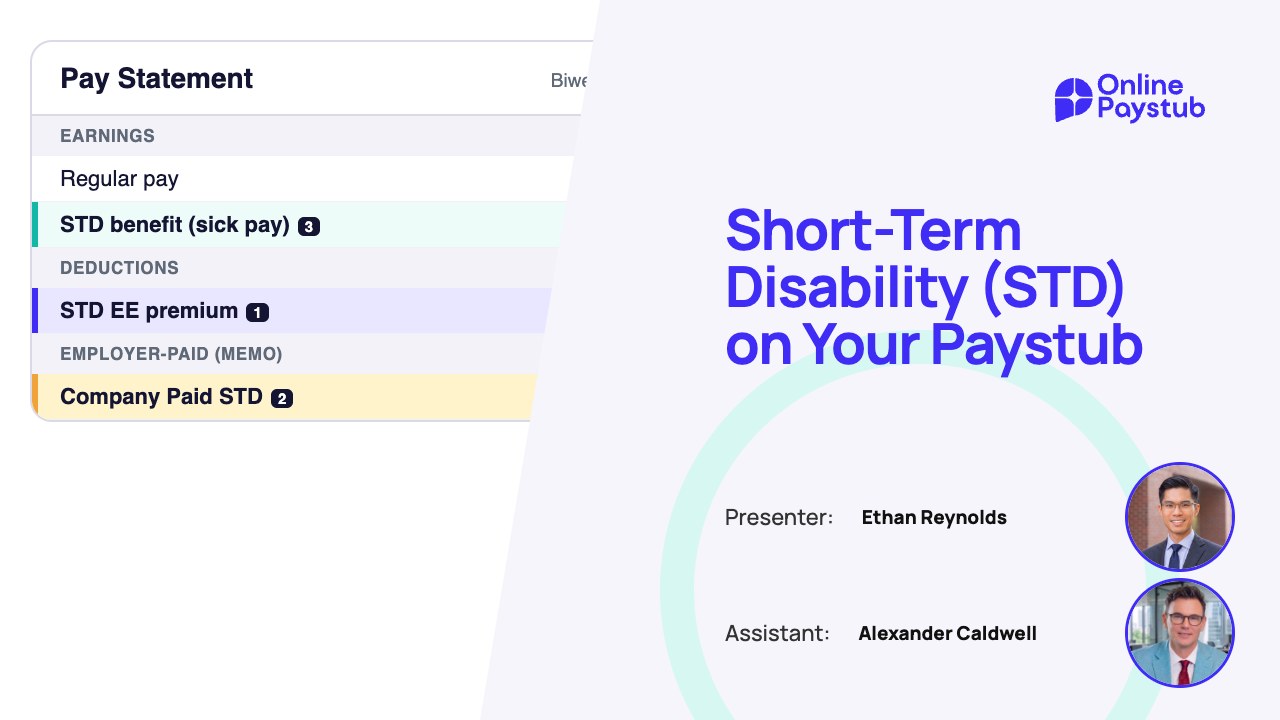
STD on your paystub stands for short-term disability insurance, coverage that pays part of your wages, often around 60%, for a few weeks to about six months if illness, injury or childbirth keeps you from working. The STD line can be a premium you pay, an amount your employer pays or benefits you receive while out on leave.
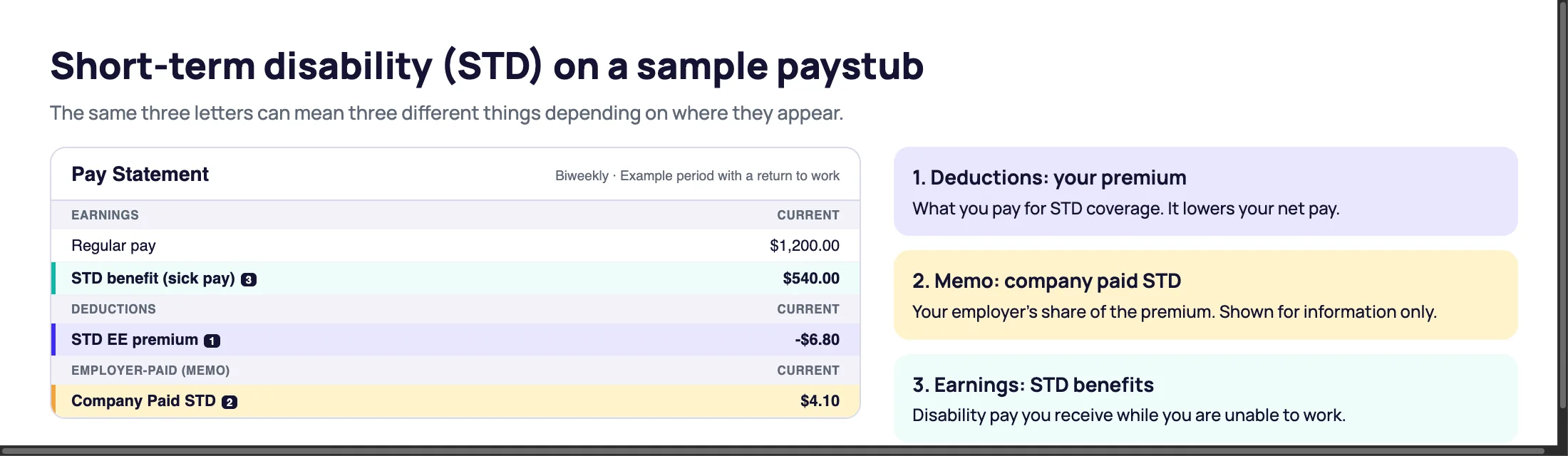
STD on a paystub means short-term disability, not anything medical in the everyday sense of the abbreviation. To tell what your STD line is, look at where it sits: under deductions it is your premium, in an employer or memo section it is your employer's share and under earnings it is disability pay you received.
What Does STD Mean on a Paystub?
STD as a Deduction (Your Premium)
The most common STD line is a deduction labeled STD, STD EE or ST DISABILITY. It is your share of the premium for a short-term disability insurance plan and lowers your net pay by a few dollars each check.
Company Paid STD (Employer's Share)
Some statements show a line called Company Paid STD or STD ER. It is the premium your employer pays for your coverage. It appears for information only and does not change your net pay, much like the employer half of Medicare shown as MED ER next to MED EE.
STD as Earnings (Benefits You Receive)
If you are out on short-term disability, the benefits you receive may appear under earnings, labeled STD, STD Pay or Sick Pay. These lines are taxed according to who paid for the coverage, as explained below. Other unfamiliar codes on the statement are covered in this list of pay stub abbreviations.
How Short-Term Disability Insurance Works
Benefit Amount, Waiting Period and Benefit Period
- Benefit amount: typically about 60% of your pay, with plans ranging from around 40% to 80% and a weekly maximum.
- Waiting period: the days you must be out before benefits start, most often 7 days and in some plans up to 30.
- Benefit period: how long benefits can last, commonly up to 26 weeks.
Every plan sets its own numbers, so check your plan summary rather than relying on typical figures.
What STD Usually Covers (Including Pregnancy)
Short-term disability generally covers illness, injury, surgery recovery and childbirth that keep you from doing your job. Recovery after giving birth is one of the most common reasons people file a claim, often for 6 to 8 weeks. Injuries at work are usually covered by workers' compensation instead.
STD vs. State Disability Insurance (SDI and TDI)
A private STD plan is employer insurance: your employer chooses whether to offer it and you may be able to decline it. State disability insurance is a government program that is mandatory for most workers in the few places that have one. If you work in one of these states, your paystub may show both lines.
| State | Program | Employee withholding (2026) | Maximum weekly benefit |
|---|---|---|---|
| California | State Disability Insurance (SDI) | 1.3% of all wages, no cap | $1,765 |
| New York | Disability Benefits (DBL) | 0.5% of wages, up to $0.60 a week | $170 |
| New Jersey | Temporary Disability Insurance (TDI) | 0.19% of the first $171,100 | $1,119 |
| Rhode Island | Temporary Disability Insurance (TDI) | 1.1% of the first $100,000 | $1,150 for claims from July 1, 2026 |
| Hawaii | Temporary Disability Insurance (TDI) | Up to 0.5% of weekly wages, no more than $7.50 a week | $871 |
| Puerto Rico | Non-Occupational Temporary Disability (SINOT) | Set by Puerto Rico law | Set by Puerto Rico law |
Rates are set each year by the state. In California, for example, the SDI line sits right next to CA SIT on every California paystub. The California EDD explains how the state benefit works.
Is STD Pre-Tax or After-Tax?
It depends on how your employer set up the plan. It also matters if you ever file a claim. The IRS FAQ on disability insurance proceeds sets the rule:
| How the premium is paid | Are STD benefits taxable? |
|---|---|
| Employer pays the premium | Yes |
| You pay through a pre-tax cafeteria plan | Yes |
| You pay with after-tax money | No |
| Shared between you (after-tax) and your employer | Only the share tied to the employer's premium |
Pre-tax premiums save you a little income tax and FICA today. After-tax premiums save nothing now but make your benefits tax-free later. The same rule applies to long-term coverage, explained in detail for LTD on your paystub.
How STD Benefits Show Up on Your Paystub and W-2
If your employer pays the benefits directly, they appear on your regular paystub as earnings and are taxed like wages. Social Security and Medicare apply to disability pay only for the first 6 calendar months after the last month you worked.
Sick Pay From an Insurance Company (Third-Party Sick Pay)
Many STD plans are run by an insurance company that pays you directly. This is called third-party sick pay. Federal income tax withholding on it is voluntary: you ask the insurer to withhold by filing Form W-4S. When your employer or its agent pays the benefit, withholding is mandatory instead. The taxable amount still appears on a W-2, either from your employer or from the insurer. Box 13 of that W-2 has a "Third-party sick pay" checkbox. IRS Publication 15-A explains the reporting rules.
STD vs. LTD
| Short-term disability (STD) | Long-term disability (LTD) | |
|---|---|---|
| Waiting period | About 7 to 30 days | Usually 90 or 180 days |
| Typical benefit | About 40% to 80% of pay | About 50% to 80% of pay |
| How long it pays | Up to about 26 weeks | Years, sometimes to age 65 |
| Paystub label | STD, STD EE, Company Paid STD | LTD, LTD EE, LTD ER |
LTD is usually designed to begin when STD ends, so the two cover one long absence in sequence.
Is STD Mandatory? Can You Opt Out?
Private short-term disability insurance is optional for employers. If your employer pays for basic coverage, there is nothing to opt out of. Voluntary coverage you pay for can usually be added or dropped only during open enrollment or after a qualifying life event. State programs such as California SDI or New Jersey TDI are different: they are required by law and you cannot opt out.
Showing STD on a Paystub You Create
If you run payroll for a small business that offers short-term disability coverage, each statement should list the STD premium under deductions, show any employer-paid share for information and record disability pay as a separate earnings line. When you create a paystub, keep the STD premium and any state SDI deduction on separate lines so employees can tell them apart. Use real payroll figures only.
This article is general information, not tax or insurance advice. Check your plan documents and your state agency for your own situation.
Need a paystub that shows a short-term disability deduction? Create one in minutes.
Create a Pay Stub Now