
Quick answer
SDI on your paystub stands for state disability insurance, a payroll deduction required in California, New York, New Jersey, Rhode Island, Hawaii and Puerto Rico. It funds partial wage replacement if you can't work because of a non-work illness, injury or pregnancy and in some states paid family leave. In California, SDI is 1.3% of all wages in 2026.
If you work in one of those places, the SDI line is a small, steady deduction on every paycheck. Find your state in the table below to see the 2026 rate, the cap and the most the program pays each week.
What Does SDI Mean on a Paystub?
SDI is a state-run insurance program. Employees pay in through payroll. If they later cannot work because of an illness, injury or pregnancy that is not job-related, the state pays part of their wages for a limited time. Work injuries are covered separately by workers' compensation.
SDI Labels by State: CASDI, NY DBL, NJ TDI, RI TDI
| Label on the paystub | What it is |
|---|---|
| CASDI, CA SDI | California State Disability Insurance (covers disability and paid family leave) |
| NY DBL, NY SDI | New York disability benefits |
| NY PFL | New York paid family leave, a separate line |
| NJ TDI, NJ SDI | New Jersey temporary disability insurance |
| NJ FLI | New Jersey family leave insurance, a separate line |
| RI TDI | Rhode Island temporary disability insurance (includes caregiver leave) |
| HI TDI | Hawaii temporary disability insurance |
Which States Have SDI? 2026 Rates and Limits
| State | Paystub label | Employee deduction (2026) | Maximum weekly benefit |
|---|---|---|---|
| California | CASDI, CA SDI | 1.3% of all wages, no wage cap | $1,765 |
| New York | NY DBL; NY PFL separately | DBL: 0.5% of wages, up to $0.60 a week. PFL: 0.432%, up to $411.91 a year | DBL $170; PFL $1,228.53 |
| New Jersey | NJ TDI; NJ FLI separately | TDI 0.19% plus FLI 0.23% of the first $171,100 (up to $325.09 + $393.53) | $1,119 |
| Rhode Island | RI TDI | 1.1% of the first $100,000 (up to $1,100) | $1,150 for claims from July 1, 2026 |
| Hawaii | HI TDI | Up to 0.5% of weekly wages, no more than $7.50 a week | $871 |
| Puerto Rico | SINOT | Set by Puerto Rico law | See the Puerto Rico Department of Labor |
Sources: California EDD, the New York Workers' Compensation Board, the New Jersey Department of Labor, the Rhode Island Department of Labor and Training and the Hawaii Disability Compensation Division.
California SDI (CASDI) in 2026
California SDI pays for two programs: Disability Insurance (for your own illness, injury or pregnancy) and Paid Family Leave (for caring for a family member or bonding with a new child). For 2026 the EDD rate is 1.3% of wages. To qualify for benefits you generally need at least $300 in wages subject to SDI during your base period. Disability benefits start after a 7-day waiting period. Employers may also offer an approved voluntary plan in place of the state plan.
Why There Is No Wage Cap Anymore
Until 2023, California SDI stopped once your wages reached a yearly limit. A 2022 law (SB 951) removed the cap starting January 1, 2024, so CA SDI now applies to every dollar you earn. High earners notice this most: SDI keeps coming out even after Social Security stops.
Example: SDI on a $2,000 Paycheck
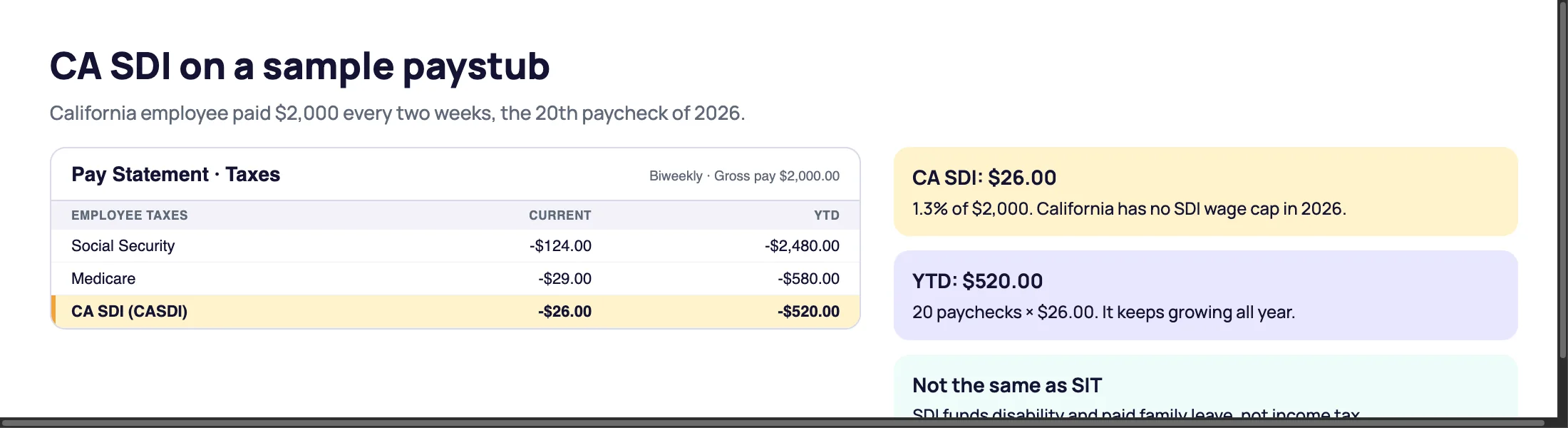
- $2,000 biweekly × 1.3% = $26.00 per paycheck.
- $52,000 a year × 1.3% = $676 for the year.
- $250,000 a year × 1.3% = $3,250, because there is no cap.
On a California paystub the SDI line sits next to CA SIT, the state income tax. California's income tax brackets are covered in our guide to California state income tax.
SDI and Paid Family Leave: Why You May See Two Lines
California funds disability and paid family leave from one SDI deduction. New York and New Jersey keep them apart, so employees there usually see two lines: NY DBL with NY PFL on a New York paystub and NJ TDI with NJ FLI on a New Jersey paystub. Both are normal.
SDI vs. Short-Term Disability (STD) and SSDI
| What it is | Who runs it | Required? | |
|---|---|---|---|
| SDI / TDI | State disability insurance for non-work illness or injury | State agency | Yes, in the states above |
| STD | Short-term disability insurance from your employer | Private insurer or employer | No |
| SSDI | Social Security Disability Insurance for long-term disability | Federal government | Funded by Social Security tax |
Some employers offer private short-term disability coverage on top of state SDI, which is why a paystub can show both.
Is SDI Tax Deductible?
If you itemize deductions on your federal return, mandatory contributions to the California, New Jersey, New York and Rhode Island disability funds count as state income taxes on Schedule A, line 5a. They are subject to the state and local tax (SALT) cap, which is $40,000 ($20,000 if married filing separately) for 2025 and later, reduced for higher incomes. If you take the standard deduction, SDI gives no extra federal deduction.
SDI on Your W-2
There is no dedicated W-2 box for state disability insurance. Many employers list it in box 14, the "Other" box, labeled 14a on the 2026 form, with a description such as CASDI. That entry is for your information and is optional for the employer. Your December paystub's SDI year-to-date amount should match whatever your employer reports.
Showing SDI Correctly on a Paystub You Create
For employees in these states, SDI should appear as its own deduction, separate from state income tax such as SIT withheld, with the year-to-date total carried forward. When you create a paystub, check the SDI line against the 2026 rate in the table above. Use real payroll figures only.
This article is general information, not tax advice. Rates change each January; check your state agency for current figures.
Need a paystub that shows state disability insurance on its own line? Create one in minutes.
Create a Pay Stub Now