
Quick answer
LTD on your paystub stands for long-term disability insurance. It is the premium for a policy that replaces part of your income, often around 60%, if an illness or injury keeps you from working for months or years. The line may be a deduction you pay, an employer-paid amount or imputed income. How it is paid decides whether future benefits are taxable.
Most people never think about the LTD line until they notice it on a paystub. It is usually small, a few dollars per paycheck, but how it is paid makes a real difference if you ever need to claim. This guide explains what each LTD label means, how long-term disability coverage works and why pre-tax versus after-tax premiums change the tax on your benefits.
What Does LTD Mean on a Paystub?
LTD stands for long-term disability insurance. The amount on your paystub is the premium for that coverage for the pay period. If a covered illness or injury keeps you out of work for a long time, the policy pays you a monthly benefit that replaces part of your income.
Other LTD Labels: LTD EE, LTD ER, LTD Tax, LTD Imputed
| Label | What it means |
|---|---|
| LTD or LTD EE | Your share of the premium, taken from your pay |
| LTD ER | Your employer's share, shown for information |
| LTD Tax, LTD Imputed or LTD Inc | Employer-paid premium added to your taxable wages |
| LTD PRE or LTD POST | Whether your share is taken before or after taxes |
| DISBLTY INS or DIS INS | Disability insurance, sometimes covering both LTD and STD |
EE stands for employee and ER for employer, the same convention used for Medicare tax as MED EE and MED ER. Other short codes on the statement are explained in this list of pay stub abbreviations.
How Long-Term Disability Insurance Works
Group long-term disability plans vary, but most follow the same pattern:
- Benefit: typically around 60% of your pre-disability pay, with plans ranging from about 50% to 80% and a monthly maximum.
- Elimination period: the waiting time before benefits start, usually 90 or 180 days. It often lines up with the end of short-term disability.
- Benefit period: how long benefits can last, such as 2 years, 5 years or until age 65.
- Offsets: many plans reduce the LTD benefit by other income you receive for the same disability, such as Social Security disability or workers' compensation.
Your plan documents or summary plan description give the exact numbers. Treat any figure here as typical, not guaranteed.
Who Pays for LTD: You, Your Employer or Both?
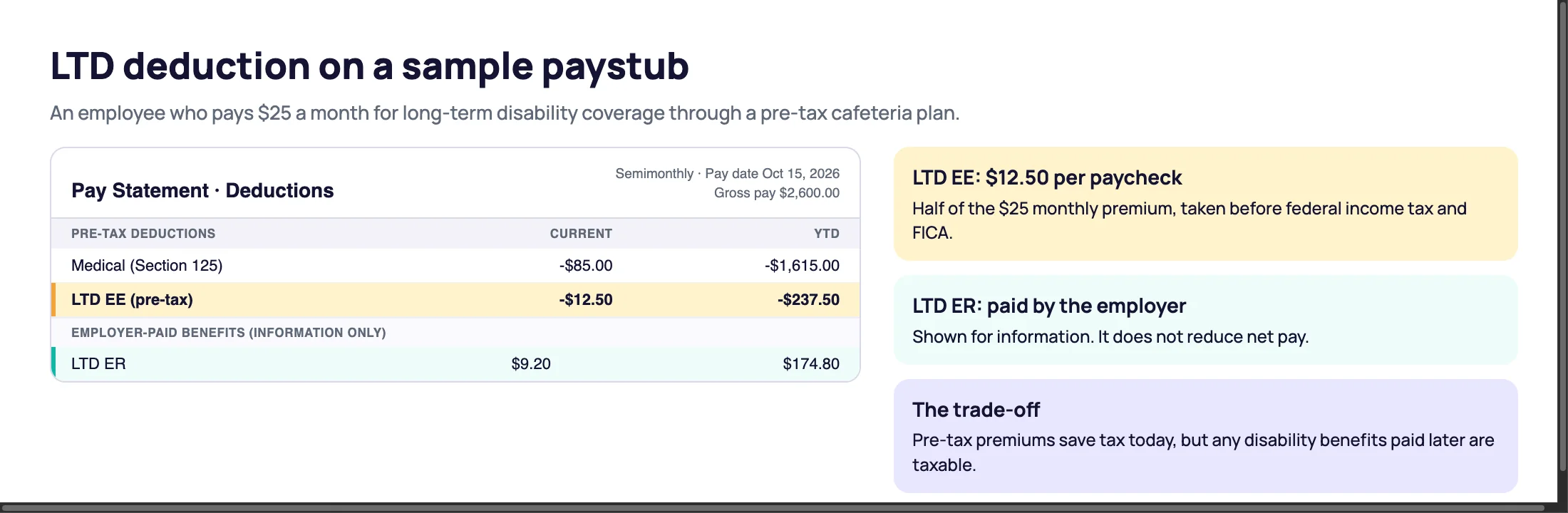
There are three common setups. Your employer may pay the whole premium as a benefit, in which case you might see only an LTD ER line or nothing at all. You may pay the whole premium yourself through payroll, often as an optional benefit chosen during open enrollment. Or the cost may be shared, with an LTD EE deduction and an LTD ER line on the same statement.
Pre-Tax vs. After-Tax LTD: Why It Matters If You File a Claim
The IRS rule is simple: if the premiums were paid with money that was never taxed, the benefits are taxable. If you paid them with after-tax money, the benefits are tax-free. Paying through a pre-tax cafeteria plan counts as employer-paid for this rule. The details are in the IRS FAQ on disability insurance proceeds and Publication 525.
| How the premium is paid | How it looks on a paystub | Tax saving on the premium today | Are disability benefits taxable? |
|---|---|---|---|
| Employer pays | LTD ER (information) or not shown | No tax to you on the premium | Yes |
| You pay pre-tax (Section 125) | LTD deduction marked pre-tax | Yes, federal income tax and FICA | Yes, all of it |
| You pay after-tax | LTD deduction marked after-tax | No | No |
| Employer pays, reported as imputed income | LTD Imputed or LTD Tax earnings line | You pay tax on the premium amount | No |
| Shared: employer plus you after-tax | Two lines | Partly | Only the share tied to the employer's premium |
Example: Same Premium, Two Different Tax Results
Suppose your premium is $25 a month. Assume a 12% federal income tax bracket and 7.65% FICA.
- Paid pre-tax: you save about $4.91 a month in taxes ($25 × 19.65%), about $59 a year. But if you later become disabled and receive $3,000 a month in benefits, that $3,000 is taxable income.
- Paid after-tax: you save nothing on the premium today. If you receive the same $3,000 benefit, none of it is taxable.
The pre-tax option wins in every month you stay healthy. The after-tax option protects more of your income in the months you cannot work, which is exactly when it matters most. Some employers let you choose during open enrollment; many decide for you.
LTD Imputed Income: Why LTD Can Show Up as Earnings
Some employers pay the LTD premium but report it as part of your taxable wages so that any future benefits are tax-free. On your paystub this appears as an earnings line, often labeled LTD Imputed or LTD Tax, with no cash attached. The amount is added to your taxable wages and the matching amount is taken back out, so only the tax on it reduces your net pay. It works the same way as GTL imputed income for group life insurance.
LTD vs. STD on Your Paystub
| Short-term disability (STD) | Long-term disability (LTD) | |
|---|---|---|
| Waiting period | Often 0 to 14 days | Usually 90 or 180 days |
| Typical benefit | About 50% to 70% of pay | About 50% to 80% of pay, often around 60% |
| How long it pays | A few weeks to about 6 months | Years, sometimes until age 65 |
| Paystub label | STD, STD EE, STD ER | LTD, LTD EE, LTD ER |
Short-term disability covers the first weeks or months of a disability and LTD picks up when STD ends. A few states, including California, New Jersey, New York, Rhode Island and Hawaii, also run state disability programs that appear as a separate SDI line.
Is LTD Mandatory? Can You Opt Out?
No federal law requires employers to offer long-term disability insurance. If your employer provides basic coverage at no cost to you, there is usually nothing to opt out of. Voluntary or supplemental LTD that you pay for can normally be added, changed or dropped only during open enrollment or after a qualifying life event.
What to Do if LTD Looks Wrong on Your Paystub
- Check your open enrollment choices to confirm you selected the coverage and the amount being deducted.
- Look at whether the line is pre-tax or after-tax and make sure it matches what you chose, because it decides how future benefits are taxed.
- Ask HR or payroll to fix any deduction for coverage you did not elect and to refund the difference.
Showing LTD on a Paystub You Create
If you run payroll for a small business that offers disability insurance, each statement should list the employee's LTD deduction, note whether it is pre-tax or after-tax and show any employer-paid amount for information. When you create a paystub, check that a pre-tax LTD deduction lowers taxable wages and that the year-to-date total carries forward. Use real payroll figures only.
One more rule for anyone running payroll during a claim: Social Security and Medicare tax apply to disability pay only for the first 6 calendar months after the last month the employee worked. IRS Publication 15-A covers sick pay reporting.
This article is general information, not tax or insurance advice. Check your plan documents and a tax professional for your own situation.
Need a paystub that shows an LTD deduction? Create one in minutes.
Create a Pay Stub Now